


28 May Postcards from the Road to D.C.
It took some time to learn this lesson, but as a writer-photographer team, Audrey Hall and I have embraced the idea that it’s important to leave space — in your mind, in your schedule — because that’s when the magic happens.
This particular magic took shape as an epic road trip. It was conceived during holiday festivities in Livingston, Montana while Kirk Johnson, Sant Director of the National Museum of Natural History, was describing Smithsonian events that would mark the 250th anniversary of the country’s founding.
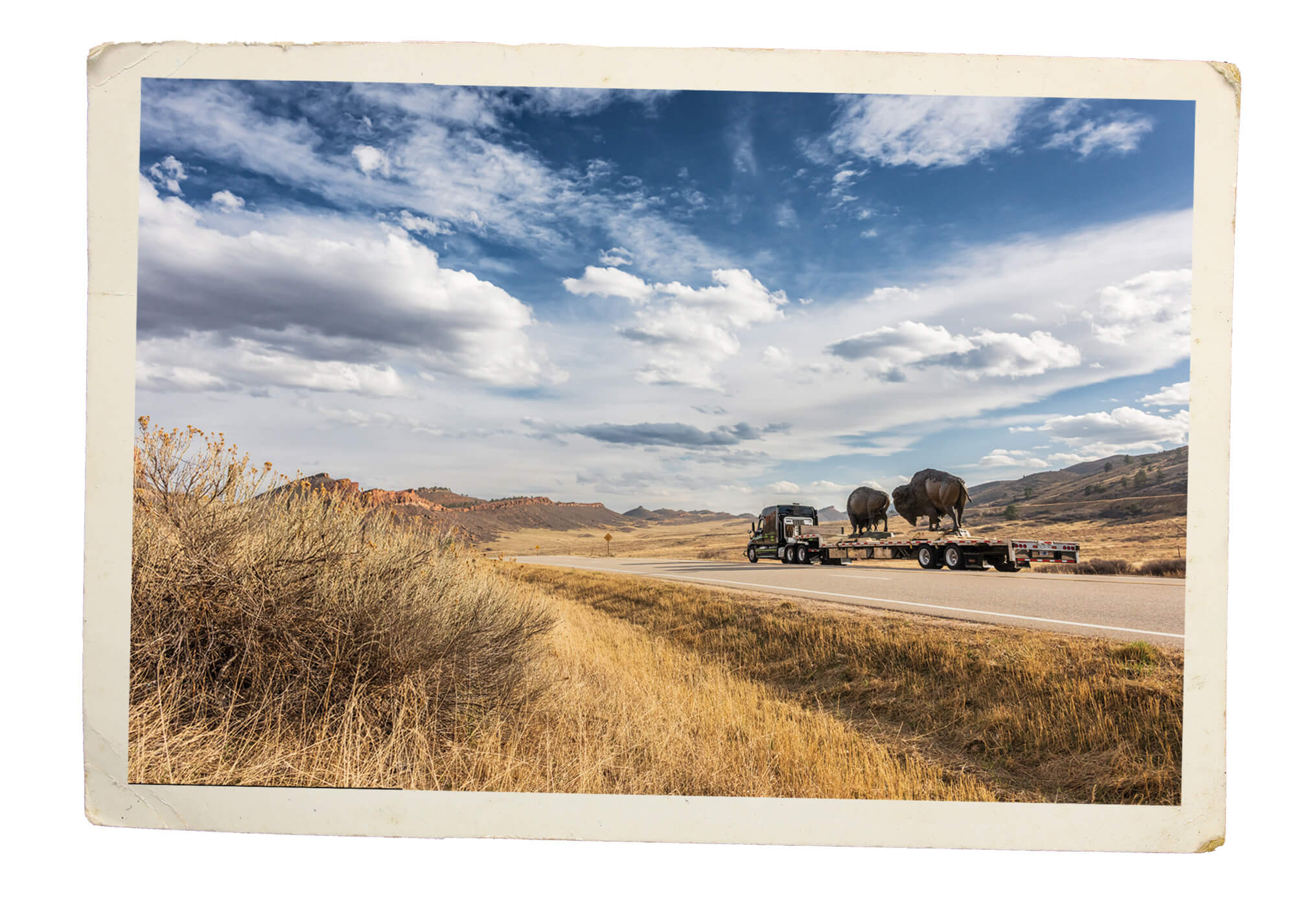
The bull, cow, and calf were hauled in the open air on a flatbed trailer, traversing the U.S. before arriving in their new home. | ROAD TRIP DAY 2
Johnson had long been contemplating the most fitting objects to occupy the plinths that flank the museum’s entrance. (Inconceivably, they’d been empty since the building’s completion in 1910.) After driving up to see the original Smithsonian bison on display in Fort Benton, Montana, Johnson and his wife, Livingston-based leather artist Chase DeForest, had an idea.
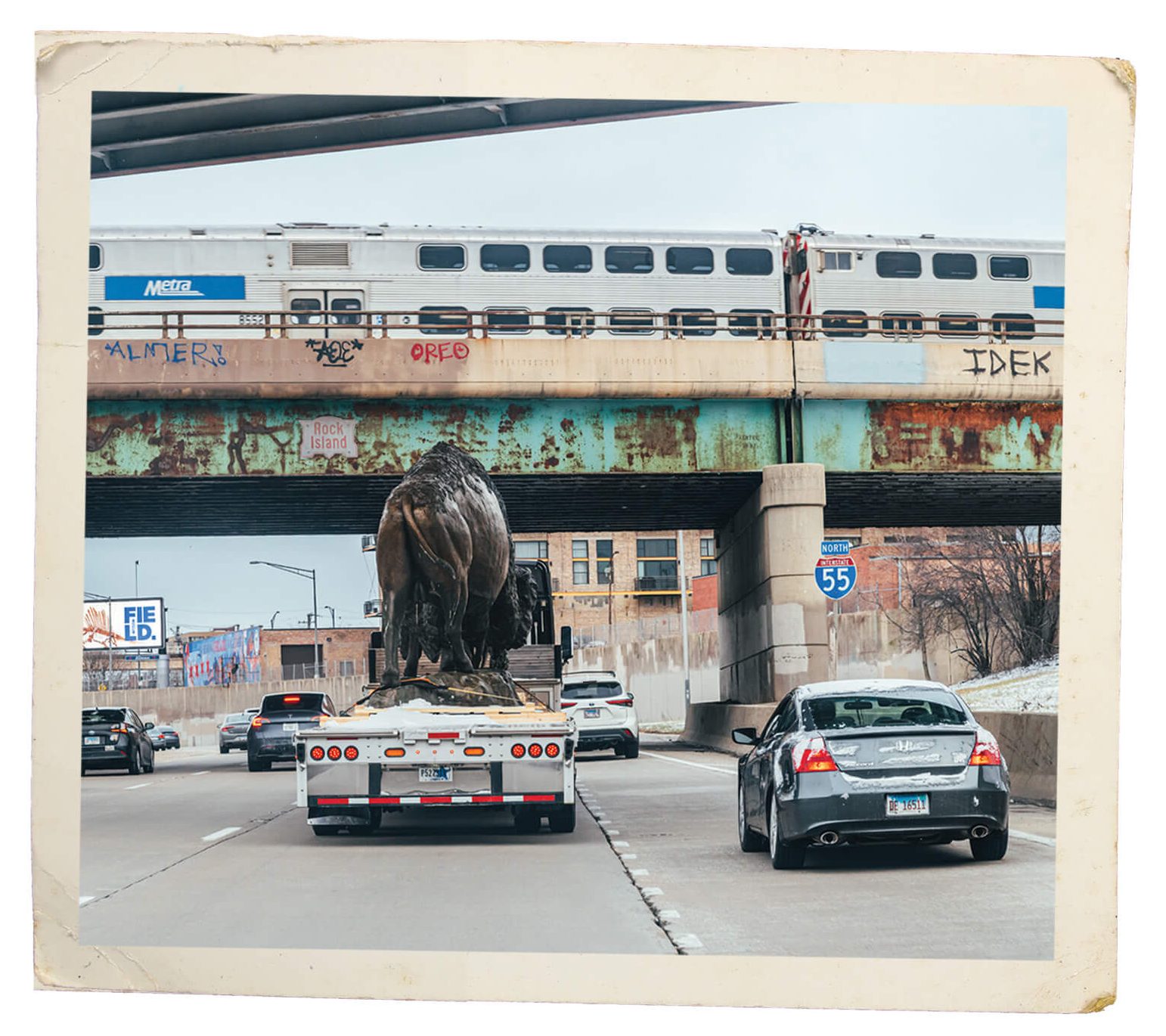
The sculptures weathered the last of the winter season and their arrival in Washington, D.C. ushered in spring. | ROAD TRIP DAY 8
The museum’s original bison group was composed of six animals shot by William T. Hornaday in Montana in 1867. (Hornaday was so distressed by the near extinct state of the bison population that, in 1905, he founded the National Bison Society with Teddy Roosevelt.) The taxidermied bison were displayed as a group until 1955, then repatriated to Montana, where they ended up in various institutions. Ultimately, the small herd was reassembled in Fort Benton, where they remain on display today. Although Johnson couldn’t reclaim the original bison for the museum, he could do the next best thing: commission sculptures modeled after them.
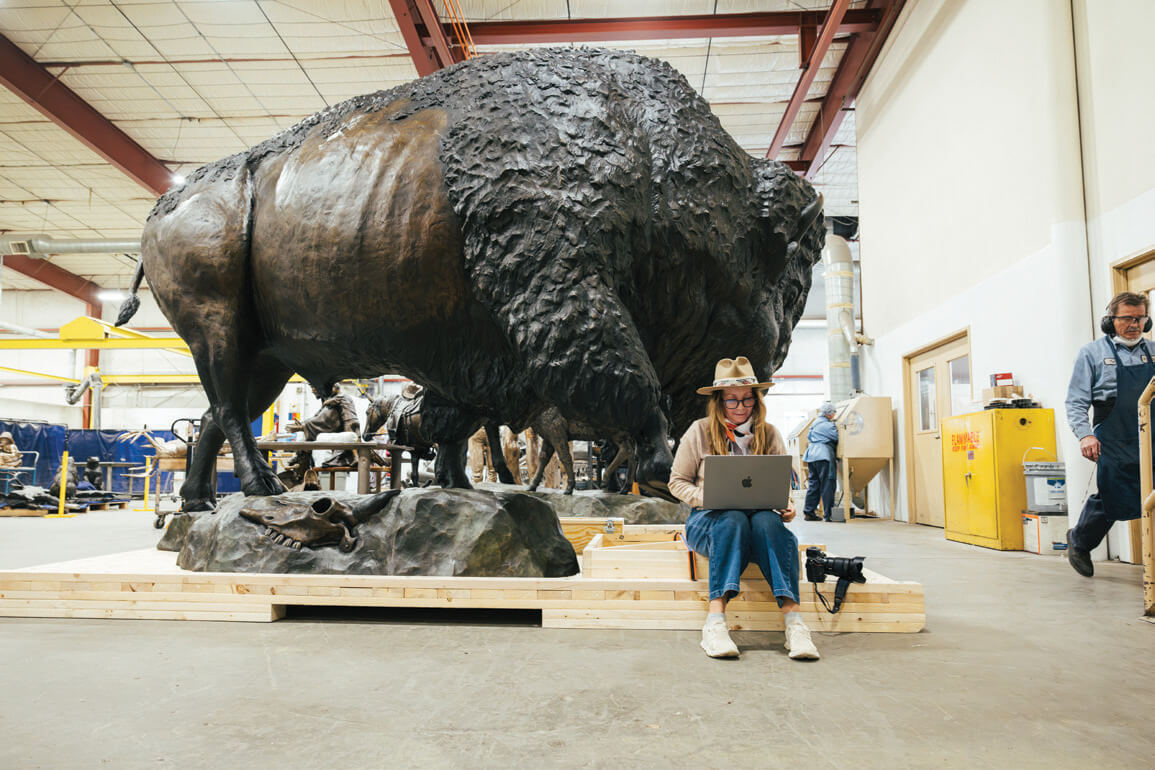
Working on the fly, photographer Audrey Hall edits photos at Art Castings of Colorado.
Thus began a story that would witness the creation of two monumental sculptures — one of a cow and calf and the other of a bull — in paleoartist Gary Staab’s Missouri studio, continue with the casting of the bronzes in Loveland, Colorado, and end on the nation’s doorstep, just in time for the opening of the Smithsonian’s landmark exhibition, Bison Standing Strong, and America’s semiquincentennial celebrations.
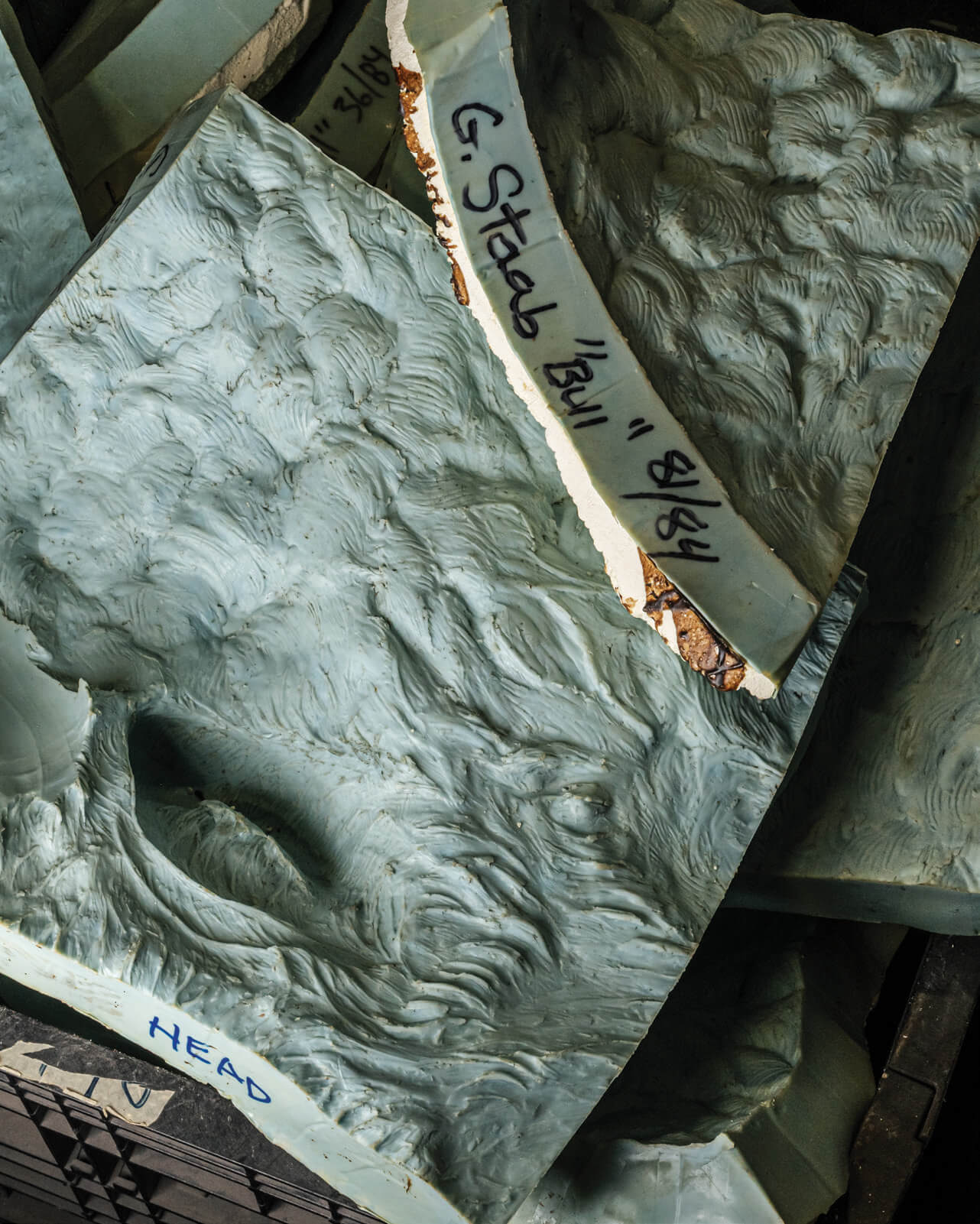
Staab’s models were cast in sections then assembled.
The road trip’s small convoy included a Montana-based writer-photographer team following two 2,500-pound sculptures mounted on an open flatbed truck as they traversed two-thirds of the continent and untold layers of history. We traveled through grass fires, the sandhill crane migration, and a major winter storm while visiting natural history museums in Denver, Lincoln, Iowa City, and Chicago. The trip ended in Washington, D.C., where the bronzes were lifted by crane and mounted on plinths.
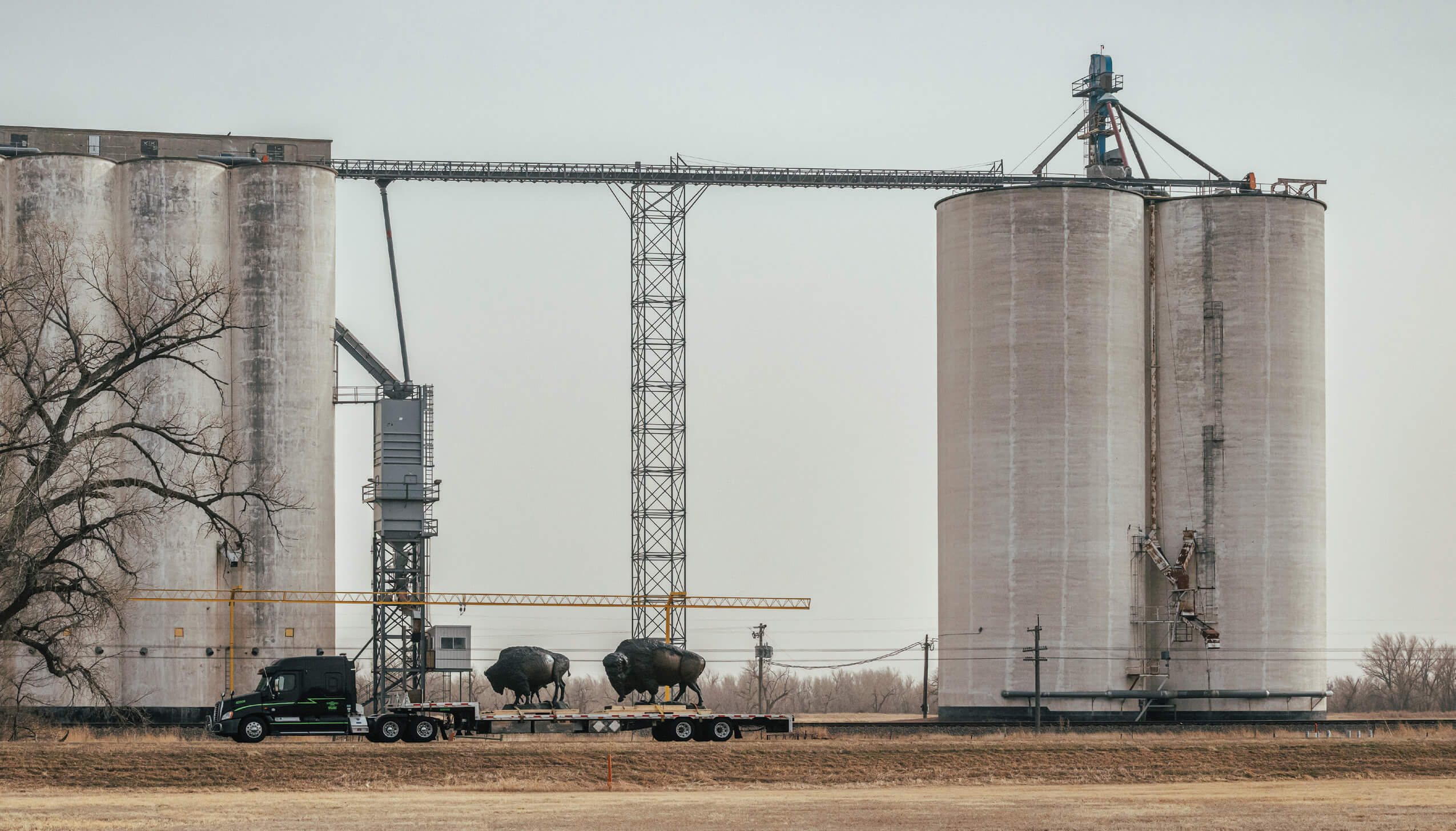
The bison traveled across the country in the open air; here, they pass grain elevators on the Colorado/Nebraska border.
There they’ll remain in perpetuity, as Johnson describes it, “our national mammal, in front of the national museum, overlooking the national mall, in celebration of our national anniversary.”
March 9, 2026
Montana to Loveland, Colorado
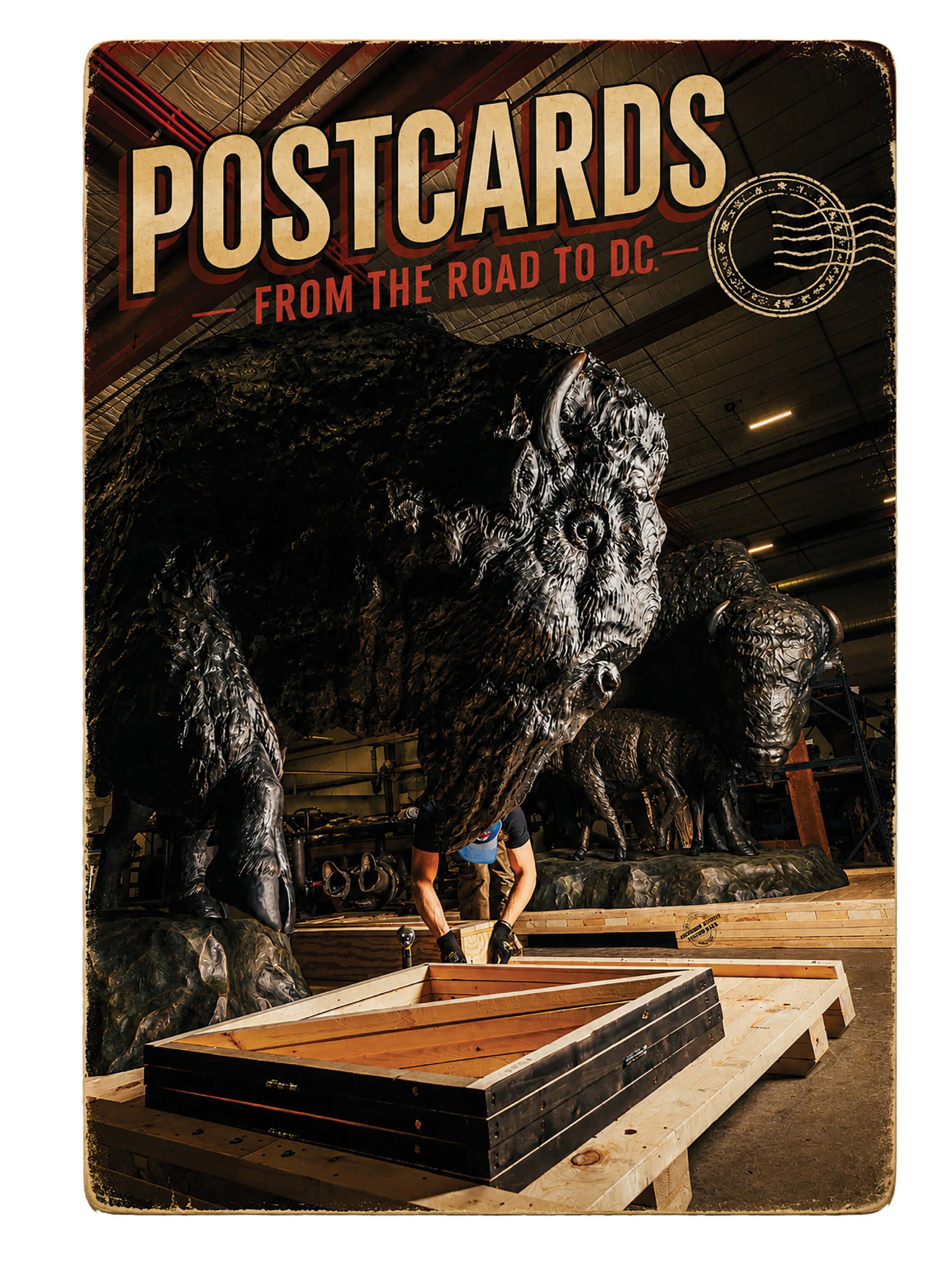
Clay meets fire. We’re spending the day at Art Castings of Colorado, witnessing how Staab’s sculptures move through the ancient, lost wax process, transforming from hand-shaped clay into monumental bronze. The bison are cast in 2-square-foot sections — 86 of them for the bull — and each piece will be carefully welded together.
Three monumental bison now stand inside the foundry. They are immense and powerful, with an awe-inspiring presence. The artistic detail is remarkable.
In a way, it feels like the herd is returning, more than a century after the Hornaday bison first stood inside the Smithsonian, representing a warning for what was almost lost.
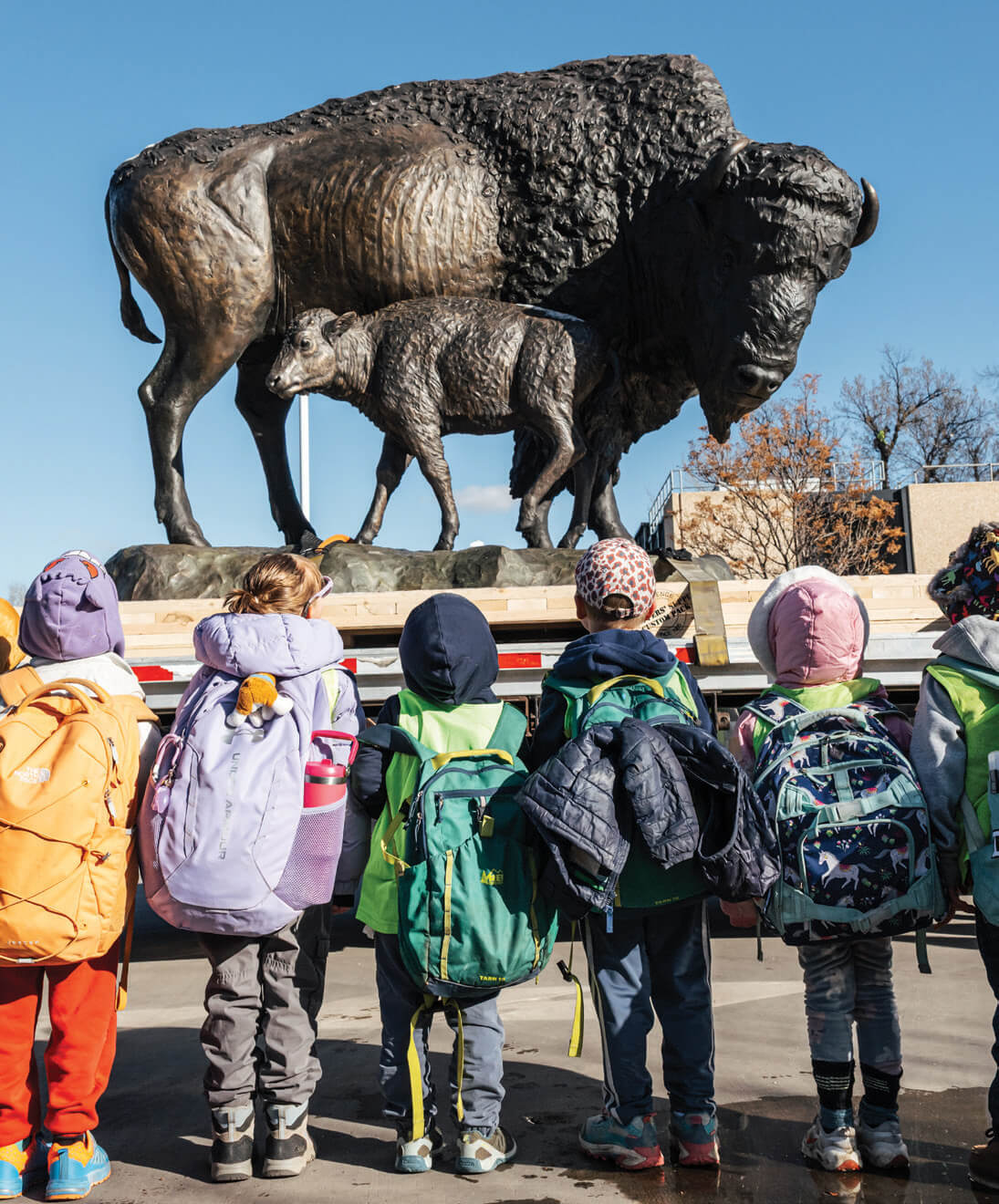
Schoolchildren line up to gaze at the cow and calf bison in front of the Denver Museum of Nature & Science.
March 12, 2026
Denver, Colorado
The bison arrive in front of the Denver Museum of Nature & Science with fresh snow on their shoulders. When they reach D.C., it will be spring.
The best part of today is watching visitors’ reactions. We see jaws drop, hear stories and memories. We field many questions. We meet bison ranchers and people reminiscing about their first time seeing bison in Yellowstone. One man wants to recognize the 10th anniversary of the naming of bison as our national mammal; he says it’s our “bison-versary.” We love watching a bunch of schoolchildren, their backpacks lined up in a row, as they gaze up at the huge, lifelike figures.
A big part of this journey is education. This amazing animal used to rule the continent. In a few short decades, tens of millions of them were wiped out. As we cross the Great Plains, the Smithsonian bison represent resilience and hope.
March 13, 2026
Big Springs, Nebraska
The Plains can read as desolate, especially when 50-mph winds are whipping topsoil in our faces. But the region is full of life.
We watch the bison cross the Union Pacific railroad, the same tracks that originally split the great bison herd, which marked the beginning of the end for the buffalo.
We see the monuments roll across an overpass, a powerful silhouette against the sky between towering grain silos.
We play leapfrog with the truck on the highway as it pulls the bronze bison through America’s Heartland.
Nebraska is on the migration route for sandhill cranes. They’re pointing us east.
March 14, 2026
University of Nebraska, Lincoln, Nebraska
The University of Nebraska’s Morrill Hall shares a parking lot with the Cornhuskers’ stadium, capacity 85,000. It’s pretty cool that this monument devoted to football shares space with a monument devoted to fossils.
Johnson, of the Smithsonian’s National Museum of Natural History, is enthusiastic to be back in Nebraska. Hurrying through the halls, he spews fossil facts: “Morrill Hall has one of the best Cenozoic fossil mammal collections in the entire country. Between the ages of, say, 50 million years ago and now, there was a series of different megafauna, and this place has them all. There are mammoths and mastodons and Gomphotheres, which are the elephants. There are tons of Entelodonts, which are pig-like animals. They have giant camels here, 13 feet tall. They have the most amazing predator called Barbourofelis. It’s a saber-tooth animal with sabers like knives. Even its incisors are shaped like sabers. It’s the scariest-looking little animal you’ve ever seen.”
Also present are Staab and NatGeo wildlife photographer Joel Sartore, both of whom have exhibits in the museum. We love watching kids learning about bison from museum educators like the Omaha tribe’s Renée Sans Souci.
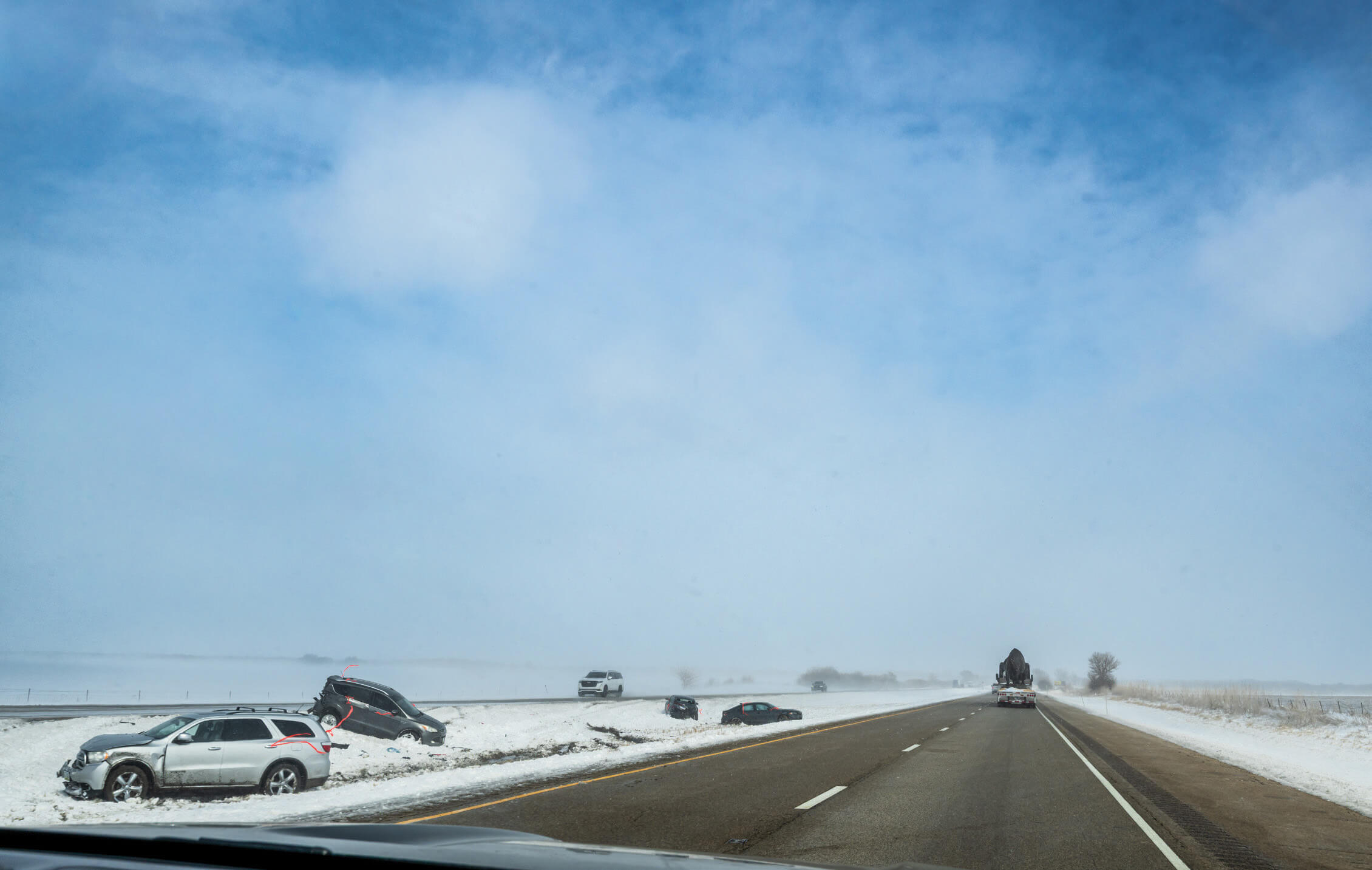
A March road trip across the Plains brought its fair share of drama: grass fires, the sandhill crane migration, engine trouble, and a major winter storm.
March 15, 2026
Iowa City, Iowa
The weather has turned. First rain, then blizzard warnings. And we have vehicle drama.
The University of Iowa straddles the Iowa River, with MacBride Hall at the heart of the campus. The 1908 Neoclassical building, which has a carved bison over its entrance, is the second-oldest museum west of the Mississippi.
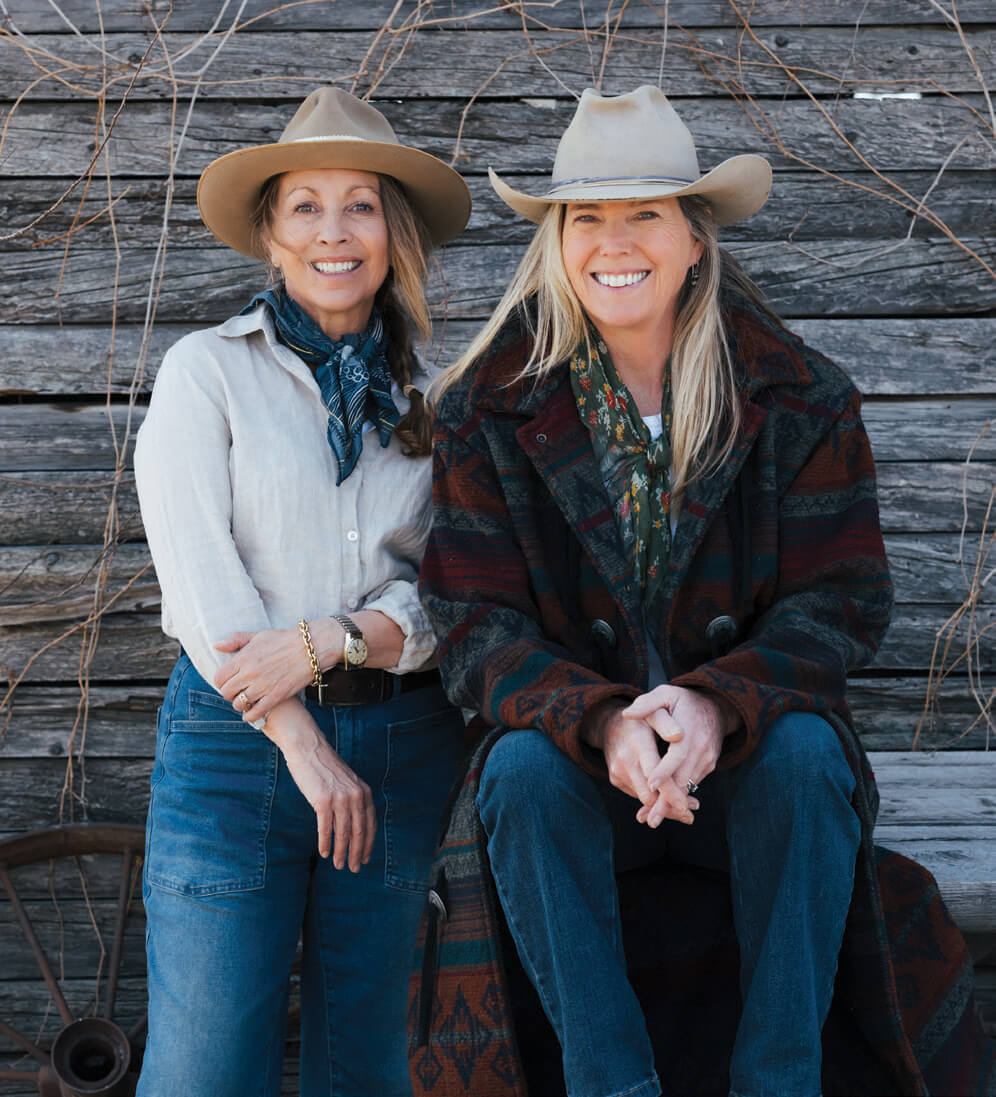
Montana-based collaborators, photographer Audrey Hall (left) and writer Chase Reynolds Ewald, sit for an impromptu portrait at Fort Cody in North Platte, Nebraska.
Even on a rainy Sunday during spring break, the bison are causing issues as people slow to look, then awkwardly park their cars to jump out. (And we thought bison jams were limited to Yellowstone!)
Inside, the museum is packed with skeletons and dioramas, including taxidermy by Hornaday. It was Hornaday who shot some of the last living bison, the very animals Staab’s sculptures are modeled from.
After gathering in the vintage auditorium to hear about bison genetics and the Smithsonian’s exhibit, Bison: Standing Strong, bison cookies are served. The bison wave-off takes place under dripping umbrellas.
March 16, 2026
Iowa & Illinois
It is 15 degrees Fahrenheit; add wind and the conditions are Arctic. The rig has a “check engine” light on, so we spend three hours hanging around. Finally, we get the good-to-go.
The forced delay is a blessing in disguise. As soon as we start driving, we see cars and semis abandoned in ditches. We count 27 wrecks in the first hour.
After the storm, the day is gorgeous. Fresh snow blankets the ground and hovers incandescently over Iowa’s bucolic farm fields.
We trail the rig the whole way, right into Chicago.
It’s surreal to leave rural America behind and enter the post-Industrial Age on the outskirts of the city. After 1,000 miles of open plains, farm fields, grain silos, and stands of trees, we see the patina of graffiti and rust while passing under the elevated train tracks.
We follow the truck through the McCormick Place garage, its clearance barely enough for the bull bison’s hump. We arrive at the Field Museum where the driver parks the bison between the columned facade of the majestic 1921 Beaux Arts edifice and a row of shiny skyscrapers.
March 18, 2026
Smithsonian National Museum of Natural History Washington, D.C.
We enter D.C. escorted by flashing lights and sirens. Surprised tourists scramble to take photos as the sculptures pass in front of the Capitol.
The bison spend the afternoon parked in front of a giant crane on a blocked-off road between the grand facade of the museum and the National Mall.
There are crowds, including hundreds of schoolkids, getting the first glimpse of the bison in front of their new home.
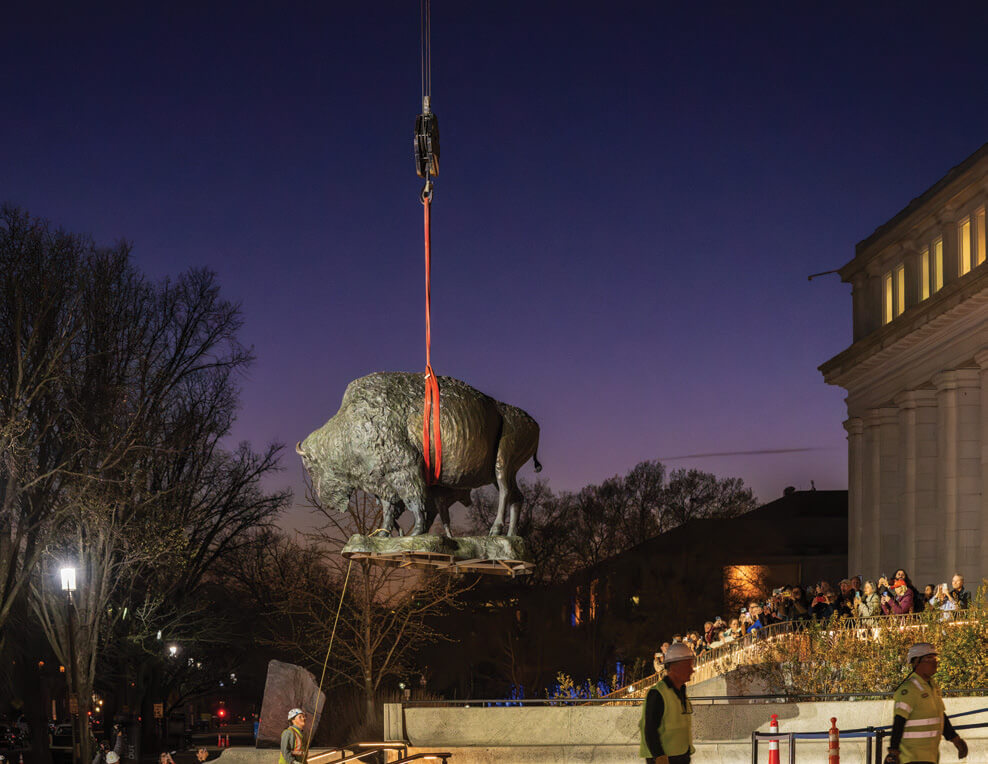
At journey’s end, a giant crane parked between the National Mall and the National Museum of Natural History in Washington, D.C., lifted each 2,500-pound sculpture up and onto its base.
That night, after friends of the museum attend a presentation by Johnson and Staab, the group steps outside to witness the historic moment.
Everyone holds their breath as the giant crane lifts the cow and calf off the truck, then slowly swings toward the building. The piece is carefully lowered onto the plinth; soon, it is in place, bolted to the granite. Securing the massive bull takes longer, but when a time capsule is secreted within the cavity at its base, a collective cheer goes up.
Sealed inside the time capsule — along with a copy of an 1888 letter from Hornaday, museum memorabilia, and a platinum-palladium print by artist Audrey Hall — is a sculpting tool. Staab selected one that still had some clay on it — a message of process, permanence, hope.
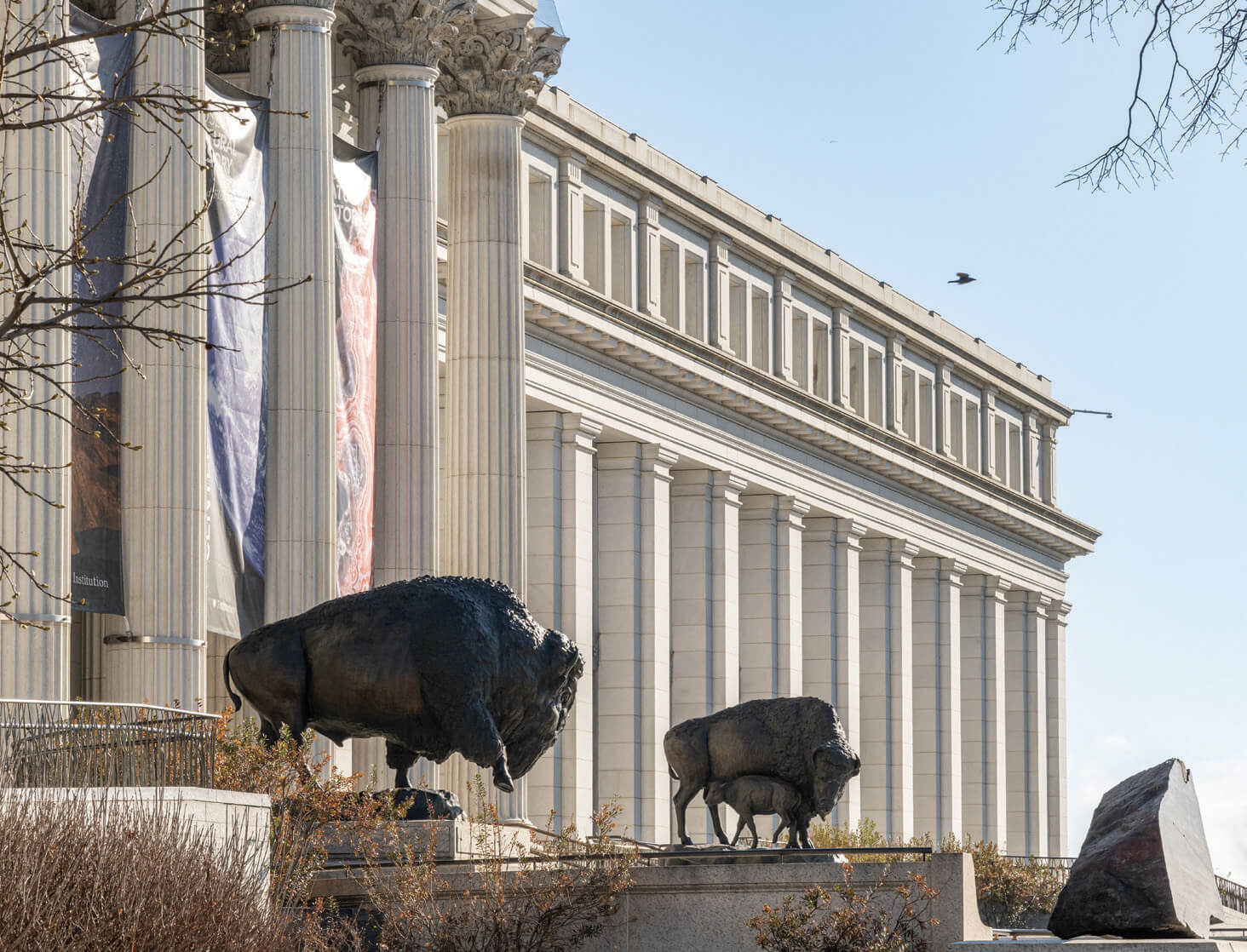
The plinths had been empty since the building’s completion in 1910. The Smithsonian bison, our national mammal meticulously rendered and perfectly scaled, have found their forever home.
Staab has been creating sculptures for museums for decades, but this project was next level, he says. “The biggest challenge was to not be intimidated by the placement of these sculptures. They’re going to be there for lifetimes. When we’re dust, they’re still going to be there.”
Chase Reynolds Ewald’s deep connection to the landscape, traditions, and lifestyle of the mountain region has yielded a rich body of work chronicling the timeless yet ever changing West. Her 20 books include seven with photographer Audrey Hall. Their most recent titles are Modern West and the multi-award-winning Bison: Portrait of an Icon. A frequent contributor to Big Sky Journal, Ewald is a graduate of Yale and U.C. Berkeley’s Graduate School of Journalism. When not exploring western byways, she resides in Montana.
Visual artist Audrey Hall is known for her evocative images of wild places and elegant captures of architecture and interior design. Her art is part of the TIA Collection, whose unique purpose is lending significant works to museums and institutions. She brings the rigor of her fine arts and architectural background to the challenges of creativity, resulting in a growing collection of celebrated books, features, and creative projects.
No Comments