


31 Jul Animals In Action
Montana artist Mike Barlow is enamored with his subject matter. Like many artists, Barlow can be shy when talking about aesthetics. Serious artists, after all, are in the business of making art and are happy to leave judgment regarding its merits to philosophers. But when pressed to explain his use of the word “beautiful,” Barlow pauses to give it some serious thought.
“What makes an animal’s movement or gesture beautiful?” he muses. “To me, it’s when, in one split second of captured time, the identity of an animal is characterized. A bull elk’s bugle, a graceful leaping whitetail, or a standing, alert grizzly tells the story of who they are to me. It’s like each animal species has a signature movement that distinguishes it from all others. I try to capture that beautiful signature.”
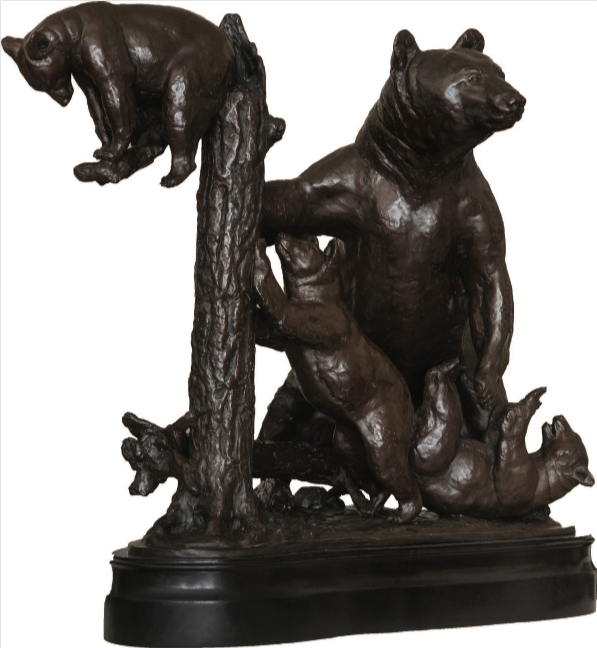
Mama Bear | BRONZE | 20 X 22 X 14 INCHES
It’s evident that Barlow has become versed in capturing exactly that kind of beauty: consider Prime Time, a 2015 piece that depicts two bighorn rams butting heads. The tabletop piece is prominently displayed in the Montana Governor’s office, and because the TV show Yellowstone sometimes films on location there, Barlow’s work has appeared in several episodes.
“Few things embody the rugged, untamed spirit of Montana like bighorn sheep, and Mr. Barlow has a unique talent for capturing their energy and vitality through sculpture,” says Governor Greg Gianforte. “I am proud to have his work on display in the Capitol.”
Barlow was born in Gillette, Wyoming in the early 1960s and grew up hunting and fishing in some of the finest wild country in the U.S. in and around the Bighorn Mountains. In childhood, he developed a passion for wildlife, which his father cultivated by giving him free rein in his vast library of books on wildlife art. As it happens, his father, Bob Barlow, was himself a well-respected plein air landscape painter. He occasionally made sculptures, too, and was happy to share modeling clay with his young son.
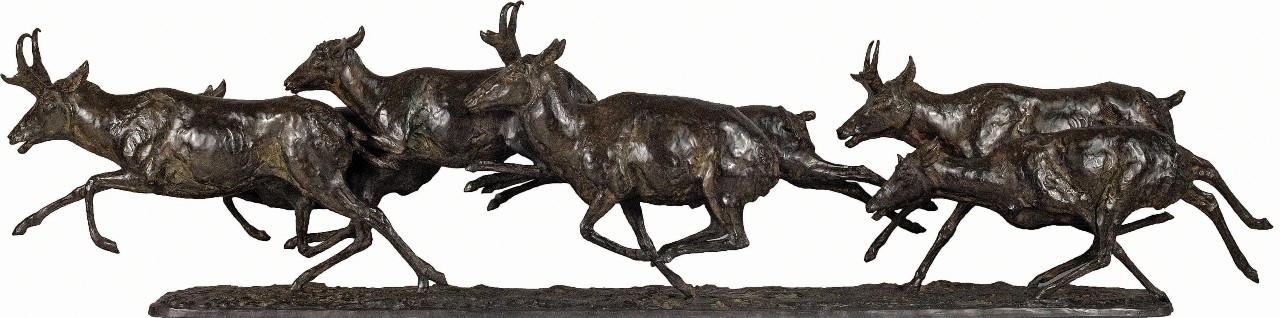
One Minute Mile | BRONZE | 15 X 73 X 11 INCHES
“I started sculpting at 6 years old,” Barlow says. “I’ve just always had that urge to try to mold what I see.”
As a teenager, Barlow began to intensively study the American and European masters of sculpture and painting, which developed into something of an obsession that would pay off later when he became seriously interested in making his own sculptures. He studied works by Alexander Phimister Proctor [1860–1950], for example, considered by many to be America’s foremost animalier. But François Auguste René Rodin [1840–1917] also ignited his passion for expression, along with other notables such as Antoine-Louis Barye [1795–1875], one of the leading animaliers of the Romantic era in Europe.
Before he’d even reached the age of 20, Barlow had immersed himself in a self-directed, intensive curriculum in art history, having visited art museums all over the world: Florence, London, Los Angeles, Madrid, Moscow, New York City, Paris, and St. Petersburg. In fact, Barlow has since traveled the world in pursuit of his muse: In his 20s, he toured New Zealand, Australia, Nepal, India, Egypt, Kenya, Israel, Turkey, and various countries in Eastern Europe. Even while studying in college, Barlow spent his breaks in places like the USSR and China, gaining an appreciation for the world’s immense treasury of wildlife and diverse landscapes.
The philosopher Elaine Scarry once observed that, “the eye sees beauty, and the hand wants to draw,” an insight that seems to cut right to the heart of Barlow’s own aesthetic principles: From an early age, he was entranced by the intense beauty of nature, especially wildlife, and he was compelled to try to make art that captured those moments he found profoundly moving.
Long before he gained momentum as a bronze artist, Barlow sharpened his eye as a photographer. While at the University of Wyoming in Laramie, Barlow studied the liberal arts but always had a camera nearby. Photography became his life’s blood after graduation.
“Photography took priority in my youth,” he says. “For 15 years I lived in Gardiner, Montana, photographing the life cycle of pronghorn antelope. That series was published in 1990 in a French magazine.” For a decade and a half, Barlow immersed himself in the wildlife around Yellowstone National Park, shooting hundreds of photographs every day.
“I developed a real relationship with those animals,” he says. “I made long expeditions into the park, and then I went to Alaska and did the same thing.” Barlow explains that immersive experience in wildlife photography provided a requisite skill set for shifting to sculpture. “Fifteen years of daily photography gave me a great background in movement, gestures, anatomy.”
While many sculptors work from photographs, probably not many can say that they have tens of thousands of images they’ve shot themselves, all categorized and archived. Years of intimately studying animals in the wild gave Barlow a firsthand familiarity with the most subtle features of animal movement. Movement, of course, is a tricky concept to create in painting and sculpture, since the forms literally render still life. But it’s an almost innate sense of physiology and gesture gleaned from patient study that allows an artist like Barlow to present the illusion of dynamic impact in an immobile bronze sculpture such as Prime Time.
Barlow says on his website that “I work to express the strength and power of the animals I sculpt in a classic context while incorporating a contemporary flair.” That flair is exemplified in Barlow’s tendency to minimize or almost eliminate the sculpture base. This is coupled with his skill in depicting dynamic anatomy — the subtle, almost imperceptible nuances of the artist’s touch in presenting the illusion of motion — and results in a classic Western sculpture that practically floats in space.
“When I told Clyde Aspevig that I wanted to be a sculptor, he said to me, ‘If you want to be a sculptor, you have to be a master of anatomy,’” Barlow reflects. “He was right, of course. You need to know bone structure and musculature, what they do, what they do under stress or under load. Animals in action — the big challenge is to make a static thing look like it is moving. Compression, contraction, extension. Showing action is very challenging.”
Part of the difficulty is the fact that animals often move in ways that are not particularly striking or beautiful. A moose, for example, can look awkward and ungainly. “A lot of animal movements or gestures are not necessarily pleasing to the eye,” Barlow says. “But you have to focus in on the beautiful movements. Even a horse can look awkward.” Barlow has realized over time that those moments of “stress” in the anatomy — those instances when the animal is “about to do something,” as Barlow puts it — are what generate the natural lines Barlow thinks about when he uses the word “beautiful.”
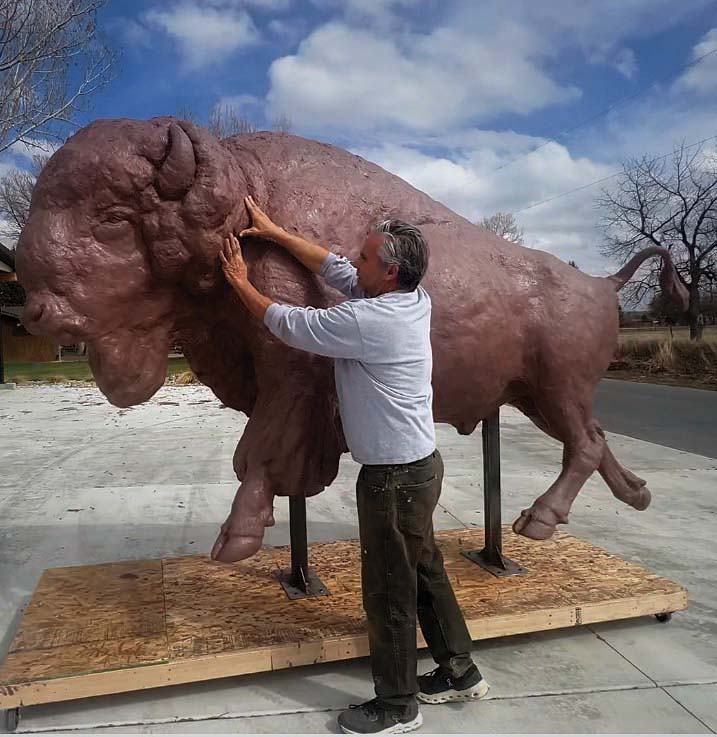
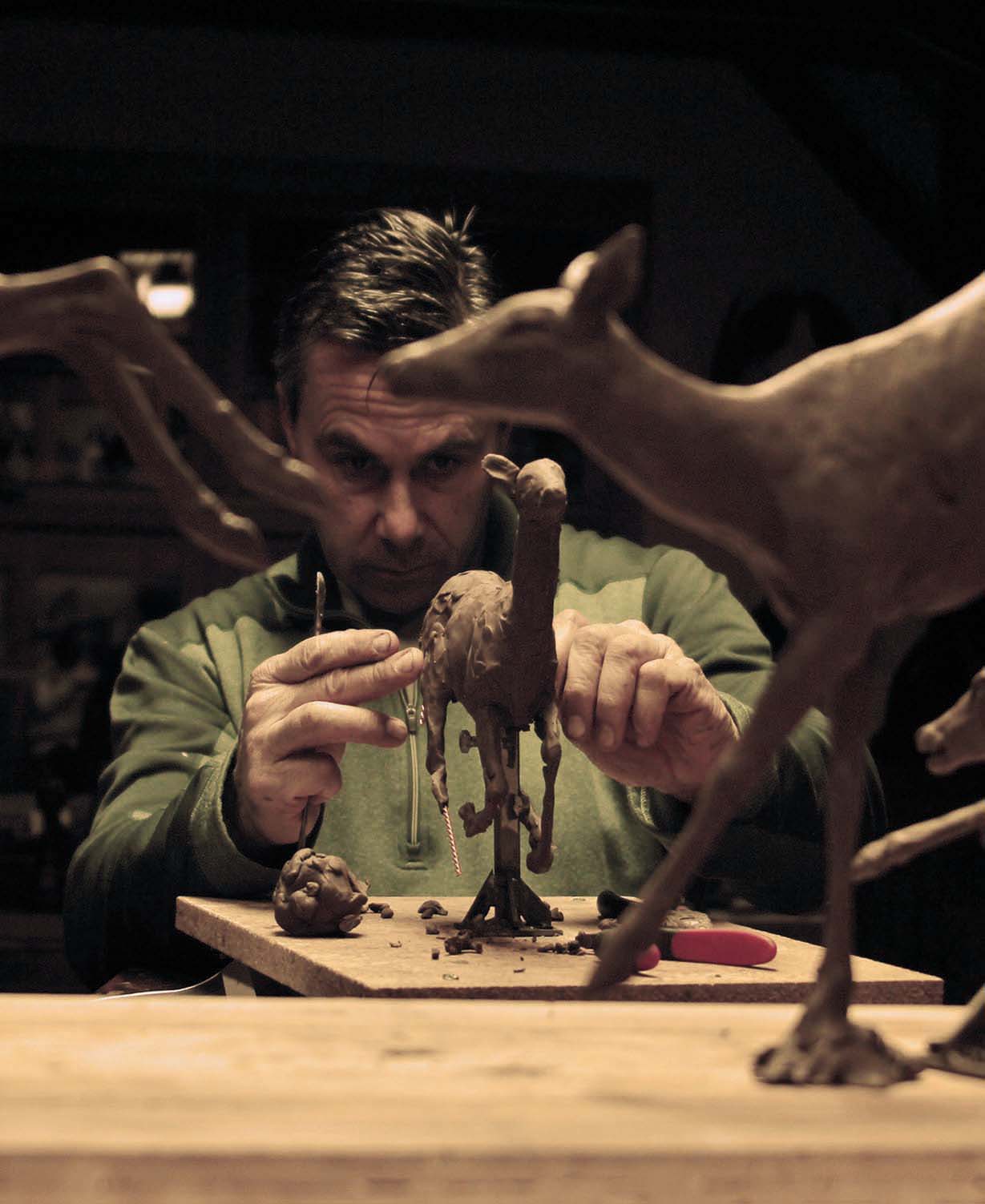
Although the majority of Barlow’s sculptures are designed for the tabletop, he sometimes sculpts life-size animals. “This is one of three life-size bison that I am doing for a commission project about Theodore Roosevelt — which will depict the hunting trip he took to North Dakota after his wife died,” Barlow says. | COURTESY OF MIKE BARLOW
“A whitetail running — when the deer is stretched out — that creates a symmetry and balance between positive space and negative space, those flowing curves,” Barlow explains. “I find that simply pleasing to the eye.”
Perhaps the most stunning example of what Barlow is talking about may be discerned in his 2026 sculpture of a brace of pronghorn antelope racing across the horizon, aptly titled One Minute Mile. Barlow’s sculpture does more than simply offer a freeze-frame of North America’s fastest land mammal in action, which would be impressive by itself. But the nuance of each animal’s form and gesture crystallizes millions of years of evolution, capturing in visual form a simple equation between speed and survival. The effect is reinforced by the minimal presence of the base, which the animals extend beyond in both directions.
Or consider the clever arc of the leaping salmonid rendered in Brown Trout. By presenting the stately fish open-mouthed and nearly vertical, Barlow compels the viewer to think about the streamlined physiology of fish in general, and their kinship with other waterborne creatures, including mammals like the porpoise. Barlow has an uncanny ability to depict the dynamic range of whatever animal he’s sculpting, distilling the innate force of its anatomy in a way that shows us both the genius of its evolutionary design and its connection to geologic time. It’s hard to imagine the individual personality of a fish, but Barlow’s Brown Trout exudes determination in the subtle hook of its lower jaw and the intense curiosity of its wide eye.
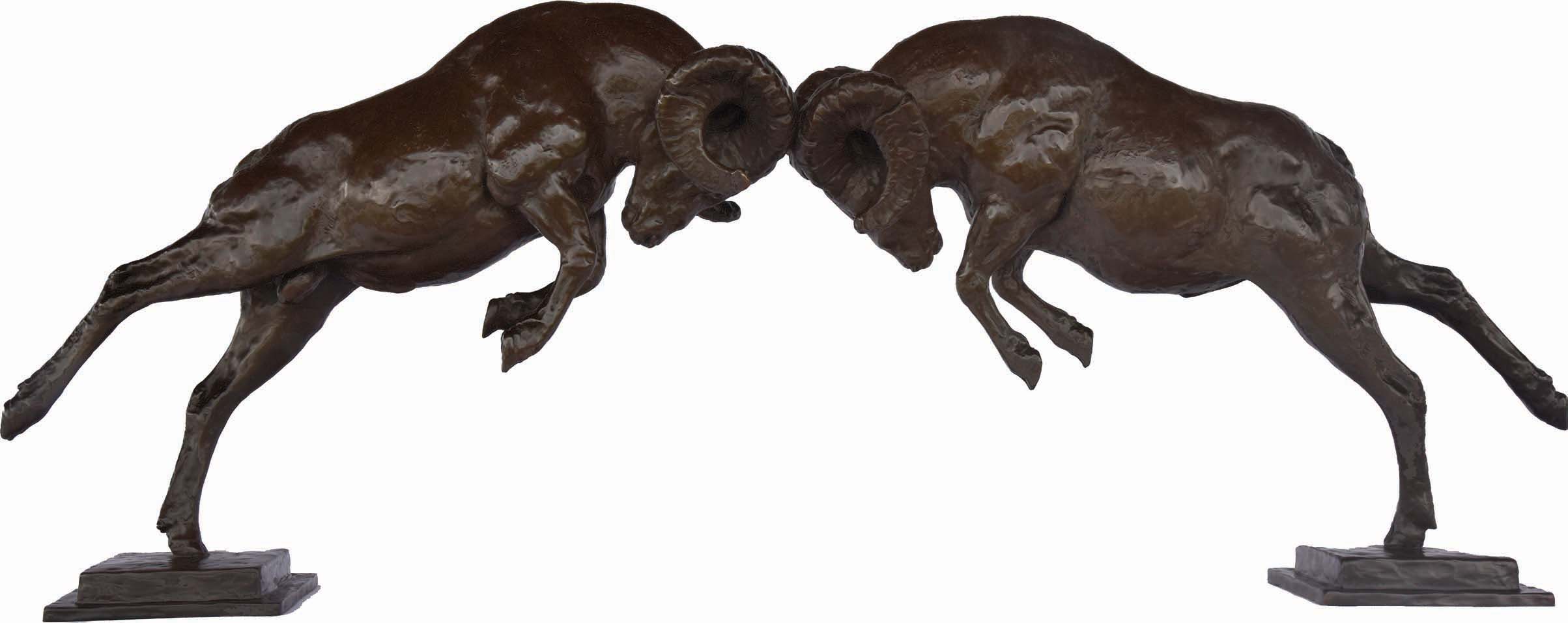
Prime Time | BRONZE | 17 X 55 X 9 INCHES
Several of Barlow’s most recent sculptures present the theme of what Barlow calls “feminine strength,” a concept that is central to his understanding and appreciation of the natural world he has spent most of his life portraying. “I’m interested in representing feminine strength,” he says, and points to Girls Got Rhythm, which displays an Andalusian mare mid-stride, neck curled in a nearly perfect golden-ratio curve. When it comes to human anatomy, of course, women are celebrated for their curves, especially by artists, but Barlow points out that straight lines are practically non-existent in nature. This underlies his contemporary approach to sculpture. In fact, he says, “Traditional sculptors often used large bases that incorporated habitat and emphasized intricate details like hair. But in many of my works, the base is the only element that incorporates straight lines, as they are never found in nature.”
Barlow’s affinity for the nonlinear reality of nature also comes out in his sculpting style. His dedication to the beauty of a gesture or muscle movement reveals itself in understated abstraction, without the need for sculpting every last tuft of hair or articulation in a fin. The mare in Girls Got Rhythm exudes elements of anatomical understanding that would be obscured by obsessive detail, and Barlow instead distills the essence of the mare’s rhythmic strength by way of curves and the suggestion of tension beneath them.
Barlow’s work ranges in scale from one-quarter life-size down to five- or six-pound pieces “about the size of a softball,” as he puts it. He uses the classic lost wax method, sculpting in clay that is then cast in plaster. Once the clay is removed, then a wax casting is made in the plaster, which then becomes the core of a ceramic mold that, when fired, loses the wax and becomes the final mold for the bronze casting. Almost all his work is cast at Boyer Bronze, a foundry in Livingston.
Barlow still loves photography but observes that sculpture is almost a more meditative form simply because of the time involved. “Back in the day, with film, every shot cost basically a dollar, and you’d shoot reel after reel,” Barlow says. “The hard part about sculpture is the time it takes. You can’t be thinking about the foundry stage the way you think about what will happen in the darkroom.” Barlow may spend from a few weeks to a few months on a given sculpture. One piece Barlow made after a trip to Africa took seven years to finish. “I get more patient as I get older,” he says. “I don’t think about rushing something off to the foundry.”
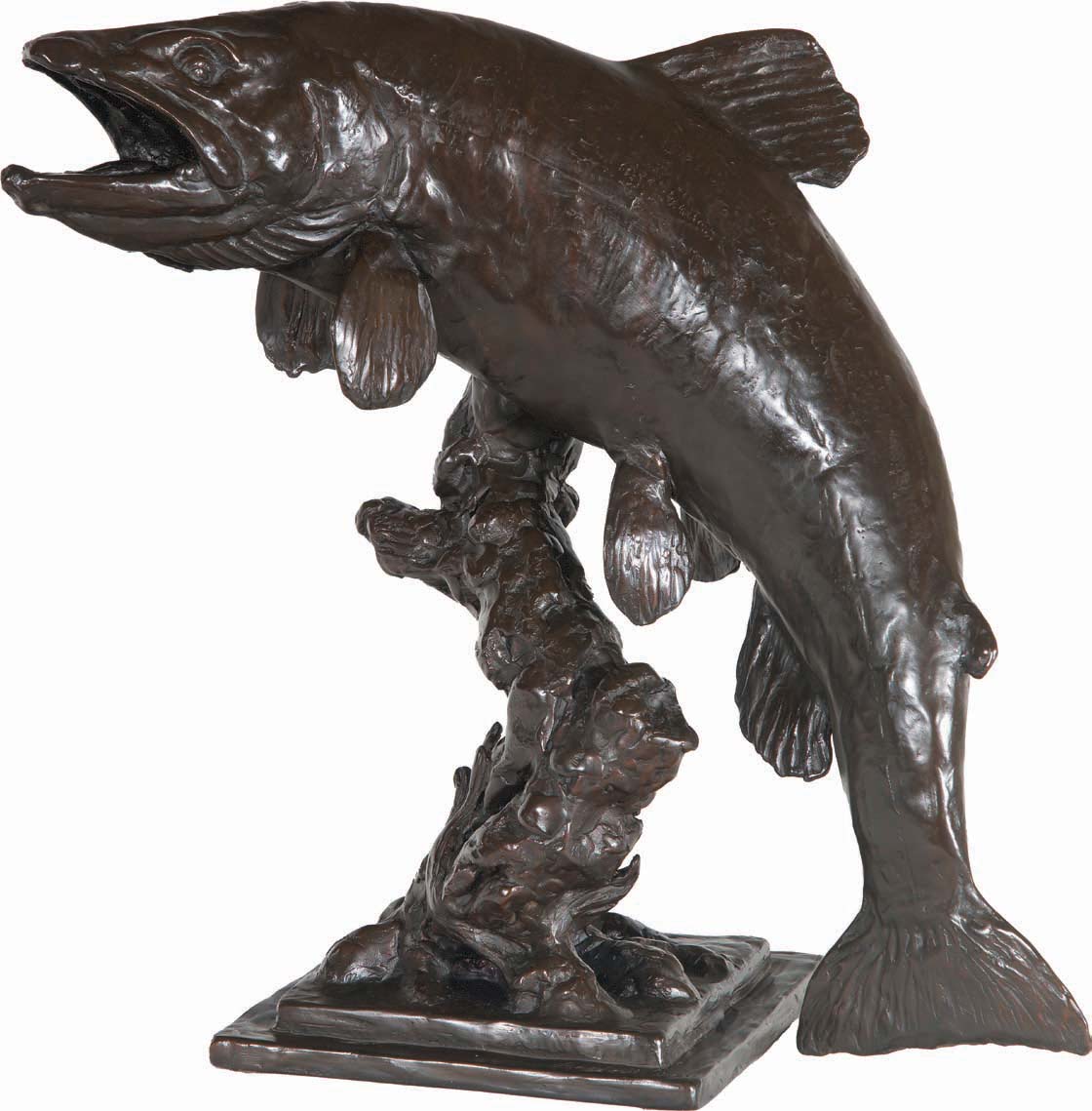
Brown Trout | BRONZE | 13 X 12 X 7 Inches
Probably the most important plaudit an artist can receive must come from a colleague who understands what’s at stake in the creative process. Western painter Charles Fritz was close with Barlow’s father, Bob Barlow. “The great Golden Age illustrator, Harvey Dunn, used to tell his students, ‘Don’t paint the thing, paint the spirit of the thing,’” Fritz says. “Mike Barlow accomplishes in sculpture what Mr. Dunn enthused.” Fritz remembers watching an enthusiastic young Mike immersing himself in photography, surrounded by “nature, art, and good literature.” It was an upbringing that served him well. “Of all the elements I value in an artist, authenticity is the greatest,” Fritz says. “Mike has lived with enthusiasm and dedication, and it shows.”
Aaron Parrett is a writer and musician who runs a letterpress shop called Territorial Press in Helena. He has published essays in many fields, and his book of short fiction, Maple & Lead, won a Montana Artist Innovation Award and a High Plains Book Award. Most recently, his essay, “Idgas and Montana Literary Criticism,” appears in a recent issue of Whitefish Review. He lives with his wife and daughter in Helena, Montana.
No Comments