


31 Jul Ones to Watch
The Northern Rockies remain a treasure trove for artistic talent, with many new and emerging artists hitting their stride. Here are a few artists catching our attention.
Amanda Markel
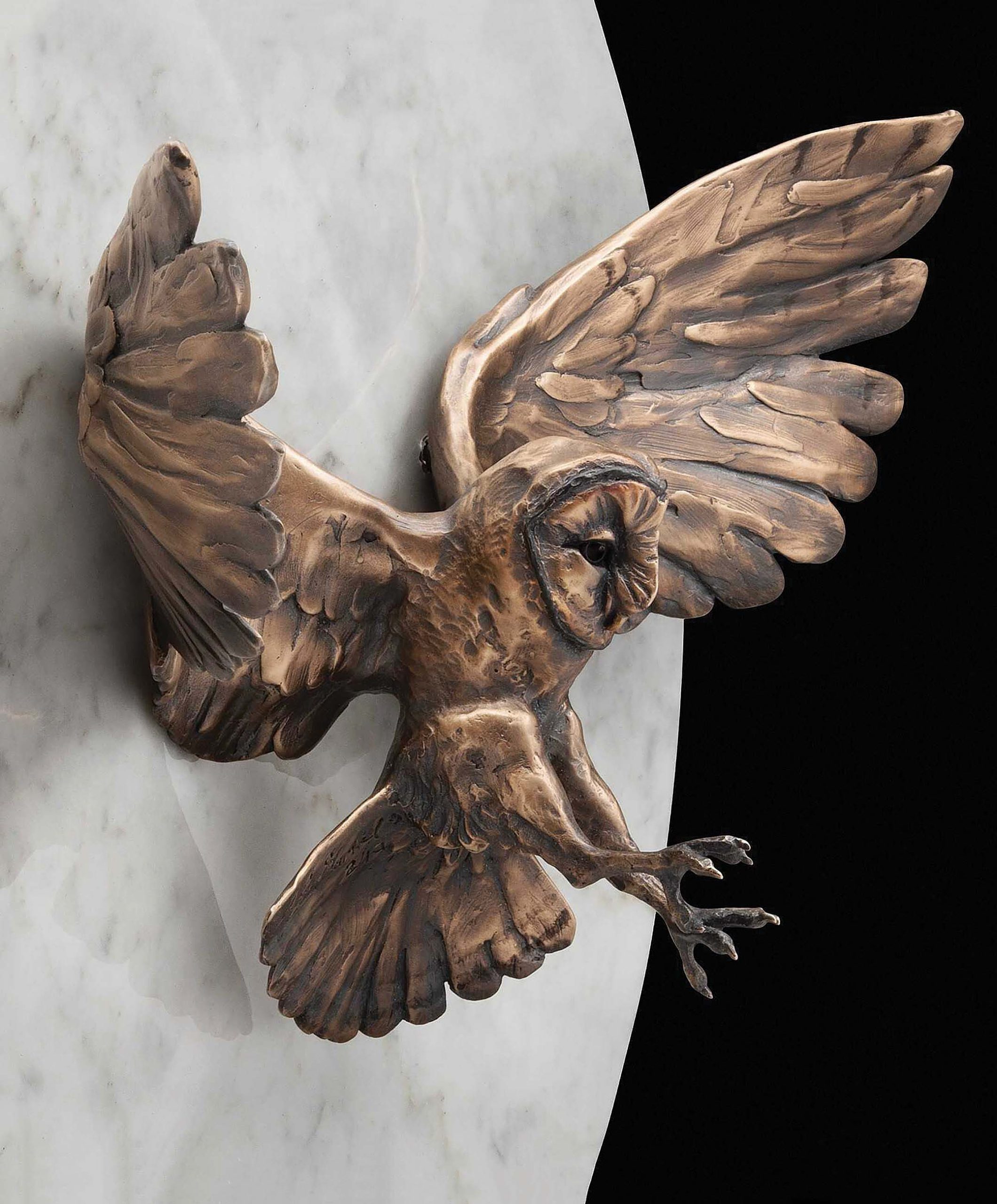
Sculptor Amanda Markel takes the fluidity of paint and translates it to bronze. Through the idea of negative space and unmarked areas, she completes a work by tapping into the viewer’s own imagination. A technique often used in painting, Markel harnesses the power of space to incorporate an open-ended narrative.
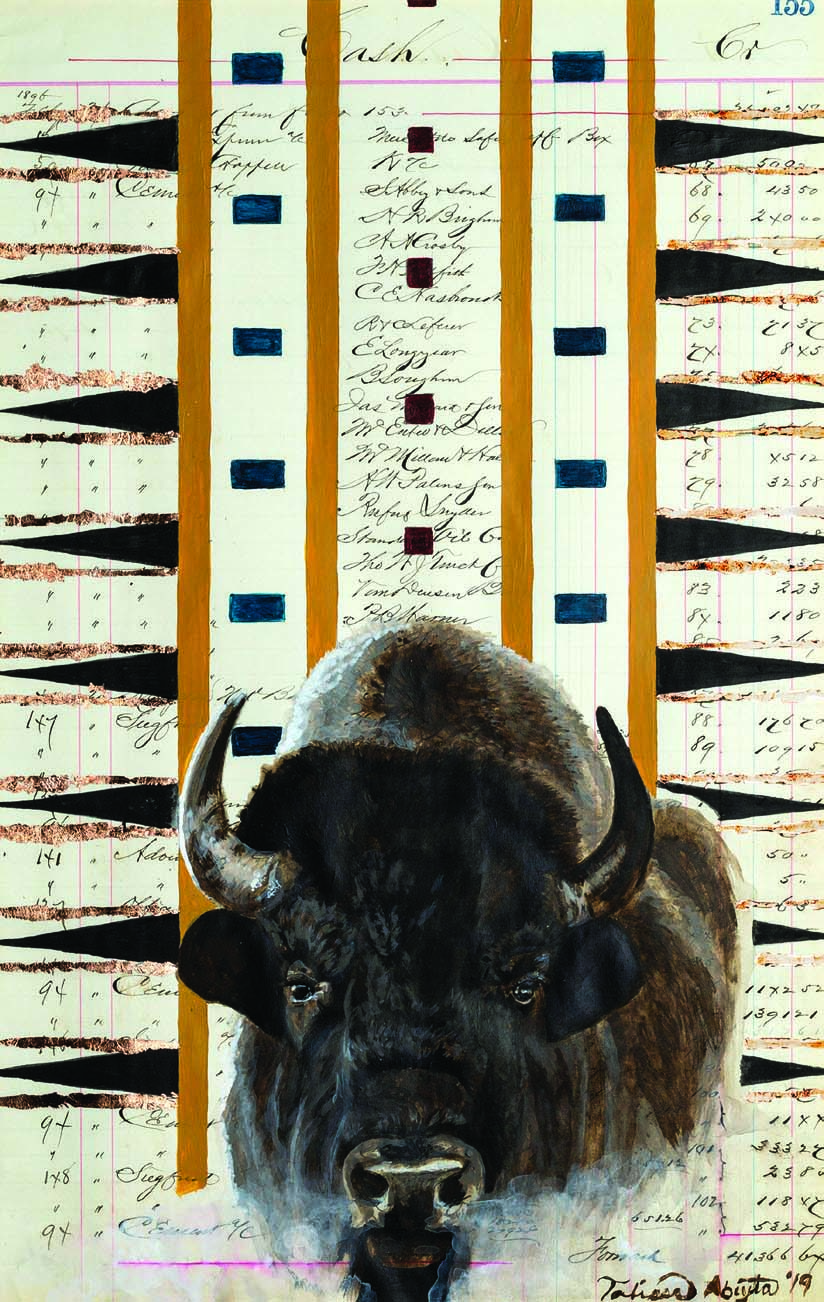
Good Medicine | TALISSA ABEYTA | ACRYLIC PAINTING ON ANTIQUE LEDGER PAPER | 15.5 X 9.75 INCHES
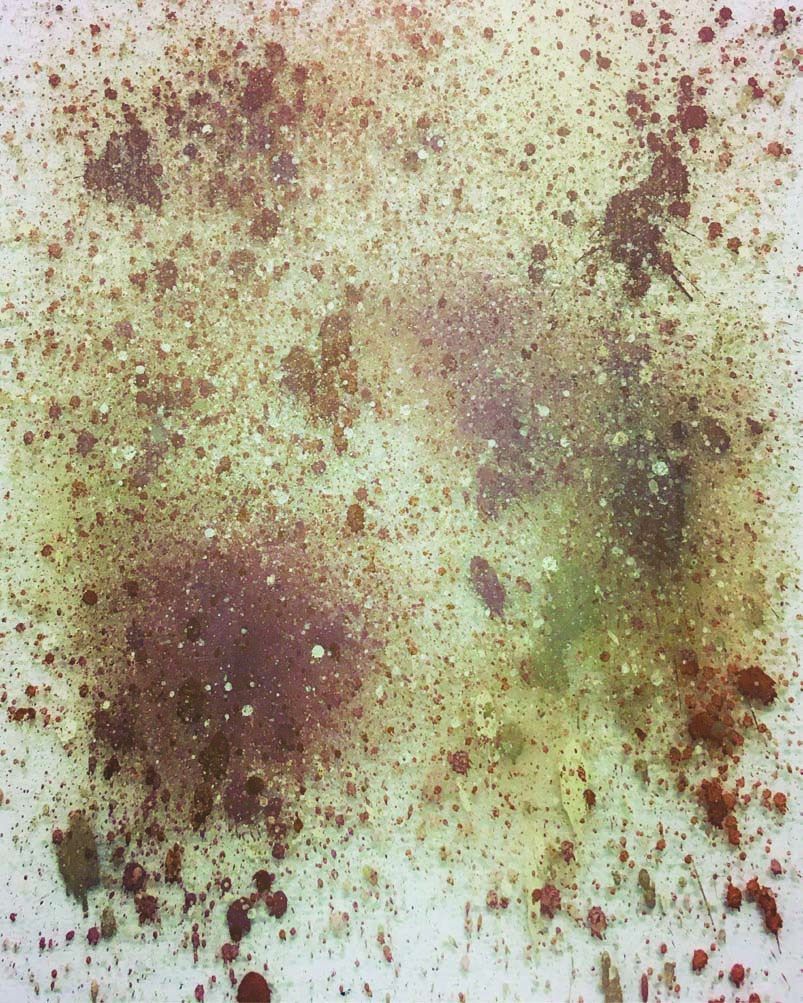
Clay Spittle | KEVIN TRACY | LOCAL CLAY AND SALIVA ON PLEXIGLASS | 30 X 26 INCHES
Her sculptures lead the viewer to new kinds of landscapes. For example, with her bronze Mountain Heart, a wolf stands on an EKG symbol for a heartbeat, the jagged dip and climb outlined in gold. Instead of presenting the wolf’s full body, Markel carved out space to create a mountain range visible inside the animal.
“It’s not a specific mountain range,” she says. “I wanted to show a broken and fractured process and create strength and beauty. Most of my ideas are born from my own journey. I create work because I love the process; I sell art because it fundamentally changes the buyer’s experience of life. There is a lot of hardship in life. People can get stuck in the darkness, but art sheds light on that.”
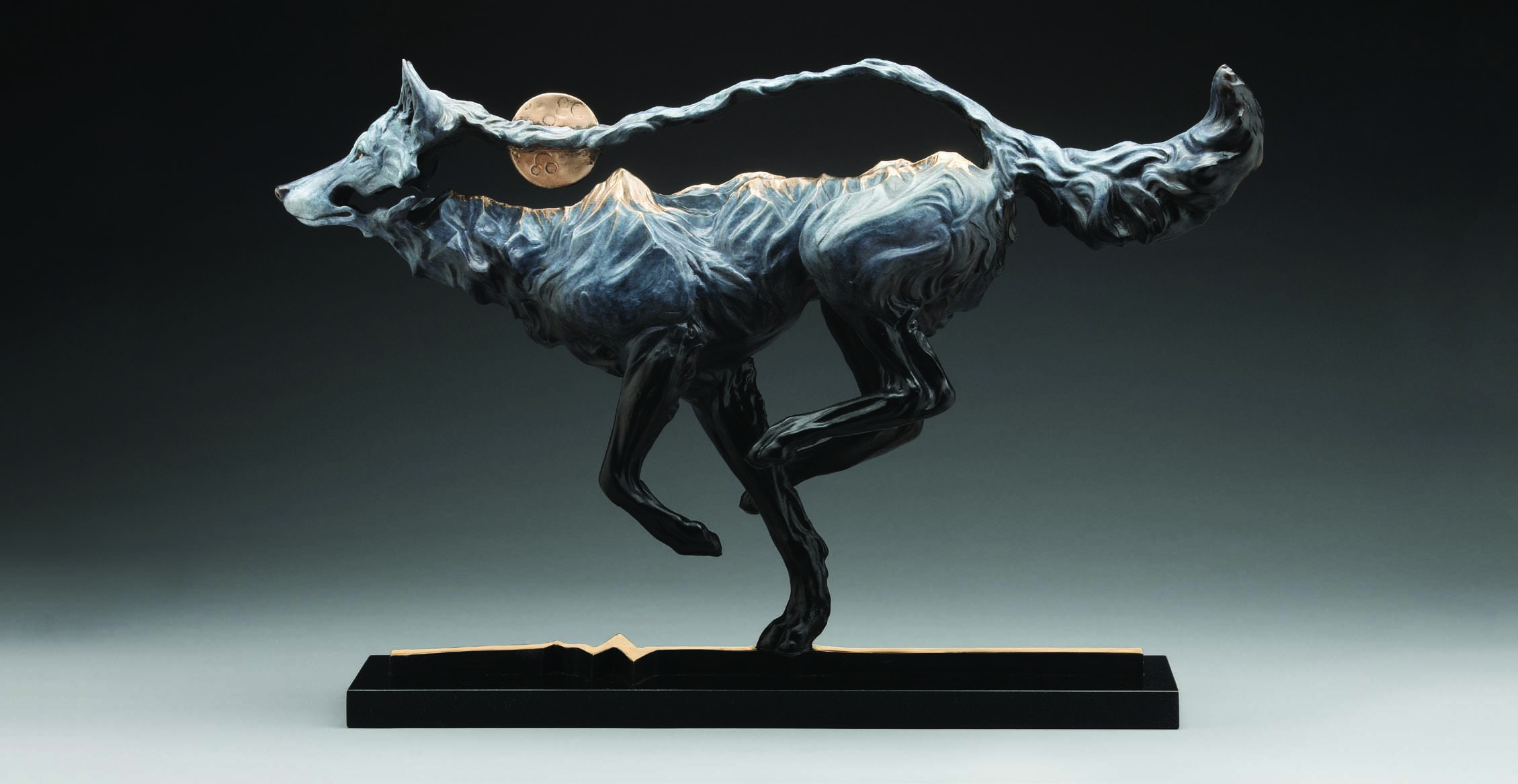
Mountain Heart | AMANDA MARKEL | BRONZE | 21 X 30 X 6 INCHES
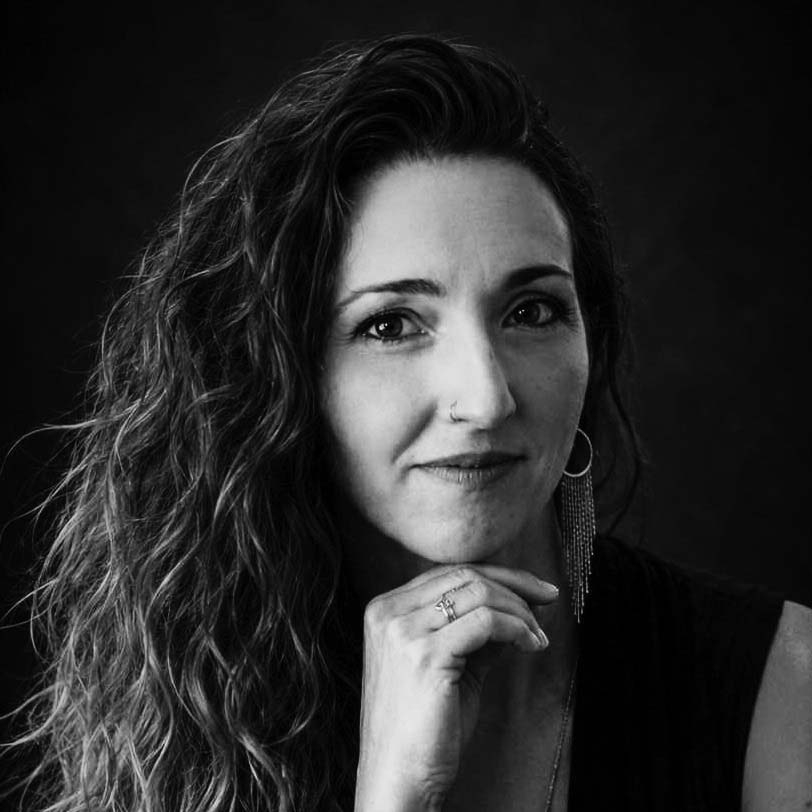
Drawn to sculpt animals such as wolves, elk, owls, and foxes, Markel, who is based in Bozeman, sees the forms as a way to speak a universal language. It’s something she’s comfortable with, having grown up in Colorado with a lot of animals around. “I use them to represent archetypes,” she says.
During the COVID pandemic, Markel endeavored to ramp up her art practice, moving from painting into bronze. Then all her booked shows were canceled. She lost her job.
“When everything around you is changing, what do you hold on to?” she asks. “I allowed myself to experiment. It was a season to play without pressure. The idea of incorporating negative space into my sculpture work began to take shape.”
She desired to bring in the parts of painting she loved — the blurred edges, the unresolved aspects of the canvas — and explore different ways form can engage the viewer. “I wanted to address how we let go and transform,” she says. “The coping mechanisms that kick in when we don’t feel safe or when we feel captive.”
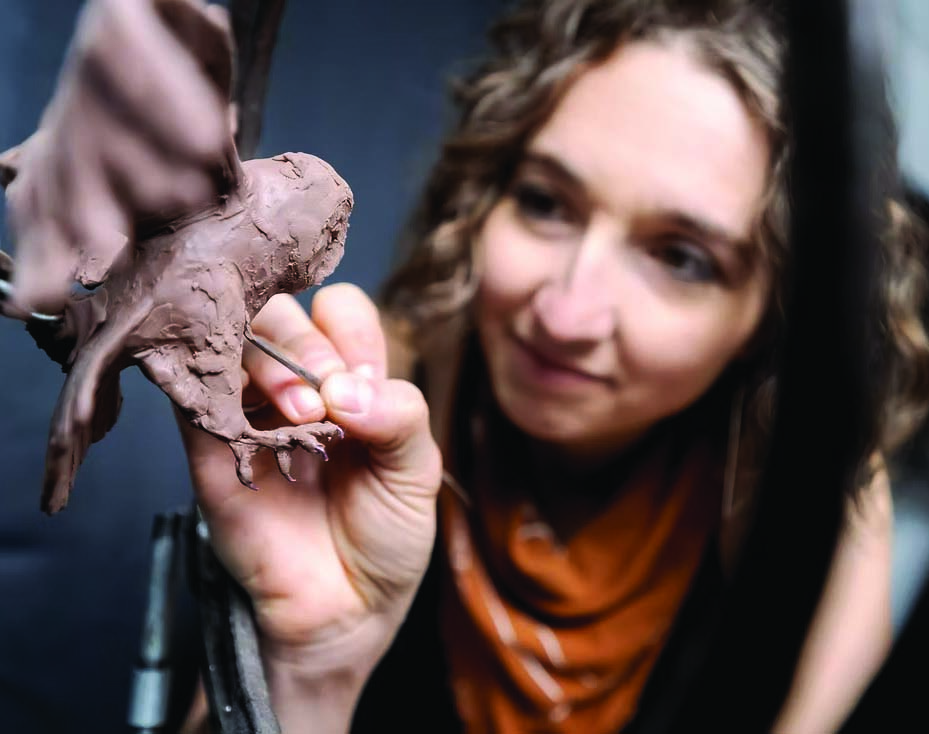
Amanda Markel puts the finishing touches on a clay sculpture before she turns it into bronze at the foundry. | JAFE PARSONS INC.
An example of this idea comes across in her piece Liminal. The wolf’s back seems to be released from his body slowly — can slowly be said of a bronze sculpture? — step by step, shifting into a flock of birds overhead. “It’s a letting go of pieces of ourselves,” Markel says.
While most of her earlier works were smaller than life-size, Markel has recently begun working on much larger pieces. Last year, Ridge Runners, a 14-foot permanent installation that depicts three wolves in motion, was placed in the Benson Sculpture Garden in Loveland, Colorado. This year a client commissioned a life-size grizzly bear bust for his collection in Great Falls, Montana.
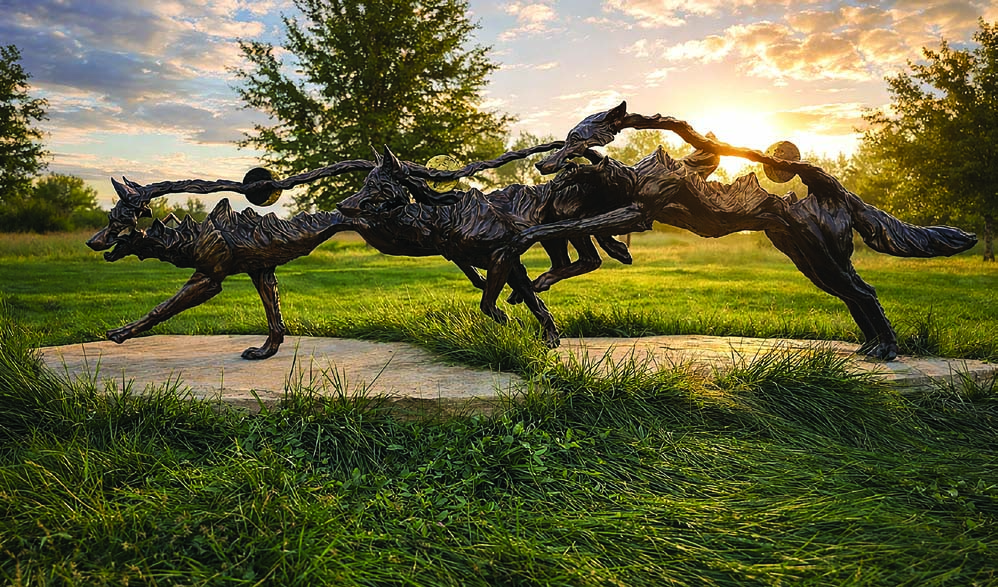
Ridge Runners | AMANDA MARKEL BRONZE | 4 X 14 X 3 FEET | Photo by JAFE PARSONS INC.
“I love the idea of public art,” Markel says. “And working bigger is just so much fun.”
Amanda Markel is represented at Old Main Gallery in Bozeman and Gallery Wild in Jackson, Wyoming.
Whitney Weidow
Using historic photographs and in-depth research, Whitney Weidow of Hamilton, Montana paints Montana cityscapes from the turn of the 20th century as they might be remembered — through a gauzy lens and a dream-like nostalgia.
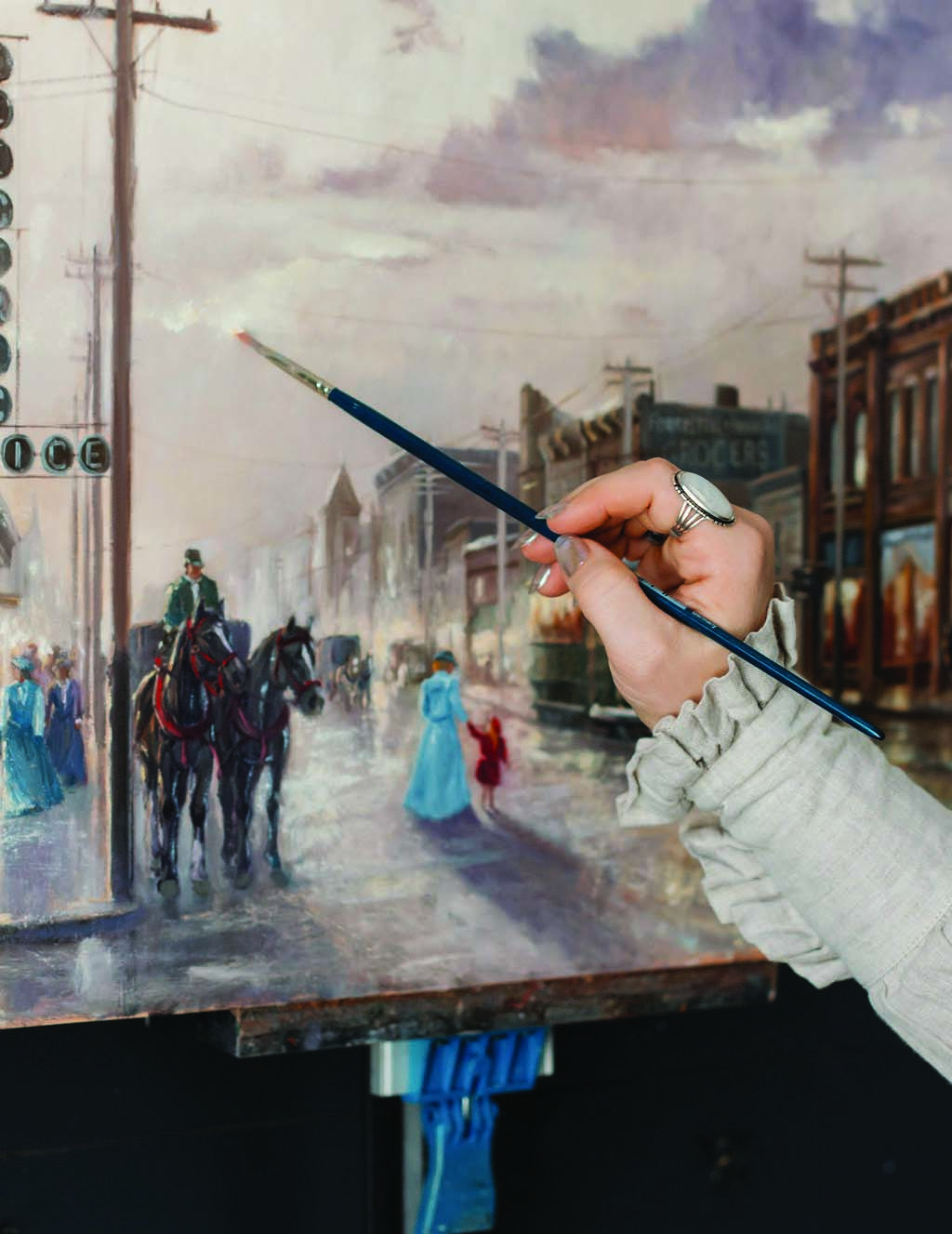
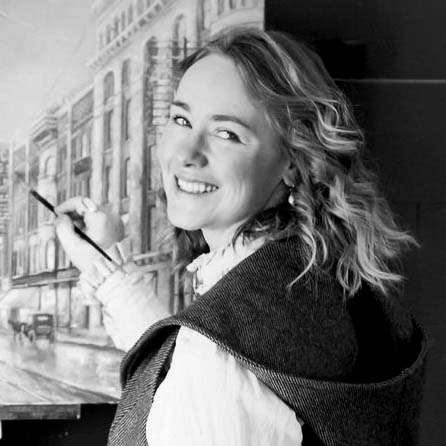
Whitney Weidow works on an oil painting of a turn-of-the-century Montana town in her studio in western Montana. | DANI JO PHOTOS
“The premise of my work is to send people back to those simpler times,” Weidow says. Her oil paintings show old street corners with carriages, horses, and Model T Fords. “They are mostly hazy with glittery spots. Then I like to fill in those gaps with sparkly aspects. The periphery is hazy, and key moments are pronounced. That’s what the glow in my work is supposed to represent — those ‘good ol’ days.’”
Weidow relies on museums and historical societies across Montana to research scenes for her art. Depending on where she’s having a show, she will visit the area, either in person or online, to gather historic photographs of the town, then cross-reference those with how the town stands currently.
“I’ve found the Polk directory very helpful, as it gives me business addresses during a certain year,” she says of the R.L. Polk & Company’s series of business directories published throughout the 1900s. “If I nail down the date and I need to know which businesses were around and where,
I can recreate a whole town.”
She also reads newspaper articles published during the era she’s painting.
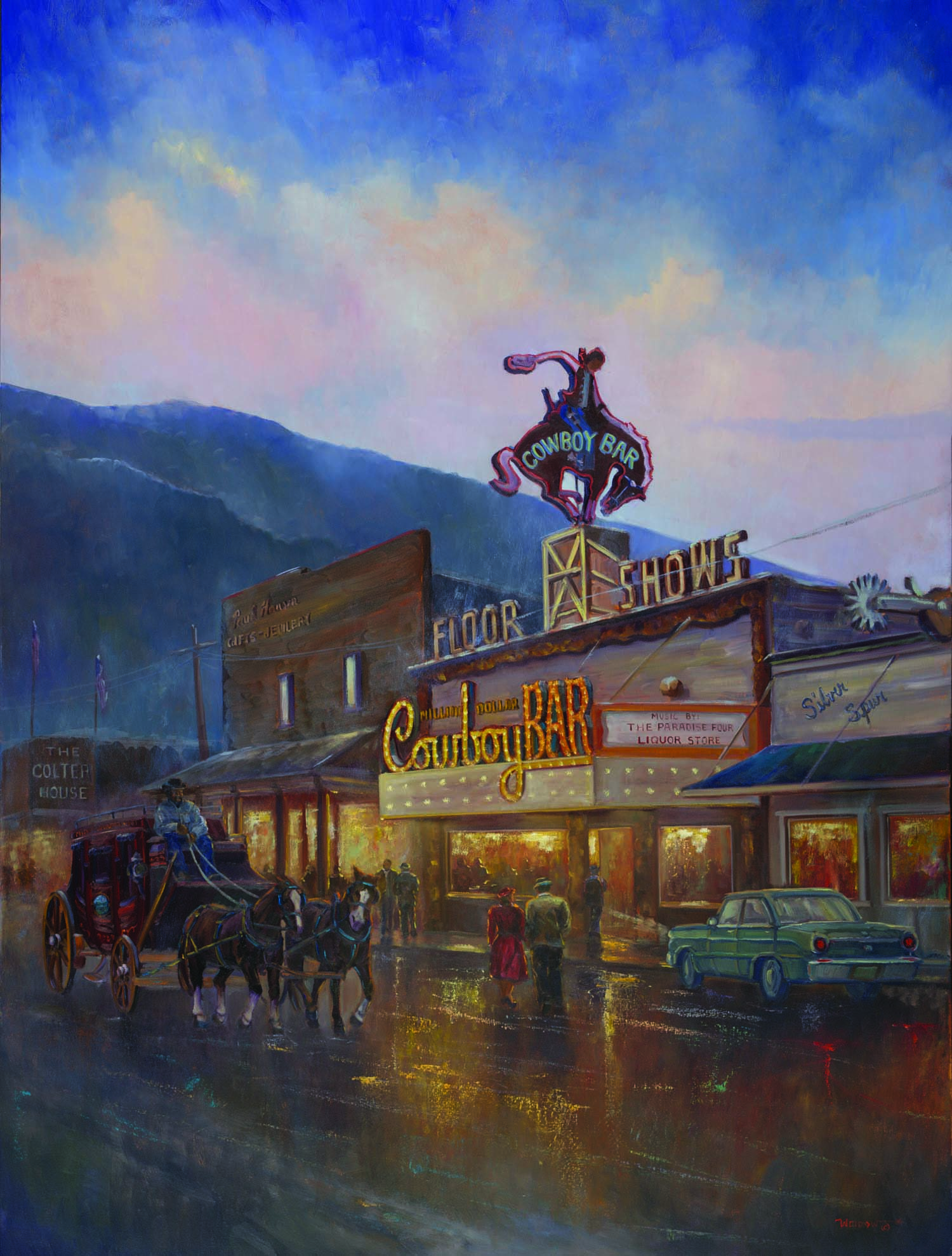
Cowboy Reflections | WHITNEY WEIDOW | OIL ON CANVAS | 40 X 30 INCHES
“The 1890s to 1930s are my sweet spot,” she says. “It’s that transitional period, where there are streetcars, horses and carriages, and early vehicles. I put all those things in the painting at once. It’s kind of romantic. A coming of age, and a call back to traditional roots.”
While she’s gained momentum as a painter, Wiedow had no intention of becoming an artist.
“I wasn’t artistic as a kid; I was always athletic,” she says. “Then I was going to be a nurse, got a scholarship, but then I realized that skin creeped me out.”
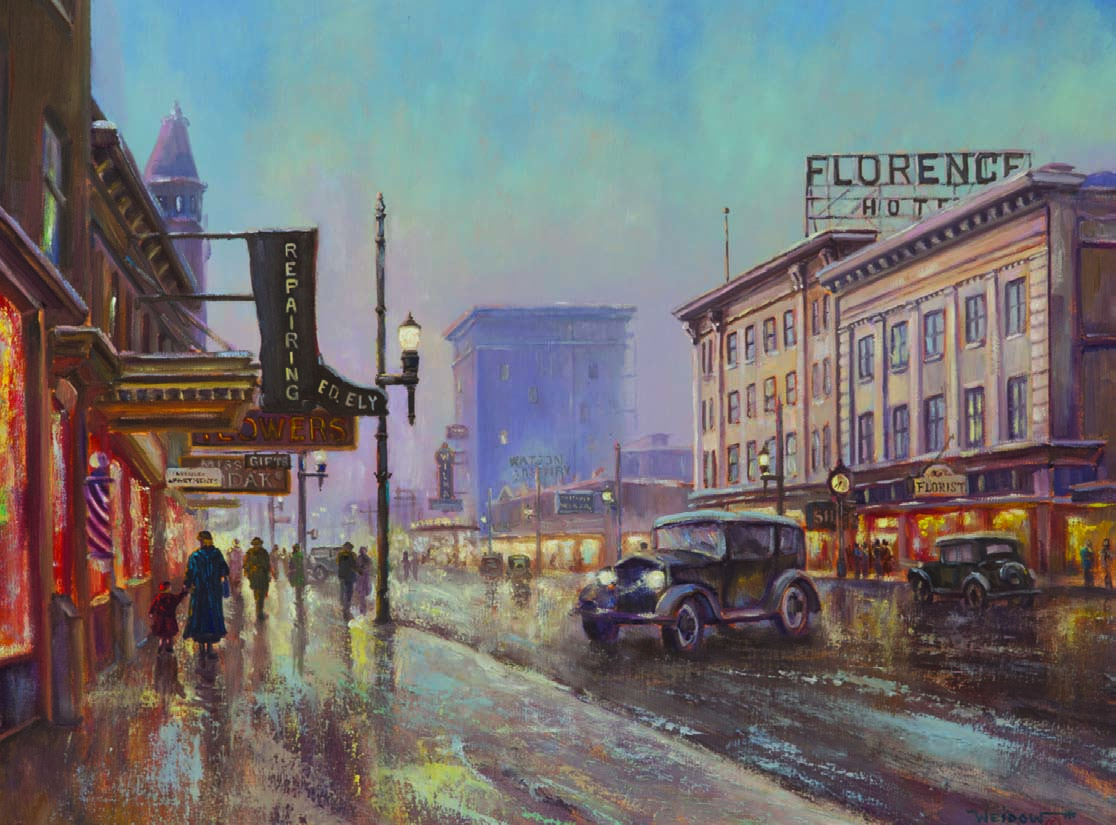
Missoula Memories, 1935 | WHITNEY WEIDOW | OIL ON CANVAS | 16 X 20 INCHES
She ended up back in her old stomping grounds of Montana’s Bitterroot Valley, cleaning the studio of artist Gary Lynn Roberts, who is known for his historical paintings of cattle drives and cowboys on horseback. As she cleaned, she watched him work.
Then art found her.
“One day I asked if I could try to paint,” she says. “I painted every time I cleaned his studio. After a couple of months, he told me to quit my day job. I worked with him for two years. He taught me the business side and how to make a living doing artwork. I was very fortunate to land in that position.”
Without meaning to, she had discovered that she was an artist.
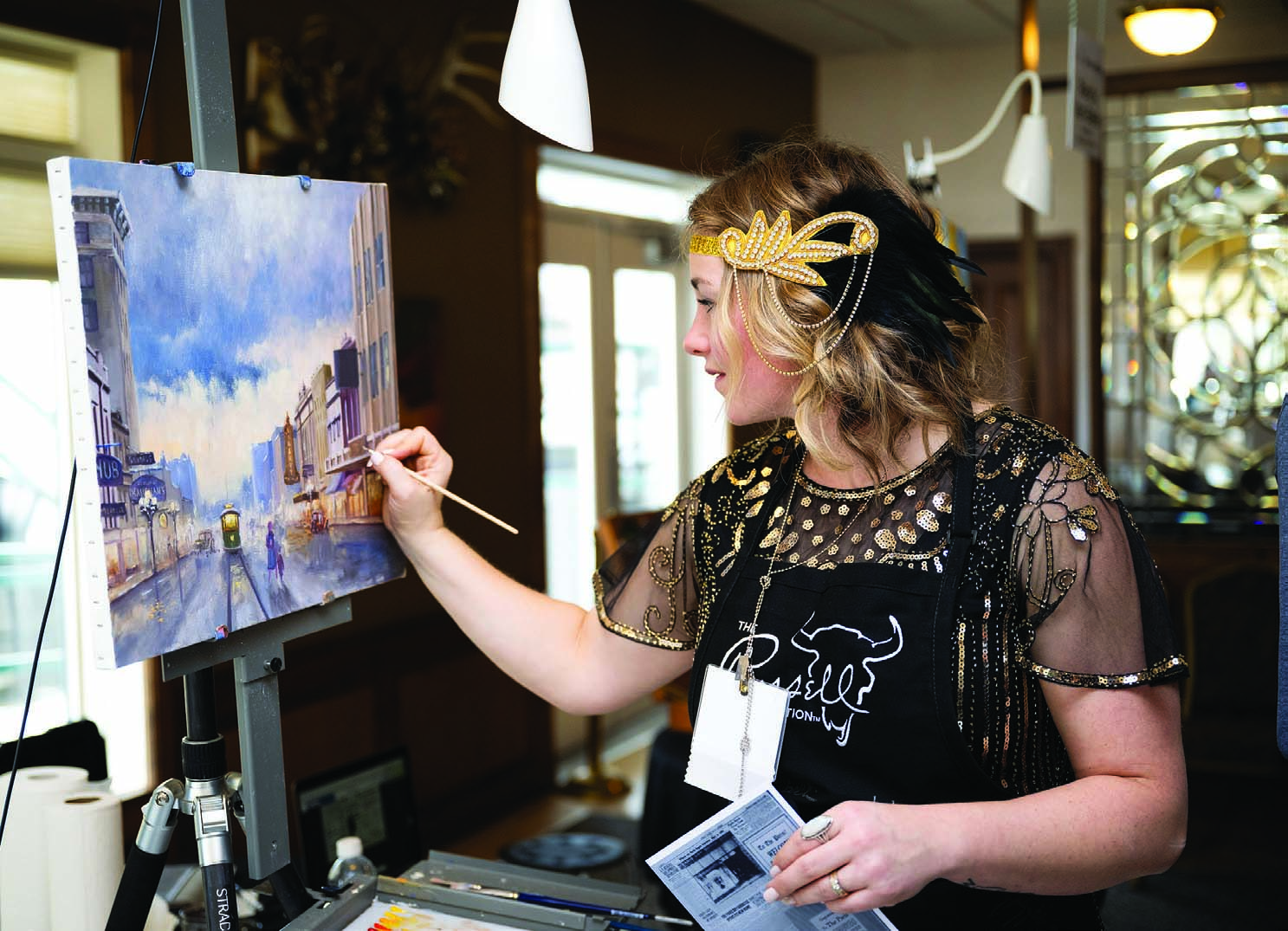
Weidow finds the right color to accent her oil painting of a Great Falls cityscape in the early 1900s. | COURTESY OF C.M. RUSSELL ART IN ACTION
“A lot of different circumstances had to happen,” she says. “I remember coming home one day and my world exploded — I went from seeing black-and-white to full-blown color: values, shapes, and tones.”
As an artist, she seeks to portray authenticity, albeit with that added sparkle. Recently she finished research for a collection of Jackson Hole portraits set in the 1940s to 1970s in preparation for the September Jackson Hole Fall Arts Festival.
“I am preserving moments of history, and that’s why I find it so important to be accurate,” she says. “My biggest dream is to work with historic preservation societies in each state and create a body of work for them.”
Whitney Weidow is represented by Mountain Trails Gallery in Bozeman, Montana, Jackson, Wyoming, and Park City, Utah.
Talissa Abeyta
Raised on the Wind River Reservation in Wyoming, Talissa Abeyta is an Indigenous contemporary artist and sixth-generation descendant of both Chief Washakie of the Eastern Shoshone and Wovoka of the Paiute. She’s inspired by her heritage and culture, and her artwork reflects the feeling of having one foot in the present and one in the past.
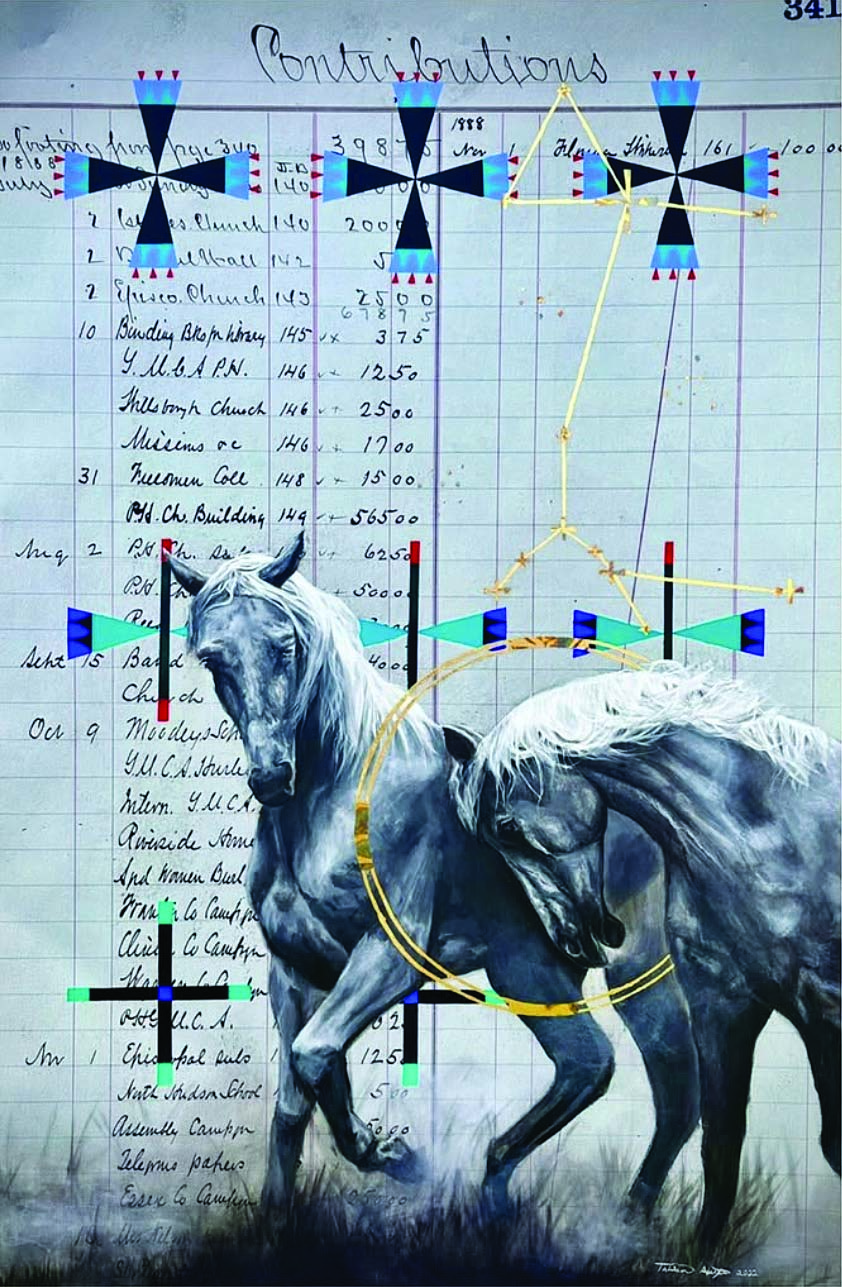
Written in the Stars | TALISSA ABEYTA | ACRYLIC ON CANVAS WITH GOLD LEAF | 60 X 42 INCHES
“I feel blessed to be a Native American female artist in the modern era,” Abeyta says. “Through my art I found my voice.”
In her ledger-art-inspired paintings, she uses the images of ledger paper as an underpainting, then adds contemporary touches to situate the works in modern times. Ledger drawing emerged in the 1860s in response to U.S. government policies that forced Indigenous peoples onto reservations. Due to the destruction of buffalo herds and other game animals, the traditional practice of painting on hides gave way to works on paper, muslin, and eventually canvas. Once held inside forts, without the traditional materials to tell their hunting and war stories, they sought out any materials they could find, usually leftover administrative paper — also known as ledger paper.
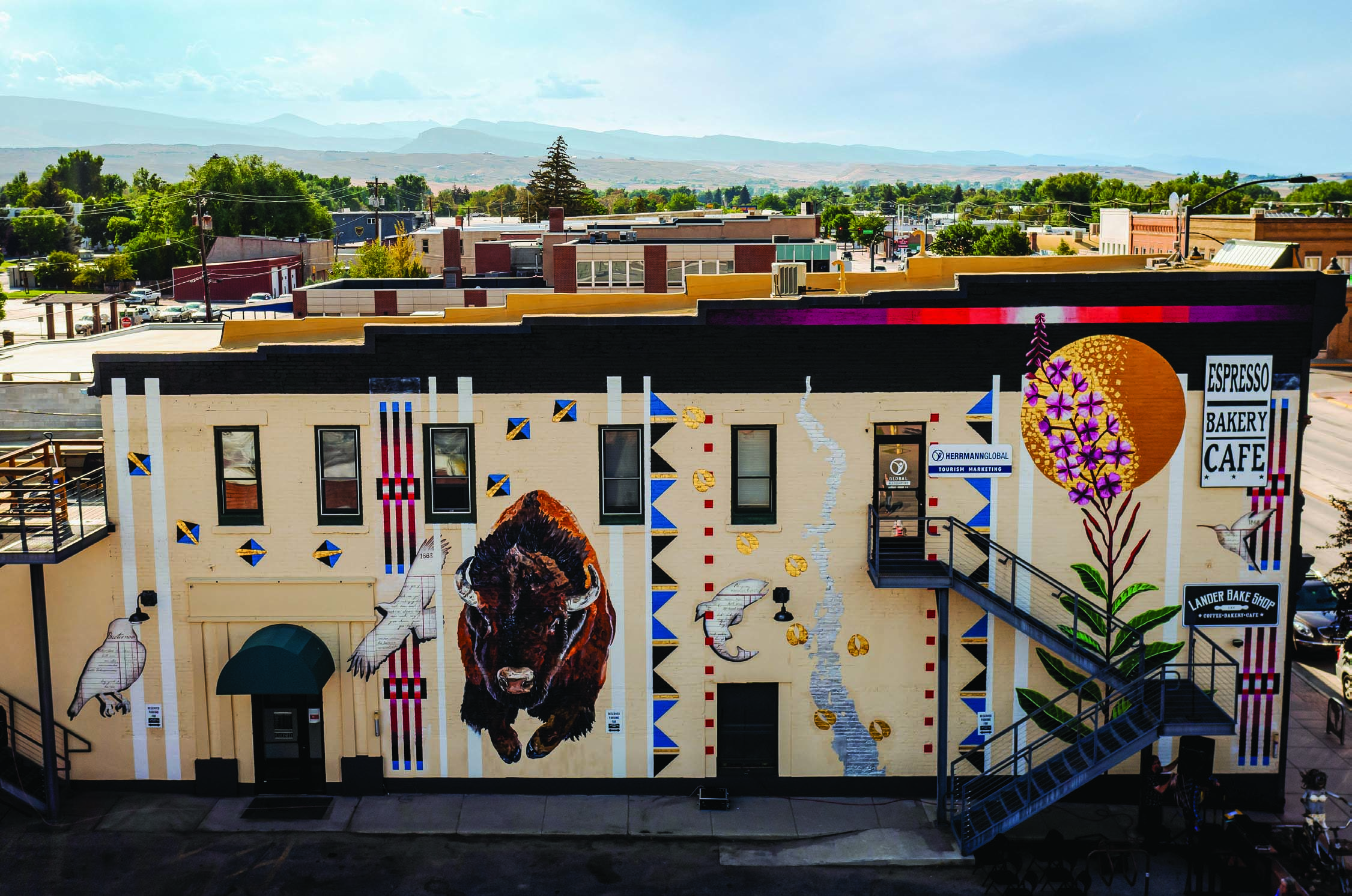
Muralist and painter Talissa Abeyta reflects her Indigenous heritage while adding her own contemporary perspective by working in the ledger-art tradition and using colorful geometric shapes in her murals, such as one on an exterior wall of a café in Lander, Wyoming. | CASEY MCGARR
“I want to remind people of the history behind ledger art,” Abeyta says. “I connected with that resilience, but I do modern imagery to make my works very present. It’s more about honoring where ledger art comes from. I tie it into my artwork to show how far we’ve come as people and that we’re always going to be here.”
Human figures and animals often show up in her pieces, and Abeyta concentrates on getting motion into these forms.
“I want to use movement to show emotion,” she says. “I love painting the emotions, and I do my best to get that into my animals.”
For portraits, she says she loves doing dancers. She also completed a series in honor of her ancestors. “My dad was in the foreground, and Chief Washakie was in the background,” she says. “That piece speaks to the idea that our ancestors stand behind us throughout our lives.”
In addition to ledger art, Abeyta has found a talent for mural painting and recently finished her second mural. The first is on the exterior wall of a café in Lander, Wyoming, and the new work spans across the lobby ceiling of the Museum of the Rockies in Bozeman.
Her murals incorporate colorful shapes that refer to mountains and canyons alternating with trails. She uses geometric shapes to reference the landscape as a nod to the parfleche bags of the Indigenous peoples of the Great Plains, which were usually decorated with brightly colored designs.
Abeyta expresses her deep connection to her culture through her artistic style, showcasing beauty, grace, and strength. Through her artwork, she strives to reconcile, heal, enlighten, and honor her ancestors.
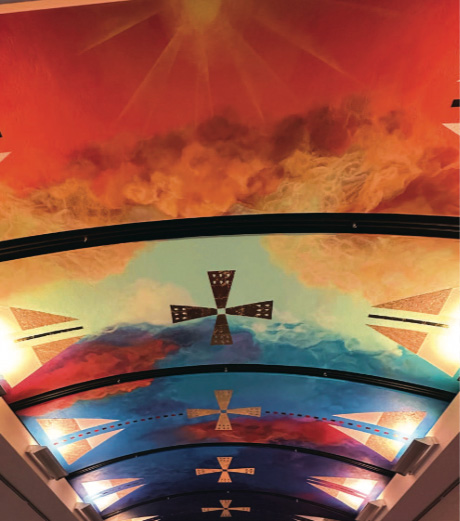
Abeyta recently completed her second mural on the ceiling at the Museum of the Rockies in Bozeman, where she applied evocative colors and geometric shapes to reference parfleche bags of the Indigenous peoples of the Great Plains. | TALISSA ABEYTA
Talissa Abeyta’s work can be viewed at Underscore Art Gallery in Whitefish, Montana.
Kevin Tracy
Experimental artist Kevin Tracy of Bozeman questions the relationships between the earth and the body, between open and closed systems, and how conditions interact or change over time.
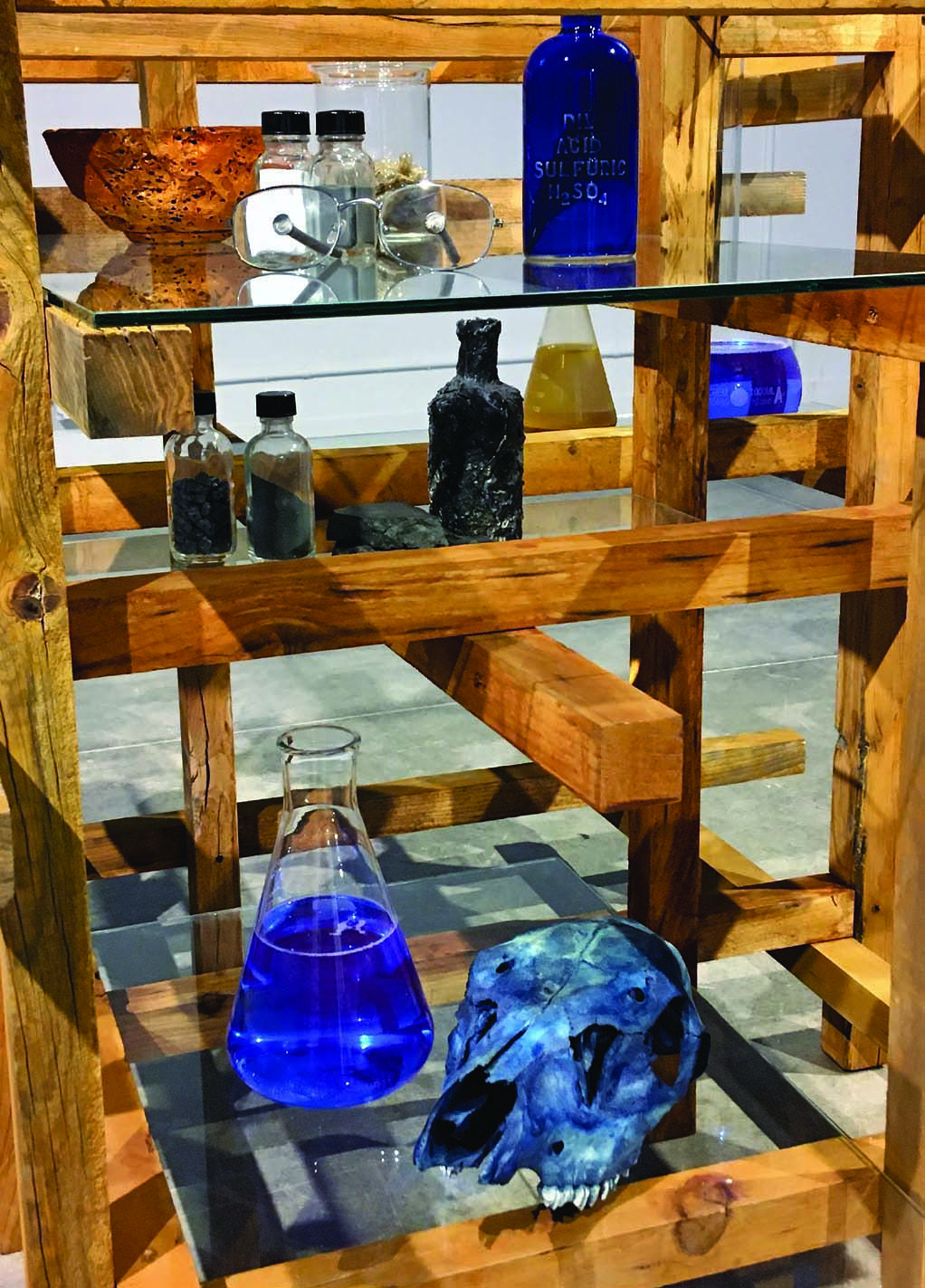
Constructed Archive | KEVIN TRACY | BEAKERS OF CYANIDE AND ACID MINE DRAINAGE, INDIGO-DYED COW SKULLS, IRON-STAINED CERAMICS, CAPSULES FILLED WITH NATIVE GRASS SEEDS, GLASSES PIERCED WITH NAILS, CRUSHED BUTTE, MONTANA SLAG, AND A SINGLE SHEET OF GOLD LEAF | 36 X 36 INCHES
“My early work emerged from a process-based investigation into clay as both material and system,” he says. “I used clay as a dye, looking at the amazing variety of local soil in Montana.”
The idea of art systems stems from a branch of conceptual art based on natural, social, or computational structures. Tracy looks at natural systems in relation to biology — earth and soil.
His studio reads as a narrative, tracing his journey from clay to printing to growing spirulina and working with the pattern of native grass networks. On one wall is a plexiglass “canvas” where he chewed clay and then spit it onto the surface. That design reappeared as a cyanotype — a camera-
less photography that uses sunlight to produce prints in Prussian blue.
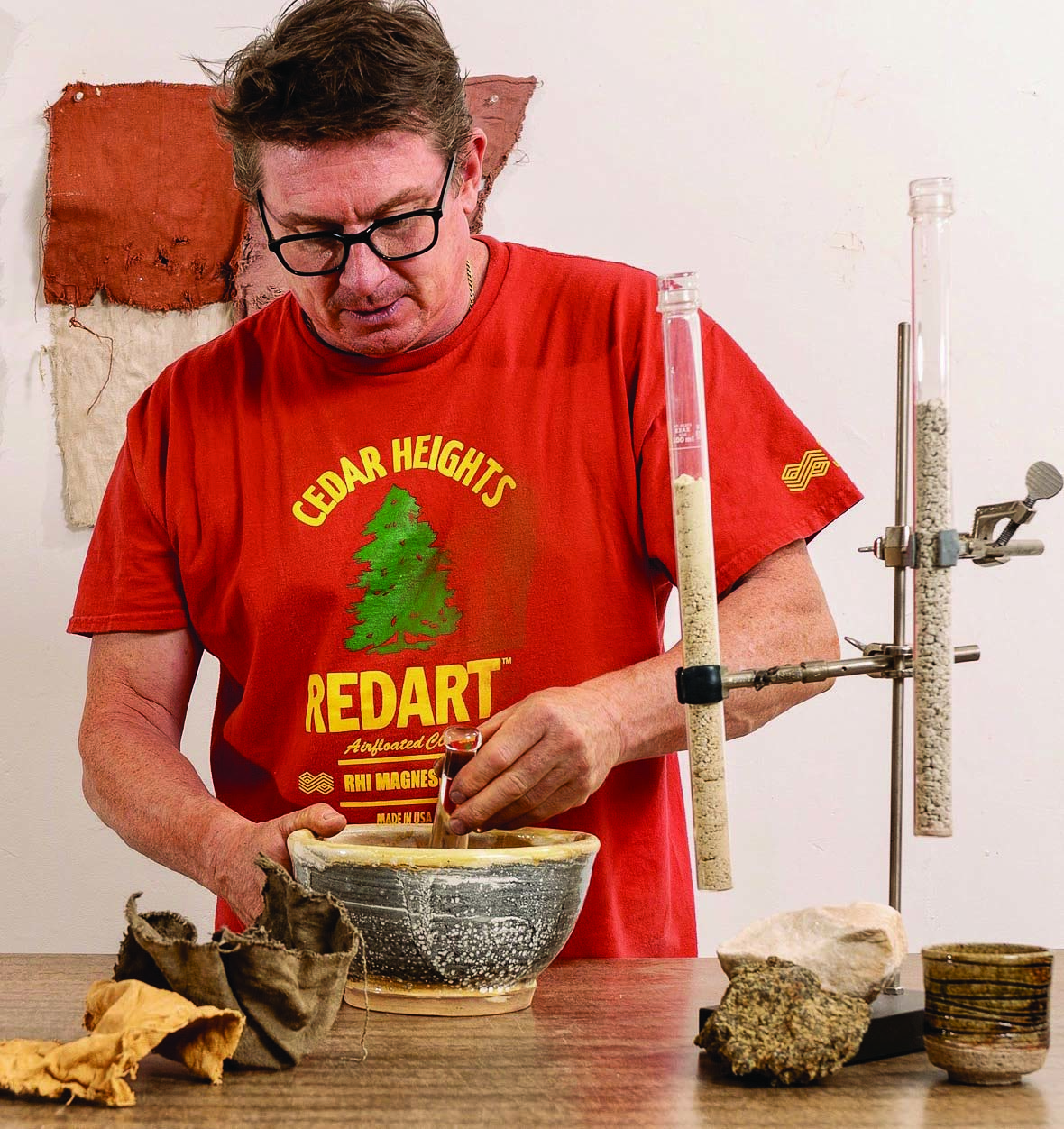
Bozeman-based interdisciplinary artist Kevin Tracy is the recipient of the Crawford Wildlife Habitat Graduate Fellowship and the Mary Edsall McLaughlin Award. His work begins with locally sourced clay and extends the concept of “earth-flavor” (tsuchi-aji) into video, performance, and installation. Through material investigation and site-responsive processes, his practice explores the relationships between place, extraction, and transformation. | MATT MACOY
“The progression of this work moves from direct material engagement to bodily interaction, and ultimately to the construction of interdependent systems,” he says. Another shelf holds the low-fired cups he recently used for an exhibit. The viewer juiced wheatgrass, drank some, and threw the rest — cup included — at a hanging surface, creating a green drip and splatter. The broken ceramic pieces then dropped into a vat of water, where the shards returned to their original clay state.
“I’m interested in how materials shift between states without reaching a final resolution,” he says. “The viewer encounters not a fixed narrative, but a set of unfolding conditions that reveal themselves through time, interaction, and material behavior.”
The intimate act of putting clay into our bodies, either through eating, drinking, or tattooing, brings in other questions about our connections to the earth and how that affects our identity as humans.
At age 14, Tracy began working at Evans Ceramics in Healdsburg, California, where he was introduced to the full cycle of ceramic production. From that point onward, he was hooked on ceramics and the process of making. He sharpened his craft working within the design-focused studio, producing slip-cast decorative vessels and assisting in mold preparation, casting, firing, and finishing. Tracy saw both standardized production methods and experimental techniques, including post-firing reduction processes such as raku, where vessels are removed from the kiln and placed into reduction chambers to alter surface and color. The alchemy of materials exposed to fire introduced him to both the excitement and the tension of unpredictability.
“It’s an awareness that continues to inform my approach,” Tracy says. “Early exposure to layering materials, combining clay with other substances, and observing transformation through heat and atmosphere contributed to an ongoing experimental curiosity that extends into my current work.”
That kind of learning, by literally getting his hands dirty, initiated a career of curiosity, filled with untold avenues of investigation and discovery.
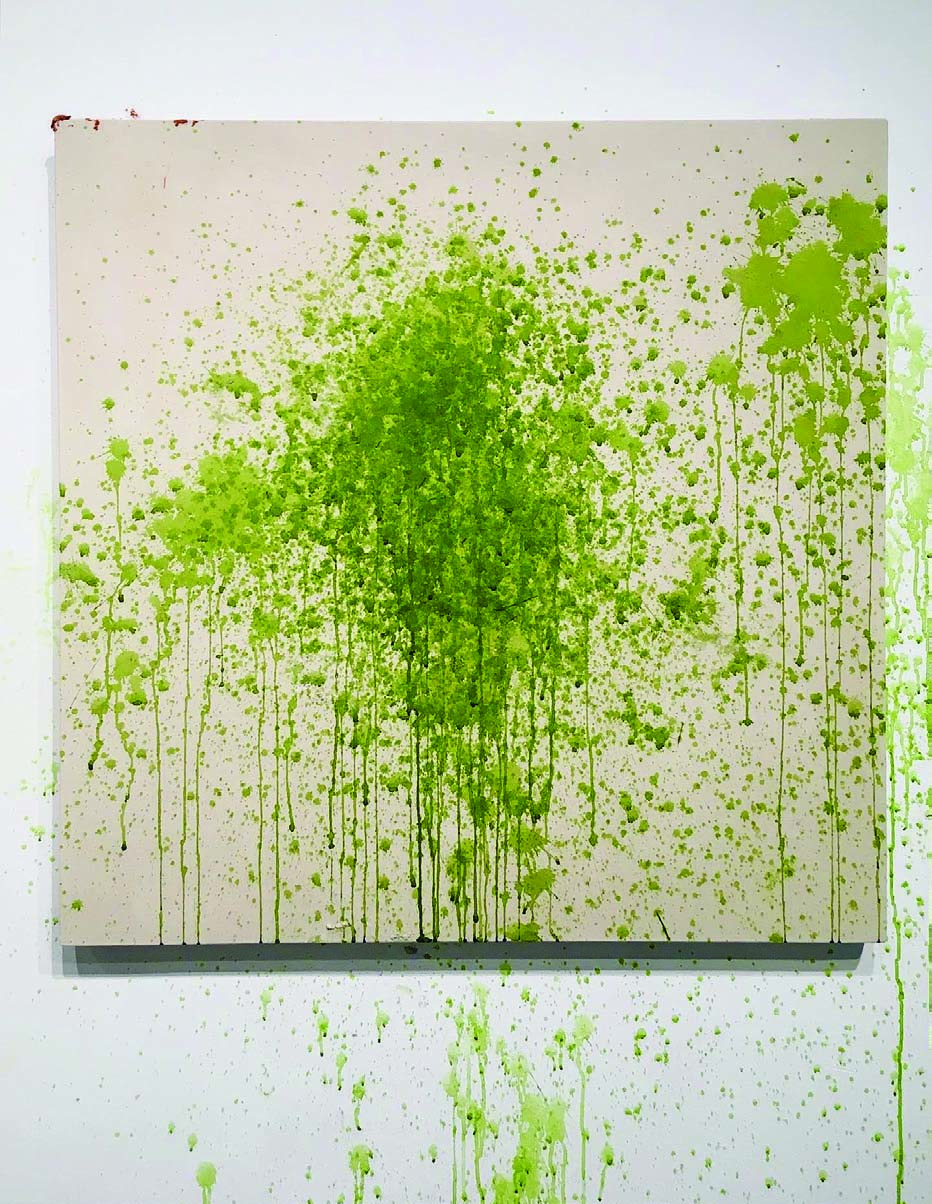
Wheatgrass Action Painting | KEVIN TRACY | LOCAL CLAY, WHEATGRASS, CANVAS | 42 X 42 X 3 INCHES
Lately, Tracy has dipped his talents into the questions of extraction, both as an act and as an art form. Prior to this body of work, Tracy presented the actual remnants, a kind of residue or map of human interaction with the material. His new work centers around the idea of extraction as an active condition.
“Materials are held in tension, bodies are embedded within the environment, and processes are not represented but enacted,” he says. “The viewer does not simply observe the system — they move within it, encountering a landscape that is at once constructed, inhabited, and continuously unfolding.”
Kevin Tracy’s exhibition Seek the Sun is on display August 7–November 1 at the Holter Art Museum in Helena, Montana.
Freelance art writer, teaching professor, and author Michele Corriel earned her master’s degree in art history and her doctorate in American art. She has received a number of awards for her nonfiction, as well as her poetry. Her latest book, Montana Modernists: Shifting Perceptions of Western Art (Washington State University Press, 2022), won four awards, including a national award from the Western History Association.
No Comments