


31 Jul Outside: Fiction
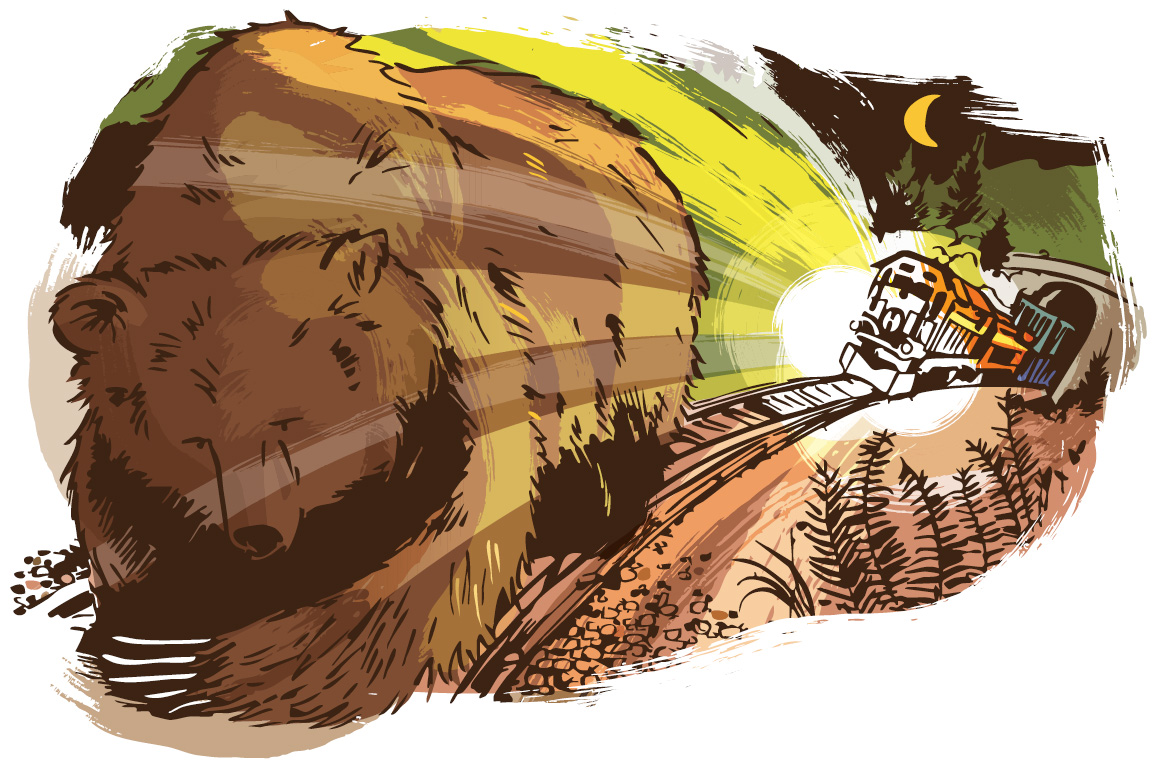
They never knew their locomotive engine had hit a bear that night. Up in the cab, amid all the engine noise and random conversation, Slug and Dillon droned down the rails, in the dark, westbound on Burlington Northern freight number 766. They didn’t feel so much as a shudder as the bear was broken into two. There were similar stories, of course, about rail crews plodding through dark nights, fierce blizzards, or ground fog hitting whole herds of cattle or deer and knowing nothing of it until they arrived at their next stop and saw the carnage stuck to the front of the engine.
Slug, the engineer, had gotten his nickname from his days as a Golden Gloves boxing champion. He had the crooked nose to prove it. And his ears had been so pummeled that they hung in contorted folds high up against his cheek. One day, while working in a dead-end trades job, a friend tipped him off that Burlington was recruiting engineers, and soon enough, he was off to Kansas City for training.
That was 11 years ago. He and his co-shift conductor, Dillon, had shared many miles in the cab of their 7,000-horsepower locomotive, and on this leg, they were grinding down Marias Pass, elevation 5,213 feet. Behind them, besides the two other helper locomotives, were 2.1 miles of hoppers full of grain and bound for Asia. Other days, it might have been car cars, the double-decker enclosed automobile affairs headed eventually for some dealer’s showroom in Peoria or Pittsburgh. In more recent years, it might have been coal cars destined for West Coast terminals. Or oil cars from the Bakken.
Dillon had been to college years back but never finished his business finance degree and found little success in securing career pathways back in his hometown. He was drawn to the railroad because of its good pay, benefits, and retirement, sort of in that order. He liked to hunt and always filled his B tag in the fall, replenished his freezer, and fed his family. He wore a camo ball cap and read pithy books written by authors Slug had never heard of. That is, when he was not juggling his duties as Slug’s partner, doing load calculations, checkpoint alerts, speed settings, and brake pressures. Against company policy, Dillon often took over the engineer’s duties in the right seat while Slug took a brief nap. Lots of crews did it.
Upon arriving in the early morning light at Whitefish, Montana (a fueling station and switching point for crews), the personnel for the next shift walked up to Slug and Dillon.
“Looks like you guys hit a bear,” one of them said. “The Amtrak eastbound saw it at Snow Tunnel Number 7. Cut right in half. They couldn’t tell if it was a black or a grizzly, but it was really dark colored. Probably a black bear, so … oh well. But if it was a grizzly, they’ll be reporting it. The trainmaster was told to hold us up while they get some Fish and Game guy over here to pull some hair samples from the front of the engine. Pretty gross.”
Slug and Dillon glanced at each other, knowing there could be some kind of investigation since grizzly bears were a threatened species, the holy grail of megafauna lore in these parts, and Montana’s official state mammal. They walked toward the parking lot, threw their duffel into their truck beds, and lit up cigarettes, a practice they’d done for years at the end of their run.
“You thinkin’ what I’m thinkin’”? asked Dillon.
“What?” Slug said as he crushed out the first cigarette on the asphalt and reached for another.
“What if it is a griz? Whaddaya say we go back up there to the tunnel and check it out for ourselves?” And then, after a long pause, “There could be claws, you know.”
Slug studied his partner closely, looking for signs that he was kidding but knowing that he was not.
“You know what griz claws are going for?” Dillon continued. “There’s a whole black market for ’em. Hundreds, maybe thousands of dollars for the right buyer.”
“You crazy? They are federally protected. That would be a felony,” Slug snapped.
“Yeah, but we can get there before those investigators drag their asses out of their office chairs. Plus, we know how to get there on that maintenance road to the tunnel. C’mon, Slug. Let’s just go have a look. Time’s a-wastin’.”
Looking across at each other, each leaning on opposite bed rails of the pickup, the chasm between them could not have been more symbolic. Or deeper. Dillon was prone to impulsiveness, for sure, and Slug was steadfast in his resolve to conduct his affairs in proper ways. In the many years of sharing the locomotive cab, their disparate personalities seldom emerged, and their inner beliefs were largely kept secret. It was just better that way. But now, this unexpected standoff.
“I dunno, Dillon. It just don’t feel right.”
“Look, I got all the right tools here in my truck,” Dillon said, gesturing to his cross-bed toolbox. “Hop in. We can talk about it on the way up.”
Dillon climbed into the truck cab. Slug raised his hand to the passenger door handle, halted, then dropped it to his waist. “I dunno about this man. I dunno.”
The phone rang at Walton Ranger Station, but Kurt couldn’t get to it in time. He had been down in the fire cache shed preparing smokechaser fire packs for the coming fire season, pulling old MREs from each pack and replenishing them with “new” ones, which were just the same as the “old” ones he was discarding. It was a seasonal ritual. A small frame office sat adjacent to the tidy log cabin ranger residence. It had an outside phone ringer to summon employees around the station.
Truth is, nobody ever called Walton Ranger Station, known as the “soft underbelly” of Glacier Park, where just about any sort of mischief in the sprawling district often went undetected, like arson, fishing violations, illegal camping, poaching, and unauthorized firewood harvesting. There had even been a murder back in the ’60s. Walton was situated alongside Highway 2 and adjacent to the Burlington Northern’s main line that paralleled Glacier’s southern boundary. Tourist traffic whizzed by and seldom turned into the tiny station.
Kurt was in his fourth year as a seasonal ranger. His real career was teaching history at a small liberal arts college in Wisconsin, a nine-month faculty position that left his summers off to work in Glacier. When the phone rang again, he made his way to the office and snatched it quickly from the receiver.
“Walton Ranger Station, Kurt Kruger.”
On the other end was the chief ranger at the district office telling him of a possible bear fatality on the railroad tracks. The voice instructed him to investigate it. Even though the incident site was not within the park’s boundary, park rangers were obliged to respond through a mutual aid agreement with the adjacent Flathead National Forest. Within minutes, Kurt grabbed some gear from the fire cache and summoned two trail crew boys, Spiller and Turk, who were lounging in the bunkhouse on a day off. With the three of them in the truck cab, he headed up to Tunnel Number 7.
Upon arriving, they could see two black spots far down the track, one near the rails and the other farther down the slope on the ballast. After the long walk down the tracks, they approached the bear. It was very dead, having been cleaved exactly in half by the locomotive. But then they saw something that stopped them cold in their tracks and made the hair on their necks bristle. There were no feet.
“Oh man, this is spooky,” Turk said as he slid his ball cap off and rubbed his head. “Real spooky.”
“Think someone got here before we did,” Spiller concluded as he sat down on the rail and studied the scene. It was — or had been — a young male grizzly, maybe 200 pounds or so, not yet an autumn-fattened one preparing for hibernation. But he had been actively feeding, trying to build up body weight as evidenced by stomach contents strewn down the tracks: false
hellebore and cow parsnip.
With little else to do, Kurt took some photographs and flagged the site. He and the trail boys gloved up, put bandanas over their noses, and set about loading plastic garbage bags with the poor ol’ bear’s ghastly remains. A grim task. Back at the truck, with the bags secured in the bed, they headed to the district office and met with the chief ranger, a Montana game warden, Forest Service law enforcement rangers, and a federal Fish and Wildlife officer. A dead grizzly was a big thing. Kurt knew he was handing over possible crime scene evidence and signed all manner of documents and forms to preserve the chain of evidence protocols. He told them of looking for clues at the site: a beer can, a cigarette, a snoose box, candy wrappers … anything. But there was nothing. After a briefing, he headed back to the station and returned to assembling his fire packs.
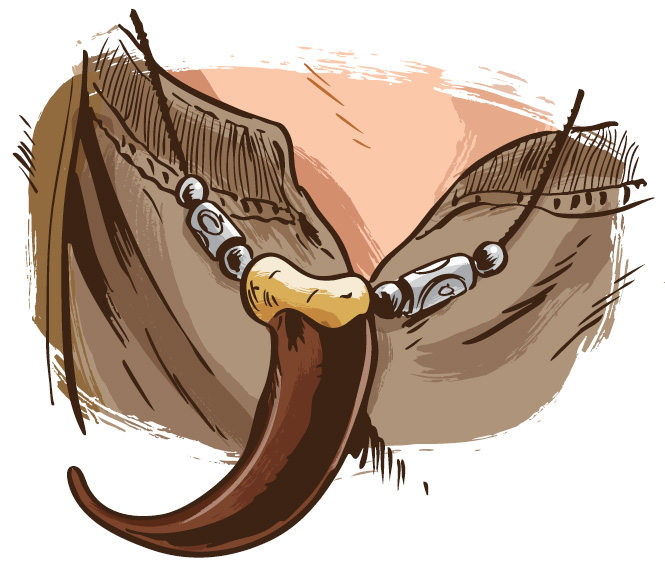
Nobody ever found out who took those bear claws. Around the Flathead Valley years after, someone would be seen wearing a necklace sporting a single bear claw, polished and in a well-crafted setting. When asked, the wearer usually said something like, “Oh, this? My grandfather shot this grizzly in 1908 down on the South Fork.”
Many years later, post-career, widowed, and with grown kids, Kurt made his annual pilgrimage to Glacier from his retirement home in Tucson. There, he sought old friends — those who were still alive, anyway — hiked familiar trails, ate at his old haunts, played tourist.
One day, he drove the long and dusty North Fork Road to Polebridge, a small hardscrabble community of back-to-the-landers, gimme-shelter-in-a-log-cabin types, and off-the-grid folks. The center of their community was the vintage 1914 Polebridge Mercantile, now a bustling and popular tourist site. From a small bakery at the back of the store wafted the smells of cinnamon rolls, set to come out and join the crammed bakery case next to the cash register. Peering at the tempting display of cookies, donuts, and bread, Kurt leaned over.
“Those are ‘bear claws.’ Really popular here,” said the woman at the counter. “Folks from down the valley drive all the way up here to buy ’em. We can’t keep them on the platter. They always sell out.”
True to her story, the rounded donut did look like a bear’s forefoot, with the central pad radiating to five crudely etched toes in the dough.
“Want one?”
Kurt nodded.
When he left, he settled into an antique bench on the covered porch and withdrew the bear claw from its little white bag. He took a bite and chewed thoughtfully. Then he put the pastry back into the bag and headed toward his truck. As he stepped off the porch into the sunlight, he dropped the bag into a trash can.
Born in Havre, Montana, Michael J. Ober spent 40 years as director of library services at Flathead Valley Community College, where he also taught Montana history. Seasonally, he worked 44 years as a wildland firefighter, backcountry ranger, and law enforcement road patrol ranger in Glacier National Park. He is the author of Glacier Album: Historic Photos of Glacier National Park and Montana Historic Places on the National Register: From Banks and Barns to Bridges and Battlefields.
No Comments