


25 Sep Images on the Rocks
Let us begin with a flight of imagination purely of my own making. Around the time of first European contact, a band of Indigenous hunters has camped out of the wind in a sheltered canyon in what is now southern Montana. Perhaps they are Crow who are close to home; perhaps they are Salish who have traveled east to hunt before the coming winter. After a successful day, they are exhausted from the work of breaking down bison carcasses.
Despite his fatigue, one hunter rises and walks toward the nearby canyon walls. Some memorable highlight of the day’s events has roused him — perhaps the number of animals taken or a purely spiritual inspiration. Tribal traditions or some deep personal urge he cannot define motivate him to record this event. After running his fingers along the rock to locate a flat surface shielded from wind and sun, he opens a small buckskin satchel, runs an ochre powder through his fingers, and begins to paint a series of symbols on the rock.
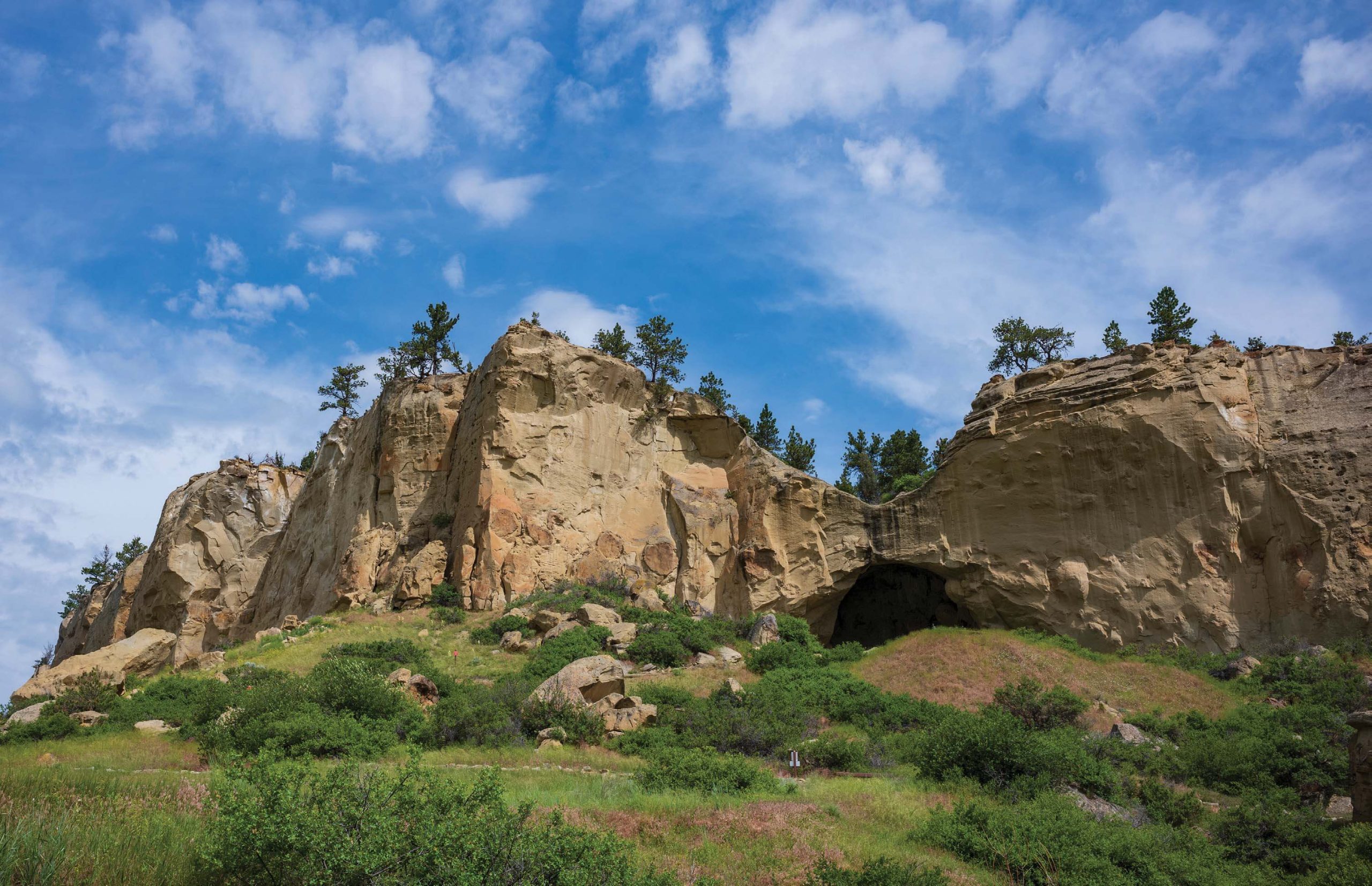
The largest cave at Pictograph Cave State Park south of Billings is appropriately named Pictograph Cave. The access trail runs some distance below the cave and its images to minimize disturbance. | JONATHAN W. COHEN
The urge to create art and record events seems as old as our species. No form is older or more widespread than the pictograph. As its root words suggest, a pictograph can be any form of writing with images, although the term commonly refers to images painted on rock by Indigenous cultures. They are distinct from petroglyphs, which, although often serving the same purposes, are etched or engraved rather than painted. Pictographs are not necessarily written on rock. Many symbols on Montana rock pictographs also appear on the winter count records painted on bison hides. While these images are commonly described as “pre-historic,” that term has always troubled me. If an image of a bison recorded on a rock face isn’t history, what is? Furthermore, many of Montana’s surviving pictographs were created after the European invention of the printing press.
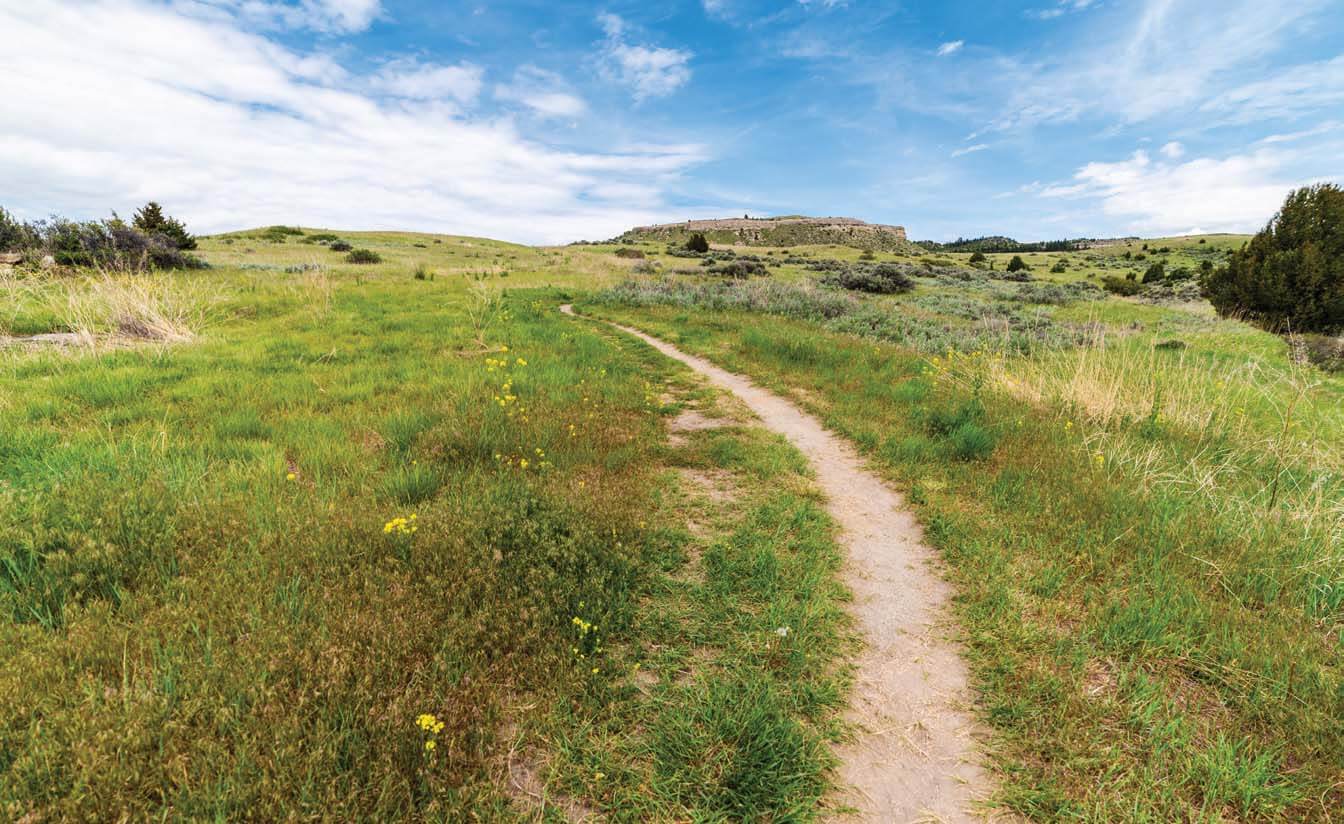
Visitors to any of the sites described in this story will enjoy opportunities to see more than pictographs, and scenic trails are well maintained to accommodate. | ADOBE STOCK
Pictographs have been found on all continents, dating back as far as 68,000 years at one site in Indonesia. Archeologists use several methods to determine their age. Sometimes style and context alone can provide an estimate when compared to pictographs that have already been dated. The widely known carbon-14 method requires organic material, which is present in almost all pictograph paint. This makes them easier to date than carved petroglyphs, but carbon-14 dating becomes more difficult and less accurate in paintings made more than 30,000 years ago. Determining the age of truly ancient images like the Indonesian example and others in southern Africa requires complex methods beyond the scope of this discussion. The oldest known pictographs in Western America date back approximately 15,000 years, around the time of human arrival in the New World.
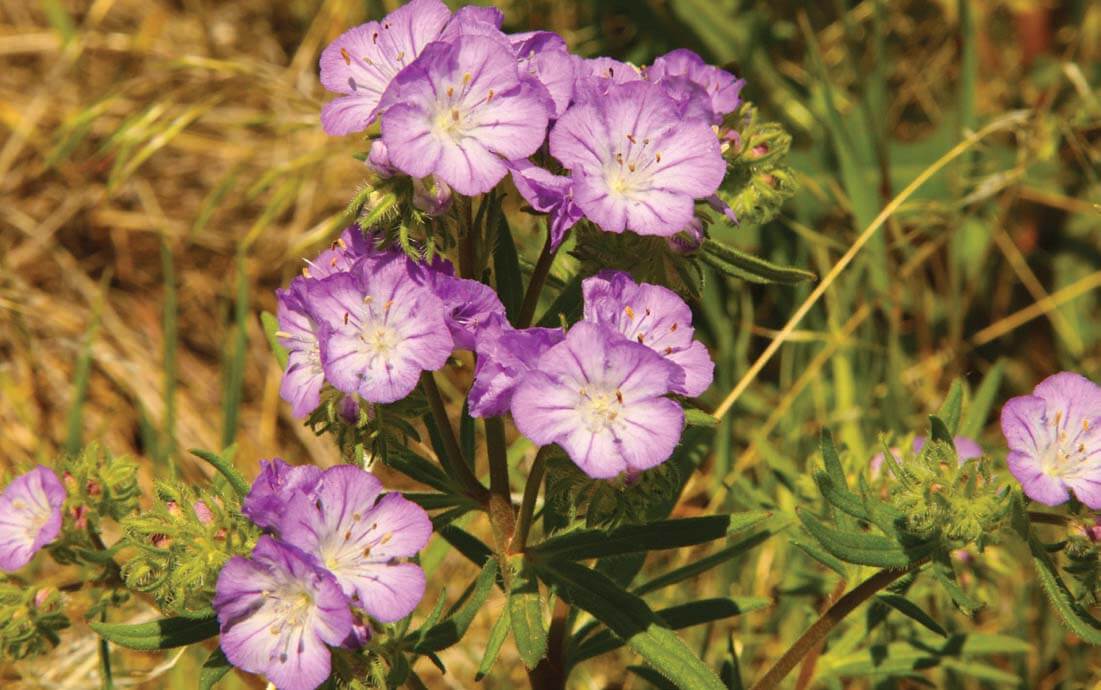
Likely encounters with birds, wild animals, and wildflowers like this threadleaf phacelia at First Peoples Buffalo Jump State Park provide textural context for
a trip to view pictographs. | ADOBE STOCK
While not as well-known as the large, elaborate Upper Paleolithic paintings in the French caves at Lascaux and Chauvet, Native American pictographs are just as intriguing and significant to archeologists and amateur students of the past. Montana is especially rich in pictographs, likely, I believe, because of environmental factors. Our geology includes an abundance of suitable vertical limestone and sandstone faces, and the dry climate helps preserve painted images. In damper climates along the Pacific Coast, most surviving early Native images are petroglyphs.
What do Montana’s pictographs look like? How were they made? Why were they made? And what do they mean? While we can answer the first two questions with reasonable accuracy, the last two require speculation and may be beyond the grasp of those outside Native cultural traditions.
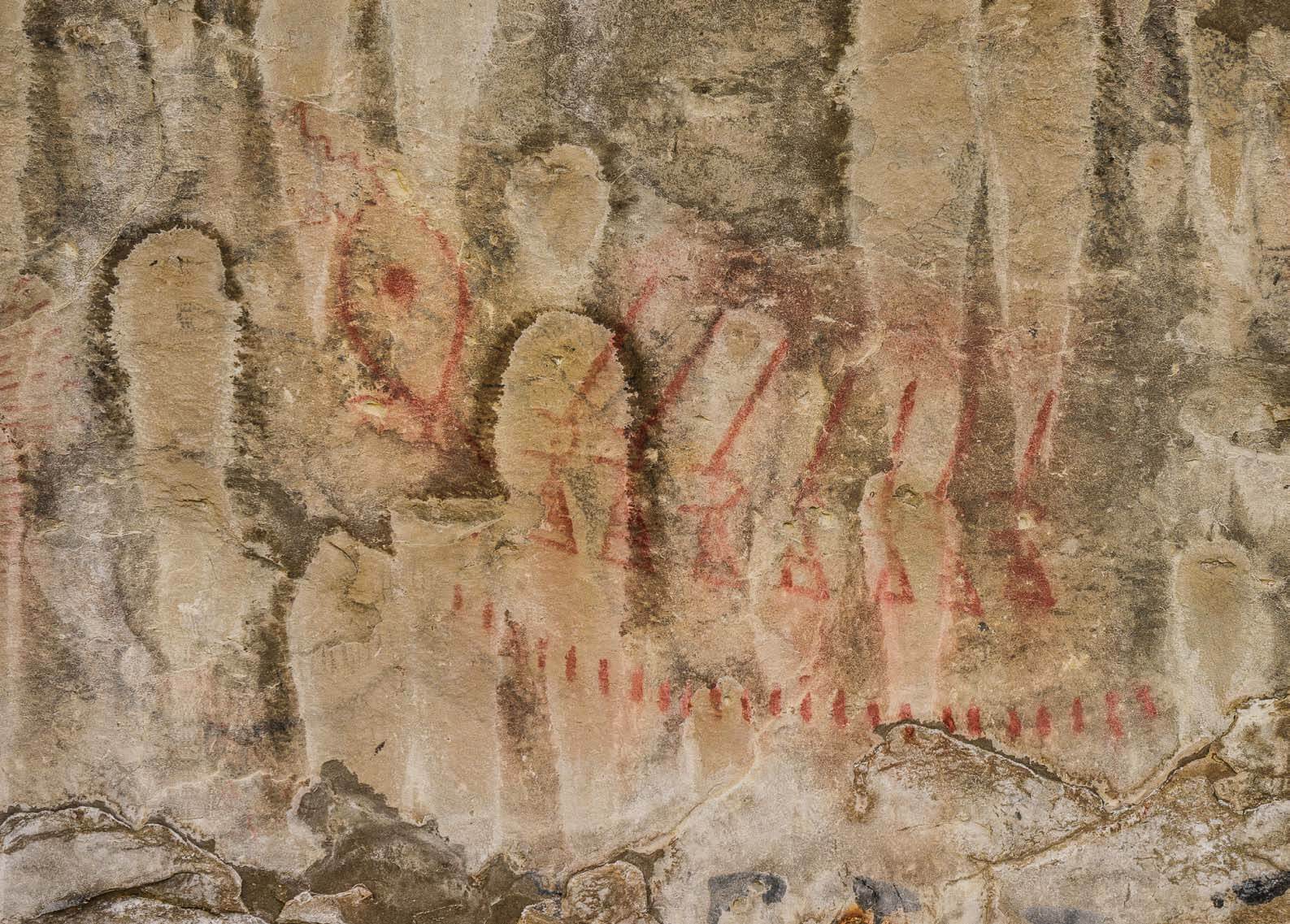
The readily recognized firearms in this image from Pictograph Cave establish that it was painted after first European contact. | DON AND LORI THOMAS
Fortunately, Montana offers abundant opportunity to address the first question at several readily accessible sites. (Sadly, defacement and vandalism are common problems wherever pictographs have been “discovered.”) In addition to wildlife — a common subject of pictographs — images of human activity and people appear frequently, in notable contrast to European cave paintings, which rarely include human figures. Abstract symbols are especially common in Native American pictographs.
Pictograph paint usually consists of a binder such as animal fat or clay mixed with pigments from a variety of sources: iron oxide for red, gypsum or calcium carbonate for white, charcoal for black, ochre from a variety of organic ingredients for yellow. Earth tones predominate.
So much for the easy questions. Now on to the more elusive issues of motivation and meaning. Some pictographs are records of significant events — history written on rock rather than the printed page. Depictions of wildlife and activities like hunting may be easy for a modern eye to interpret, while abstract symbols are more difficult. Many are recurrent, apparently representing a form of written language. Some seem to have practical implications, identifying good places to hunt or camp or warning of difficulties nearby. Others are likely territorial markers left by families, bands, or tribes.
Many pictographs, especially those composed of symbols rather than representational images, served spiritual rather than practical purposes. These may be difficult or impossible for outsiders to understand, and perhaps it’s best that way. Pictographs in this category remain sacred to the descendants of those who painted them and should be regarded with appropriate respect. For modern Native communities, pictographs are important links to their own cultural background.
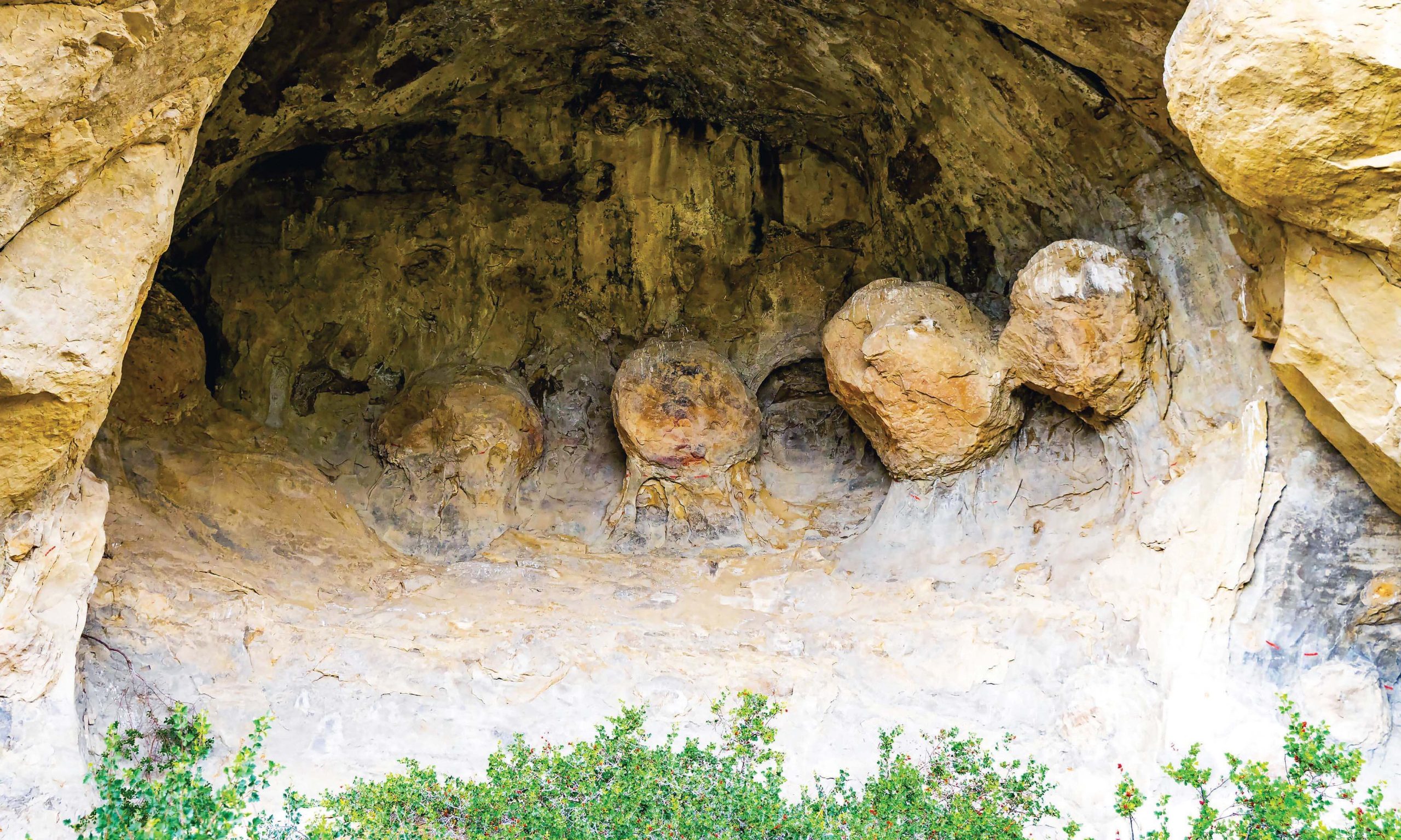
The upper cave at Pictograph Cave State Park is smaller than the main cave and unfortunately no images remain. | ADOBE STOCK
Could some simply represent art for art’s sake? As French and Spanish cave paintings demonstrate, ancient peoples were willing to spend substantial time and effort creating images more beautiful than they had to be for any practical purpose. While most North American pictographs are smaller and less detailed, perhaps those who made them were motivated in part by the same creative impulses that make modern artists paint today.
However, because of the spiritual significance of the more abstract pictographs, many contemporary Native people reject the “art for art’s sake” thesis and dislike the term “rock art” commonly used to describe them. While I accept that I will never fully understand their spiritual significance, I still let myself enjoy the aesthetic qualities of Montana’s pictographs.
Readers familiar with photographs of the large, visually striking images from Lascaux and other nearby sites in France should not expect anything similar in Montana, for reasons that have nothing to do with the artists’ skills. Located deep in caves, those European pictographs enjoyed much better protection from the elements over the passage of time. Less nomadic than their counterparts in Montana, those artists were able to remain in one place as they worked, and they almost certainly required elaborate scaffolding to complete the scenes. Many of the photographs that make these paintings famous today come from a modern replication site created by the French government to reduce visitor impact on the originals.
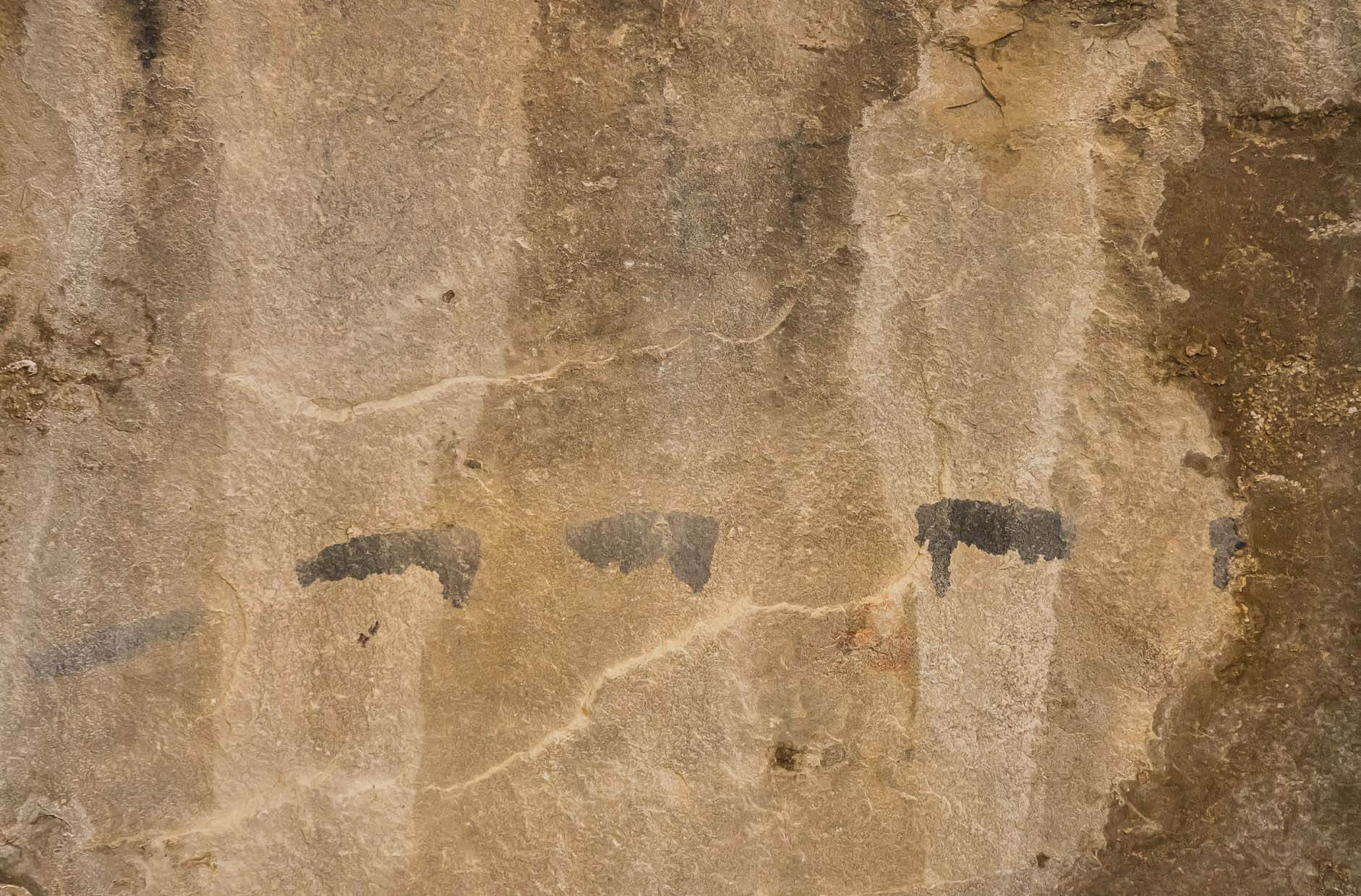
The dark pigment of bison images in Pictograph Cave likely derives from charcoal. | DON AND LORI THOMAS
Montana pictographs were largely created by people on the move. While they appear on relatively sheltered surfaces, they have still been exposed to varying degrees of rain, wind, and snow for centuries. It would be easy to walk by many without noticing them, while it is difficult to appreciate details in others even when you know they are there. However, visiting Montana pictograph sites was never meant to be like attending a curated display at an art museum. The value of visitation derives from the link to the past and those who lived here before us.
Now for a tour of some of the state’s most accessible pictographs, beginning with a personal favorite.
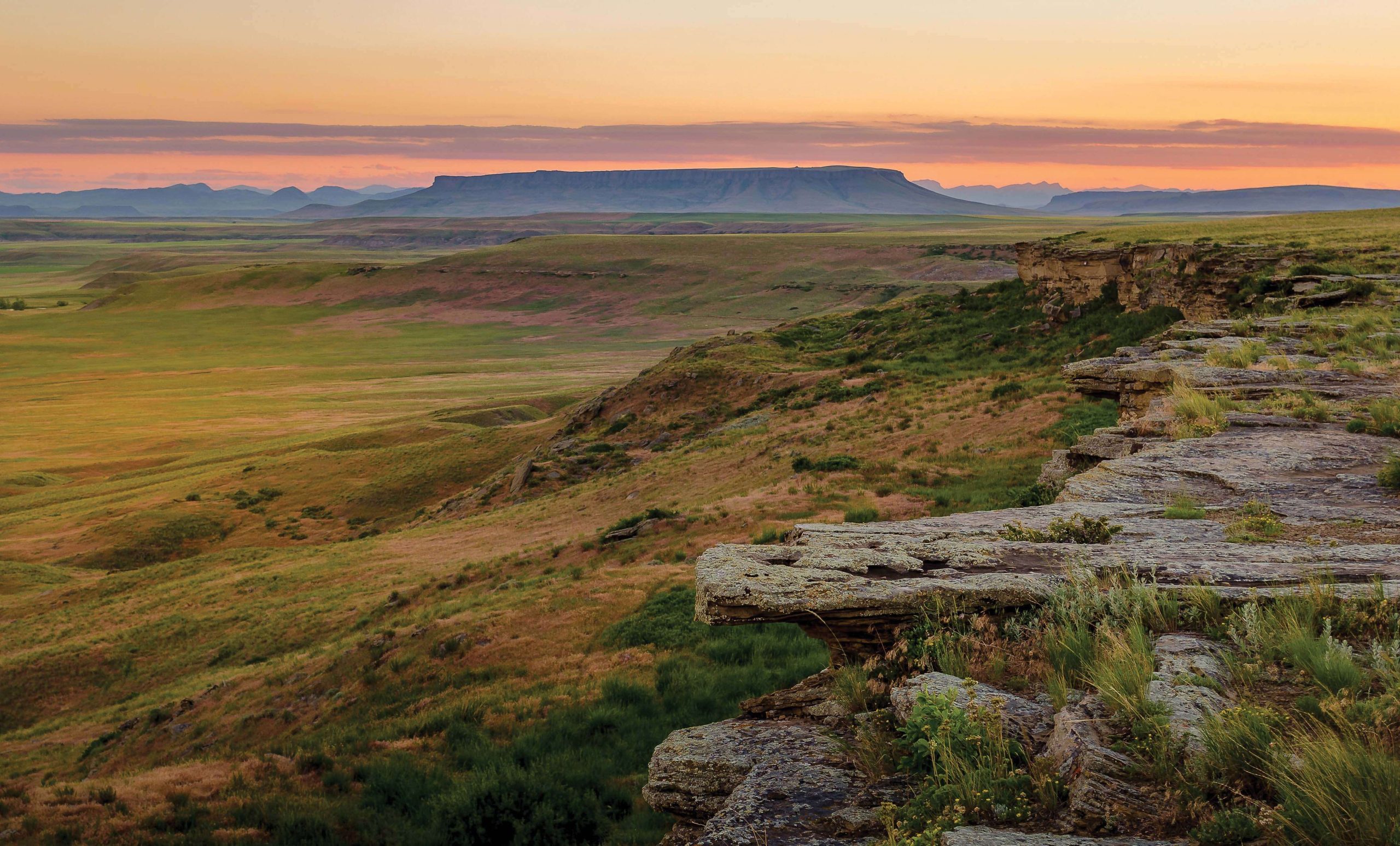
Located 10 miles south of Great Falls, the First Peoples Buffalo Jump State Park (also known as Ulm Pishkun) is managed by Montana Fish, Wildlife, and Parks (MT FWP). Well known as the location of the largest buffalo jump in North America, the site also contains pictographs on the rock face over which multiple tribes collaborated to drive bison. My wife, Lori, and I recently made a return trip to visit with Clark Aasom and Andy Keller of MT FWP, who proved extremely knowledgeable and helpful.
The site is unique in that at least 14 tribes visited during the fall to gather winter meat supplies by running buffalo over the cliffs on the eastern side of a nearby butte. Although some were traditional enemies who battled routinely, when multiple tribes were there at the same time, they declared a temporary truce and worked cooperatively harvesting the buffalo and preparing the meat for transport home. This socialization provided many opportunities to record events and interactions in pictographs on the face of the jump.
After centuries of exposure to weather, some 50 pictographs remain. Using context and comparisons to other pictographs rather than carbon-14 dating, best estimates indicate that they were created between 500 and 1,000 years ago. Red ochre derived from iron oxide is the predominant color. Images include the outline of a grizzly paw, a shield-bearing warrior, and numerous handprints — a recurring theme at many Western pictograph sites. While their precise meaning is speculative, they may simply represent a Native version of “we were here” by members of the many tribes that visited the area.
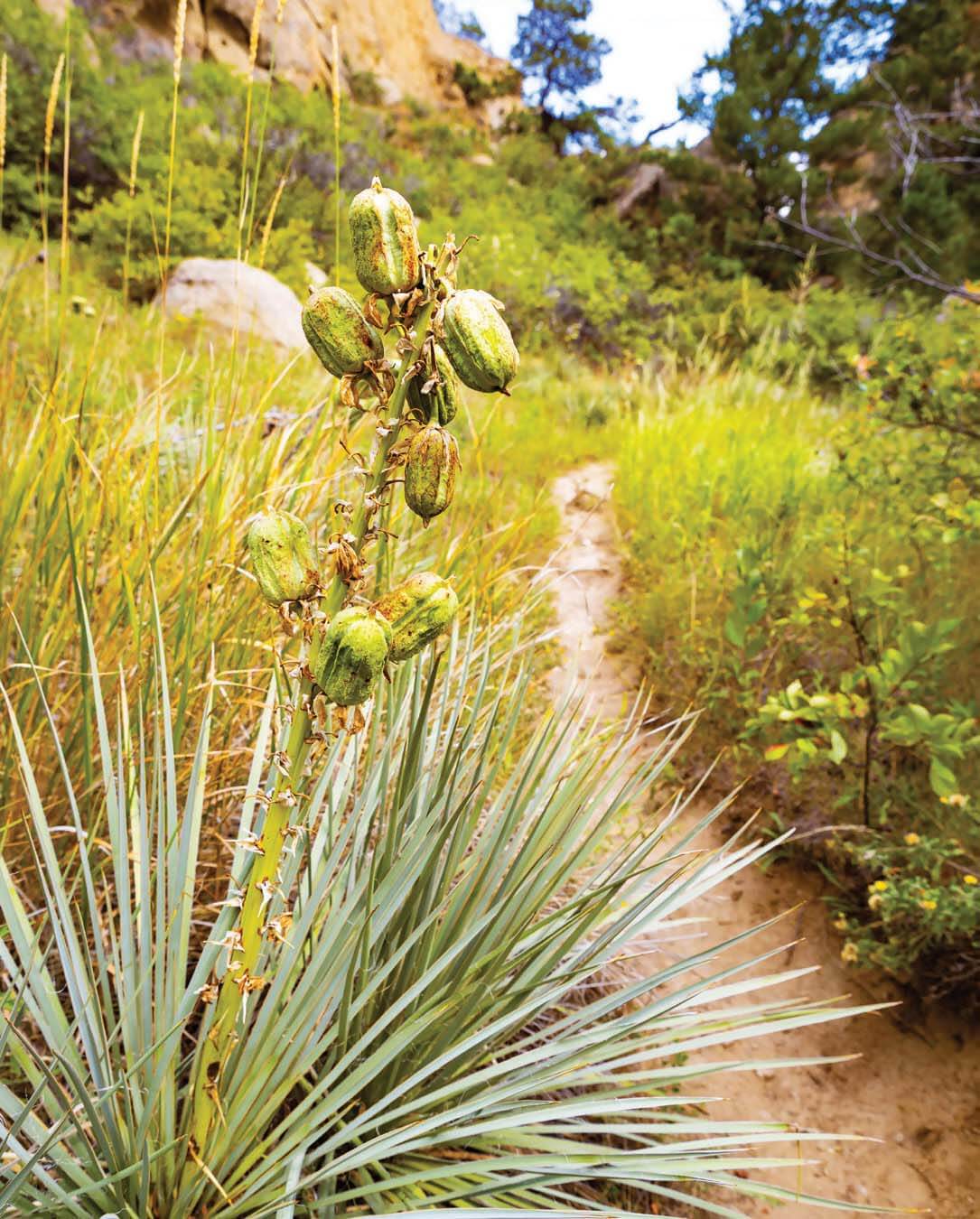
A short, easy loop trail connects the three caves at Pictograph Cave State Park. | ADOBE STOCK
Viewing the pictographs begins with an easy climb on a maintained trail from park headquarters but requires a more challenging off-trail hike to reach the images. Our visit took place on a blazing hot summer day and we declined the trek, not because we wouldn’t have enjoyed the hike but because it was prime season for rattlesnake activity. During our 30 years together, Lori has learned to tolerate grizzlies, sharks, lions, and elephants, but she admits being terrified of snakes ever since her childhood on a Montana ranch. The cliffs with the pictographs are ideal rattlesnake habitat, which is why MT FWP staff conduct tours during the winter when the snakes are less active.
Admission is free for Montana residents who pay the state parks fee with their annual vehicle registration. Fees for other residents and non-residents are nominal. For details on tours and general information, visit fwp.mt.gov/stateparks/first-peoples-buffalo-jump or call (406) 866-2217.
Six miles south of Billings, Pictograph Cave State Park is also managed by MT FWP. A half-mile loop trail leads to three shallow caves, the largest of which, appropriately named Pictograph Cave, contains rock paintings dating back between 200 and 2,000 years. When pictographs were first identified there in the 1930s, the caves contained abundant artifacts, many of which were removed without supervision. The locations of many are now unknown, but some pictographs remain. However, time and weather have taken their toll, and they are located high on a rock wall away from the access trail to reduce the chance of further vandalism. Without interpretive signage provided by MT FWP, one could walk by without recognizing them.
The park is open to visitors at different hours in both summer and winter. Park admission fees are as previously described. Visit fwp.mt.gov/stateparks/pictograph-cave or call (406) 254-7342 for details.
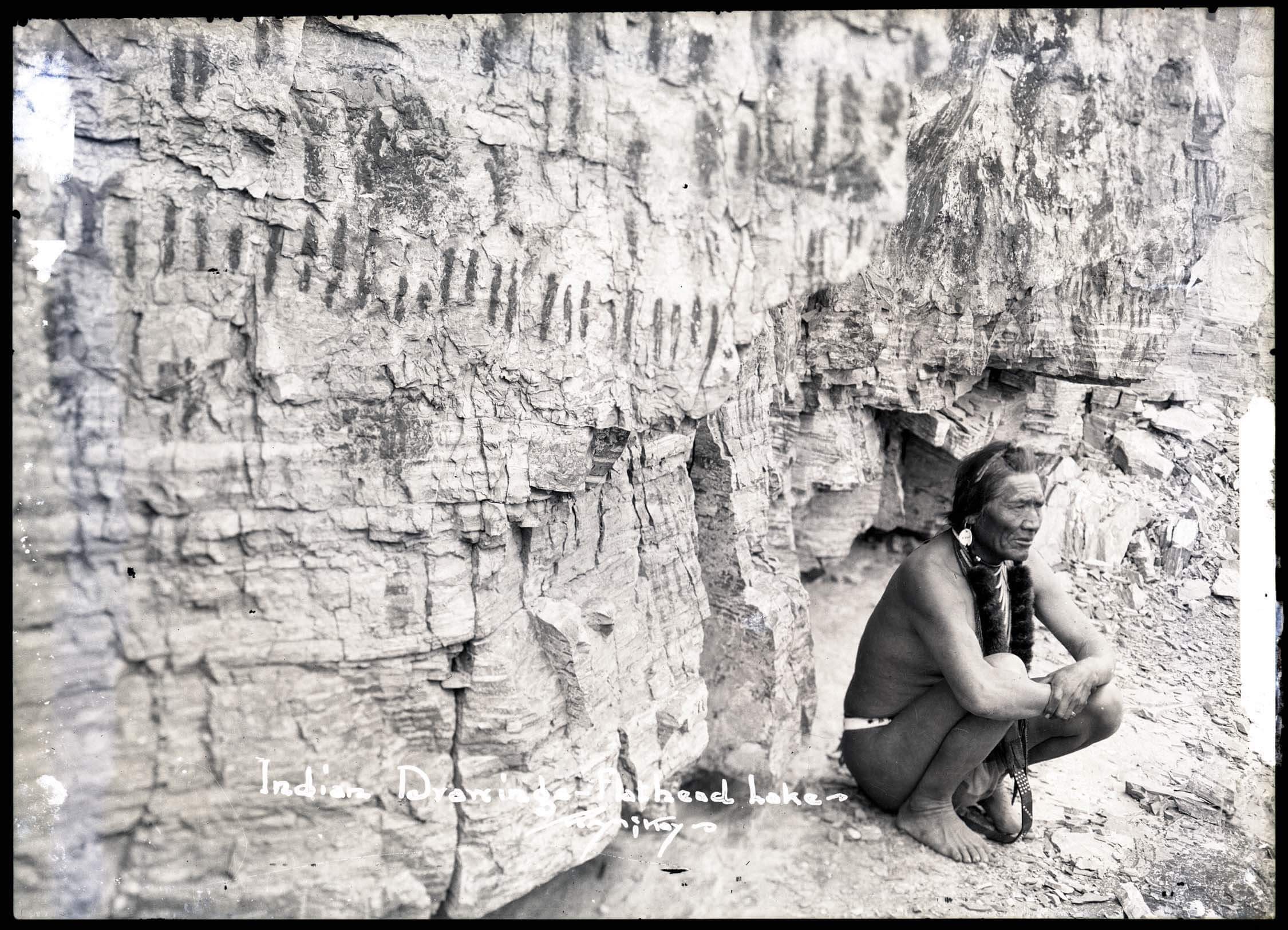
In this undated photograph, Sam Kaltomee Resurrection (Inkʷ ̓ƛ ̓l ewncu) sits in front of a rock wall containing drawings near Flathead Lake, possibly at what is known today as Painted Rocks along the western shore of Flathead Lake. | ARCHIVES & SPECIAL COLLECTIONS, MANSFIELD LIBRARY, UNIVERSITY OF MONTANA
Located north of Augusta, the Sun River pictographs are on public land managed by the U.S. Forest Service. Access is by vehicle via Willow Creek Road to Gibson Dam followed by a short hike. The site lies at the intersection of two important Native trails —
the Old North Trail running north-south and the east-west Raising Dust Trail, so named by the Blackfeet. The predominantly red-and-black images reflect the variety of Native tribes that interacted here. Contact the Helena-Lewis and Clark National Forest at (406) 562-3247 for details.
The Kootenai left images on a rock face overlooking Flathead Lake, now accessible only by boat. Contemporary Native sources explained to me that they tell an elaborate and moving creation story involving multiple animal spirits. These paintings emphasize the spiritual significance behind many pictographs and explain why they provide such important links between modern Native communities and their past. So much for the dismissal of pictographs as nothing more than “rock art” or ancient graffiti.
Montana is home to many other known pictograph sites, in addition to countless Indigenous images yet to be “discovered.”
As an avid bowhunter, I spend a lot of my time in the field looking at the ground rather than ahead for whatever game I’m after. The potential rewards are many — a patch of morels, a grizzly track — but none excites me more than spotting a stone arrowhead. The jolt comes not from the acquisition; in fact, I often leave them in place rather than claiming them as my own. What matters is the reminder that somewhere back in the long reaches of time — perhaps 300 years, perhaps 3,000 — a fellow human being was in the same place doing the same thing I’m doing. While that ancient hunter and I arose from different cultures, I like to believe that in many ways we are more alike than different.
Pictographs have the same effect. Perhaps some arose from the same impulse that drove Vincent van Gogh or Pablo Picasso, although most Indigenous artists were likely influenced more by spiritual concerns and cultural tradition. Whatever the case, these remarkable images remain to provide Montanans and visitors alike a unique link to the past.
A central Montana resident since 1973, E. Donnall Thomas Jr. has been everything from a physician to a bear hunting guide in Alaska. He writes about the outdoors for numerous publications and lives in Lewistown, Montana with his wife, Lori, and their bird dogs.
No Comments