


28 May Lessons in Burying Hatchets
During a time of hardship, perhaps the lowest point in 20th century Montana history, here was a chance for celebration. It was 1926. Drought had shriveled the state’s agriculture. Banks had failed. Homesteaders had fled. Bankruptcy rates were the highest in the nation. Most roads remained unpaved, industries were stagnating, and incomes were falling. Uniquely among U.S. states, Montana’s population was shrinking.
June 25 of that year marked the 50th anniversary of a violent conflict on the Little Bighorn River. So Montanans of all stripes got together for a bit of nostalgia. Led by General Edward Godfrey, an old Indian fighter with a delightfully absurd moustache, event organizers invited veterans of the Indian wars — on all sides — to come to the battlefield for what one newspaper called a “monster ‘hatchet-burying’ fête.” Here, at the river also known as the Greasy Grass, Godfrey organized a celebration to not only make people feel good but also put Montana on the map of the nation’s growing frontier nostalgia.
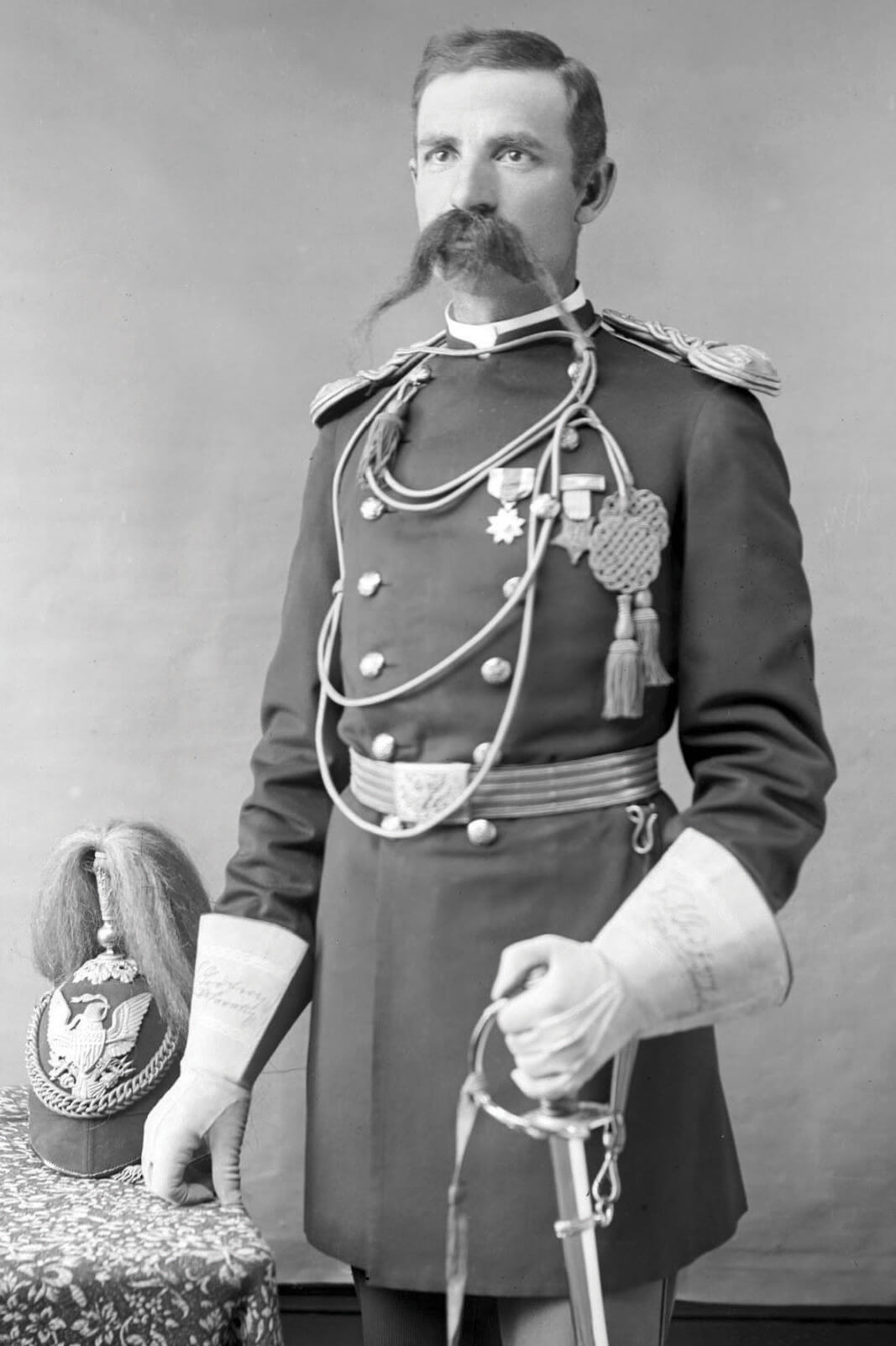
Edward Godfrey and his moustache stand for a portrait just before the Little Bighorn battle in 1876. | WIKIMEDIA COMMONS
Now, a century later, for the battle’s 150th anniversary, we are tasked with remembering. How should we do so? Recapitulations of General George Custer’s 1876 “Last Stand” have become so ubiquitous as to be underwhelming. After all the Wild West shows, dime novels, movies, textbook treatments, scholarly monographs, Indigenous pictographs, and tavern lithographs, it’s hard to say anything new.
But the story of how those events were remembered 50 years after the fact is both little-known and compelling. Here, we see a battle over the battle’s meaning. Here, we see efforts by well-intentioned Montanans to shape the Little Bighorn into a story that all sides could be proud of. And here, we also see the misconceptions and prejudices that continue to drive people apart.
In 1876, Godfrey served as a first lieutenant under Captain Frederick Benteen, reconnoitering a few miles to the south of the five companies under Custer’s command. Godfrey thus survived the battle, and indeed was among the first to be asked to identify and bury the fallen soldiers.
Godfrey then had a long military career, including many campaigns against various Plains Indian tribes. He also wrote extensively about the Little Bighorn, generally defending Custer while criticizing Major Marcus Reno. After Godfrey retired as a brigadier general in 1907, his interest in remembering the battle grew.
That interest was also growing among the general public. A 25th anniversary had been cancelled for lack of interest, and a reenactment the following year had turned into a fistfight. But in 1916, 5,000 people attended a 40th anniversary commemoration. Five years later, noted the late historian Douglas McChristian, those crowds tripled. By 1924, the battlefield cemetery was receiving 10,000 visitors each summer.
Official events often betrayed biases: Organizers talked in patronizing ways about “civilization and progress” versus “barbarism and wilderness.” As McChristian wrote, “Despite the best of intentions, the underlying rationale of these early commemorations was to reiterate the justness of Manifest Destiny,” the racist idea that whites were fated to occupy the entire continent.
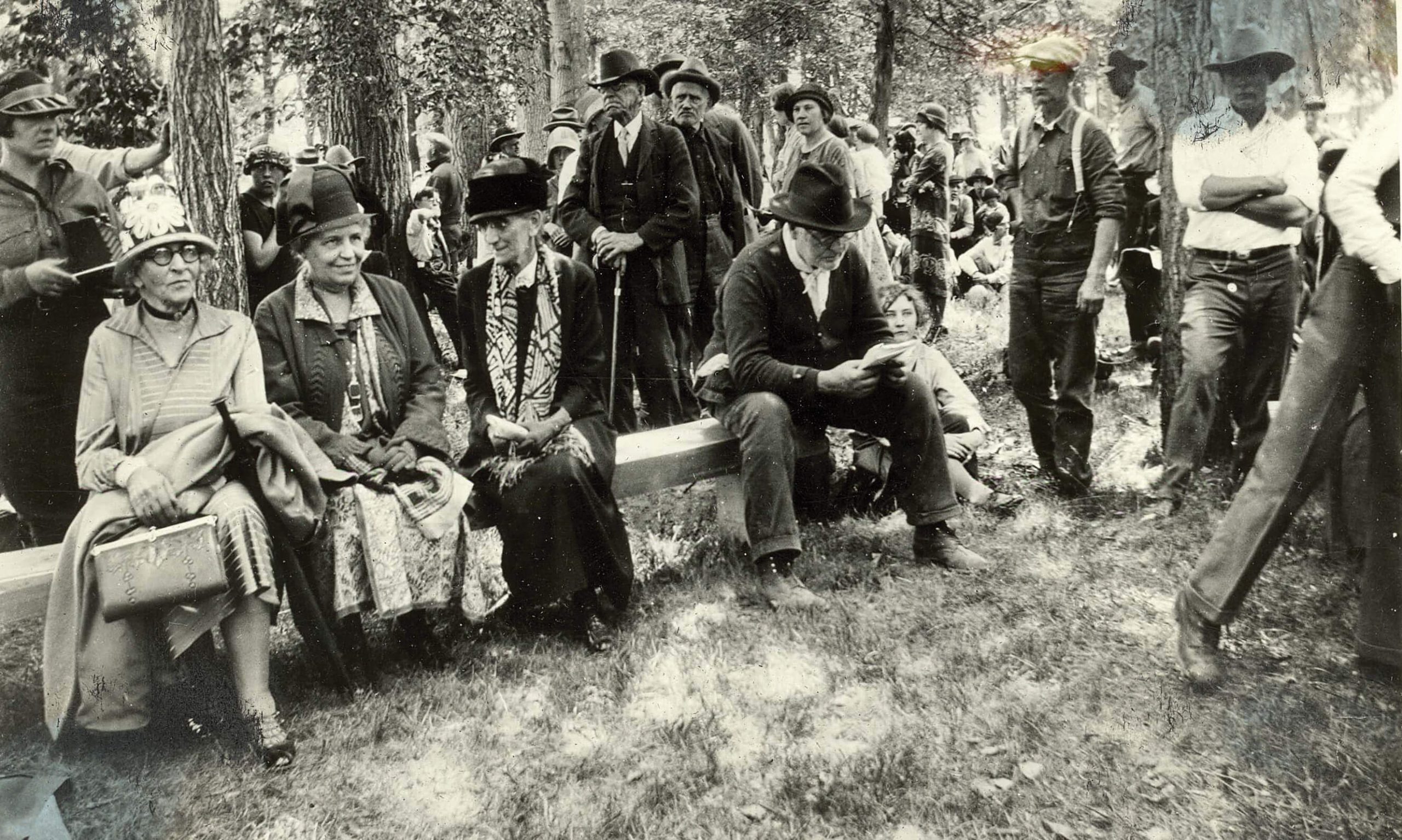
Attendees’ varied hats — from cloches and toques with flowers and ribbons to bowlers, fedoras, and cowboy hats — demonstrate the breadth of society interested in the 1926 anniversary. | NATIONAL PARK SERVICE, LITTLE BIGHORN BATTLEFIELD NATIONAL MONUMENT
In 1926, Godfrey and his colleagues wanted a new tone. They sought formal, symbolic reconciliation between former enemies.
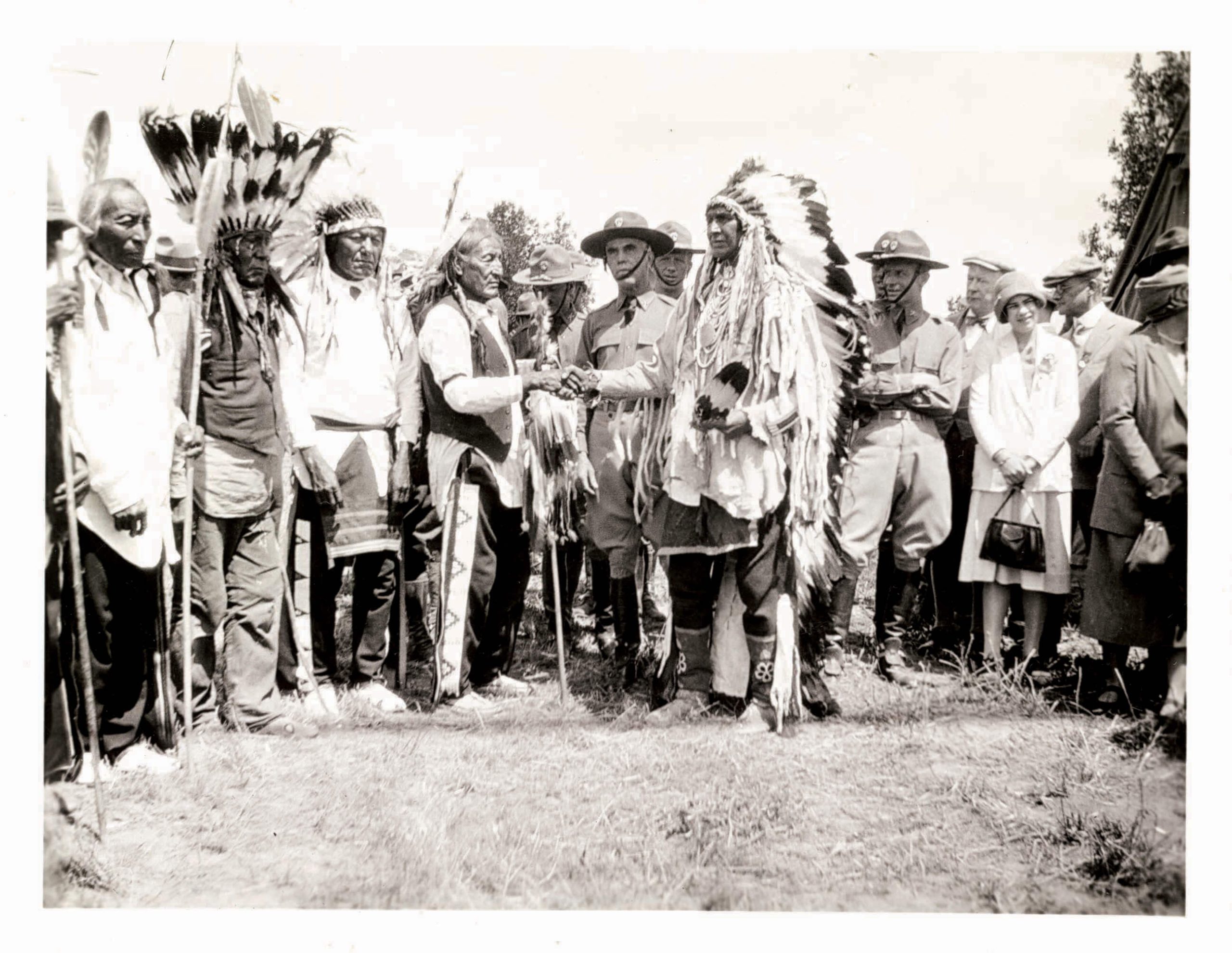
The centerpiece of the anniversary was a ceremony in which Godfrey, in uniform and on horseback, led the Seventh Cavalry across the old battlefield to the sounds of a funereal dirge. From the other side came a column of Sioux and Cheyenne, also in full war regalia. They were led by White Bull, a Minneconjou Lakota, nephew of Sitting Bull. White Bull had also participated in the battle; some rumors had him participating in the death of Custer himself.
As they approached each other, White Bull held up his hand in a traditional sign of peace. Godfrey dramatically dropped his unsheathed sword into its scabbard. The two men clasped hands. To the delight of photographers, they cemented their friendship with an exchange of gifts: a blanket and a flag. Then, the cavalrymen and warriors rode off the field in pairs.
Later, Godfrey and White Bull buried a literal hatchet — sometimes referred to as a tomahawk — in a grave with the remains of a Seventh Cavalry trooper, which had coincidentally been found by road crews just a month earlier.
By most estimates, about 50,000 people were in town, including 4,000 Native Americans. Honorees included eight white survivors of the battle, about 80 Sioux and Cheyenne survivors, and the lone Crow scout still alive. (The Crow had been scouting for Custer’s troops.) Because the event was positioned as a memorial to a broad era, it also included at least 122 U.S. Army veterans of other Indian wars.
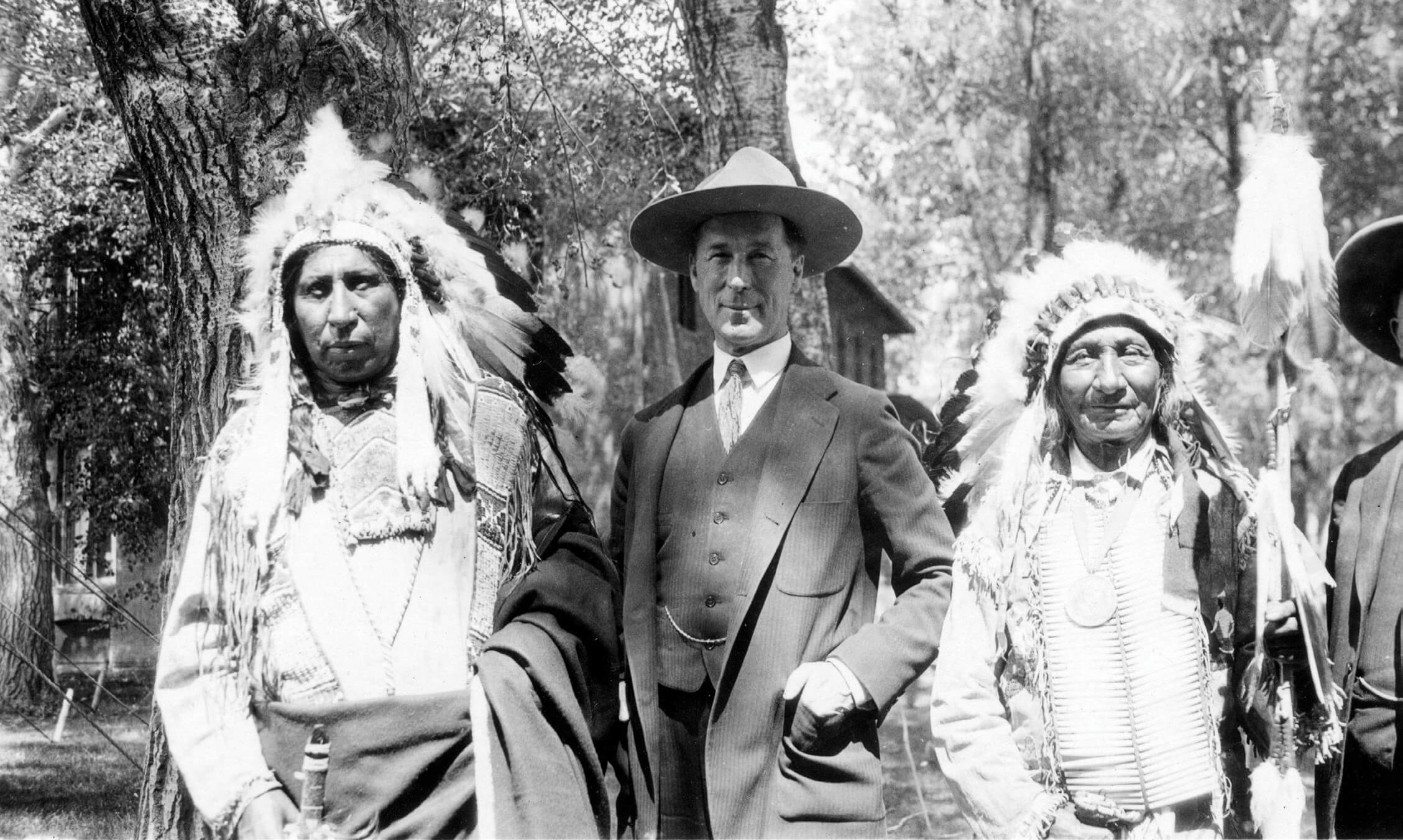
White Bull, who led the Lakota contingent at the ceremony, poses at left with cowboy actor William S. Hart and the Lakota Hollywood luminary Luther Standing Bear. | SEAVER CENTER FOR WESTERN HISTORY RESEARCH, LOS ANGELES COUNTY MUSEUM OF NATURAL HISTORY AND THE CITY OF SANTA CLARITA
Also present were politicians and celebrities: Montana Governor J.E. Erickson; the contemporary Seventh Cavalry; and writers George Bird Grinnell, E.A. Brininstool, and Mary Roberts Rinehart. Most notable was the attention received from the ascendant movie industry. The Flaming Frontier, a Hoot Gibson film with a Custer-themed plot, played that week at the Orpheum Theater in nearby Sheridan, Wyoming. Meanwhile, Gibson’s biggest rival, silent-film star William S. Hart, attended the events in person (as chronicled in “History: Noble Horseman,” published in Big Sky Journal’s 2023 Fly Fishing issue).
Thus, the anniversary was a fascinating combination of nostalgia and futurism, with movies, military biplanes, and motorcars. At least 3,000 automobiles (and perhaps up to four times that many) delivered attendees to the site. Parked all around the battlefield, they provided a stunning contrast to the old warriors on horseback.
In an era before numbered cross-country routes, many of the cars had traveled the Custer Battlefield Highway, a lavishly marketed road that snaked from Omaha, Nebraska to Montana’s Glacier National Park. It had been organized in 1919 to, as the magazine American Motorist described, “traverse a section of the United States teeming with the romance of the old West.”
In other words, the anniversary also represented tourism development for a state struggling to adapt to a 20th century economy. “Burying the hatchet” was an important component of this new vision: Tourists needed to know that the Old West might be romantic, but it wasn’t dangerous. The wars were over, you wouldn’t get attacked, everyone was friends now.
McChristian wrote that the battlefield events were a “rousing celebration, with not a little commercialism.” Airplanes flying over the crowds pulled banners advertising The Flaming Frontier. The city of Billings plugged its own events. The program featured the logo of a railroad sponsor. Journalists kept asking Hart about the movie business.
In a sense, then, the 1926 events featured a new battle, a very 20th century one between commemoration and commerce. The honored guests, both white and Indigenous, might have been mourning fallen colleagues or a bygone way of life, but advertisers and organizers saw a big crowd as a chance to make money.
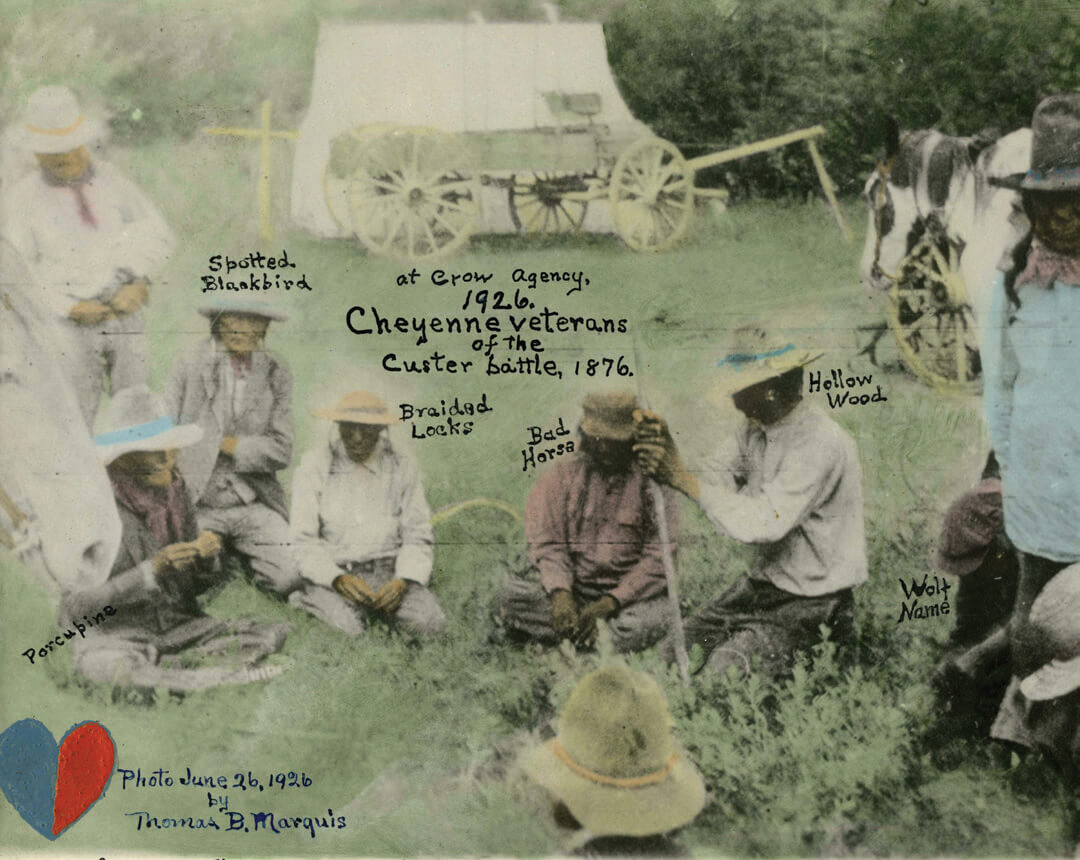
Six Cheyenne veterans of the Battle of the Little Bighorn (from left: Porcupine, Spotted Blackbird, Braided Locks, Bad Horse, Hollow Wood, and Wolf Name) sit in Council at the 50th anniversary celebration. | NATIONAL PARK SERVICE, LITTLE BIGHORN BATTLEFIELD NATIONAL MONUMENT
This created tensions for some of the attendees. For example, Hart was determined to keep a low profile — this was a solemn historical occasion rather than a PR stunt. Hart and his Hollywood friend Luther Standing Bear, an Oglala Lakota, thus spent their time in Indigenous camps rather than at press conferences.
But PR stunts are often how history gets made. Journalists report on the events in front of them, quoting the people who are willing to talk. Historians then rely on those accounts, among others. Sadly, coverage of the day included only limited Indigenous perspectives. Even the most heartbreaking story — that One Bull, the aged half-brother of Sitting Bull and a participant in the battle, had refused to attend the anniversary because he was afraid of being hanged — was sourced to a white man, R.H. Shipman.
What if Luther Standing Bear [1868–1939] had been given a higher profile? Raised in the oral traditions of his culture, then also educated at the Carlisle Indian School, he’d worked as an educator, storekeeper, and rancher on the reservation, and later as a performer in William F. “Buffalo Bill” Cody’s touring Wild West show. That brought him to Hollywood, where he both succeeded as an actor and advocated for more authentic movie portrayals of Native Americans.
Thus, Standing Bear’s perspective would have been a valuable addition to chronicles of the anniversary. As he wrote two years later in his book, My People the Sioux, “I want you to remember that all the celebrated Indians who have big names in the white man’s histories and stories were not the ones we considered important men.” Many of those big names, he said, had joined the whites only after committing crimes against their own culture, and being shunned for it. Furthermore, “the white men who came West in those days were not friends of the Indian — any more than they had been friends among their own race.”
It could be that white audiences of the day were not ready to hear stories like this. Yet if so, that means their attitudes were still dangerously close to the old Manifest Destiny ideas. As Tony Perrottet wrote in Smithsonian Magazine in 2005, “to some in the predominantly white audience, the [hatchet-burying] ceremony suggested the Indians had accepted domination by the white man.”
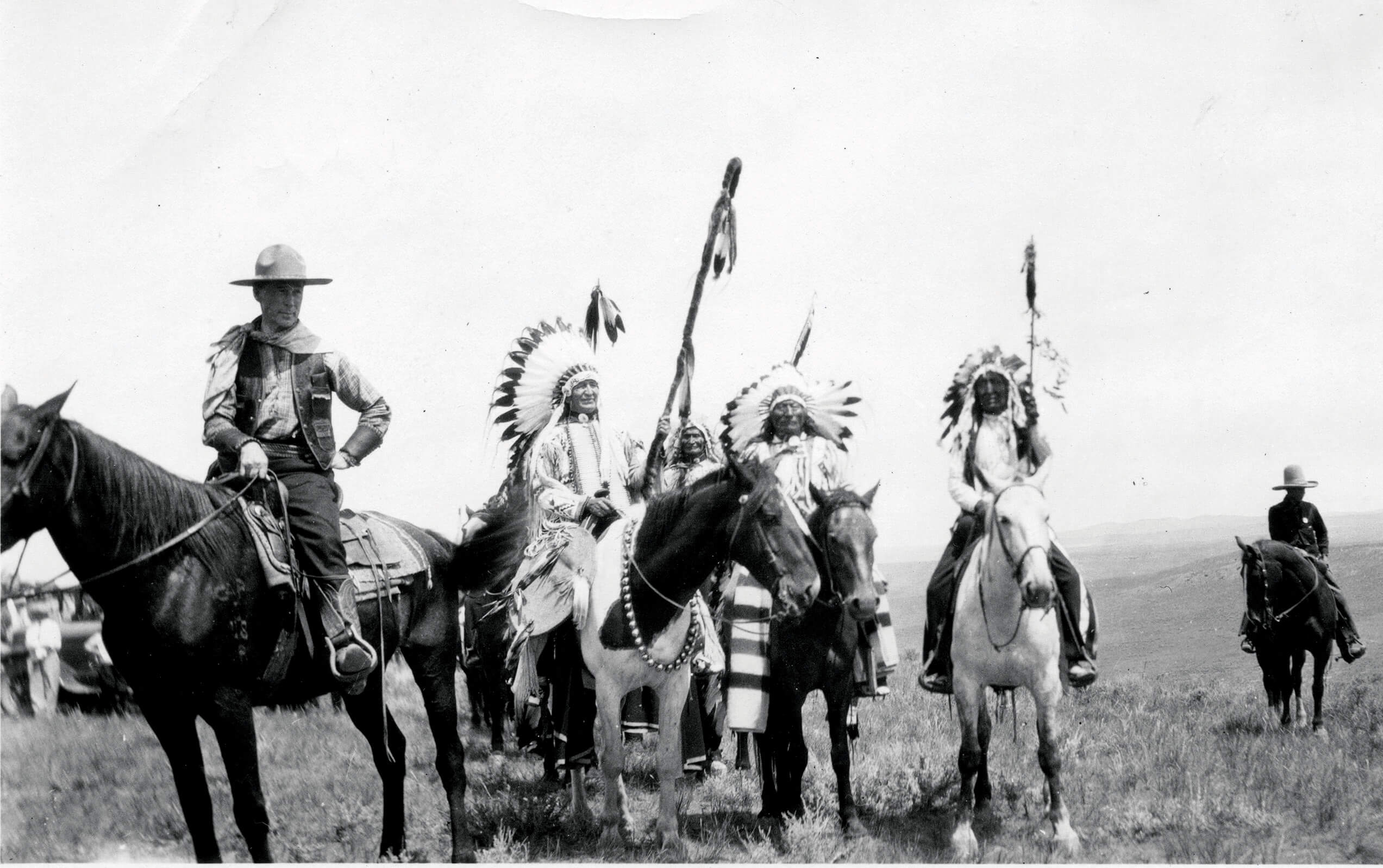
Hart, at left, tried to spend more time in Indigenous camps than with the publicists and high-society types. | SEAVER CENTER FOR WESTERN HISTORY RESEARCH, LOS ANGELES COUNTY MUSEUM OF NATURAL HISTORY AND THE CITY OF SANTA CLARITA
The events did mark 50 years of progress in white people’s attitudes. Immediately after the battle, Custer had been widely perceived as a martyr, and all “red men” as his evil killers. By 1926, that anger had mellowed into a desire to offer forgiveness. As Governor Erickson proclaimed, “While today we observe the anniversary of a tragic event, there is in our hearts no rancor, no trace of bitterness.”
There was, however, still a righteous sense that the state was missing out on worthwhile forms of economic development. Acknowledging that Montana was “not yet a land literally flowing with milk and honey,” Erickson said that it still had sufficient possibilities to suggest that Custer and his men did not die in vain.
By comparison, General Godfrey, at least, saw the other side. During the ceremony, as he received the hatchet from White Bull, he noted that the pressures of white migration and development “were accompanied by grievous wrongs to your people.” He then added that he looked forward to “the merging of both whites and reds into a common citizenship and lasting peace.”
Godfrey apparently failed to grasp how such a merging would leave little room for tribal sovereignty — a concept that had played a big role in the very wars he’d fought. Without sovereignty, these would have been “rebellions” rather than “wars” and would not have been resolved through treaties between sovereign nations. Surely, this reconciliation needed to happen on the same terms.
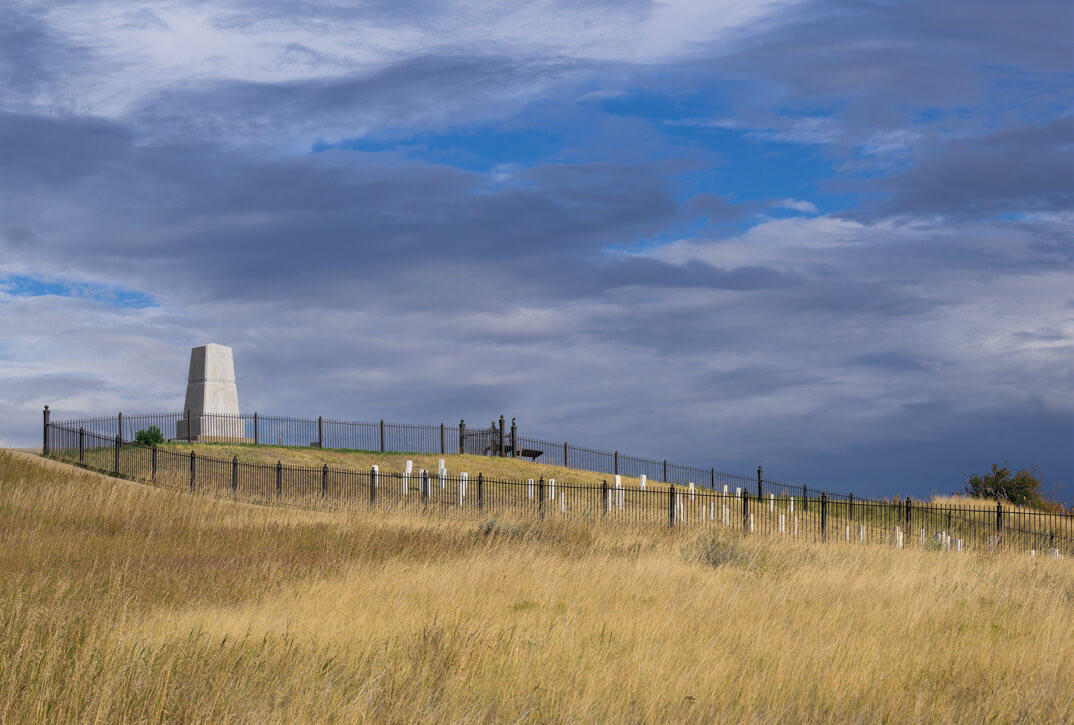
Today, the Little Bighorn battlefield site is recognized as a national monument, and Last Stand Hill hosts a literal monument of remembrance. | ADOBE STOCK
Giving Godfrey the benefit of the doubt — assuming he was sincere and willing to learn — we can imagine his actions as an effort to grow beyond past stereotypes and hatreds. But the latent racism of his society, combined with the desperate need for economic development, caused him to still stumble over concepts like this “merging” or a related idea that Indian cultures had been “doomed,” as if to extinction.
These stumbles suggest that the 1926 anniversary didn’t really achieve its ambitions. It was popular, with admirable appearances and ceremony, but it lacked sufficient deeper healing. Maybe the wounds on both sides were still too raw. In the century since those events, more of that healing work has taken place.
Has it been enough? The best way to measure may be to consider how this year’s 150th anniversary is remembered in the future. After all, any commemoration is only superficially about the history it calls to — more deeply, it honors the values of its own times.
John Clayton, a regular contributor to Big Sky Journal, is the author of several books, including Natural Rivals, The Cowboy Girl, and Wonderlandscape. He also writes the newsletter “Natural Stories;” johnclaytonbooks.com.
No Comments