


28 May History: The Funny Pages
With characters the likes of Rick O’Shay, Hipshot Percussion, and Deuces Wild, hailing from the imaginary town of Conniption, cartoonist Myron Stanford “Stan” Lynde’s Western-themed comic strips appealed to newspaper readers across the country. Published for 25 years beginning in the 1950s, these comics introduced readers to the practices of everyday life on ranches, in frontier towns, and in the mountains, serving to connect audiences with the West while preserving a legacy still enjoyed today.
A fourth-generation Montanan, Lynde [1931–2013] is widely known as the author of “Rick O’Shay” (1958–1977) and “Latigo” (1979–1983). At its peak, “Rick O’Shay” appeared in more than 100 newspapers, including the Los Angeles Times, Chicago Tribune, and Philadelphia Inquirer. Lynde developed a large international following as well, particularly in Scandinavia, where he produced original work during the 1980s and 1990s. In later years, Lynde wrote a series of popular Western novels featuring U.S. Deputy Marshal Merlin Fanshaw. Taken together, his stories of cowboys, lawmen, ranchers, and Indigenous peoples form a unique body of Western literature that has been widely praised for its authenticity and attention to detail.
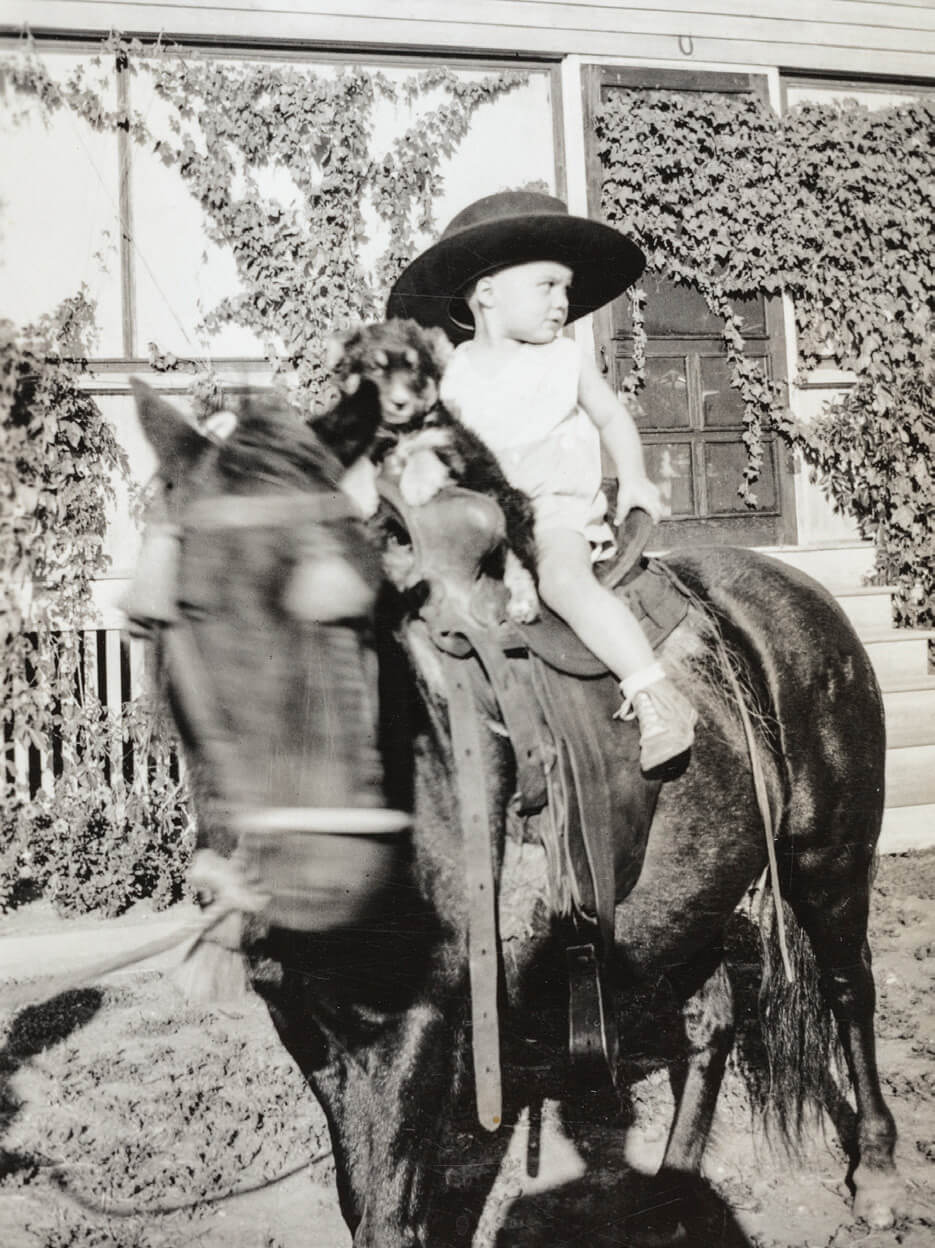
Lynde grew up in Lodge Grass, Montana, where he experienced ranch life in the 1930s. | COURTESY OF THE MONTANA HISTORICAL SOCIETY
“The way he drew was so precise. The characters, the expressions on their faces. It was a Western strip, but it wasn’t about gun battles and that kind of thing. It was more about humans,” says Phil Yeh, the legendary cartoonist, painter, and muralist known as the “Godfather of the American Graphic Novel.” Yeh grew up in Los Angeles but loved the cowboys Lynde depicted in “Rick O’Shay.” He clipped and collected “Rick O’Shay” strips from the Los Angeles Times during the 1960s and met Lynde at the San Diego Comic Convention in the 1970s, back when the event was just a gathering of a few hundred comic enthusiasts.
As a child, Lynde soaked up the still-present features of the Old West that animated his life, listening to the stories of his parents, tagging along with cowboys, and working on his family’s ranch. Lynde’s experiences made him a uniquely qualified cartoonist to depict the people, landscapes, and language of the Old West.
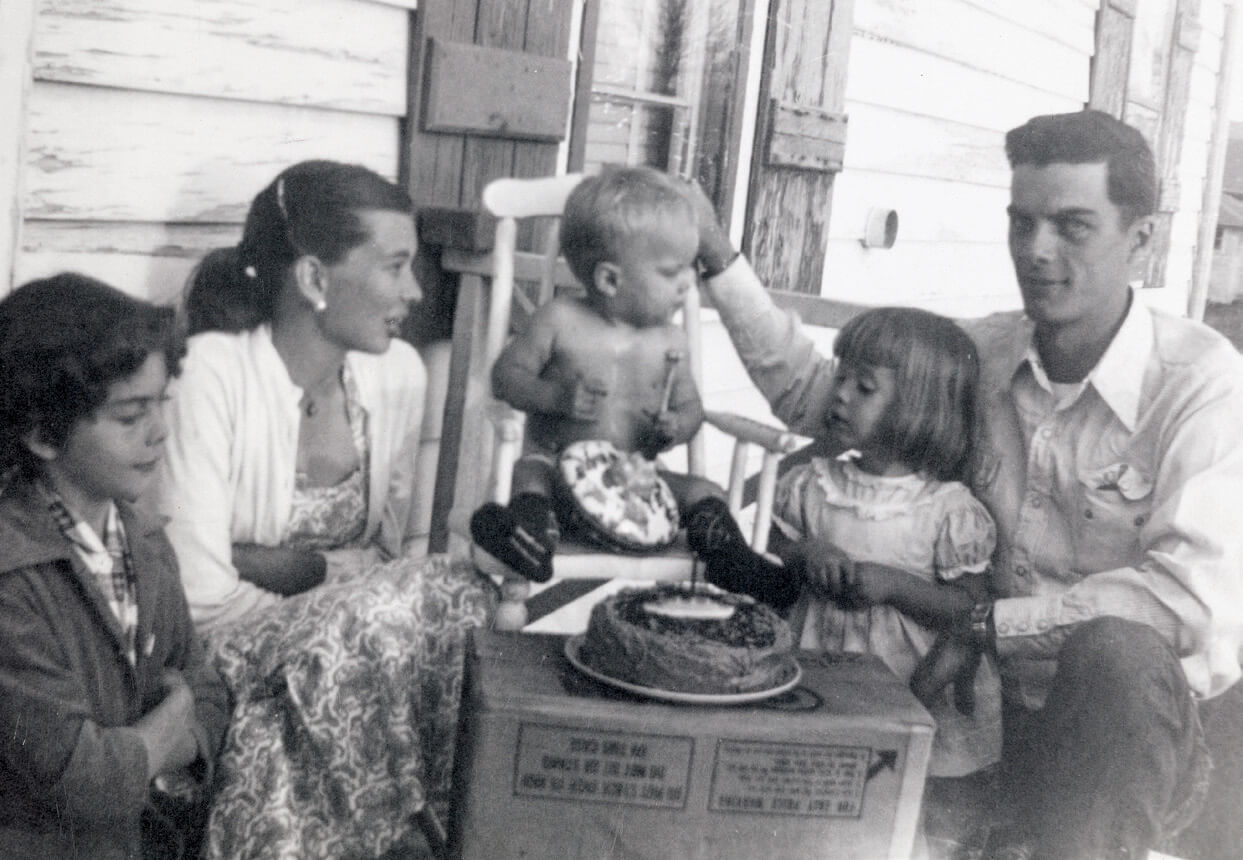
The Lynde family celebrates Casey Lynde’s first birthday in 1955. Pictured from left to right are Lorretta Lynde (Stan’s sister), Cindy Lynde, Michael Casey Lynde (seated), Shannon Kathleen “Pixie” Lynde, and Stan Lynde. | COURTESY OF THE MONTANA HISTORICAL SOCIETY
The oldest of Myron and Ellie Lynde’s four children, Lynde grew up on his father’s sheep ranch near Lodge Grass, Montana, on the Crow Reservation. The family’s ranchland was a patchwork of deeded land and land leased from members of the Crow Nation. The family followed the sheep over the course of the summer, living temporarily in wagons, tents, dugouts, and cabins. “At our peak, we had 13,000 head of sheep. We had 12 herders and innumerable people who helped out,” says Lorretta Lynde, his sister 16 years his junior. “It was very seasonal. It was a really small operation for the eastern part of the state.”
Lynde learned to hunt elk with his father, a passion he retained for the rest of his life, but it was his mother who first introduced him to drawing. As a young artist, Lynde took particular pleasure in drawing horses. Friends marveled at his ability to draw animals, people, and places from memory. He counted the writers Zane Grey and Will James, and the artists Frederic Remington and Charlie Russell, among his greatest influences.
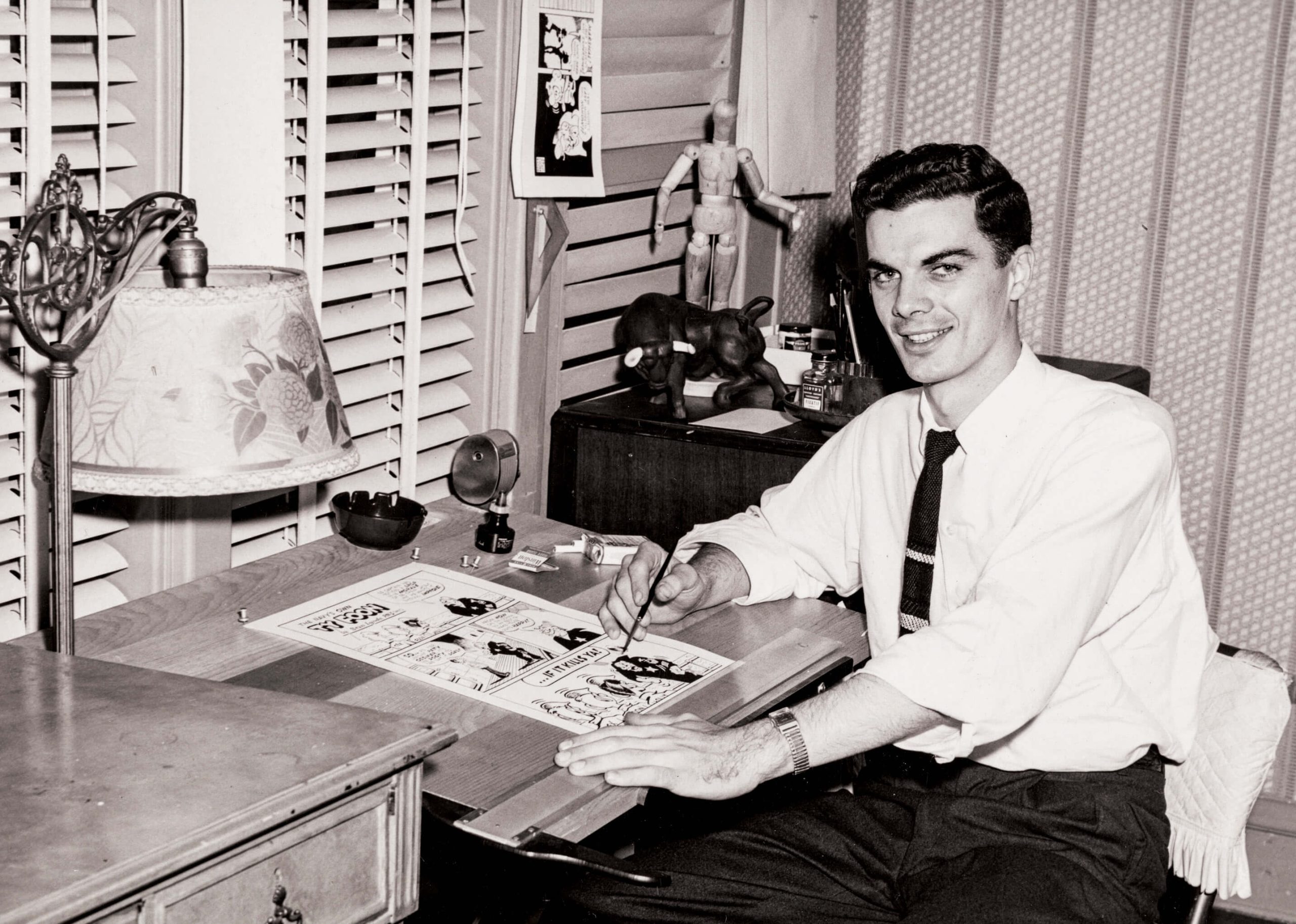
From the age of 5, Lynde wanted to write a comic strip, and in his adolescence he began drawing comics for his high school newspaper. He went on to attend the University of Montana for a time but then decided to join the Navy, creating the short-lived “Ty Foon” comic strip for Our Navy magazine during his time serving.
In 1956, Lynde moved to New York City in hopes of kick-starting his career as a cartoonist. By day, he worked for the Wall Street Journal, reading numbers off the New York Stock Exchange. By night, he worked on ideas for comic strips and, whenever he got the opportunity, pitched them to the major newspaper syndicates, which were largely based in New York.
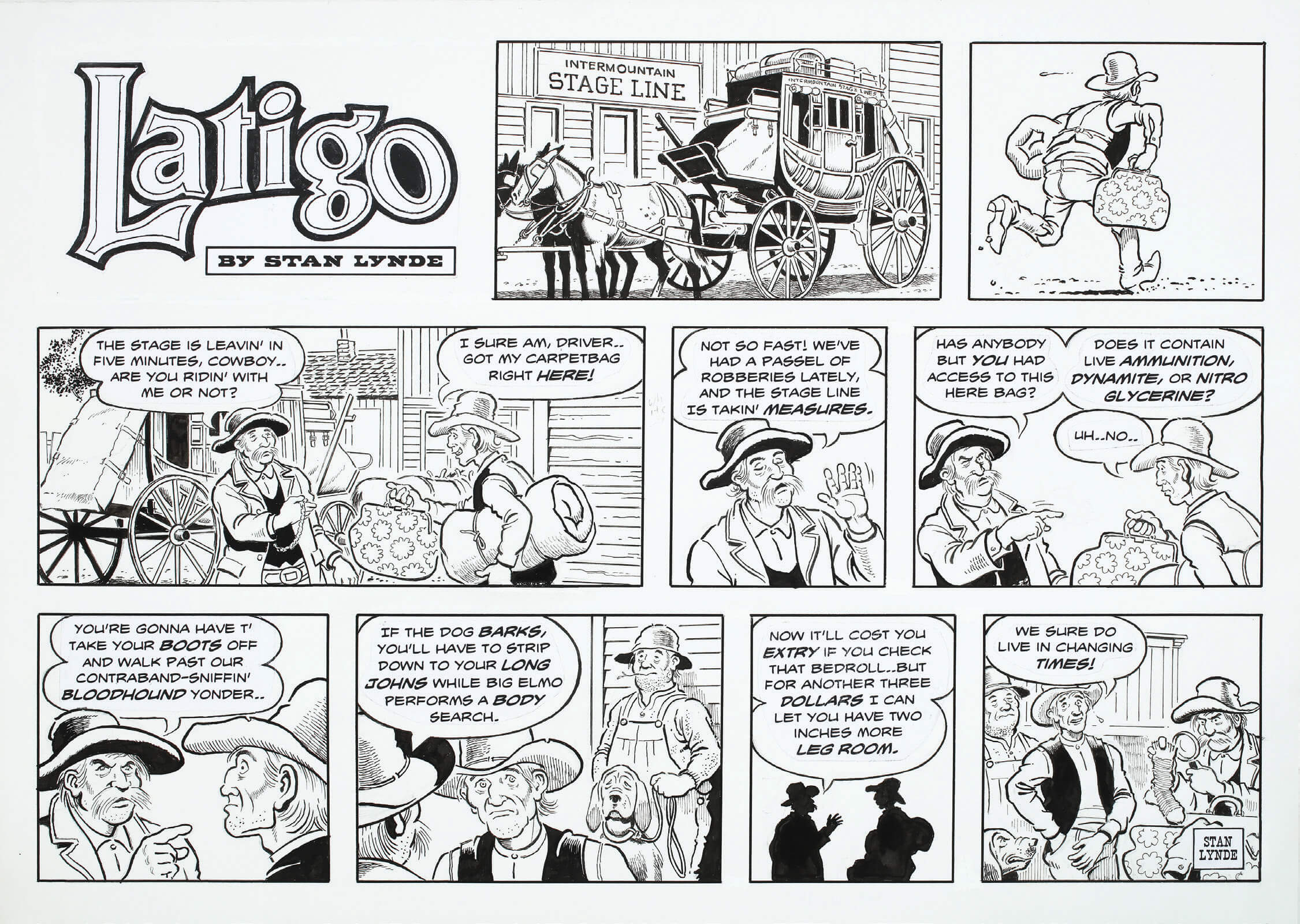
The Stage Is Leavin, comic by Stan Lynde, 2011. | COURTESY OF THE MONTANA HISTORICAL SOCIETY
“As luck would have it, he arrived at the New York Daily News/Chicago Tribune syndicate office right when they needed a Western cartoon strip,” Lorretta says. Lynde’s “Rick O’Shay” reflected the spirit of the times. During the 1950s, Westerners were a fixture on television, at the cinema, and in the funny pages.
The series was an immediate hit. Combining humor, adventure, vivid imagery, and great storytelling, the strip was set in the town of Conniption and focused on a straight-arrow marshal named Rick O’Shay and his exploits with a dashing gunslinger named Hipshot Percussion. Conniption and its many colorful denizens — such as gambler Deuces Wild, saloonkeeper Gaye Abandon (who became Rick’s wife), town doctor Basil Metabolism, and banker Mort Gage — bore a strong resemblance to Lodge Grass and the cast of Western characters that Lynde encountered as a child.
The people in “Rick O’Shay” reflected that simultaneous sense of independence and mutuality that characterized life in the Old West. “His characters were all very dependent on each other. They depended on each other for companionship, for defense, and for friendship,” says Paul Kees, who got to know Lynde while serving as curator of the Buffalo Bill Center of the West in Cody, Wyoming.
Lynde returned to Montana permanently in 1962, residing first in Billings and later in Red Lodge, Helena, and Whitefish. It was during his time in Red Lodge when his art came to adopt a new look with the addition of Denney NeVille, an artist originally from Byron, Wyoming, joining Lynde as the inker for “Rick O’Shay.” NeVille used a brush rather than a pen to ink the words. “You had a more sensitive, expressive line with brushwork than you did with a pen,” says NeVille. “For about five or six years, I did it all with a brush.”
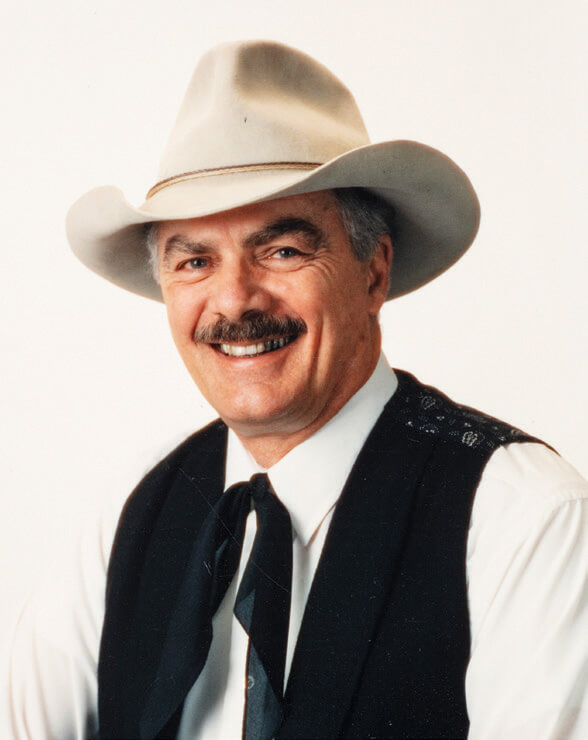
During the 1990s, Lynde was deep in his work drafting Western novels narrating the adventures of the fictional Marshal Merlin Fanshaw. | COURTESY OF THE MONTANA HISTORICAL SOCIETY
Initially, both men worked at home. Lynde drew a strip and then brought it to NeVille for inking. In later years, they worked together in a studio in Red Lodge. NeVille enjoyed working with Lynde, whom he describes as “very patient, but he had strong expectations of following what he had established [in the comic strip].” The pair worked a grueling schedule to complete six strips and a Sunday page each week. “Stan was a very hard worker. He could work all night long. The quality of his work always stayed the same,” NeVille says, noting Lynde’s unique talents as an artist, writer, and storyteller. “He once told me that ideas are not the problem. It was having the time to get them done.”
In 1977, Lynde got into a contract dispute with the Chicago Tribune syndicate, which controlled his comic. As a result, the syndicate decided to continue “Rick O’Shay” without Lynde, hiring Alfredo Alcala to pen the strip. Readers didn’t embrace the Lynde-less “Rick O’Shay,” and the strip ended in 1981.
“He was certainly unhappy about the way that he’d been treated and manipulated so that he lost control of his own creation,” Kees says.
As a result, Lynde started “Latigo” in 1979, which focused on the adventures of Cole “Latigo” Cantrell, a Union Army veteran who returned to Montana after the Civil War to serve as a federal marshal. However, the changing tastes in comic strips and difficulty finding a widespread syndicate stymied the strip, which only lasted until 1983.
Lynde took very seriously the idea of preserving Western heritage, and in the 1990s, he started writing Western novels revolving around the adventures of Marshal Merlin Fanshaw. Together with his wife, Lynda, he formed a publishing company, Cottonwood Publishing, to produce and distribute the books. The Fanshaw novels were suspenseful and filled with adventures, humor, and vivid Montana settings, and in 2009, he earned a SPUR Award for distinguished Western writing for the novel Vendetta Canyon. In later years, he tried his hand at painting and had his work for sale in several galleries.
Throughout his life, Lynde represented traditional Montana values through his work and the way he carried himself. “He was a Montana man through and through. Looked the part, dressed the part. He grew up doing the things that defined one as a Westerner,” Kees says, noting that Lynde always kept a sense of humor and recoiled at self-seriousness.
In 2012, the Lyndes relocated to Ecuador, planning to retire modestly after donating or selling off most of their worldly possessions. However, lung cancer soon brought the couple home to Montana, and Lynde died in Helena on August 6, 2013, at age 81.
Shortly before his death, he donated a huge collection of his ephemera and Western memorabilia to the Montana Historical Society. “He said he was blessed to be a spokesperson for grassroots Americans, and that there was no better place for those values than his beloved Montana,” Lynda says.
Clayton Trutor teaches history at Norwich University in Vermont. He is the author of Loserville: How Professional Sports Remade Atlanta — and How Atlanta Remade Professional Sports (2022) and Boston Ball: Jim Calhoun, Rick Pitino, Gary Williams, and College Basketball’s Forgotten Cradle of Coaches (2023); @claytontrutor.
No Comments