


28 May Artist of the West: Seeing What’s There
Living on the edge of Glacier National Park might seem like a dream. For artist Michael Booth, it’s the reality of a lifetime. The move brought Booth closer to nature, an internal calling that’s led him to some of his most iconic paintings.
Having now spent more than 40 years painting the American West, Booth has long enjoyed a deep connection to Glacier that began when he first visited the region during his early years as an emerging artist and college student. He and his family enjoyed regular visits to the park, working to build the gallery and house he lives in now. “It took us almost 20 summers to finish it,” Booth says, noting that he and his son constructed the innovative home/studio together. “Five years ago, we came up here full-time.”
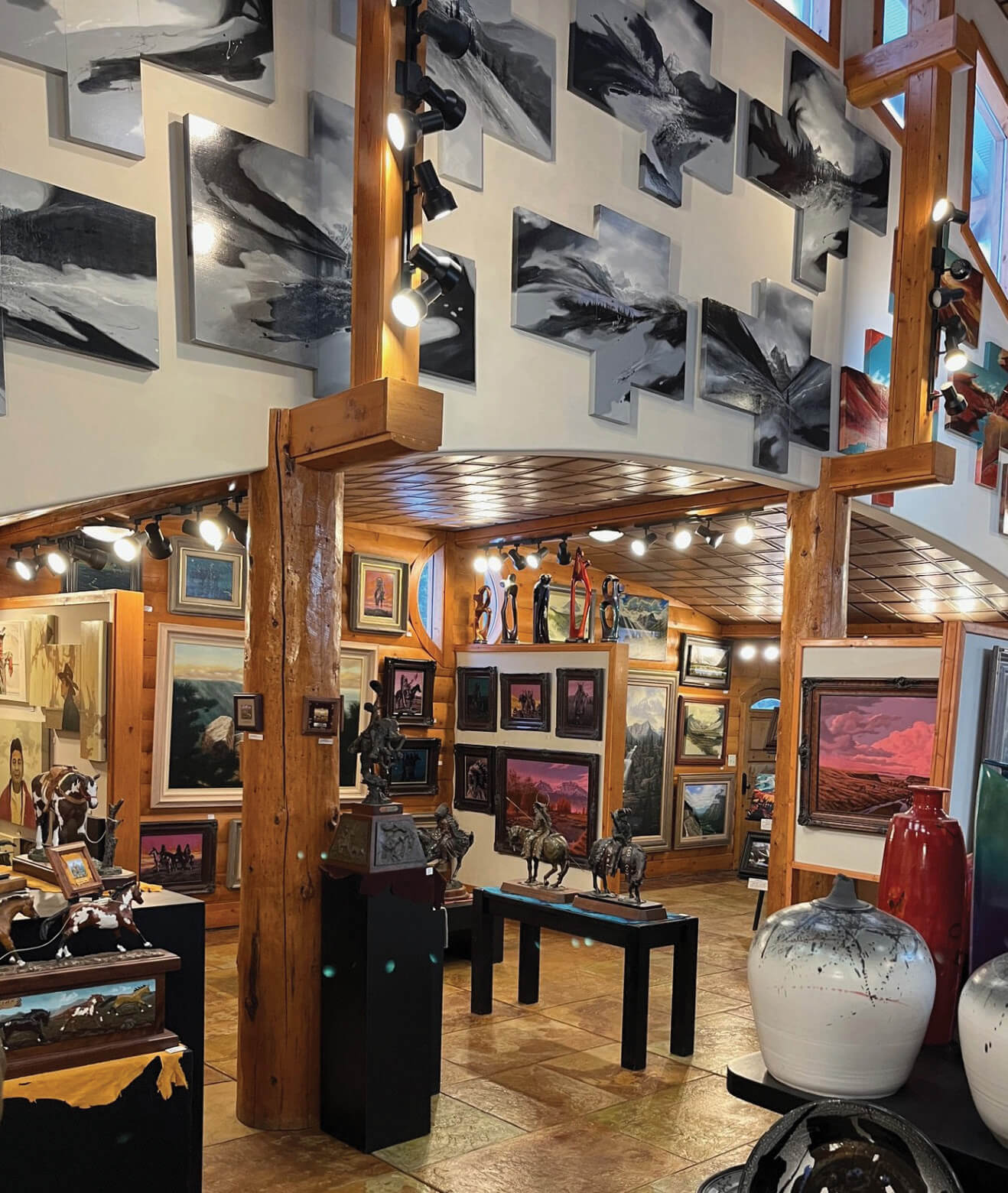
Inside Michael G. Booth’s gallery, located just outside Glacier National Park, displays showcase the various mediums Booth has worked in, including his newest canvas assemblages depicting Glacier. | COURTESY OF MICHAEL G. BOOTH
Now that he’s retired from a 35-year career teaching art at colleges across the West, he dedicates every day to following his creative vision. “I spend a lot of time in the park and outdoors; I’m always looking,” Booth says. “As an artist, that’s a constant. Seeing what’s there. The elements. How the stream comes off the mountain into the river. It’s stimulating.”
Once immersed in the landscape, he contemplates the shapes of the trees, the season, or the curve of a rise in the distance, and shoots a few quick photos for reference. With those in mind, he lets his imagination do the rest. “I’m not interested in painting just one scene,” he says, although he will take paints and small canvases out to work en plein air. The field studies help him recall the emotions of the moment. “My work is not like a camera. I take the parts that inspire and then compose a painting.”
Booth, who quickly gained a reputation for his Glacier paintings, never tires of his subject. Bringing in elements of a naturally dramatic landscape, adding his voice to those who have gone before, he focuses on the allure and mystique of the high country. “I grew up with a grand fondness for the mountains, having spent time in the Idaho forests,” he says. “This is the essence of it all. Right behind my house, I’m really in a primitive area, a wilderness.”
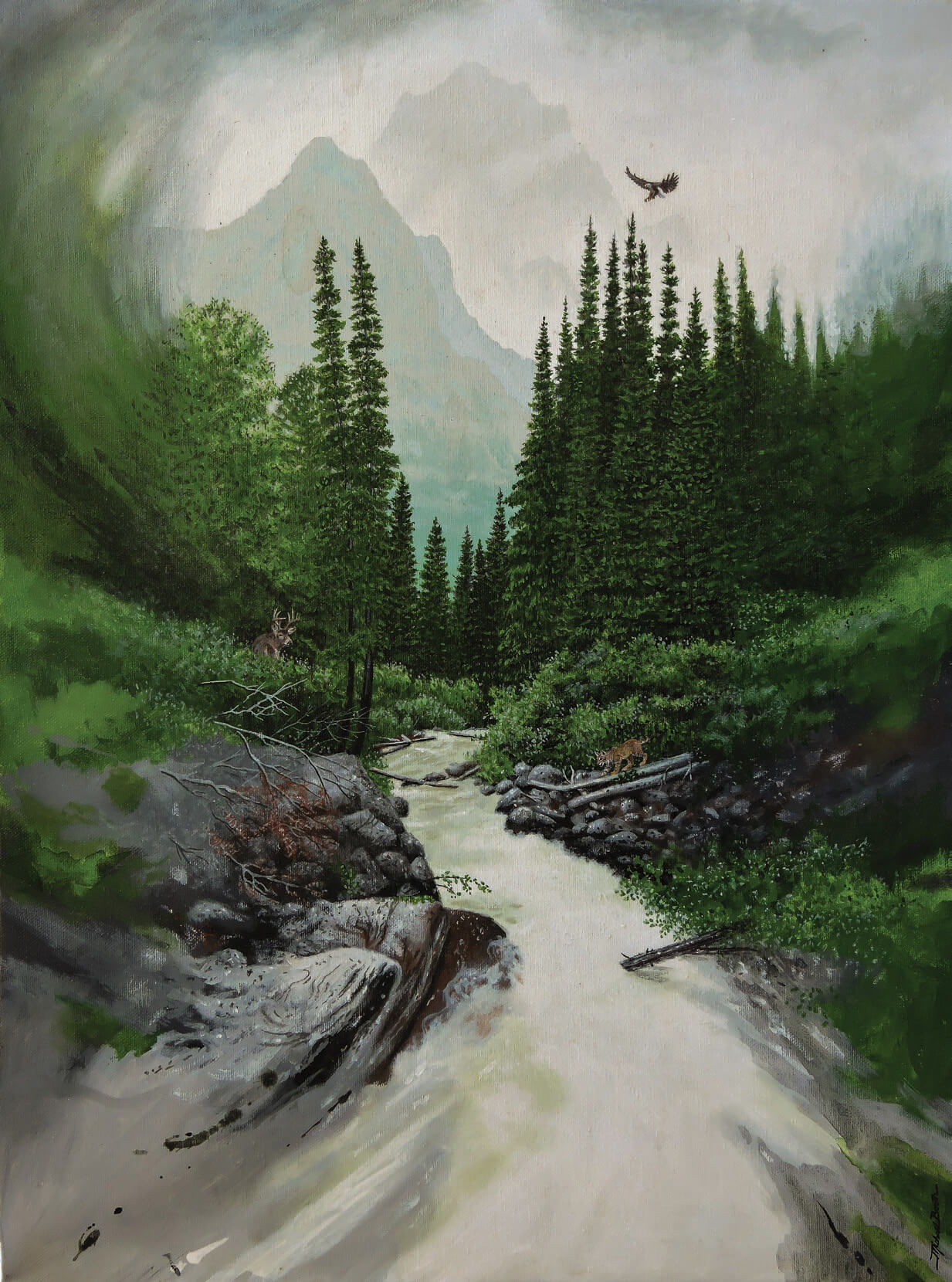
Glacier in Motion | ACRYLIC ON LINEN CANVAS | 24 X 18 INCHES
Since moving to northwest Montana, Booth feels he’s become much more focused. “I’m very much aware of precisely what I want and what I need to do, rather than spreading my talent across various disciplines all the time. That led me in different directions,” he says, referencing his explorations in various mediums and subjects. “This is where I feel totally at home. It fits me.”
There is something about intimately knowing a place that is not only personal but introspective. For instance, put up a painting by Albert Bierstadt, who traveled through the West inserting his own beliefs into his paintings, then returned to his New York City studio. Compare it with Claude Monet, who cared about light and color and painted haystacks with inquisitive passion over 25 canvases in his town of Giverny, France. That kind of personal investigation is what brings Booth to paint Glacier National Park. Although observing the land that surrounds him daily, he brings with him the innate personal knowledge of walking the same path every day and seeing something as if for the first time.
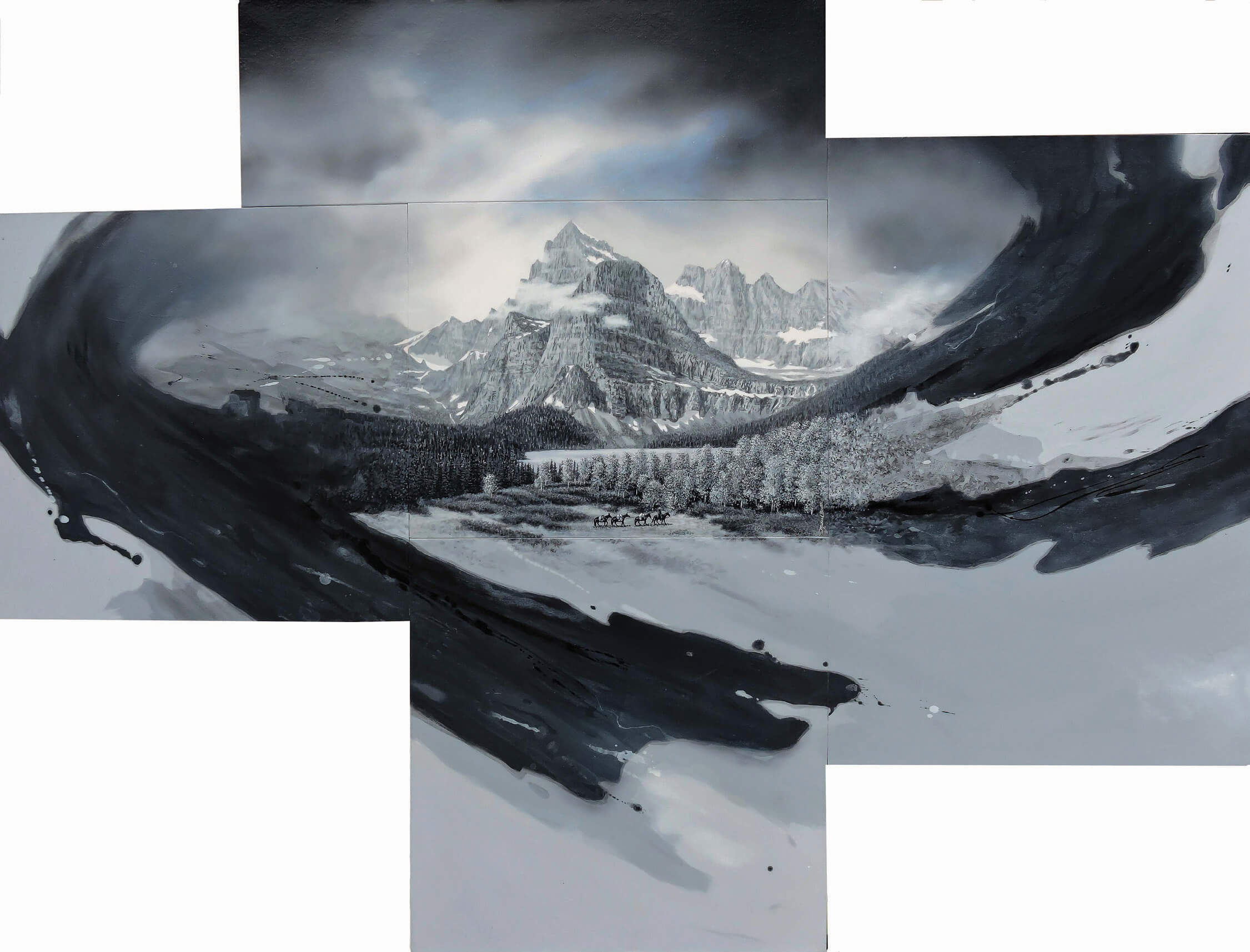
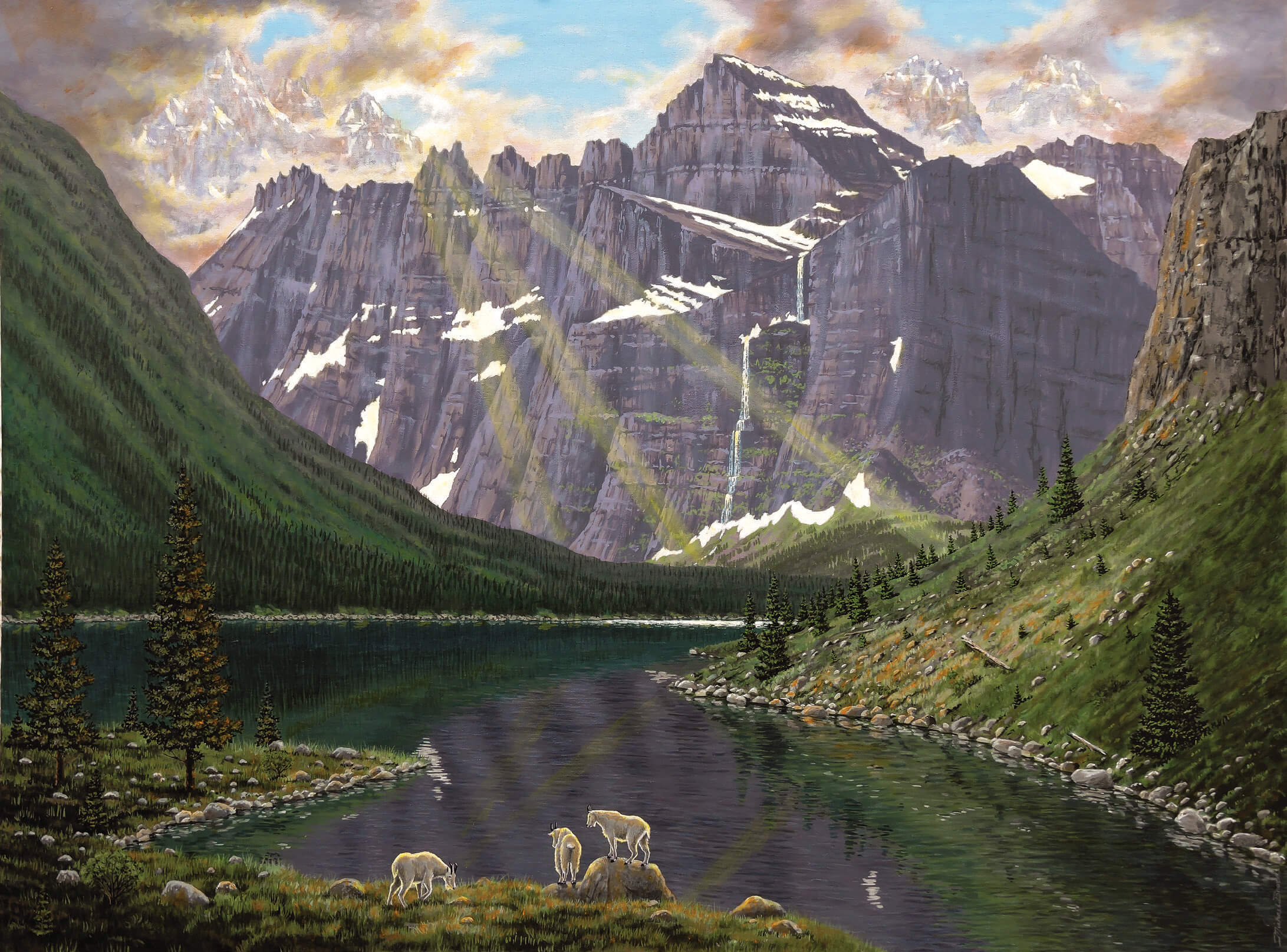
Pack String & Mount Gould | ACRYLIC ON LINEN CANVAS | 48 X 60 INCHES
When he refers to himself as more of an academic painter, which may sound staid, what he means is that he looks at the composition objectively rather than fervidly. “High detail is really sort of where I land,” Booth says. “But I really like to bring the emotion into it. I devised my own style of being highly realistic with a focal area and then the skirting around the piece is a more expressionistic style, with brushwork splatter that brings in the movement and motion.”
Each day, as he hikes around the park, different images tend to accumulate in his painter’s mind. “I used to sketch a lot,” he says. “I put my ideas down that way, work out the lights and darks and the compositions, but after so long, I can do most of it in my head now. I do like to get reference photographs — mountains, sky, water. When I’m ready to paint, I’ll go straight to the canvas and start putting those aspects together in the studio.”
Booth’s creative exploration led him to experiment with combining several canvases into sculptural wall works, which he refers to as “canvas assemblages.” These pieces uniquely blend the dynamic, energetic qualities of expressionism with Booth’s signature realistic detail. By assembling multiple canvases, Booth extends his artistic vision beyond tradition, creating works that not only capture the emotional essence of the landscape but also engage viewers with intricate realism. This fusion reflects Booth’s ongoing commitment to innovation within his practice.
“The assemblages are my own type of thing; since I taught design, I consider them wall sculptures,” Booth says. “They extend a bit with painted edges, then they have the realistic style in the middle and are more abstract as you move outward.”
These pieces, geometric in shape, jut up and out. The canvases make use of the white space of the wall, often eddying with paint around the perimeter, swirling like a portal to another time. The center usually includes extremely detailed animals — elk or deer, perhaps — seen in the park and embedded in their natural habitat. Taken all together, the pieces are at once dynamic and peaceful, much like Glacier Park itself.
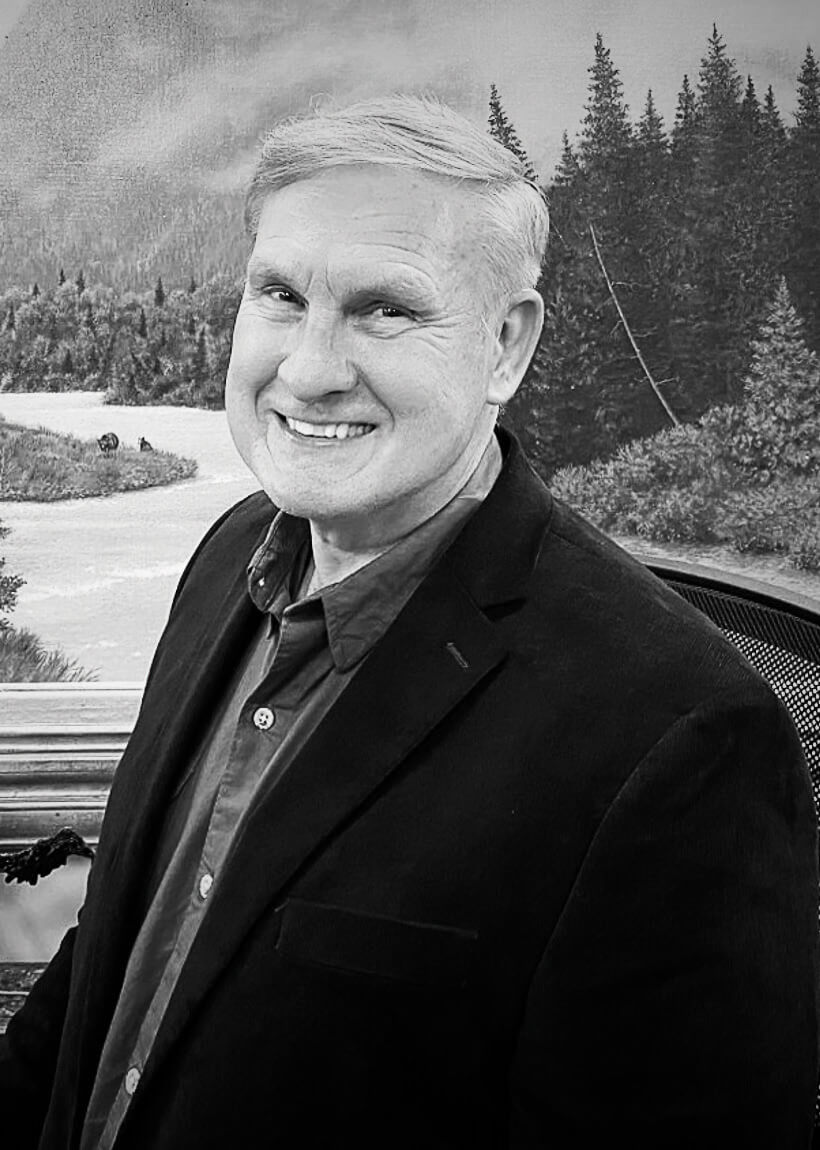
Artist Michael Booth. | COURTESY OF MICHAEL G. BOOTH
While teaching at various colleges in the West, Booth explored other mediums — ceramics, bronze, and monumental cement sculptures — but he always came back to painting. The lure of the brush called to him. “My stuff will never look like the exact thing because of what I put in there. I’m kind of an abstract painter, making up some of it,” he says. “I create a composition from the best part of what I’ve seen.”
Even so, the process remains rooted in observation. Long walks through the park continue to feed the quiet accumulation of images that later surface in the studio. “Sometimes it’s the way the clouds hang in the valley, or the color in the water late in the day,” Booth says. “You start to recognize patterns. But every day it’s a little different.”
That subtle variation is part of what keeps the landscape endlessly compelling. Glacier’s peaks, forests, and rivers may appear timeless, but light, weather, and season shift the mood of the land hour by hour. Booth approaches each painting as an opportunity to capture not just the place but a fleeting moment within it. Working in his studio near the park, he builds his compositions slowly, reflecting both careful craftsmanship and a sense of immediacy.
For Booth, living beside Glacier has allowed his work to evolve in ways he could not have predicted decades ago, when he first began spending summers there. “I feel lucky,” he says. “To wake up here every day, to walk out into this landscape, and to be able to paint it — that’s about as good as it gets.”
Freelance art writer, teaching professor, and author Michele Corriel earned her master’s degree in art history and her doctorate in American art. She has received a number of awards for her nonfiction, as well as her poetry. Her latest book, Montana Modernists: Shifting Perceptions of Western Art (Washington State University Press, 2022), won four awards, including a national award from the Western History Association.
No Comments