


25 Sep History: Hounds vs. Hare
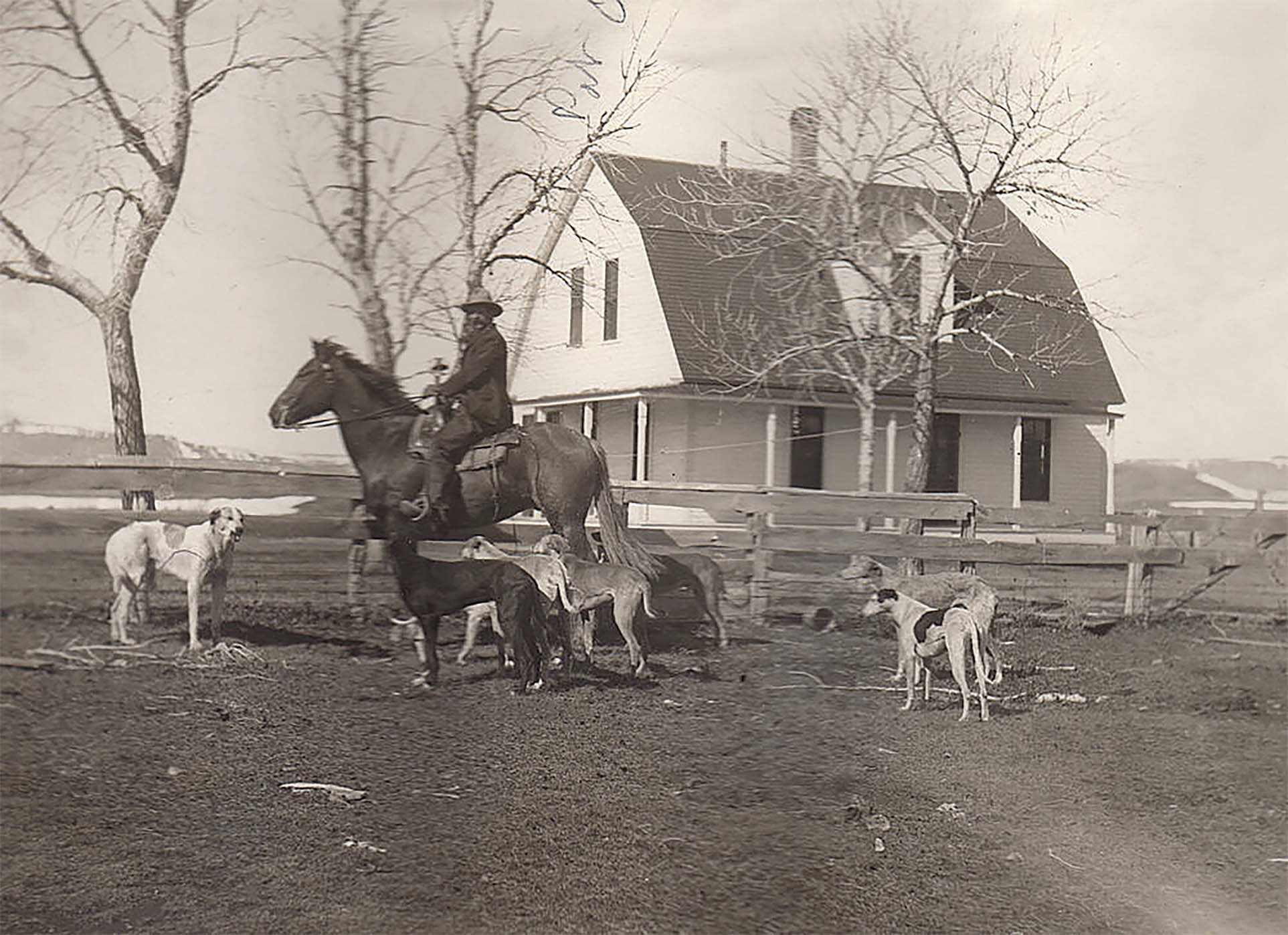
As military officers established frontier outposts in the American West, they brought with them favorite sporting traditions from back East. If an officer’s pursuit was hunting, he had to have dogs.
Greyhounds accompanied General Eugene A. Carr during his 1869 Republican River Expedition in Colorado Territory. Carr was certain his swift hounds could catch and kill an antelope, and upon turning them loose for such a chase, the antelope sprinted over a hill with the greyhounds lagging badly and losing ground at every stride. One of the guests in the party, William F. “Buffalo Bill” Cody, could not resist quipping, “General, if anything, the antelope is a little bit ahead.”
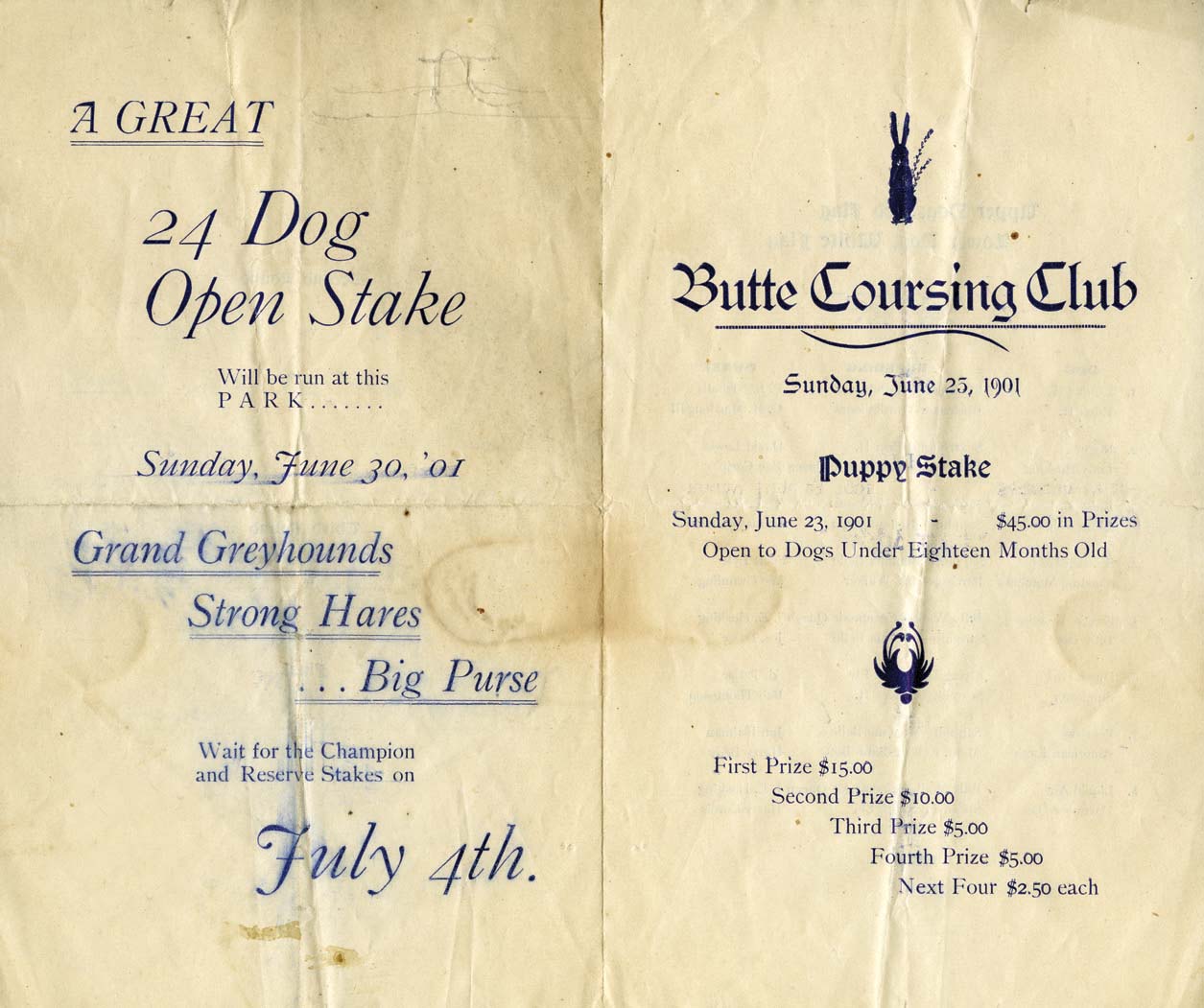
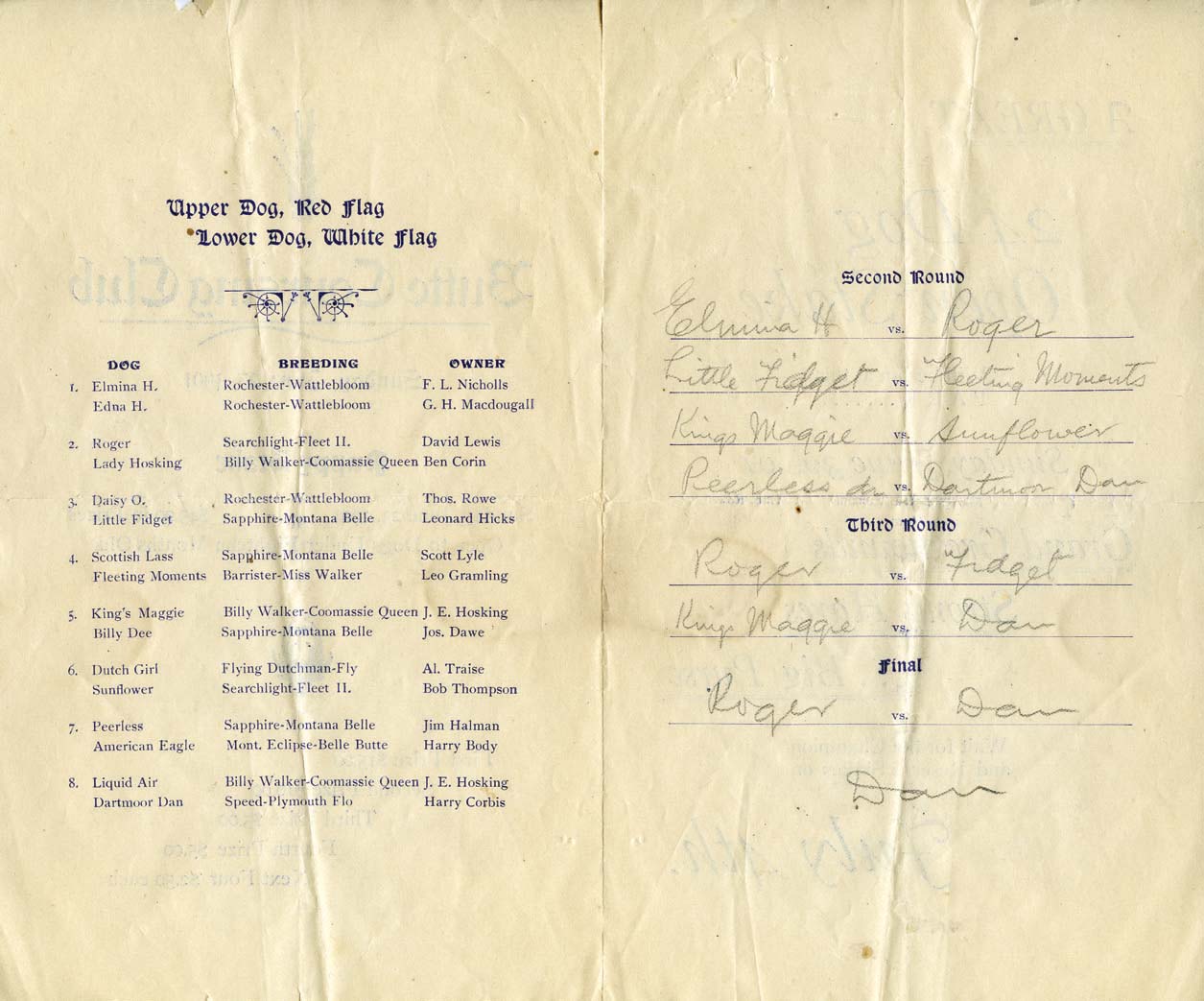
The purchaser of this program for the Butte Coursing Club Puppy Stake on June 25, 1901, charted the winners of each brace, round, and the final, won by Dartmoor Dan. According to the Butte Inter Mountain, Dan was “easily the best puppy and made a good impression on his first local appearance.” The program’s back cover entices spectators’ return for June 30 and July 4 events. BUTTE-SILVER BOW PUBLIC ARC HIVES
In another account of greyhounds in the Colorado Territory, at Fort Lyon in 1871, Frances Roe, wife of Lieutenant Fayette Roe, owned a well-loved greyhound named Hal. Frances rode horseback following Hal in pursuit of coyotes and jackrabbits.
Greyhounds also reached the Montana Territory. During the Indian Campaign of 1876, Captain William Clifford reported an eerie discovery at Fort Pease. The fort situated along the Yellowstone River had been abandoned the previous winter, but upon reaching it in April, the sole occupant, described as “a beautiful greyhound,” greeted the soldiers. “He looked sleek and fat, and the query is, ‘How has he lived?’”
Clifford wrote in his report. “There is no food to be seen here, and so we concluded that he has gained a living by hunting rabbits.”
Without a human hand to feed him, no doubt the dog’s ancestry had aided his survival. The greyhound breed originated in ancient Egypt as sight hounds, which means they hunt by sight instead of scent. They clock upward of 40 miles per hour over short distances and can sustain 30 miles per hour as far as a mile.
The West’s frontiersmen imported and bred the fleet hounds as a tool for protecting livestock from predators. Dan Toby (or Torey) of the Marias River country in Montana Territory said, “It is terrible straining on the coyote’s eyes when he looks over his shoulder and sees the largest and fastest greyhound gaining upon him at every jump. He immediately gets a new gait … but all to no purpose. He is overtaken: the dogs come upon the scene, and the coyote’s earthly career suddenly terminates.”
Greyhounds were also kept for blood sport. As told by the Butte Miner in 1886, the owners of seven greyhounds that “slaughtered” 12 hares considered the sport “very amusing.” The use of greyhounds to kill game is known as coursing. It originated in Cornwall, England, where the sport was a favorite among Cornish miners at work in the region’s copper and tin mining industries. Coursing measured the merits of dogs that chased and killed game and is considered the precursor to modern-day greyhound racing.
Coursing had plenty of detractors. One of them was Reverend E.J. Groeneveld, delivering his “The Rights of Animals” sermon in Butte on March 1, 1897. Denouncing the sport as extremely cruel and inhuman, he equated it to the “bloody and brutal sports of the pagans of ancient Rome” and said “people of today are not Christians unless animals are the better for it.” His convictions might have swayed some listeners, but Groeneveld was up against the thousands of immigrant Cornishmen whose skills in mining were in demand in copper-producing, smoke-belching Butte. They, and “the Irish,” were “forever out coursing or exercising or talking about their dogs,” noted one Butte resident. The Butte Coursing Club had organized in 1894 and was producing makeshift meets. Later, in March of 1897, coursing enthusiast Marcus Daly of Butte, an Irishman and Copper King, donated the flat, treeless ground on which to build a course.
On June 21, 1897, five days before the new course was to open, the Butte Coursing Club was short on jackrabbits and had to postpone the meet. Local rabbit contractors had captured only a few. Jackrabbits are particularly adept at escaping pursuers. From the day they are born, the likes of foxes, coyotes, birds of prey, badgers, and even snakes want to eat them. Hares are fast, clever, agile, and when chased by a foe, they know better than to run a straight line, choosing to zigzag instead.
Several weeks later, the gates to the West Side Coursing Park swung open on July 5. There were plenty of hares, 16 greyhounds, and the club had carefully planned the meet: eight braces with two dogs each, with the winners advancing through quarterfinals, semifinals, and the last pair meeting in a sweepstakes. Each event was limited to two minutes. Given all their preparation, the club expected the meet to run like clockwork, but the gears were quick to go haywire.
The 250 hares imported from Idaho were disoriented, or as the Butte Miner told it, “[too] young, a degree weak, and probably not used to the altitude and smoke [billowing from the smelters].” Before each contest started, a single hare was either herded onto the course or released from an escape hole placed at intervals around the track. The bewildered hares would barely run, and the dogs instantly killed those that absolutely refused to flee. Brace after brace had to be repeated. If a hare was to find an escape hole during the chase and dart through it, he escaped the dogs but had entered an enclosure, only to be captured again and used for future races.
The greyhounds, accustomed to being let loose on a plain and running flat out after game, were likewise discombobulated by the unfamiliar environment and handling. Nearly all resisted the slips used in formalized coursing. The slip is a leash connected to two collars. A spring-loaded
attachment yoked two dogs together. Upon a hare’s release onto the course, the person known as the slipper freed the attachment, the leash fell from the collars, and two unleashed greyhounds bolted after the hare.
As had the greyhounds and hares, the slipper struggled, too. “Mr. Deacle did not seem to be at all home as a slipper,” the Anaconda Standard noted. “But in his defense, it may be said that not more than two or three out of the 16 dogs were broken to slips and none were thoroughly broken.” The horseback judge who rode behind the greyhounds tallied the points, as directed by the coursing scoring system. Points were awarded for intercepting and turning the hare, for outmaneuvering the rival dog, and for catching and killing the hare. To signal the winner, the judge waved a small flag the same color as the collar worn by the winning dog.
Opening day at West Side Coursing Park inched toward the final event, the sweepstakes, and to spectators’ delight, the hares were increasingly energized and the greyhounds better behaved. Between contests, hares were often hopping on the course, not left there intentionally but because they could not be caught. This was the case — two leftover hares and a fresh one — in the quarterfinal between Silver Bow and Sailor. Silver Bow chased all three hard, catching and killing two in his defeat of Sailor. Next, in the quarterfinal that pitted Snowball and Daisy Belle, as the slip dropped, the dogs spotted the hare released onto the course but also eyed the dozens of bouncing hares in the adjacent enclosure. Snowball and Daisy Belle leapt from course to enclosure and all hell broke loose inside: dogs in pursuit of hares, men in pursuit of dogs, and hares in a panic trying to escape doomsday. Snowball and Daisy Belle killed five hares in the enclosure and had to repeat their quarterfinal.
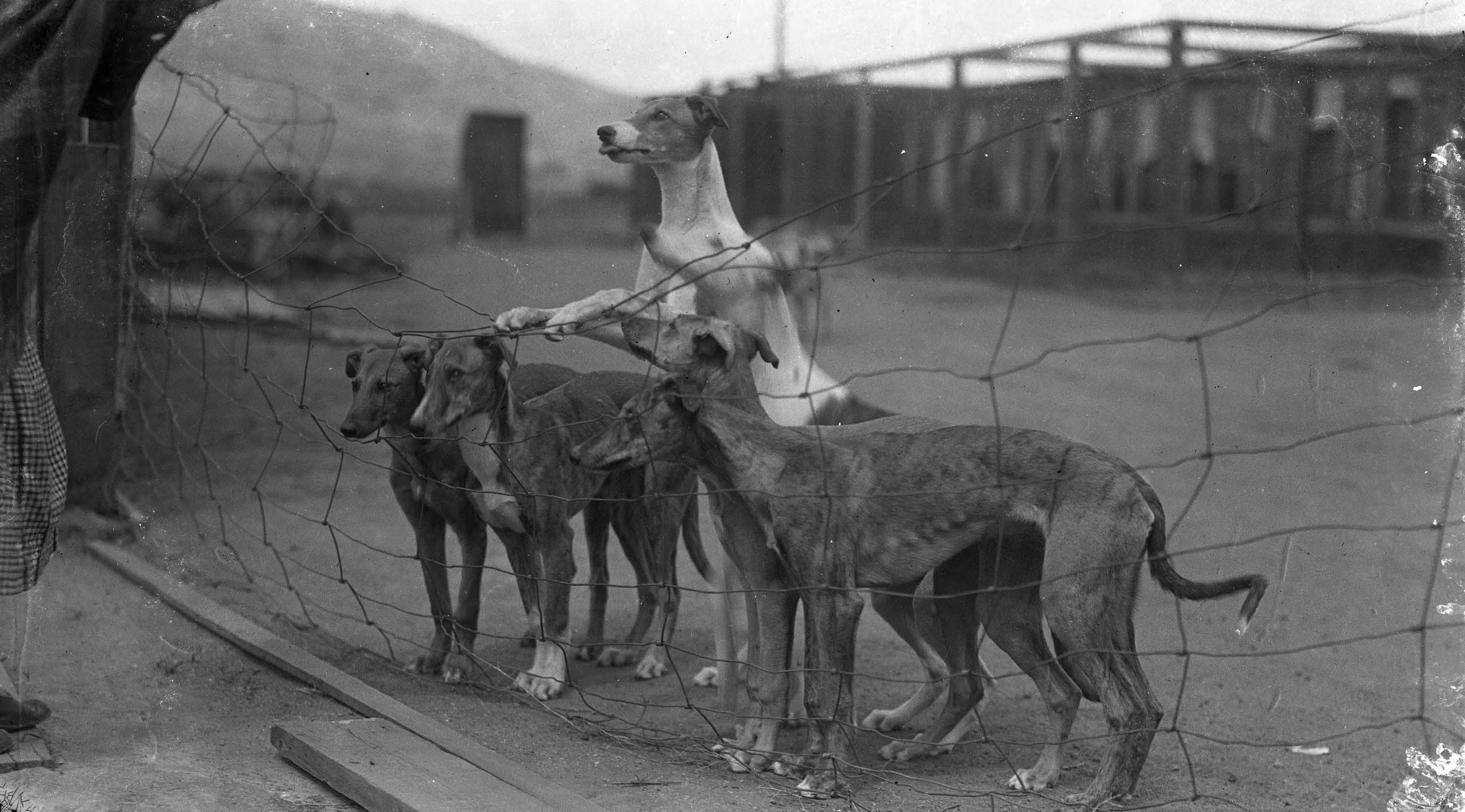
In late 19th- and early 20th-century Butte, greyhounds were affectionately known as Cousin Jack race horses for the sport’s origin in Cornwall, England. BUTTE-S I LVER BOW PUBLIC ARCHIVES
At last, the handlers walked the two finalists, Snowball and Silver Bow, onto the course for the sweepstakes.
Poor Silver Bow was gassed, and given Snowball’s quarterfinal melee, the same would have been expected of him. Yet Snowball ran the sweepstakes “gamely and cleverly,” and as the Anaconda Standard also noted about his performance, “the more contests he ran, the better he ran, and he beat Silver Bow handsomely.” Snowball won $20 in prize money and Silver Bow won $10. More than 20 hares died that afternoon.
Three hundred spectators watched the Butte Coursing Club’s
helter-skelter opening day on July 5, 1897, at West Side Coursing Park. Formalized coursing had gained a foothold in Butte and was on its way to becoming a favorite sporting tradition. In fact, in 1912, Butte coursing enthusiast Owen P. Smith invented the mechanical rabbit later adopted by the sport of greyhound racing. It was said that Mrs. Smith “shuddered at the squeal of the live rabbits when caught” and because of her distress, Smith began experimenting with a mechanical version. Greyhounds liked his idea, chasing the mechanical rabbit with the same enthusiasm they had displayed in pursuit of a live hare. Smith opened America’s first professional dog racing tack in 1919, in Emeryville, California. Of course, the hounds chased a mechanical rabbit. The American-born sport of dog racing absorbed Cornish-born dog coursing, and the latter died a natural death.
West Side Coursing Park would meet its end in 1914, the year the Montana legislature, in step with national anti-racing and
anti-gambling sentiment, made racetrack wagering illegal. The law would not be repealed until 1930, but nevertheless Butte opened the Highland Kennel Club in 1926 which closed in 1931, and the Copper Hill Club operated from 1957 to 1958. Newspaper accounts also note races occurring under the Mile High Kennel Club in the 1940s but precise opening and closing dates are unknown.
The American-born sport of greyhound racing had absorbed the Cornish-born sport of dog coursing and brought on its demise. What comes around goes around. Today, commercial dog racing is a last gasp. Competition from other sports and forms of entertainment, opposition from animal rights organizations, bans in 44 states, and advancing federal legislation to outlaw commercial dog racing and simulcast betting nationwide equates to only two greyhound racing tracks still operating — in just one state in the country: West Virginia.
Catharine Melin-Moser’s articles about horse racing, Western history, and the outdoors appear in numerous journals and magazines. She writes from her home in the Judith Mountains of central Montana. Her book, When Montana Outraced the East: The Reign of Western Thoroughbreds, 1886–1900, was released in April 2025.
No Comments