


31 Jul Windows into the wild World
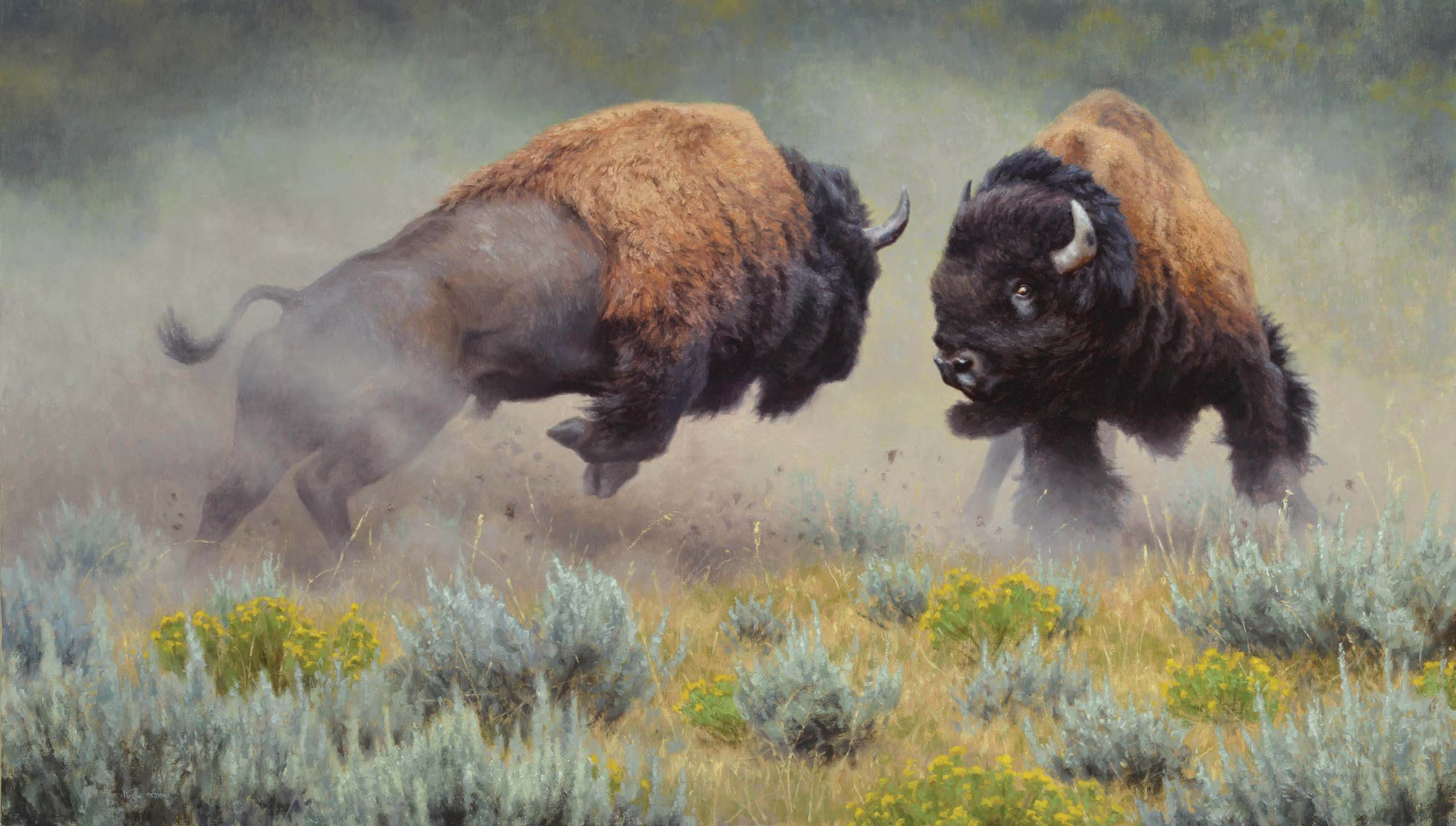
In a scene pulsing with tense energy, two bison bulls, each weighing as much as a ton, battle for primacy. Amid the clouds of dust they’re kicking up, one of them launches himself from the ground, hindquarters powerfully pushing, forelegs airborne, head and horns lowered. The other stands resolute, awaiting the collision.
Yet, viewers of Imminent Impact — one of the paintings Kyle Sims debuted this June at the Prix de West Invitational Art Exhibition & Sale in Oklahoma City — might well find their attention drawn at first not to the dynamic atmosphere, the faithful rendering of the beasts’ might, or the subtly evocative surroundings of scrubland and tree-covered hills. Instead, maybe most riveting of all in a perfectly enthralling, large-scale artwork is the gleam in the bracing bull’s left eye, a detail that captures in barely more than a brushstroke a sure sense of fierce determination.
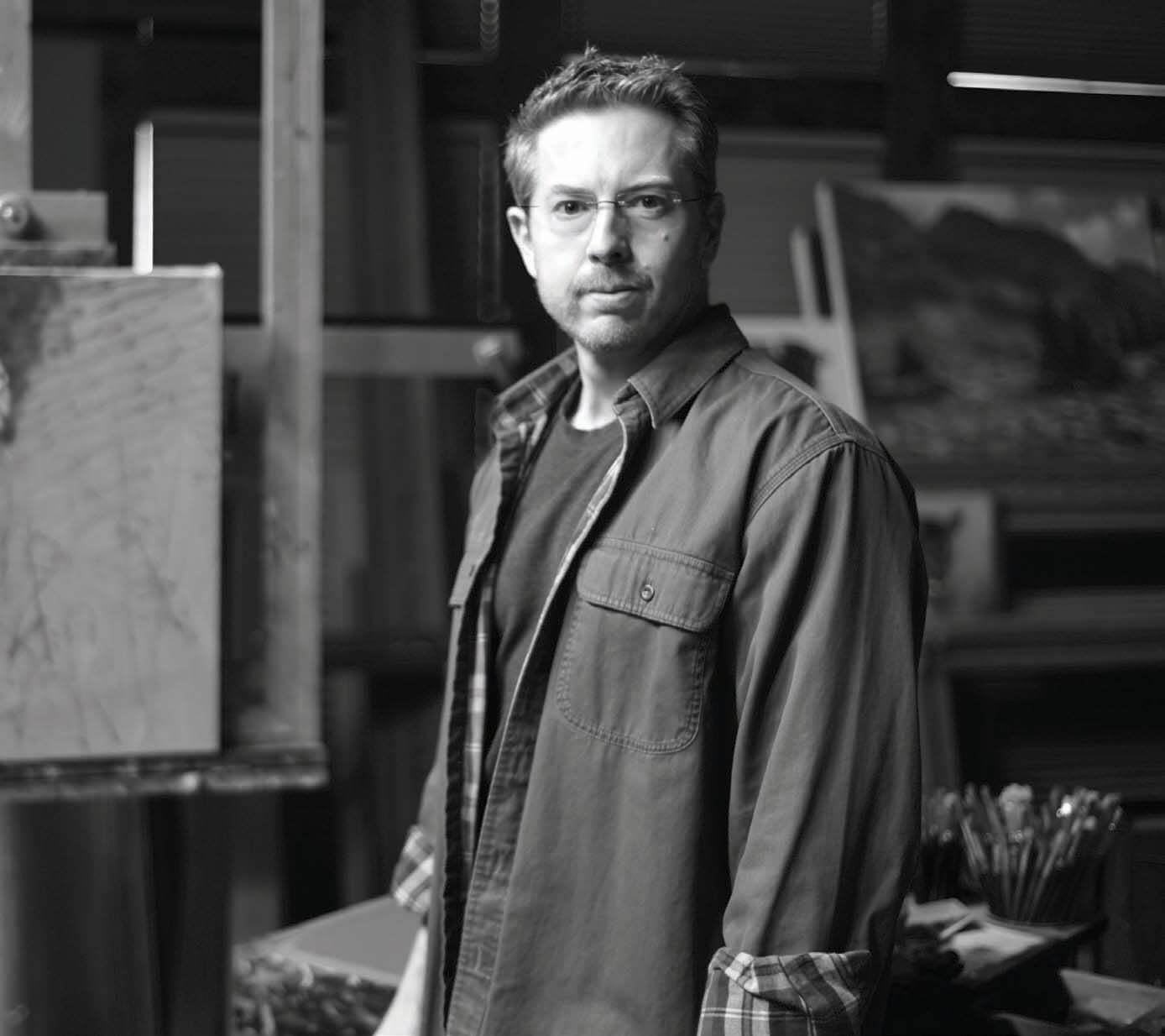
Kyle Sims stands near his palette table and easel in the 480-square-foot studio a short stroll from his home. An array of almost 100 hog-bristle, sable, and mongoose brushes enable him to lay down oils in a wide variety of thicknesses and textures. | KYLE SIMS
“The challenge with a bison fighting piece — and I’ve done them several times — is that you’ve got to figure out a way to make one of them a focal point,” Sims explains. “I started the painting with that eye and then worked out from there.” Of course, so many other elements of the piece combine in support of the drama, which found its inspiration in a photo the artist took one recent summer in Yellowstone National Park’s Lamar Valley.
“There was no dust in the photo, and I invented the sagebrush in the foreground, arranging it all to force your eye toward the action and make the scene more dramatic,” he says. “And the colors of the bison were more uniformly dark brown, so I added more natural contrast between their shoulders and hindquarters.” And the gleaming eye? “I didn’t have to imagine that,” the artist says warmly. “I probably wouldn’t have done the painting if I hadn’t originally caught that.”
Sims portrays the wildlife of the Rocky Mountain West with a skill he has diligently honed during his lifetime living in the region — from his childhood spent near Laramie, Wyoming, to his home outside of Bozeman, where, now in his mid-40s, he lives with his wife, Joy, and their 8-year-old son, Isaak. Over the years, Sims has developed a deep familiarity with and love for the region’s animals and the landscapes in which they live.
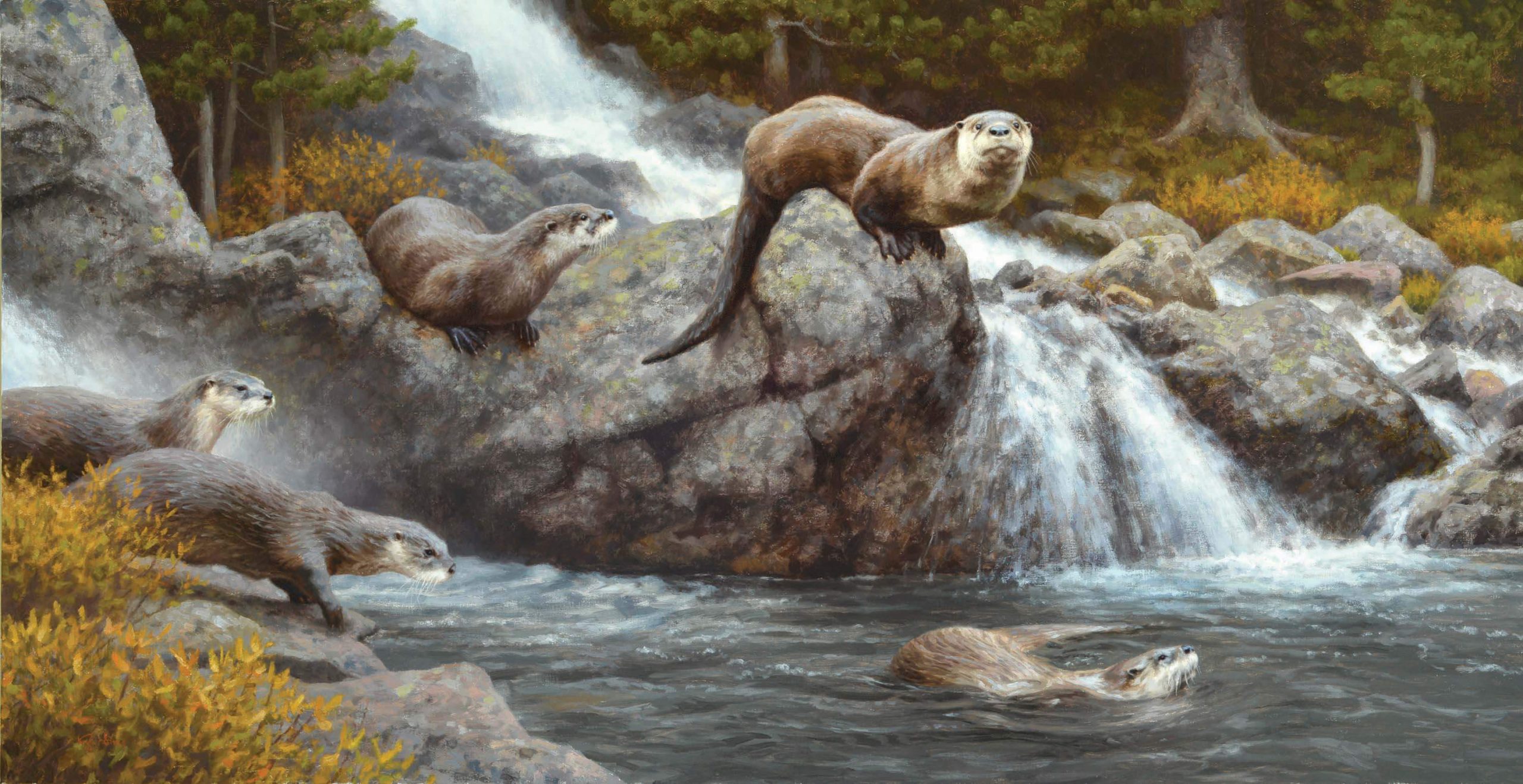
Children of the Water | OIL ON CANVAS | 34 X 66 INCHES
“Kyle doesn’t just create portraits that bring his subjects into our world,” says Sydney Weeks, director of Montana Trails Gallery in the heart of Bozeman, which has shown the artist’s work for about a decade. “He has a way of painting animals that feels like a window into their world.”
The artist has been honing that talent since at least the age of 5. “Every child likes to produce some form of art,” he says. “And around then, I had the urge to recreate the dinosaurs I’d seen on a television program. I thought I wanted to be a paleontologist, so that’s what I drew.”
By 13, he’d begun to shift his focus to an art career and to a broader range of subjects — transitioning from giant prehistoric reptiles to basketball legend Michael Jordan to, at last, wild animals. His love of and commitment to wildlife art only deepened as he discovered published works on such greats as Carl Brenders, Robert Bateman, and Daniel Smith, among others. “Then, at 16, I took my first professional workshop with wildlife painters Terry Isaac and Rod Frederick in Jackson Hole. And Terry told me, ‘Kyle, if you want to, you could do this.’”
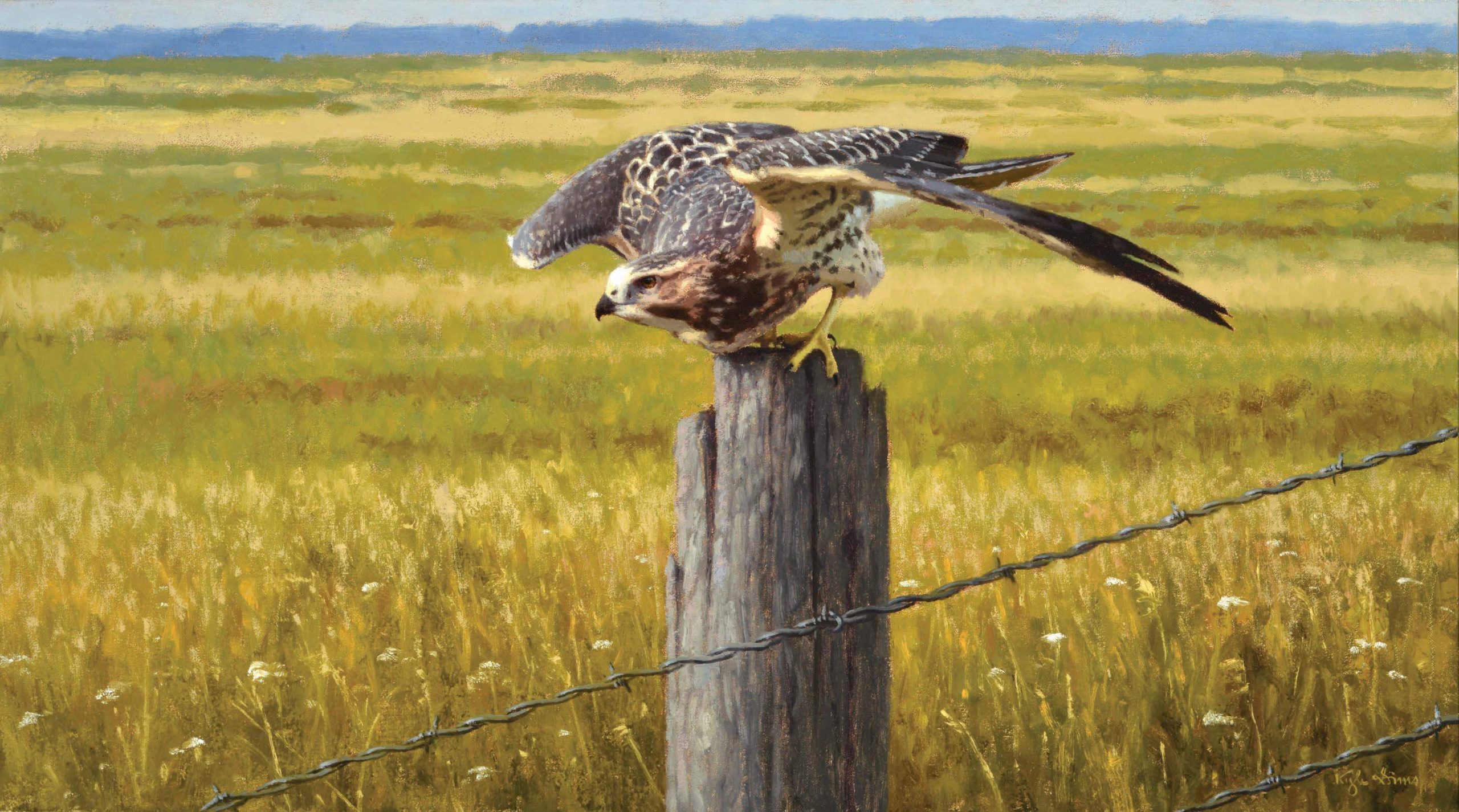
Ready for Launch | OIL ON CANVAS | 19 X 34 INCHES
So Sims furthered his studies with workshops from other luminaries, including Smith and, most notably, Paco Young, who taught at the Beartooth School of Art in Bozeman. “Paco was a bit of a father figure to me, and wildlife painting became my interest and my passion,” Sims says.
He followed that passion to the undergraduate art program at Rocky Mountain College in Billings. “There was figure drawing and other standard stuff,” he reflects of a program that didn’t greatly impact his creative path. Most importantly, though, he says, “I met Joy there.”
After graduating, Sims pursued painting full time, though his schedule at the easel was odd. “For about eight months, to make ends meet, I worked at FedEx Ground as a package handler. So, first thing in the morning, I’d get my workout in, paint until lunch, work my four-hour FedEx shift, get home, eat dinner, and paint until bedtime.” In the little spare time left, he adds, “I’d get out and meet people,” including at local frame shops. Eventually, the sales he made through such contacts allowed him to give notice at FedEx.
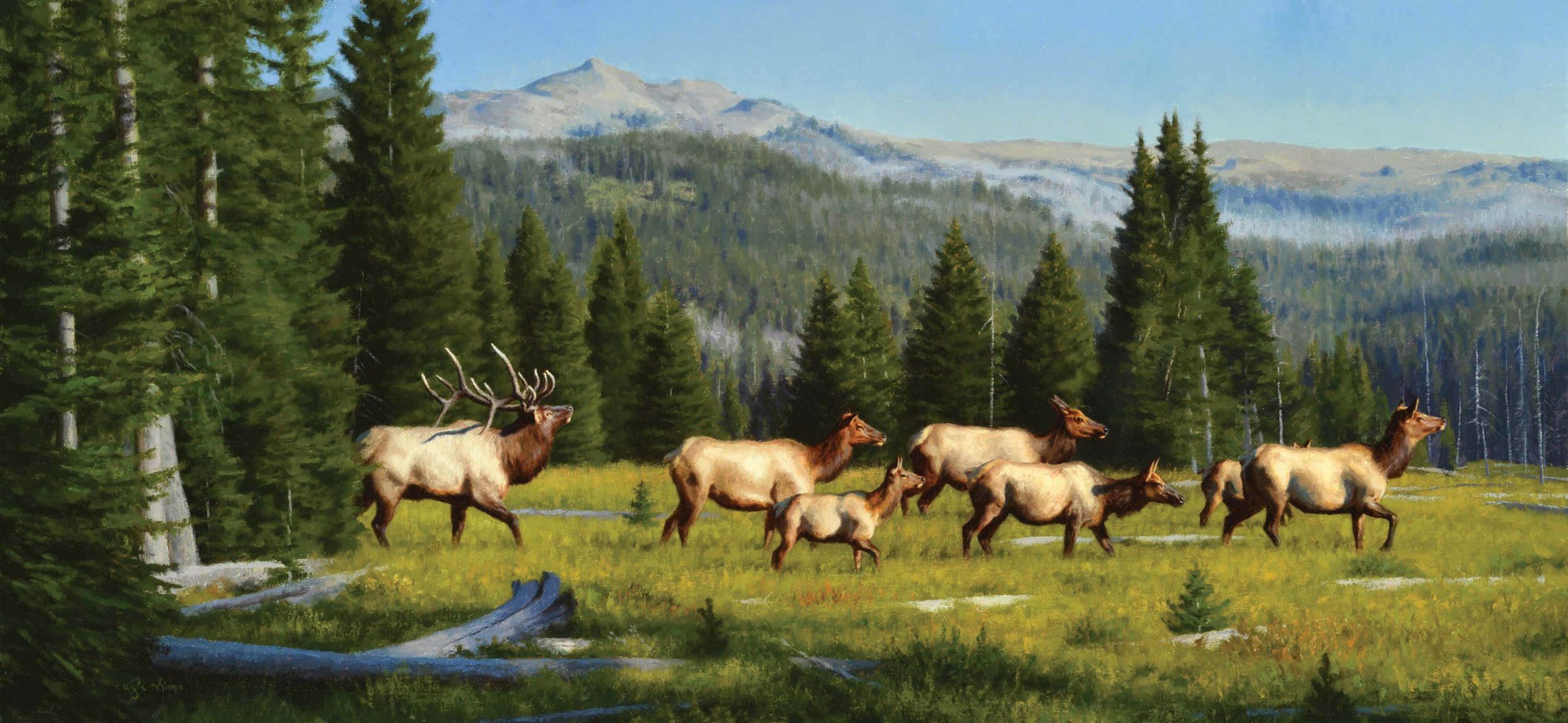
The Morn ing Show | OIL ON CANVAS | 27 X 58 INCHES
Meanwhile, at Young’s urging, Sims started heading outside to paint from life with oils. “Paco and his wife, Toni, took over the Beartooth School of Art for a while, and I was helping them, kind of like their waterboy. And John Banovich taught a workshop there, which I got to attend for free. Seeing his controlled, slow process enabled me to get used to working in oils in the studio.”
After one workshop at Beartooth in 2004, some of the attendees visited Trailside Galleries in Jackson Hole, where they enthused about Sims and his work to its managing partner and CEO, Maryvonne Leshe. “She called Paco and told him she wanted to see my stuff,” Sims says. “Within a year, she had sold some, and by 2008, I had my first showcase of six to eight pieces there.”
Though he’s no longer with that gallery, Sims is currently represented not only by Montana Trails but also Astoria Fine Art in Jackson, Wyoming; Broadmoor Galleries in Colorado Springs; and Paderewski Fine Art in Beaver Creek, Colorado. Over the past two decades, his work has earned him ever-growing recognition, including — to name just a few — repeated appearances in the Buffalo Bill Art Show & Sale in Cody, Wyoming; Masters of the American West at the Autry Museum of the American West in Los Angeles; the aforementioned Prix de West; and Western Visions at the National Museum of Wildlife Art in Jackson.
Along the way, Sims’s work has grown only more assured, lifelike, and dramatically immediate.
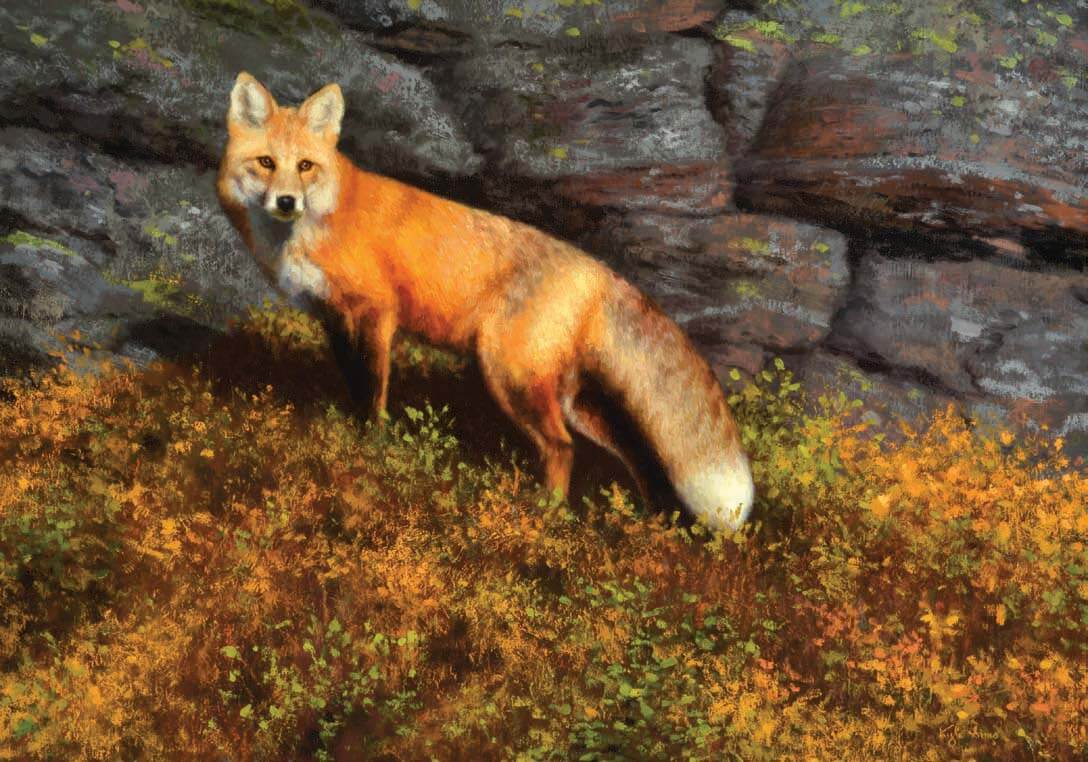
A R ich Fall | OIL ON CANVAS | 24 X 34 INCHES
Almost all his paintings begin with his travels across the West. “My first step is always to get out in the field,” he says. By making oil studies, “I start to get a true sense of my subjects’ color, what real life looks like.” He also takes copious reference photographs, grateful for the change from slides to digital photography. “It’s hard to view slides,” he says. “And with digital, you can take a picture, compare it on the spot to the real thing, and adjust the settings.”
Beyond such technicalities, he says, his approach to creating a painting differs from one work to the next. “Sometimes I start with the landscape and incorporate the animals. For others, I’ll start by drawing the animals because I know exactly where I want them, and then draw the landscape around them, making some changes along the way for the sake of the composition.”
And at times, he’ll make changes to both the central subjects and the setting as a particularly complex painting continues to evolve. Take, for example, his recent Children of the Water, which measures 34 by 66 inches. Featuring a quintet of river otters gathered in and around a pool at the bottom of a rushing, rocky cascade, it began with a photo of a “hero otter” — the one in the painting that’s poised on a rock, staring directly at the viewer — from a trove of images that were passed along to him after Young’s too-soon demise in 2005 at age 47.
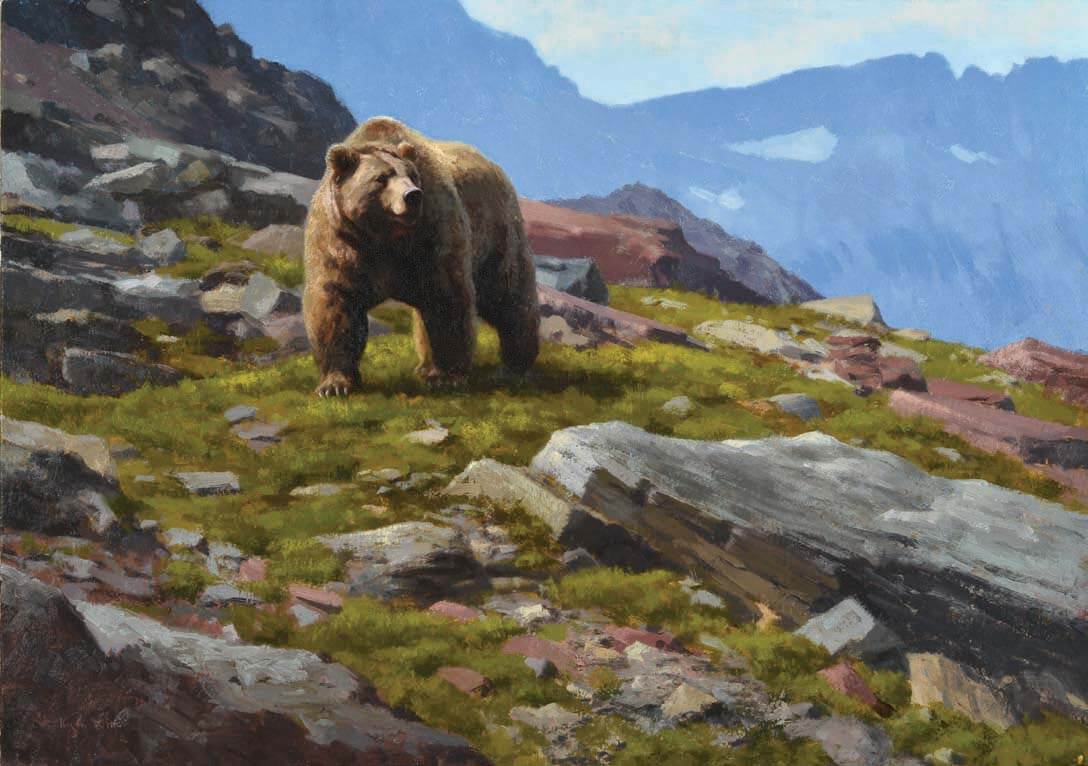
Wild and Free | OIL ON CANVAS | 26 X 36 INCHES
“In thumbnail drawings, I started with [that otter], but it just wasn’t working,” Sims says. “So, I decided to go bigger, more epic, and he became the focal point for the painting’s overall shape. And I just started creating around that, adding the other otters and the rocks and water as I went along. I love painting otters and falling water, but this is probably the most epic piece of its kind I’ve ever done.”
Epic, indeed. In a close study of the painting, viewers may marvel at the overall composition, the lifelike verisimilitude of the semi-aquatic mammals, and the setting’s high drama. Yet, as with all Sims paintings, a closer consideration offers up even more, deeper pleasures. Consider, for example, how what appear to be almost photorealistic animals are, in fact, rendered in richly expressive brushstrokes that seem to imbue them with their very lifeforce. And the surrounding scenery, unmistakably a mountain course backed by deep, dark woodlands, appears, when inspected inch by inch, to be marvelous passages of impressionism verging on abstraction. “But when you back away from it,” the artist concludes, “it just feels alive.”
Weeks, the director of Montana Trails Gallery, sincerely agrees with that assessment and applies lifelike qualities to all of Sims’s pieces. While his wildlife subjects may be traditional, she says, his compositions “allow the animals to stand out. Kyle’s work feels unmatched, fresh, and very much of the present day. When people are looking to invest in their collections, he’s among my first recommendations. And yet, in the grand scheme of things, he’s still in the early days of his career.”
From his base in Marin County, California, Norman Kolpas writes about art, architecture, travel, dining, and other lifestyle topics for magazines, including Western Art & Architecture and Southwest Art. He’s a graduate of Yale University and the author of more than 40 books, the latest of which being Foie Gras: A Global History. Kolpas teaches in The Writers’ Program at UCLA Extension, which named him Outstanding Instructor in Creative Writing.
No Comments