


31 Jul Tuning In to Sacred Spaces
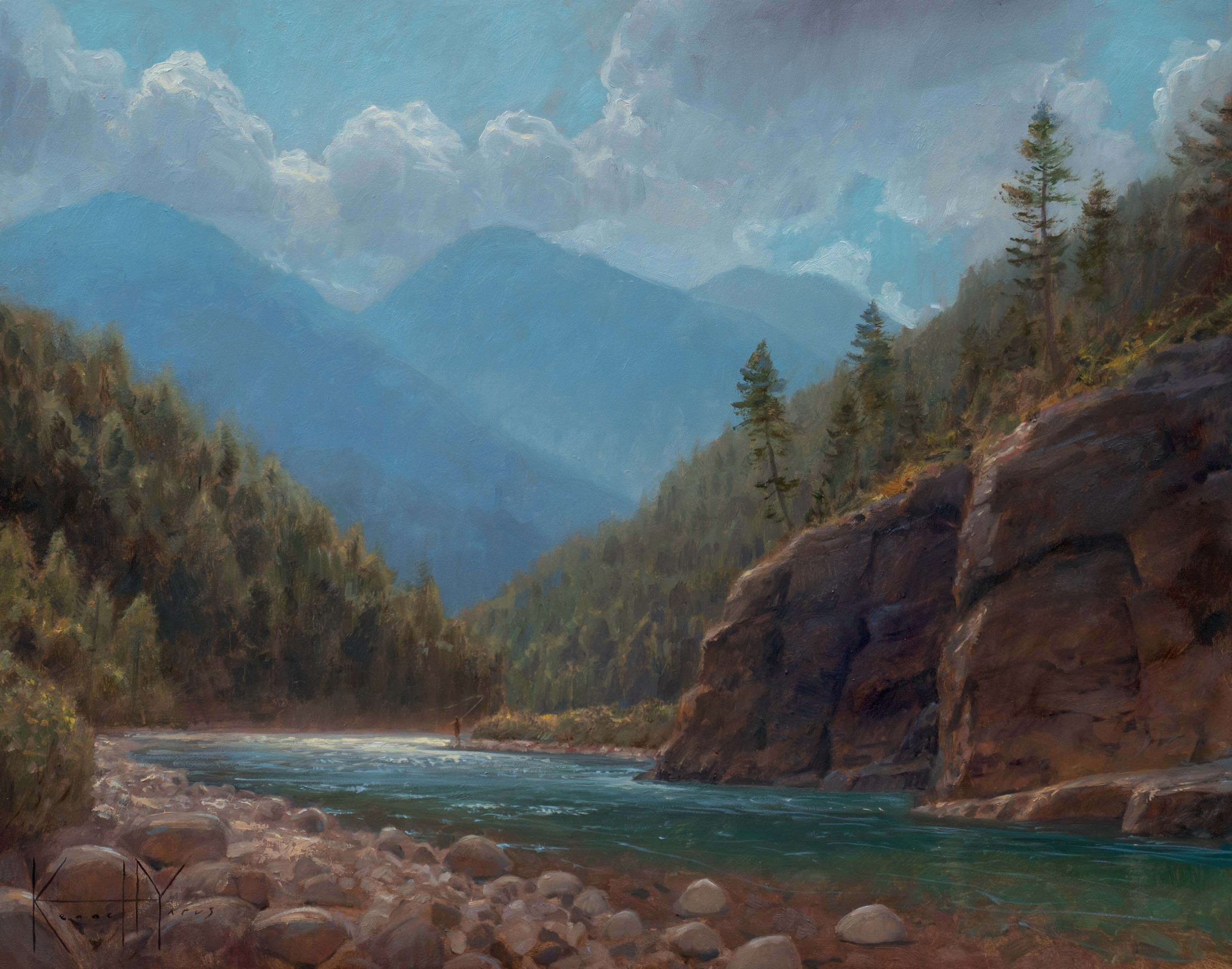
For many viewers, the first thing that emerges when observing a Kenneth Yarus painting isn’t the sheer scale of the mountains, the glint of glacial water, or the depth of the alpine sky. It’s how the piece makes a viewer feel — an emotional resonance. More than merely depicting scenes in Glacier National Park, Yarus’s works impart a clear sense of what it feels like to be there, breathing thin air and watching shadows slide across the peaks.
“Ken really wants the viewer to experience the landscape the same way he did,” says Derek Vandeberg, owner of FoR Fine Art in Whitefish and Bigfork, Montana. “There’s a compelling, nostalgic quality to his work — a romanticization that I’ve always found incredibly powerful. He really knows how to celebrate the majesty of these incredible outdoor places.”
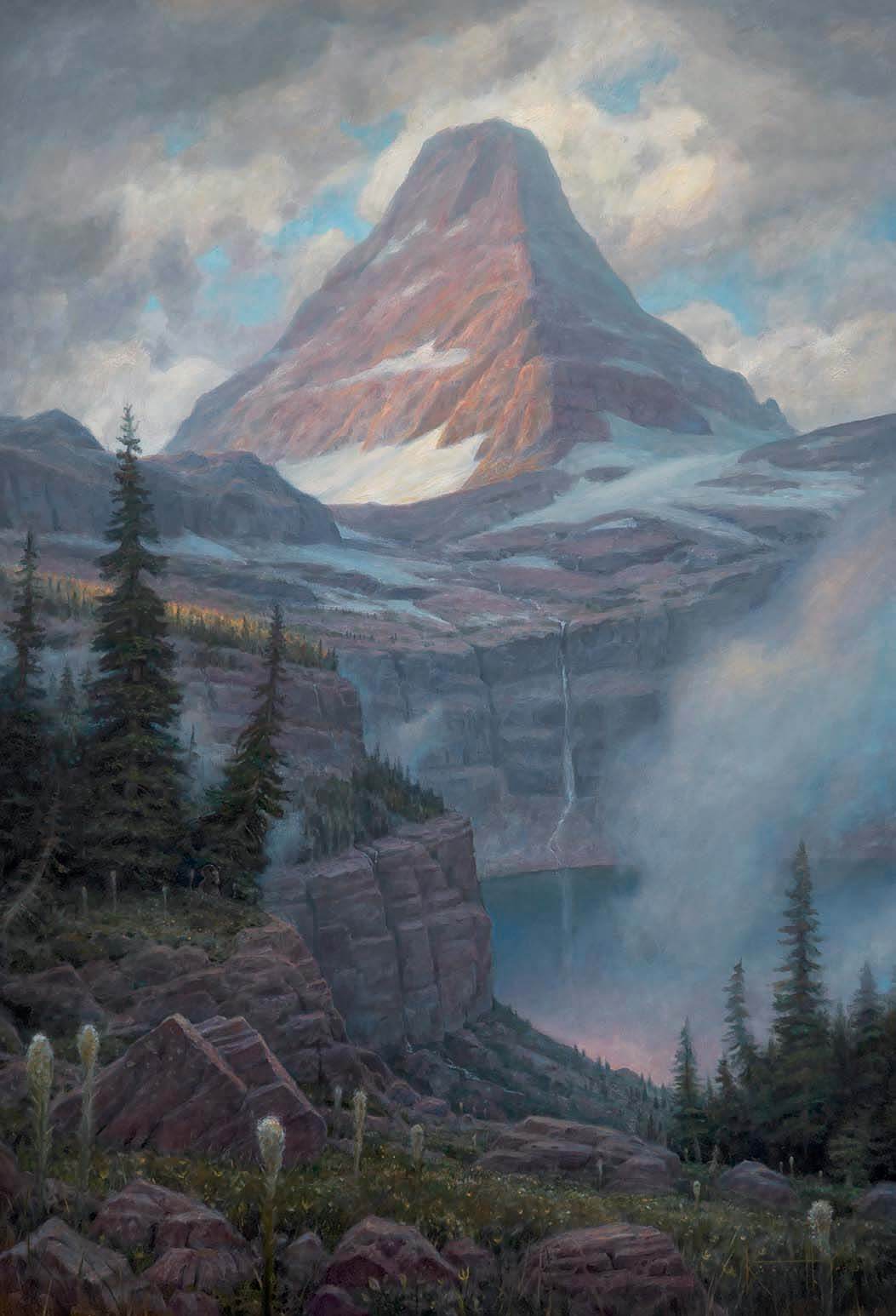
What Points the Way | OIL ON CANVAS | 72 X 48 INCHES
At its core, Yarus’s art is about quiet listening and tuning in — to the landscape, the temperamental mountain weather, and the subtle, fleeting ways that light transforms a familiar facade. It’s about bringing to life these sacred spaces so that someone in a town, in a home, or in a gallery can truly feel the experience.
“The process of going out into nature always feels like a recentering of my compass,” Yarus explains. “Everything in my life seems to fall more into place when I’m out there. My process of making paintings is simply trying to share that quietness and that resonance with other people.”
Yarus’s work is shaped first and foremost by place, and much of the emotional power in his paintings comes from his own time spent outside.
“Most of these views don’t come from the parking lot,” he says. “It typically takes me a mile or two of hiking, sweating up switchbacks, and getting up to a place where, suddenly, I feel it again. I feel myself. I feel that connection that can get easily lost when you’re down in the franticness of everyday life.”
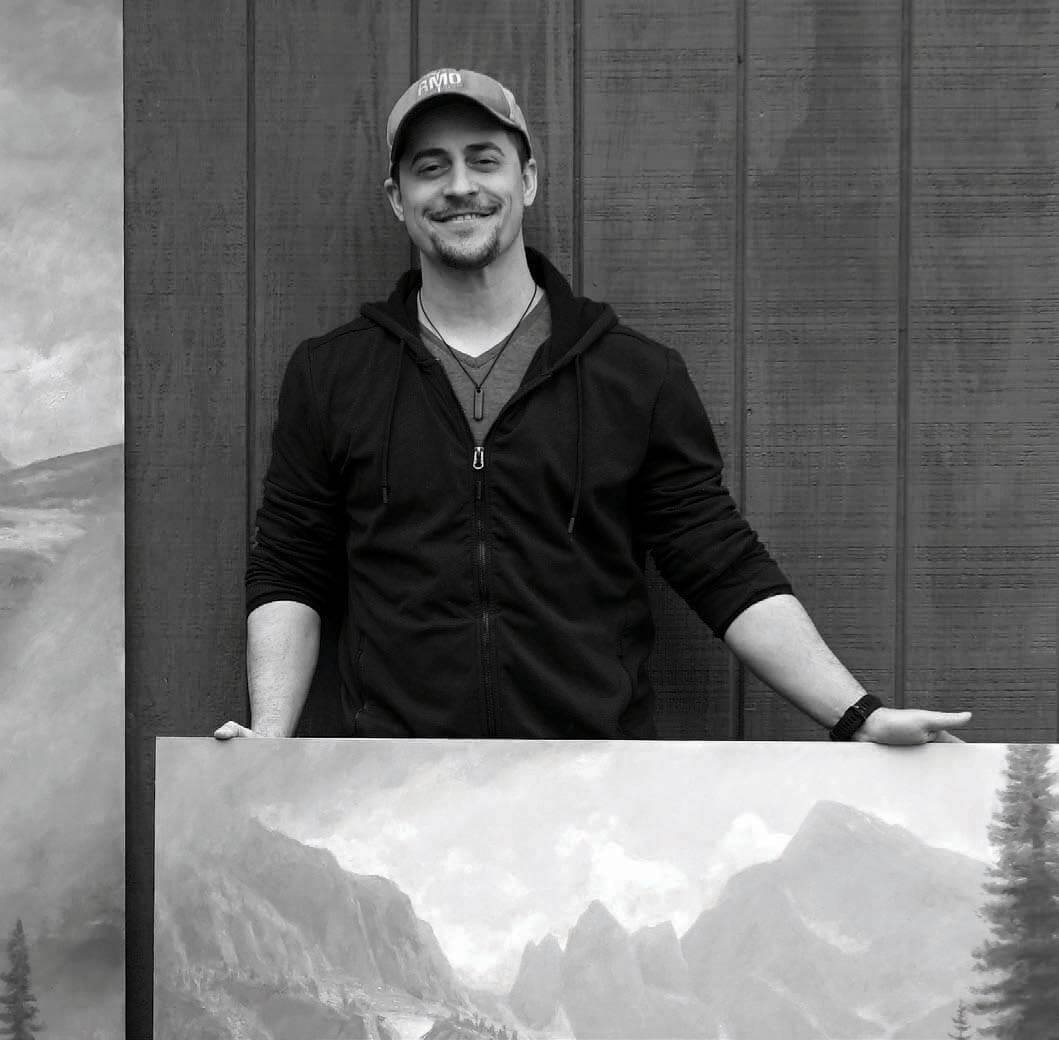
As an artist, Kenneth Yarus feels that it’s his job to capture something more than simply the place itself: His goal is to share the emotional truth of the experience. | KENNETH YARUS
Painting is, in part, Yarus’s way of revisiting that feeling — long after the hike is over and the body is back in the studio.
Take, for example, his dramatic large-scale canvas titled The Way to Rest. The piece grew out of a grueling trek to a high alpine lake. For Yarus, the journey and arrival felt like a form of renewal. “It’s how I choose to rest,” he says. “Some people prefer to rest by sitting on a couch. Me? I want to climb a mountain and suffer a little bit to find my peace.”
For Yarus, a painting is more than a detailed record of a particular location. His are rooted in very real, iconic geography — St. Mary Lake, Iceberg Lake, the Bob Marshall Wilderness, the Mission Mountains, and the Cabinets — but his finished pieces evolve into something far truer than a photograph could ever capture.
“As an artist, I feel like it’s my job to make something more than the place itself — something bigger, deeper, and completely saturated with the awe I felt in that moment,” he says. “I want to share the emotional truth of the experience.”
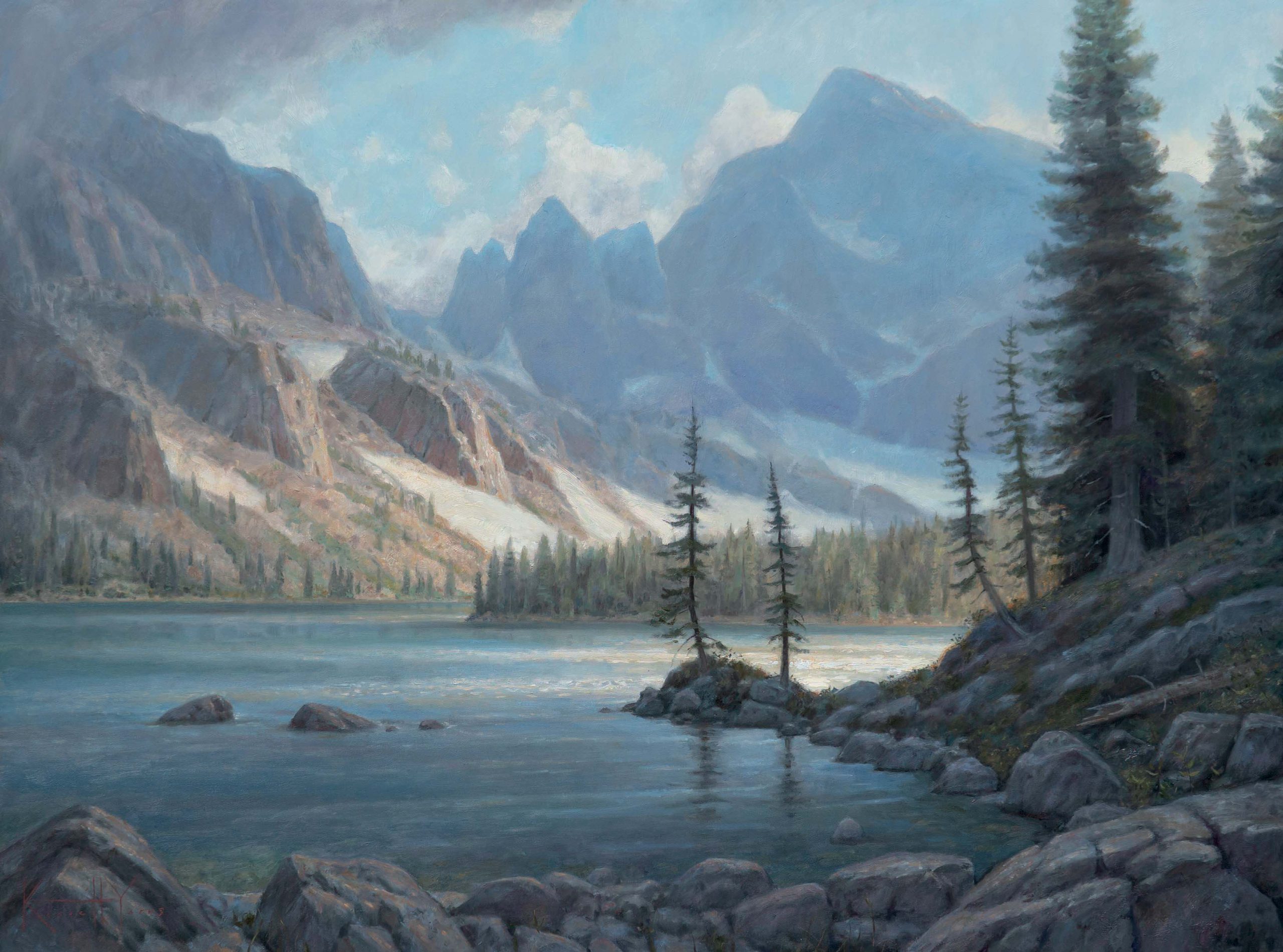
The Way to Rest | OIL ON CANVAS | 36 X 48 INCHES
Consider What Points the Way, a piece that explores how peaks act as landmarks of orientation. On a map, they are physical markers to guide a hiker. Metaphorically, though, they represent points in life — the hardships and steep climbs that give our everyday experiences shape, beauty, and meaning.
“I think about these places as sacred,” he says. “There are a lot of threats to our natural places right now. Painting them is my way of trying to honor them, to keep them safe, and to remind people why they matter.”
While Yarus’s finished paintings exude a romantic, dreamlike quality, his technical execution is organized, analytical, and deeply rooted in historical academic traditions.
Yarus grew up in Kalispell, Montana, surrounded by the very peaks he now paints. His high school art teacher, Susan Guthrie, recognized his talent early on and pushed him to take his creative ambitions seriously. She helped him secure a spot in a student exhibition at the Museum at Central School, and his father reached out to Vandeberg, in search of frames. “They came in and started unwrapping these paintings, and my jaw just dropped,” Vandeberg recalls. “I thought, This kid is seriously good.”
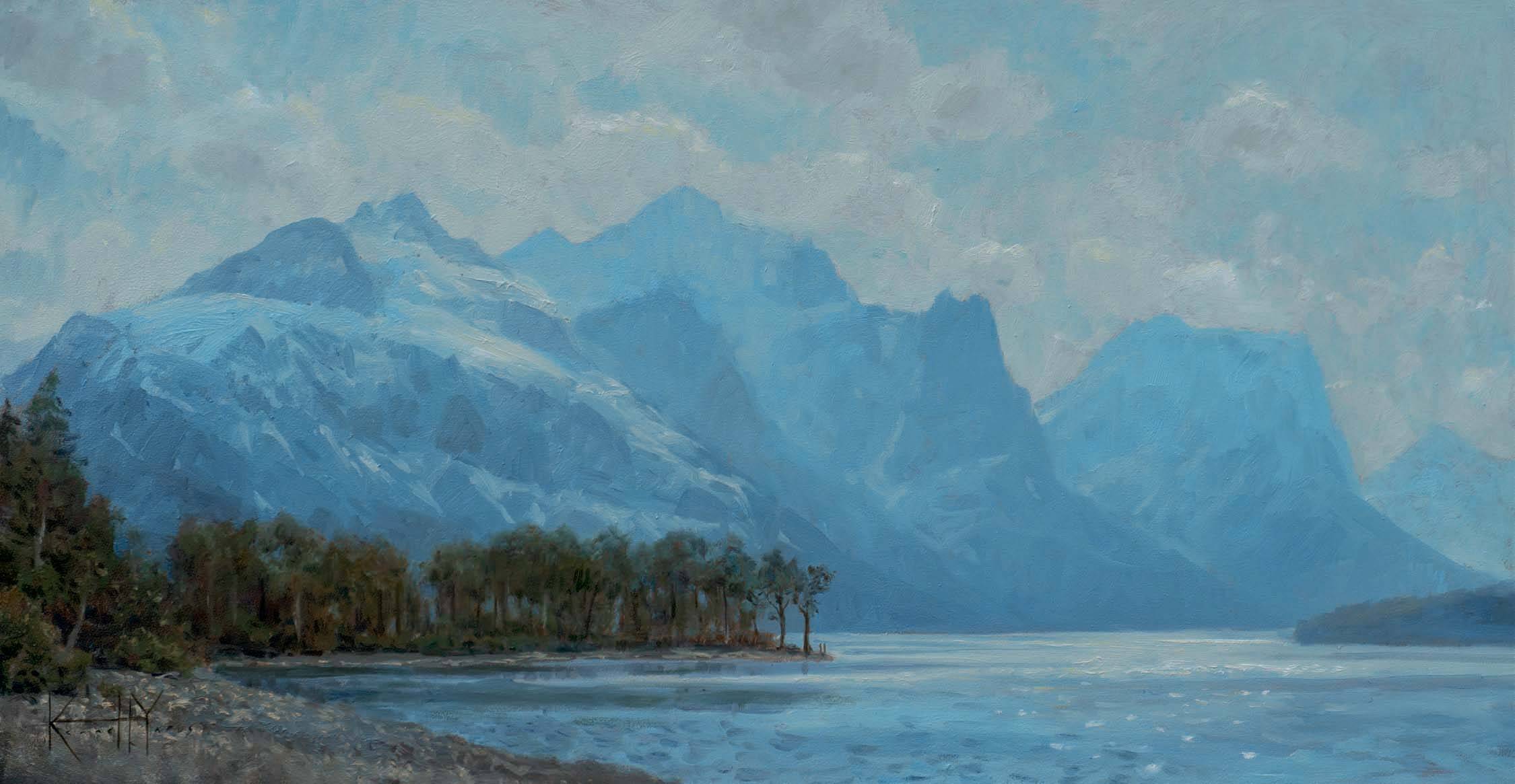
Before the Thaw | OIL ON CANVAS | 12 X 24 INCHES
Yarus went on to pursue his academic education at the Ashland Academy of Art in Oregon and the Grand Central Atelier in New York City, both known for their intensive, skills-focused training modeled after rigorous 18th- and 19th-century European academy traditions. The first thing the teachers did was take away Yarus’s paint. Instead, he worked with pencil, charcoal, Conté crayon, and graphite — drawing apples, trees, the curve of a back, muscles under skin. The focus was pure draftsmanship.
“To this day, when it comes to drawing ability, Ken is one of the finest artists I’ve ever worked with,” says Vandeberg. “It is astonishing how he can sit in front of a mountain and make it come to life with just a few precise, structural lines.”
Friend and fellow artist Nate Closson reflects on Yarus’s process and ability with a pencil, noting that the artist “doesn’t just wing it. He does a highly refined, finished sketch first. He solves all of his composition and value problems in the drawing, and only then does he transfer that grid to his panel.”
Yarus draws on the legacy of 19th-century American landscape painters, particularly the artists of the Hudson River School and the Rocky Mountain School of Art, such as Albert Bierstadt and Thomas Moran. This Old World training shows up in Yarus’s skillful handling of value, color temperature, and composition. There is a classical, reassuring clarity to his paintings, and like his predecessors, Yarus isn’t afraid to rearrange trees, deepen canyon shadows, or exaggerate vertical scales to better convey the overwhelming majesty of the American wilderness.
There are limits to how far he’ll bend a place — iconic Glacier views like Mount Wilbur or St. Mary Lake have to remain recognizable — but so many of the elements are free for Yarus to interpret and shape.
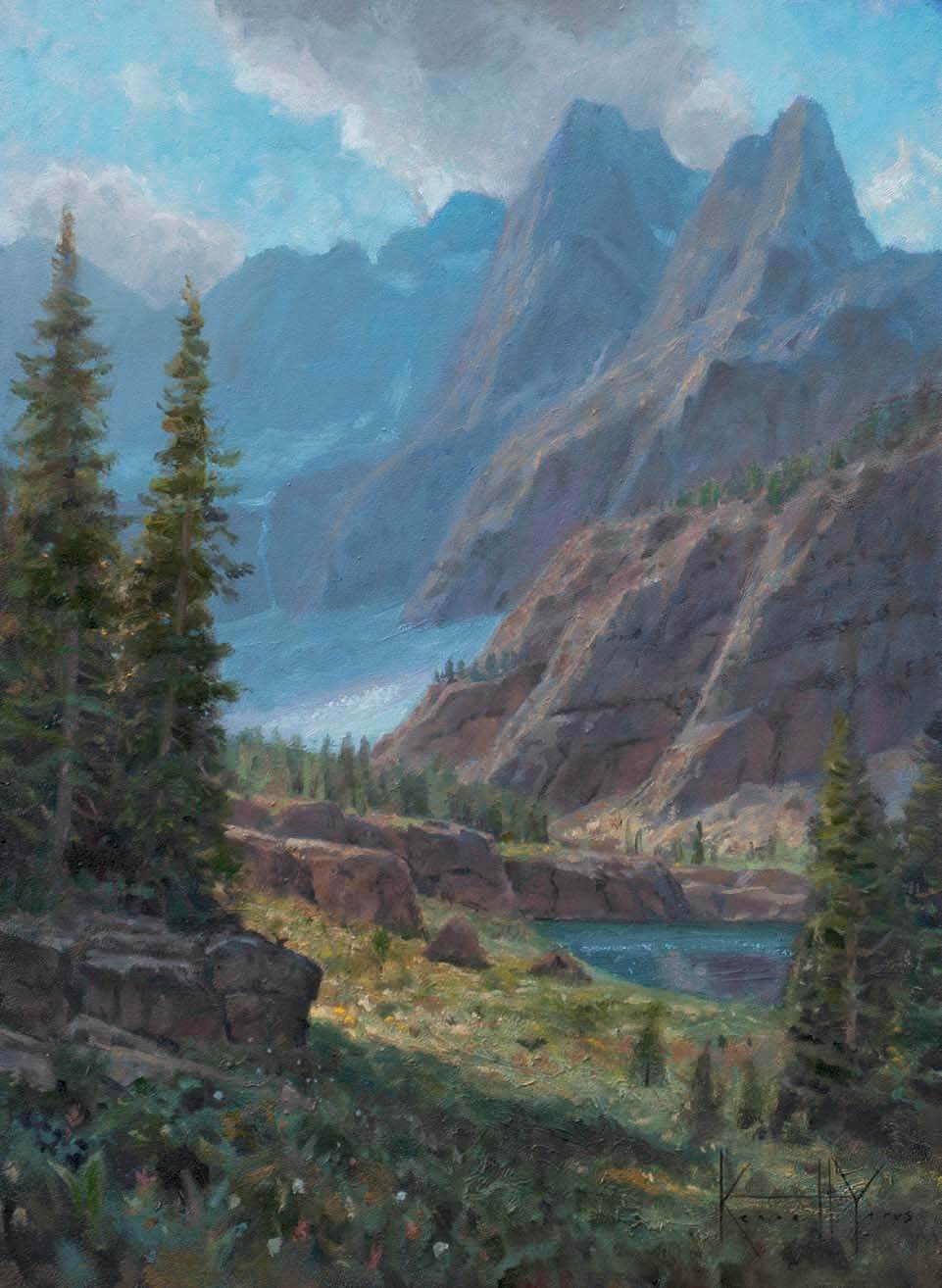
Almost There | OIL ON CANVAS | 16 X 12 INCHES
“With every artist, a painting is a window directly into how their brain processes the world,” says studio mate Richie Carter. “Ken’s work is incredibly realistic on the surface, but it’s also very imaginative. He takes tons of artistic liberties with foliage, rock formations, and light paths to serve the composition. He is OK with letting go of his reference photos and moving into a purely creative, imaginative space.”
Maintaining a sense of playfulness, many Yarus paintings feature a tiny, almost hidden chipmunk — a personal signature and a nod to the reality of most wildlife encounters. “For me, it’s always an absolute treat to spot wildlife when you’re out in the backcountry — and 90 percent of the time … it’s just a little chipmunk,” Yarus says with a laugh. “I’ll paint the scene, and then I’ll stand back, look at the composition, and think, Yeah, a little chipmunk would definitely be sitting right on that rock. So, I paint him in, just for the fun of it.”
Vandeberg points out that this tiny addition serves a dual purpose. “People don’t always understand the scale of these mountains,” he says. “Ken’s little chipmunks and the figures he adds from time to time are a subtle way to help inform the massive scale of these scenes.”
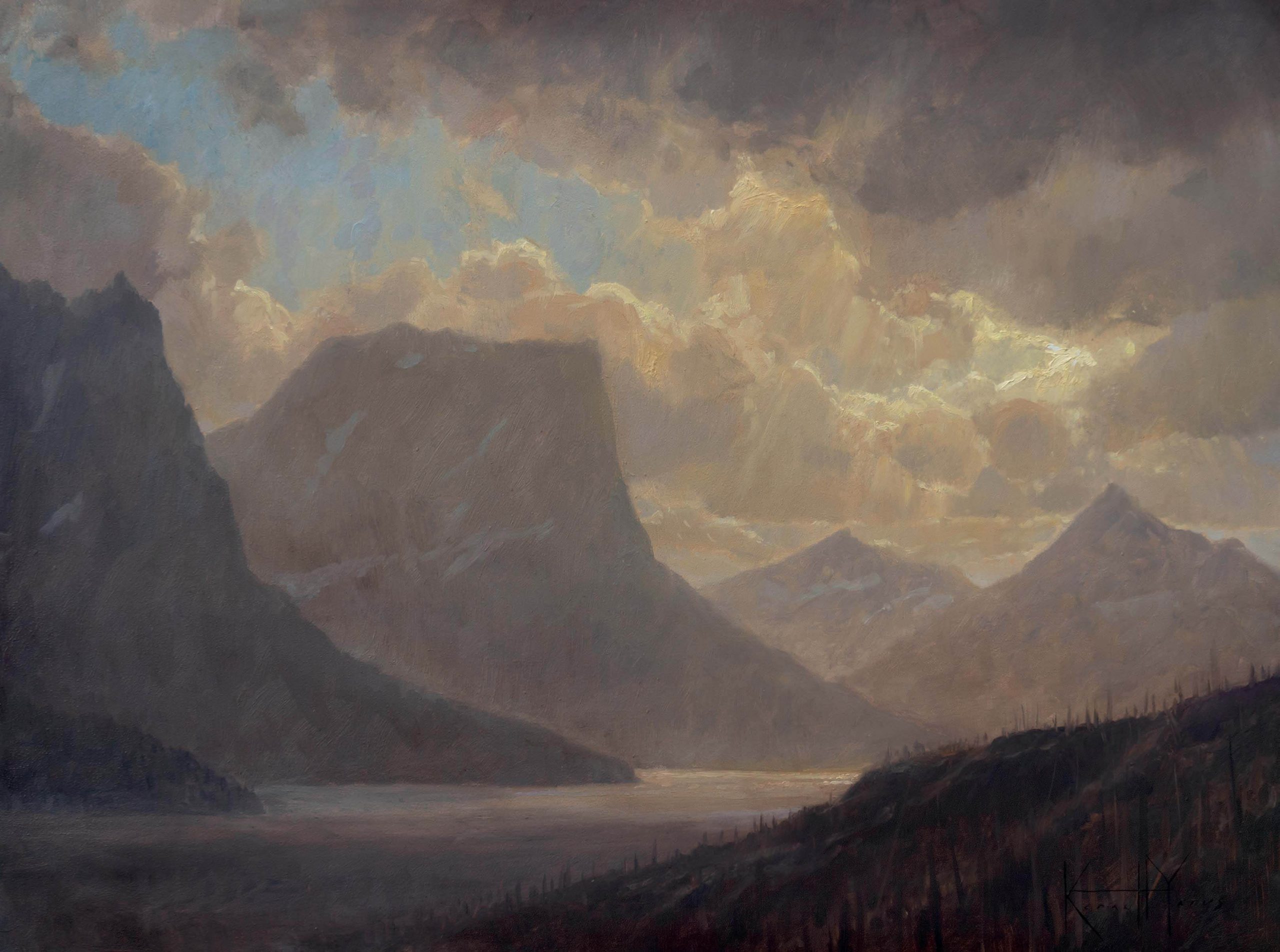
Through the Storm | OIL ON CANVAS | 36 X 48 INCHES
Yarus is often associated with colleagues Closson and Carter. The three connected years ago during Western Art Week in Great Falls, Montana, when their exhibition booths happened to be adjacent. A conversation forged into a creative camaraderie that quickly migrated beyond the gallery floors.
“Soon after we met, we went painting up in Glacier Park for three or four days in a row,” Closson remembers.
Those early trips evolved into longer road trips across Montana and beyond, and friendship grew as they talked about everything from brushwork and art history to philosophy and the world’s problems. “The running joke is that we haven’t actually solved a single one of the world’s problems yet — but we keep exploring, we keep talking, and we keep painting,” says Closson.
These shared adventures are more than just stories; they form a core part of the artists’ creative processes. In recent years, schedules have gotten fuller. There are children now — Yarus’s son, Will, is almost a year old, and Closson is father to three. Their outings aren’t as frequent, but the influence remains.
Sharing a studio with Carter for the past decade has also cemented this collaborative spirit. “We are both so lucky to be two painters working in the same studio who are focused on the same genre but handle different subject matter,” Carter says. “We are constantly ‘borrowing’ each other’s brains — we call it ‘super-braining.’ When we have a problem with the painting that we’re trying to solve, or some sort of technical issue, we can bounce things off each other. And the best part is our brains work very, very differently.”
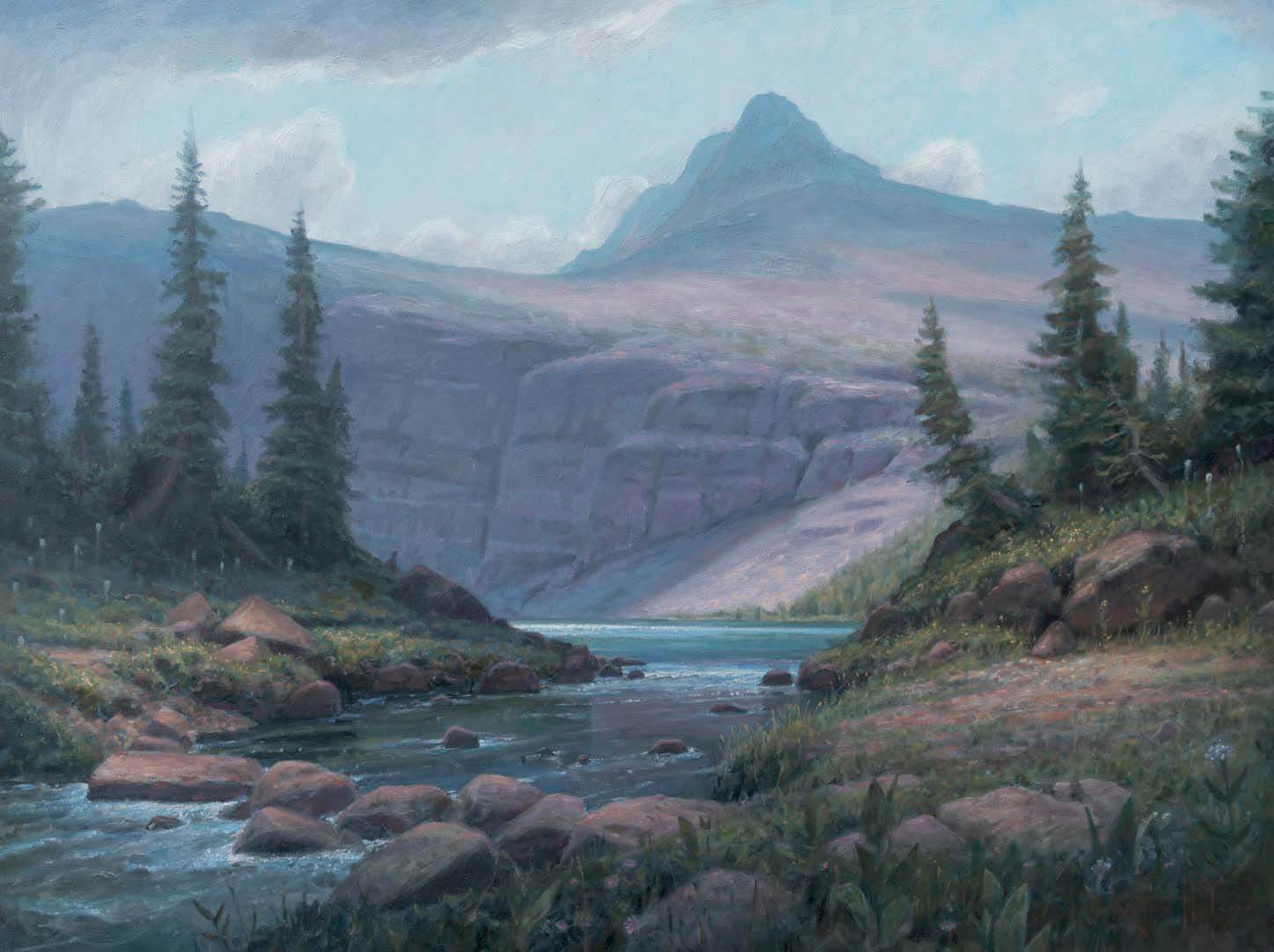
Pitamaken Lake | OIL ON CANVAS | 36 X 48 INCHES
When Yarus discusses his friends’ work, he speaks with immense reverence for their unique strengths — Closson’s luminous, atmospheric skies, and Carter’s thick, expressive paint textures. And when asked what he uniquely brings to the trio, Yarus points back to his obsession with monumental scale.
“I tend to be known for biting off more than I can chew,” he says.
But what he also brings to the group is a big heart, his magnetic personality, and a witty sense of humor.
“Spending time with Ken is just incredibly fun,” says Closson. “He inspires you not just with his polished technique, but in how he deeply looks, thinks, and responds to the wilderness in front of him.”
Carter agrees, adding that “he is one the funniest human beings I’ve ever met. Whether he’s in a good mood or a bad mood, it doesn’t matter, Ken just makes us all laugh. He is also one of the most generous teachers. Whether it’s in the studio or outdoors painting in Glacier, he’s always willing to help. If someone has a kid who wants to paint, he says, ‘Send them over!’ I think one of his neighbors did that for him when he was growing up, and he continues to do that, just really paying it forward. It’s inspiring.”
Yarus says he enjoys being in a position to give back. “You realize you have a linear, teachable process to share. Great art isn’t necessarily some magical, unattainable talent you’re born with. It’s a process. It’s a discipline that you practice every single day.”
In the end, what distinguishes Yarus is not just his rigorous training, his eagerness to get out and explore, or his passion for sharing what he has and knows with others. It’s a balanced blend of the three to translate emotion into paint.
Christine Phillips is a freelance writer based in Whitefish, Montana. She enjoys writing about art, architecture, design, health, and outdoor recreation. When not playing with words and working with her clients, she loves hiking, biking, snowboarding, taking care of her two little dogs, and teaching Pilates.
No Comments