



30 Jan Western Design: Remastered
Architecture | Dynia
Construction | Two Ocean Builders
Interior Design | Dwelling
Landscape Architecture | Verdone Landscape Architects
The land’s storied history where the John Dodge neighborhood is located between Wilson and Jackson, Wyoming — once the home of colorful John Dodge’s Wilderness Ranch — is analogous to the rich architectural history of a home within the area, which was recently purchased by new owners.
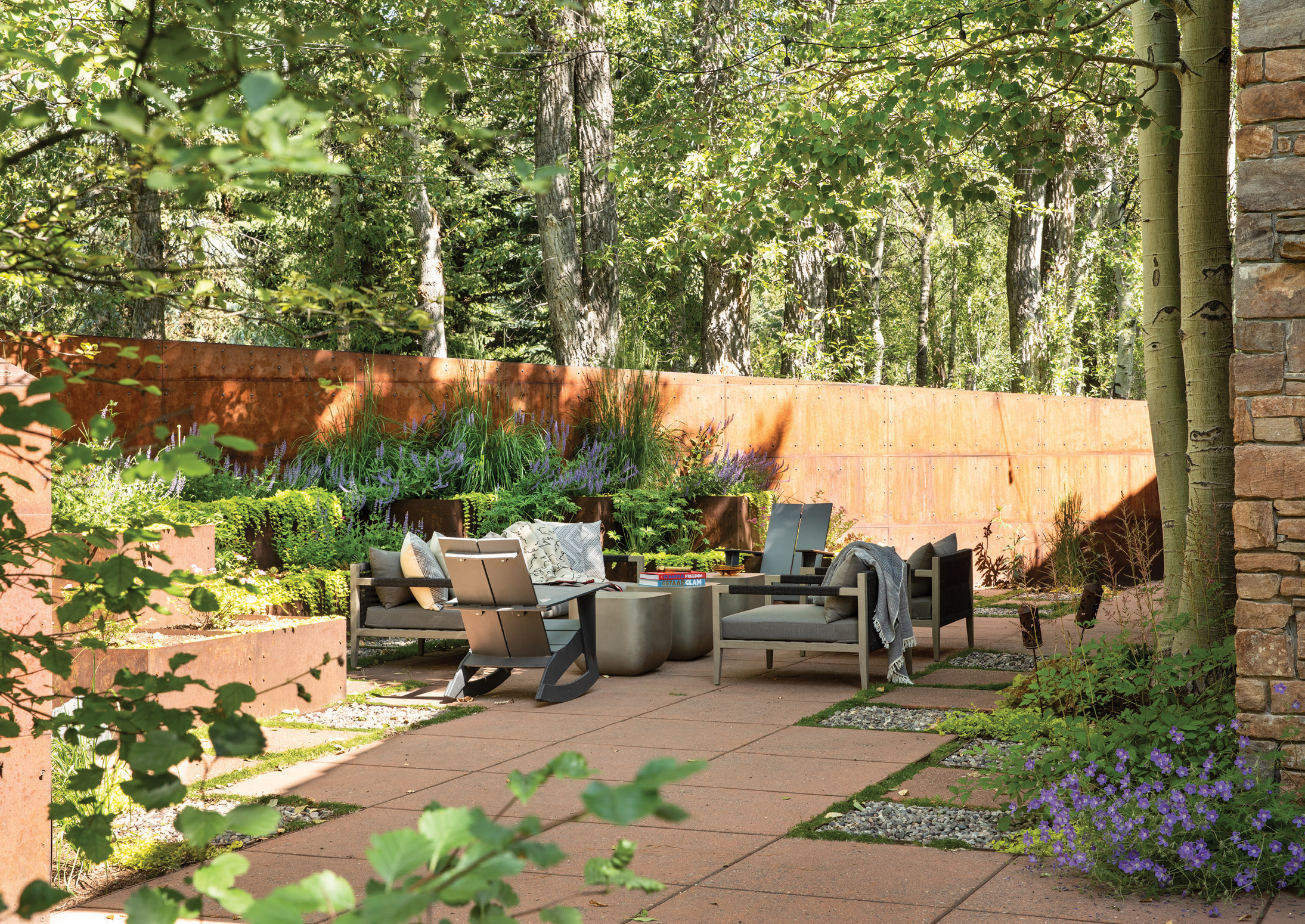
The original gardens surrounding this home constructed in the 1990s were updated with new furniture and refreshed plantings after the property was recently purchased by new owners.
Situated on the edge of the Tetons, the home was originally designed by architect Stephen Dynia in the 1990s, soon after he moved to Jackson Hole from New York City, where he was designing high-rise commercial buildings.
“The home’s progressive architectural attitude was the first of its kind in the area,” Dynia explains. “No one was designing modern homes at the time; this home stepped toward the edge of modern design.”
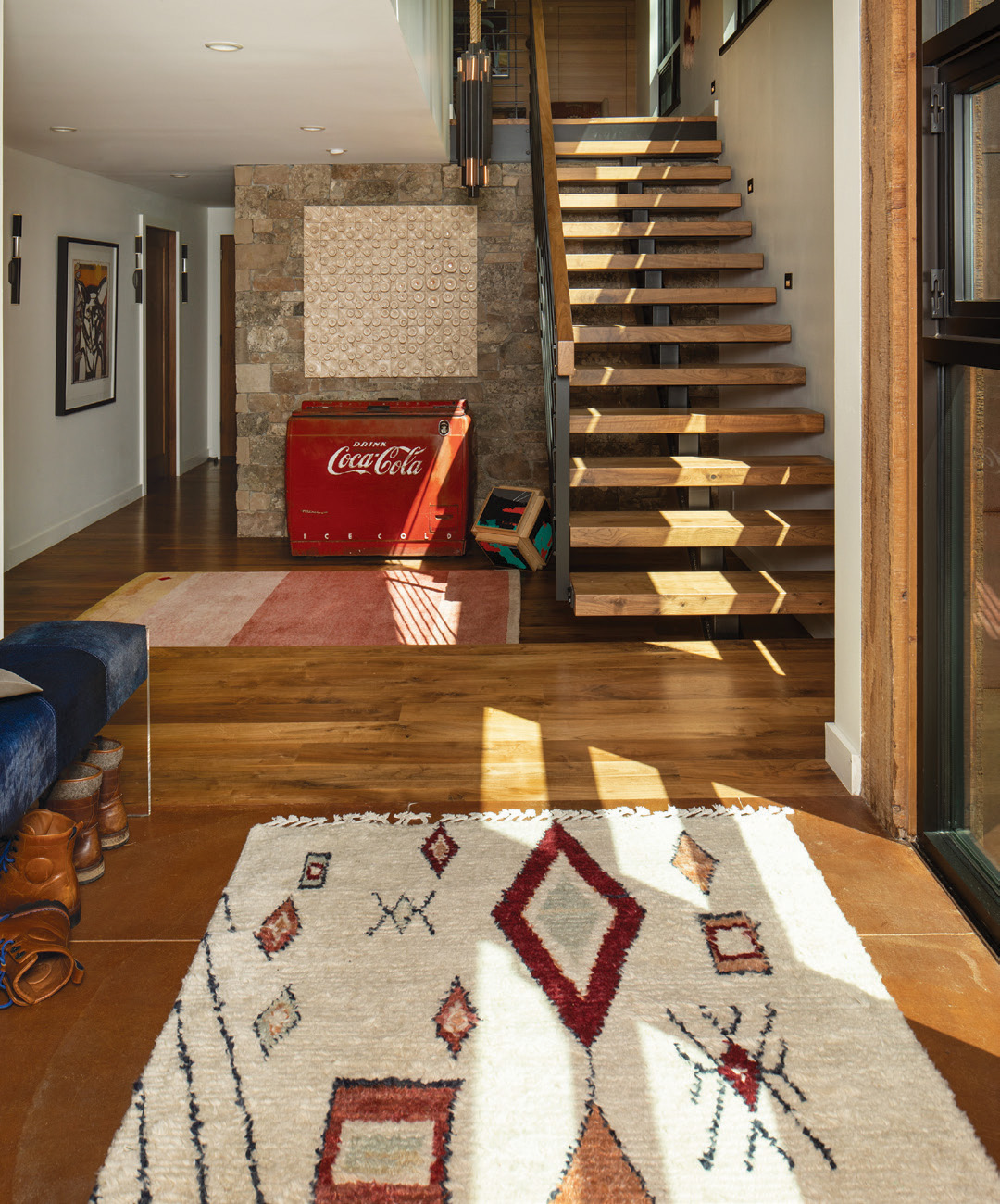
The designer sourced a one-of-a-kind Moroccan rug for the foyer in keeping with one of the home’s design themes.
Dynia, now a professor at the University of Colorado’s College of Architecture and Planning, uses this home as a case study in his lecture series. “I describe the opportunity and impact of coming to a region and introducing a new vocabulary into the area’s architectural vernacular,” he says. “Even though it has been 30 years since I designed this home, it still has a relevant vocabulary — not overtly modern but interesting enough to hold attention for decades.”
The home’s exterior features many desirable elements. A bridge, designed in a subsequent phase for the previous owners, offers an approach to the home over a carefully choreographed stream and pools of water. The original rusted-steel garden wall and tiered garden boxes remain as initially imagined by Dynia. “The house was designed to explore the environment,” the architect explains. Over the years, the previous owners added other elements, including a new garage, more bedrooms, and a home office now used as a media loft. “The project kept coming back to us,” he adds.
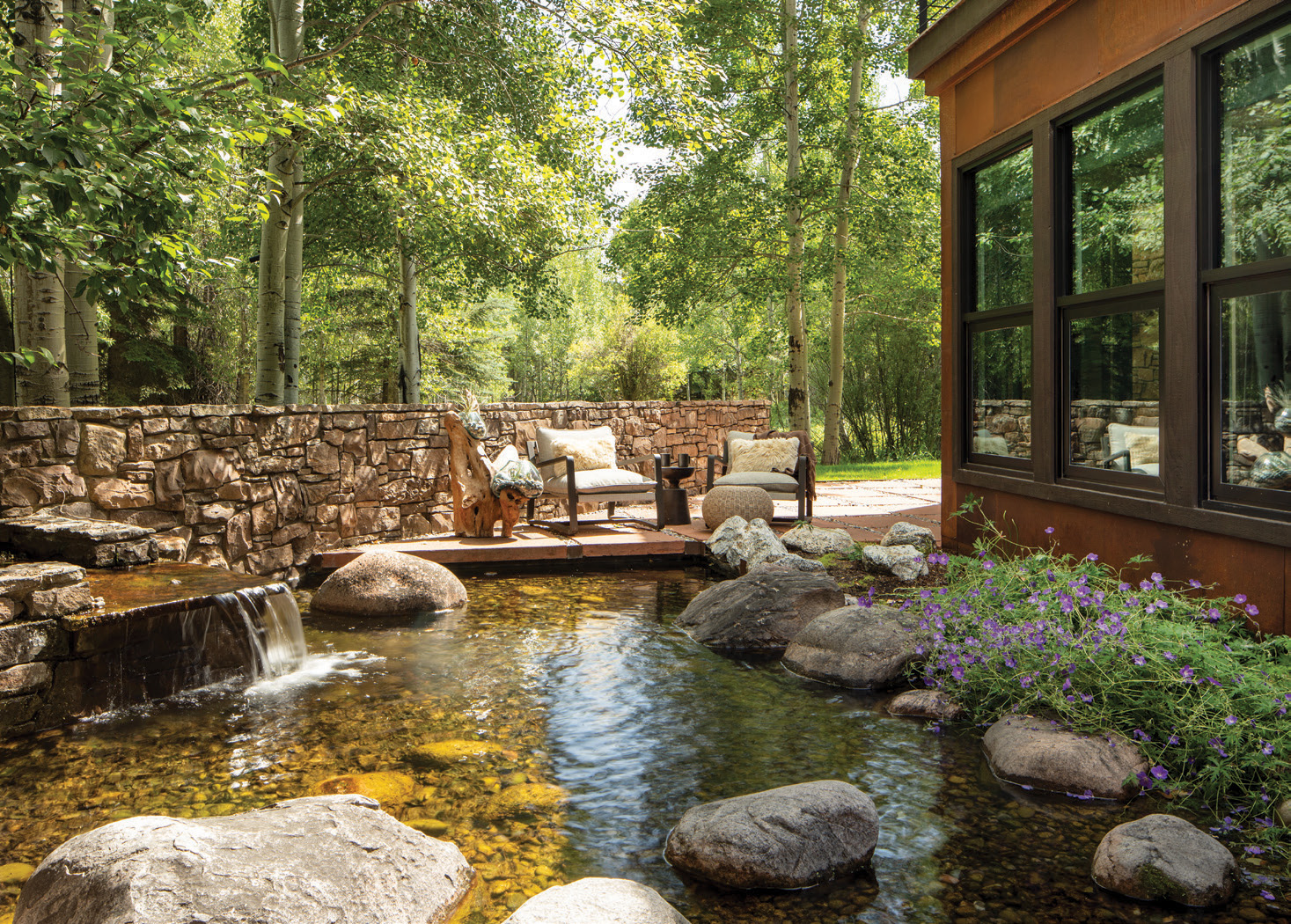
A previous renovation included the addition of a pond, a footbridge, and stepped waterfall features.
The new owner was eager to modernize the traditional interiors to match the modern exterior of stone, black steel, iron, timber framing, and cedar cladding. He hired designer Kate Binger of Dwelling to reinterpret the interiors for his style. “I wanted to preserve the ski chalet roots while adding modern twists and making it cozy,” says the homeowner.
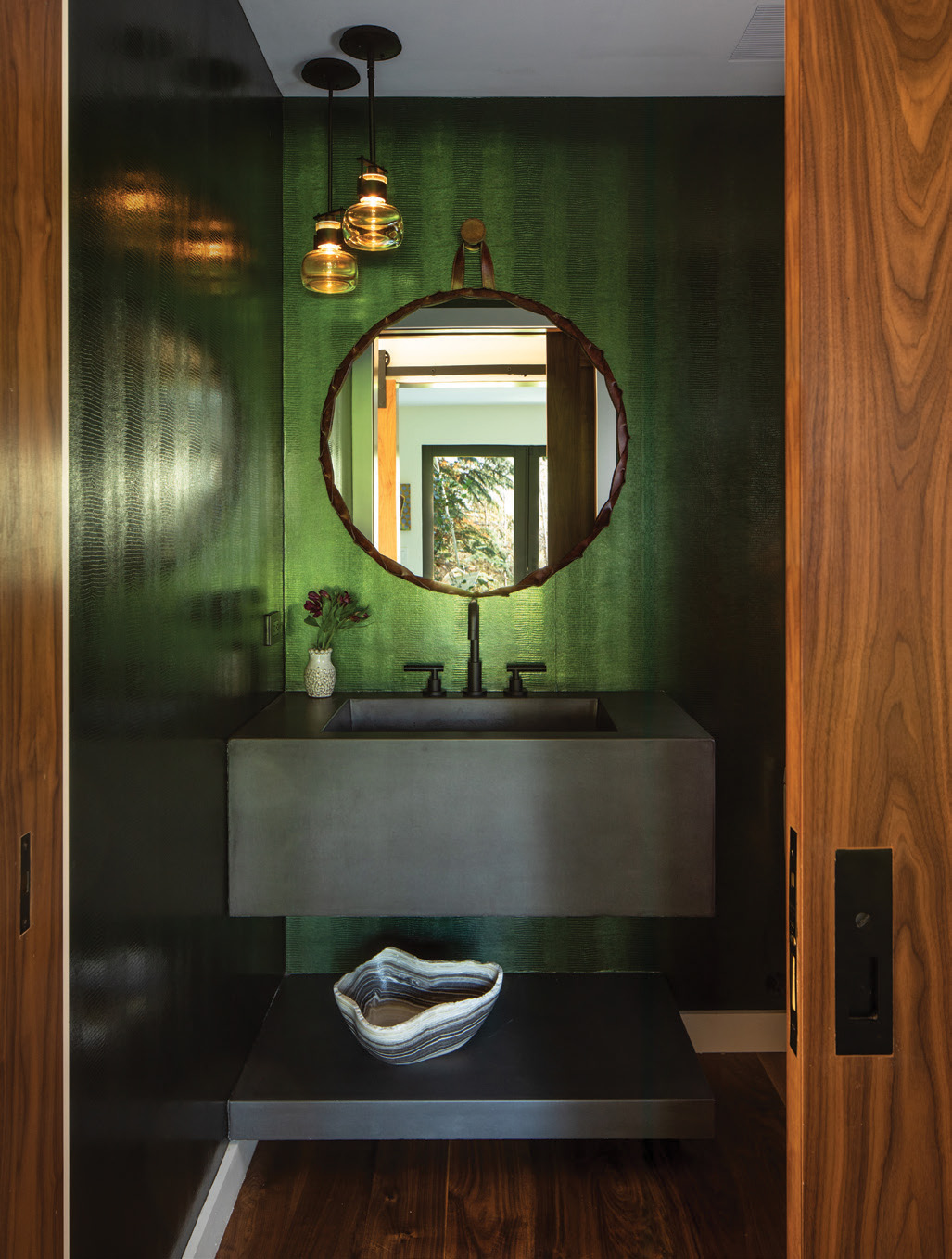
The focus on rich textural layering continues in the powder bathroom.
To answer the call for a new personality, Binger incorporated fabrics infused with texture and rich colors. “I introduced the idea of a Moroccan influence as part of the overall vibe,” says Binger. “The homeowner was open to that idea and also asked for a masculine palette, which I was able to offer through a variety of textures. Layering suede, mohair, cognac leather, rich chenille, and Moroccan Berber and kilim rugs provided depth, warmth, and a masculine feel.”
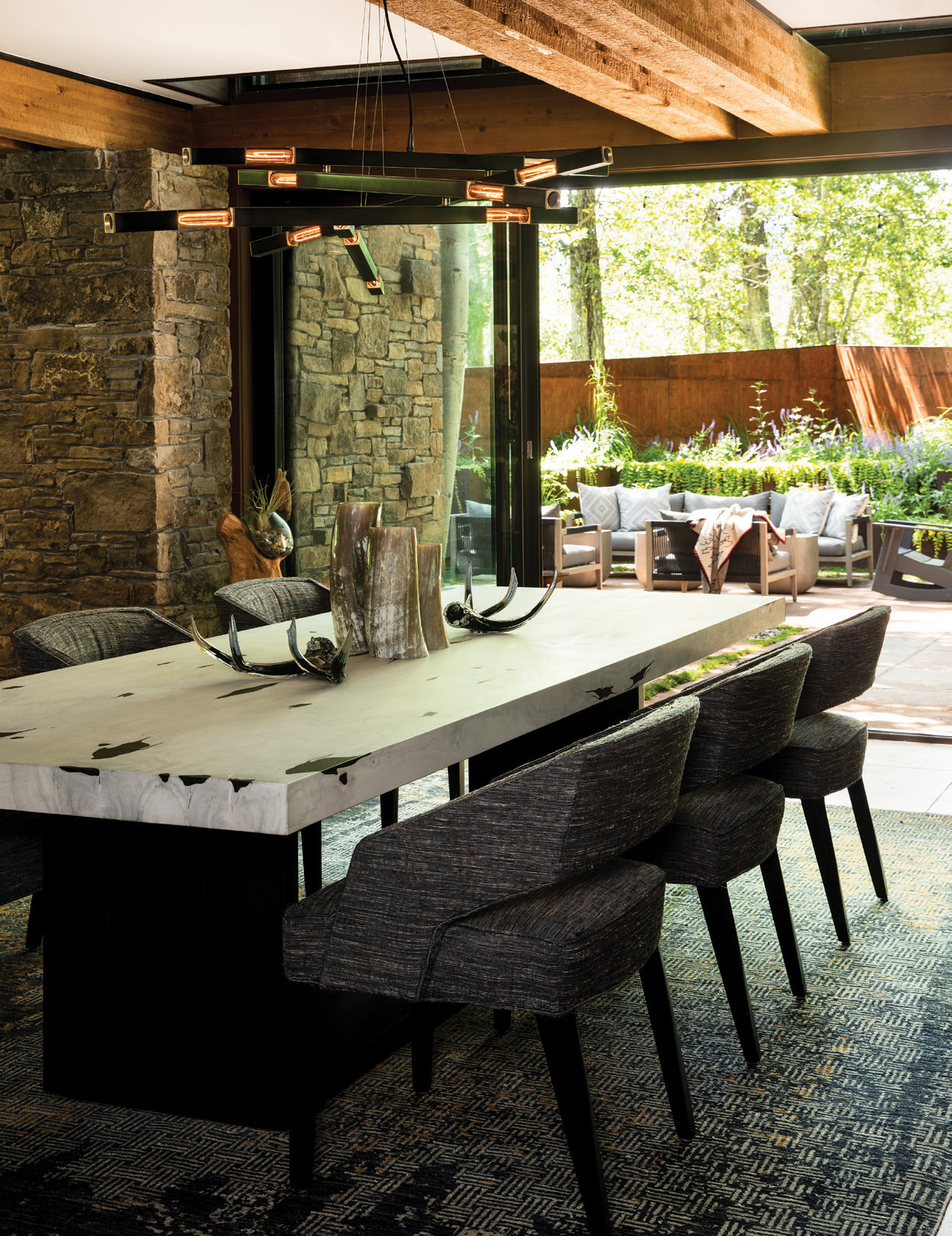
Custom Designmaster Furniture chairs surround an olive-wood table in the dining room that completely opens to the patio. The adjacent garden is protected by a rusted-steel wall that allows an expansion of the interiors while maintaining privacy.
As part of the interior reinterpretation, Binger, working with Two Ocean Builders and the homeowner, gutted and redesigned the interior of the upstairs primary suite, adding walnut stairs and a custom chandelier leading to it. The owner fell in love with the cedar walls in Caldera House, a boutique hotel in Teton Village, so they chose to wrap the bedroom walls with tongue-and-groove cedar planks and use walnut flooring to provide a dose of warmth. A faux mink fur ottoman and leather-strap chairs with quilted velvet upholstery contribute both masculinity and a feeling of contented leisure.
“From the large windows that wrap the second-level primary bedroom, you are ensconced in evergreens,” Binger says. “It feels like a treehouse on the edge of Teton Village. Waking up to those old-growth trees is magical.”
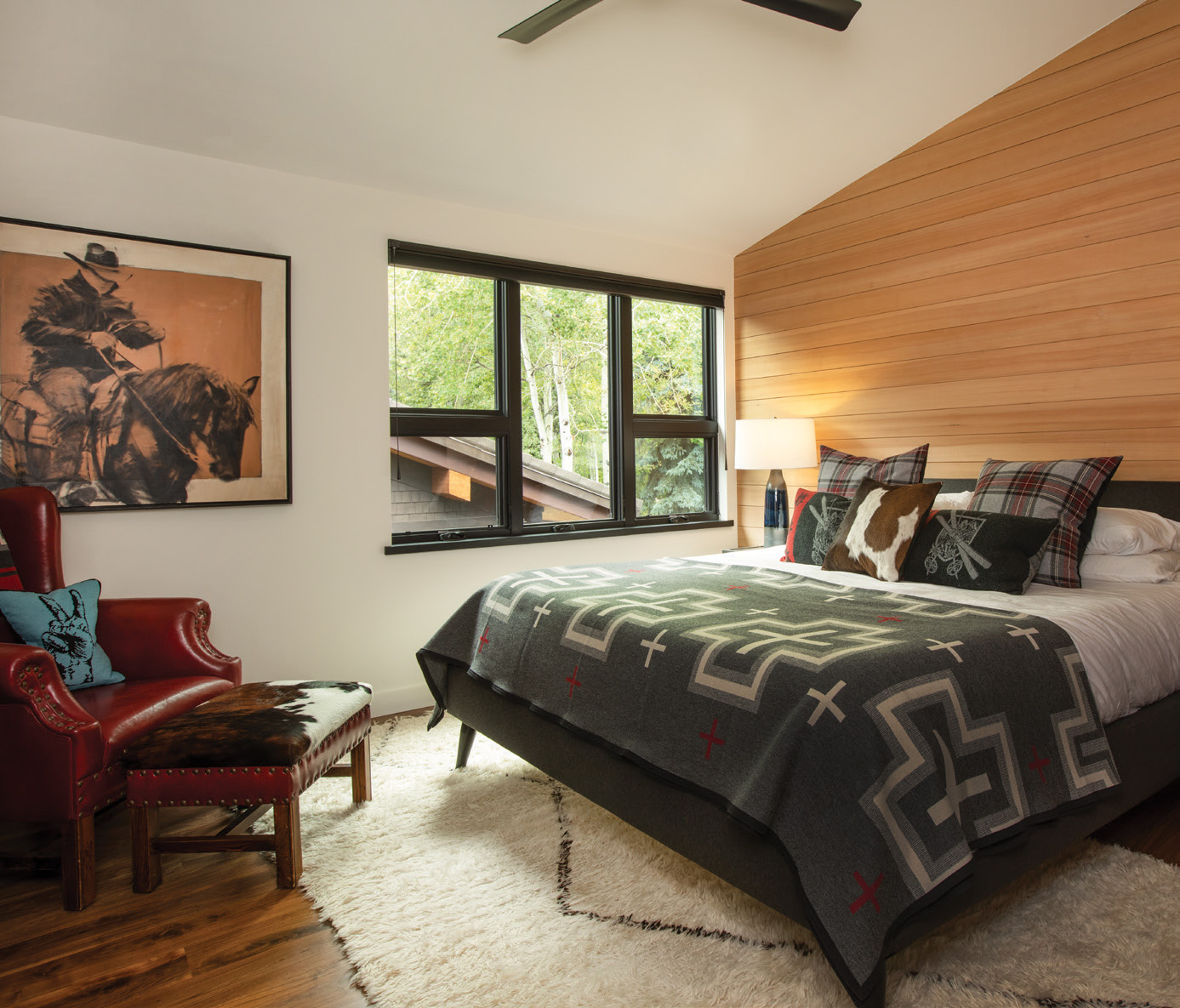
A cedar wall in a guest bedroom serves as a focal point. The intricate geometric patterns of Moroccan style can be seen on the bedcover, while the designer also ensured a masculine vibe by including plaid pillows.
Binger began the primary bathroom’s redesign by choosing a warm-gray marble to complement the hand-selected Moroccan pendants she found while visiting Marrakesh. She bleached white-oak custom cabinetry to soften the palette and added brushed-gold faucets and hardware for a warm sense of luxury.
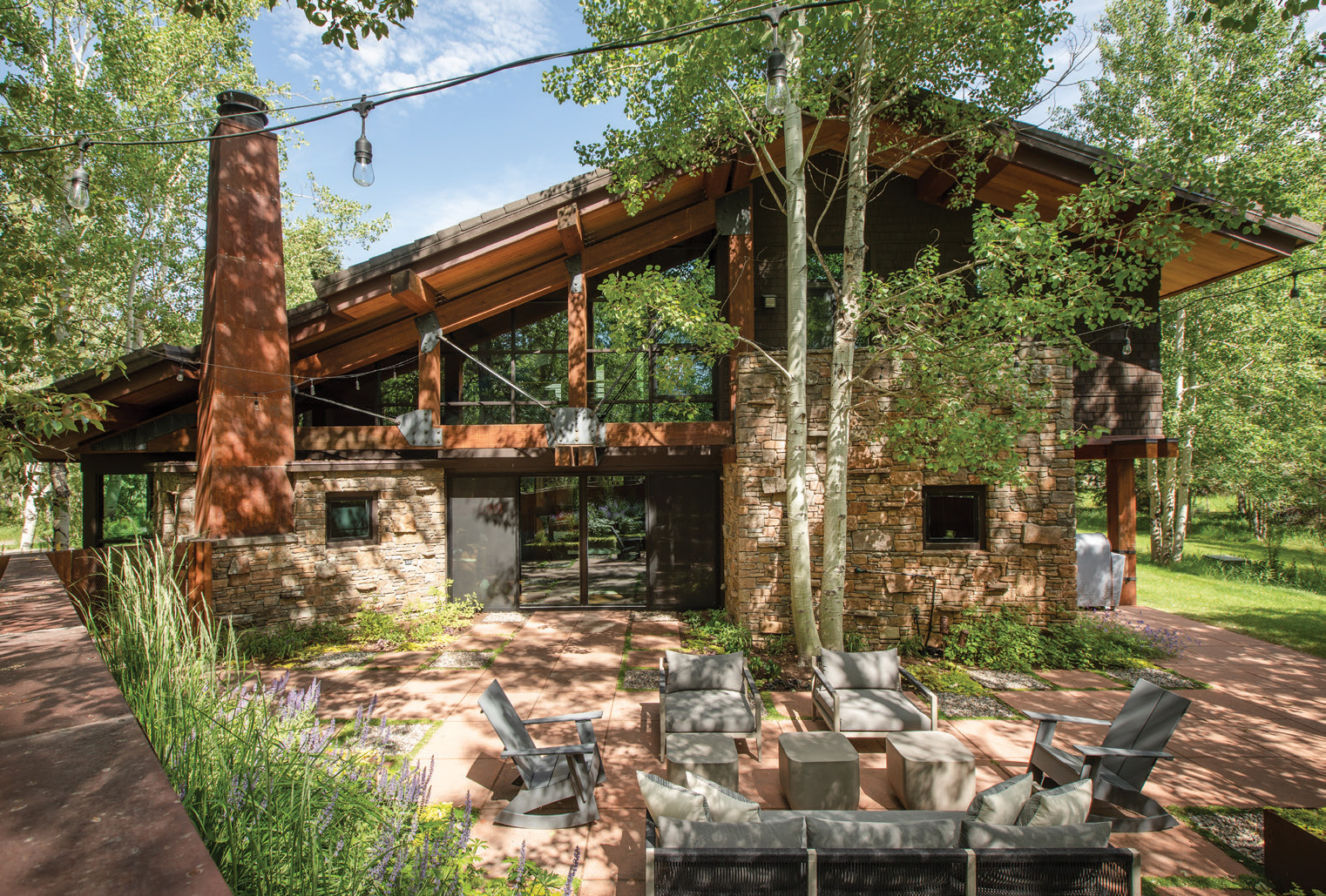
The architect completed the original home, as well as three additions over the years, that he characterizes as being “carefully done to explore the environment while still leaning modern.”
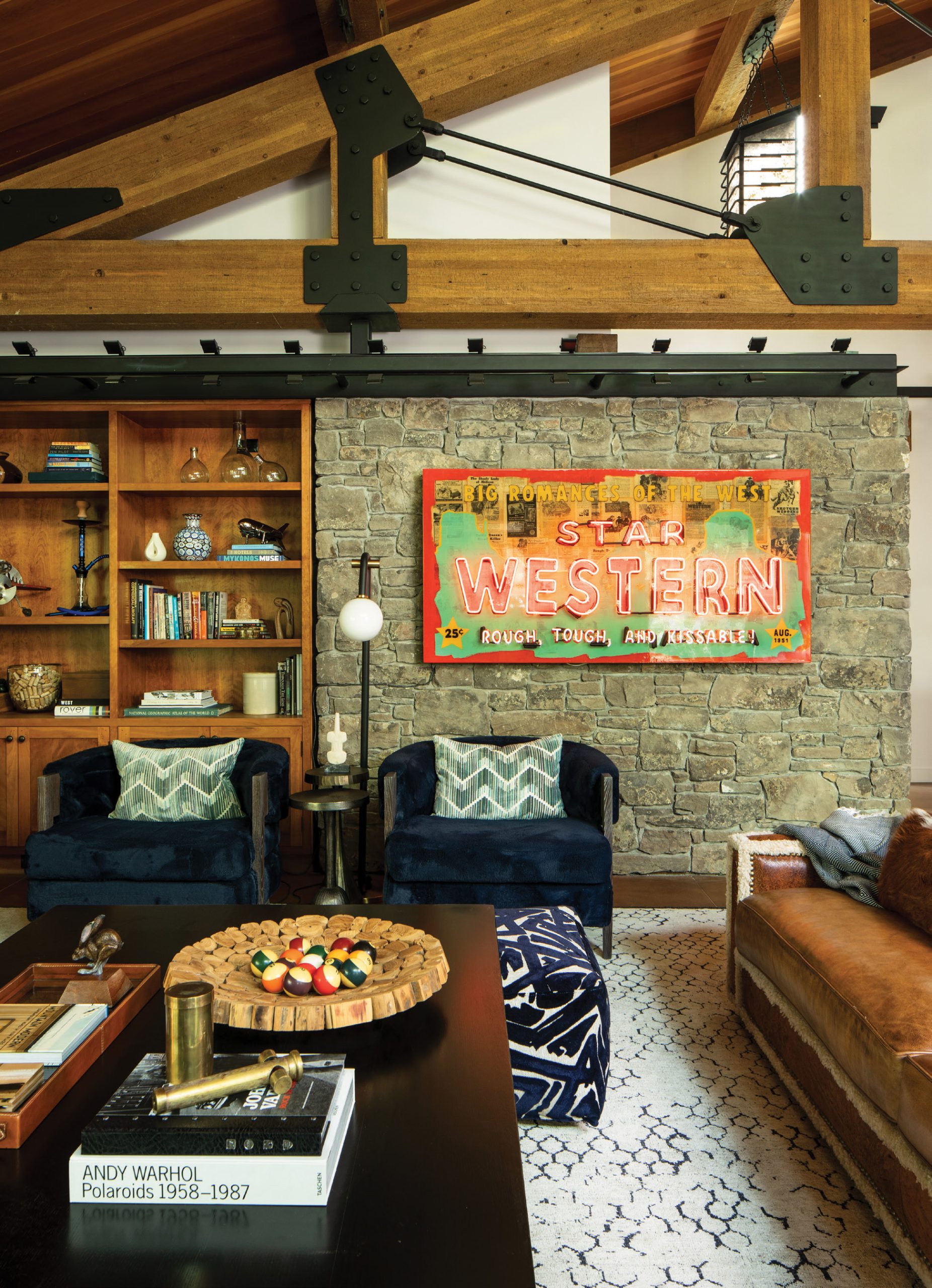
A loft, converted into a media space, is a favorite spot of the homeowner’s. The team retained the existing retro, suspended fireplace in the loft while working in a poly-velvet-covered sectional with shearling throw pillows and a modern, organic Taracea coffee table for a bit of texture. “The room offers great lounging, TV viewing, and a shuffleboard table for entertaining,” the homeowner says. The original exposed architectural elements of timber framing and steel supports are on full display in the space, which is open to the living room below.
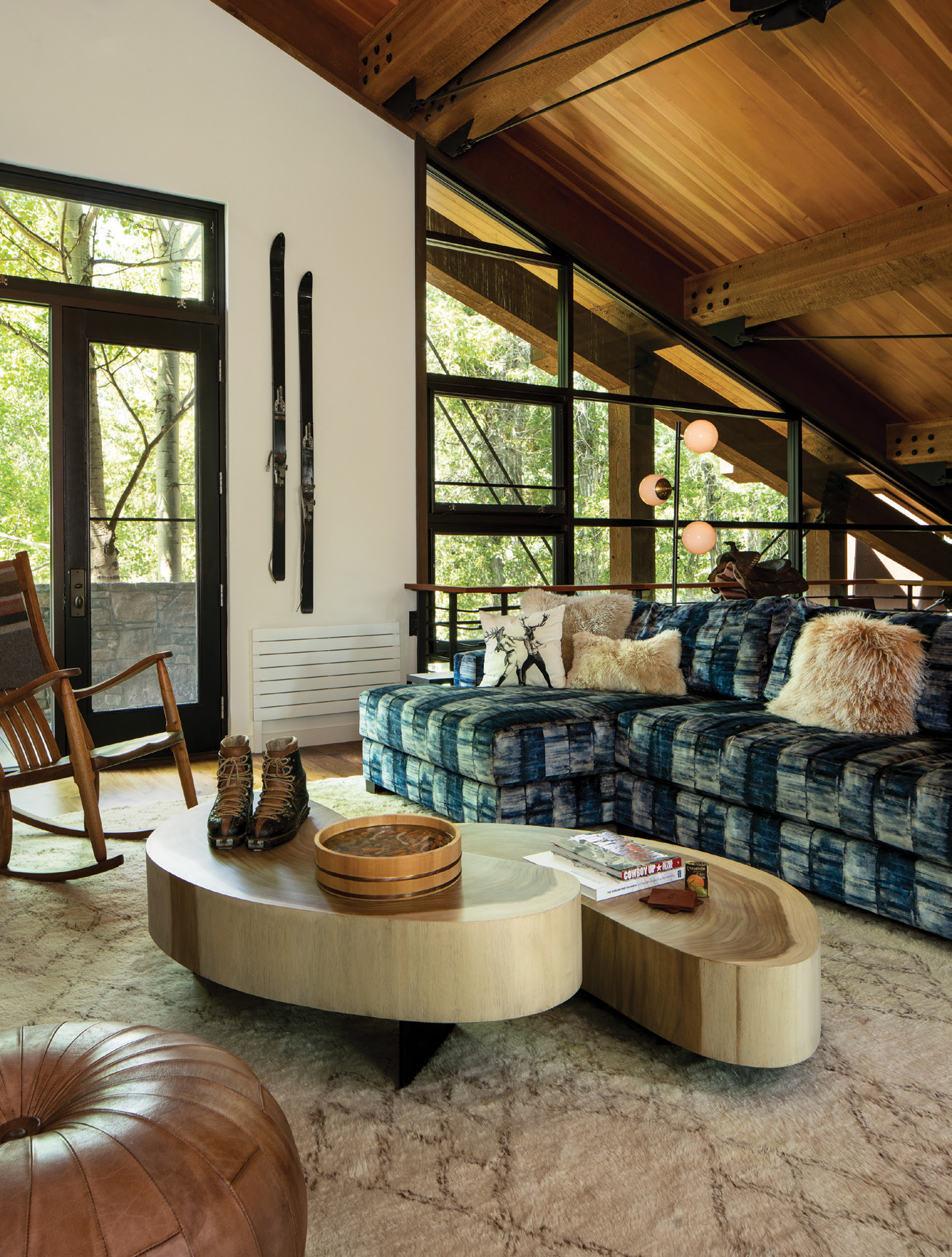
The homeowners turned the loft over the living room into a media room, and the designer brought in a custom Huntington House sectional with poly-velvet upholstery and shearling throw pillows and integrated the owner’s rocking chair into the mix.
On the main level, Binger brought in newly purchased contemporary furniture to fit the home’s scale in the open-concept living room, dining area, and kitchen, while retaining a few of the owner’s pieces from a previous residence. She also kept the original cherry bookshelves and kitchen cabinetry, adding a leathered Absolute Black granite countertop. She amplified the existing copper-colored concrete floors with cognac leather and shearling upholstery and a complementary range of blue furnishings, from deep indigo to sky blue. Island bar stools, for instance, are backed with indigo hide with faux lamb shearling on the front. A black-and-cream subpalette grounds the rooms.
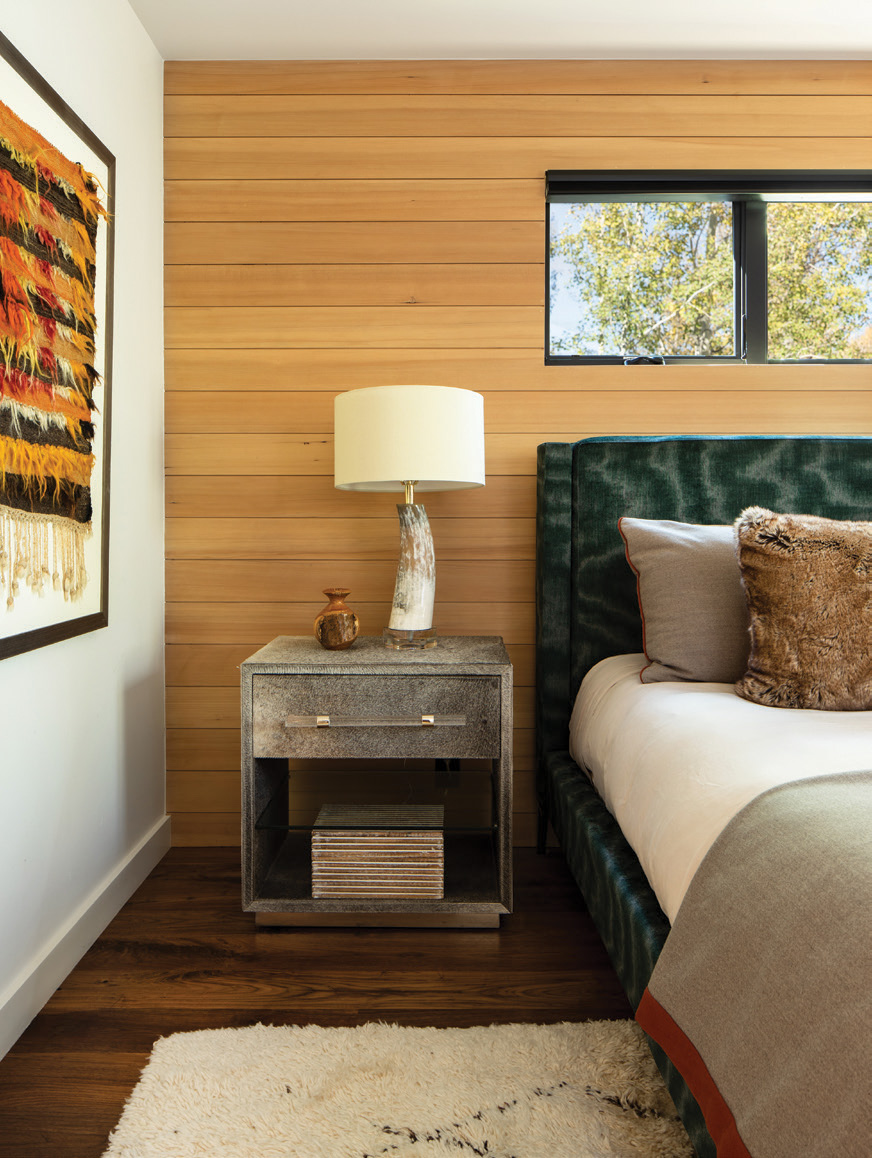
A main-level guest bedroom continues the lavish textural theme via artwork, furniture, and bedding.
The dining area provides a chance for the interiors to interact with the exterior gardens and water features. A wall of windows opens up one side of the dining room to the patio and planned gardens. The designer’s introduction of a custom olive-wood table and dining chairs with a nubby weave continue the exploration of the natural theme in this space.
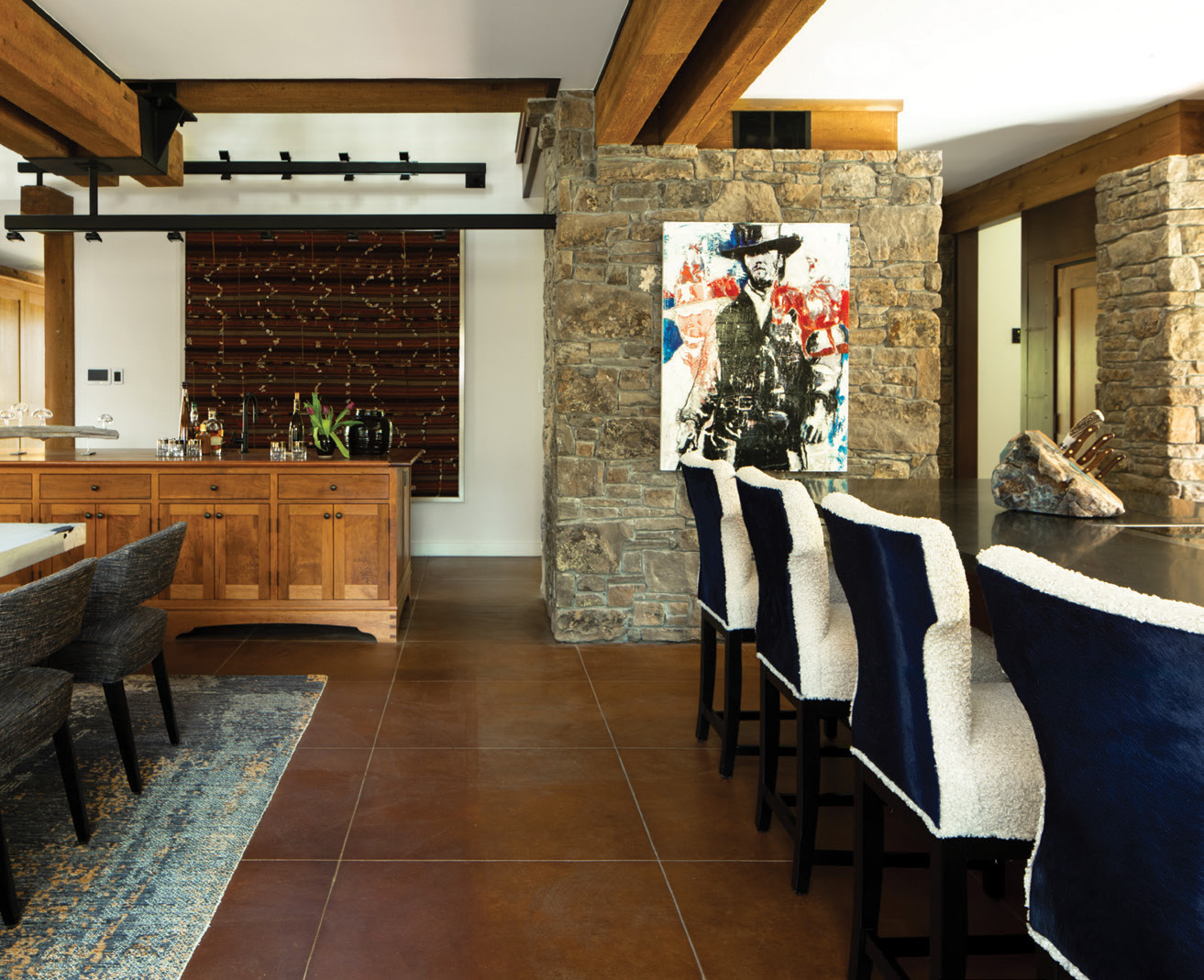
The bones of the kitchen and dining spaces were left intact, which the homeowner credits to the home’s “incredible architectural design that is filled with natural elements of stone, reclaimed beams, and steel combined with warm, inviting spaces.”
“You feel like you’re in nature when you’re in this open space,” Binger says. “We achieved the cozy yet boundless feeling by focusing on textures while inviting the outside in through the large expanse of glass.”
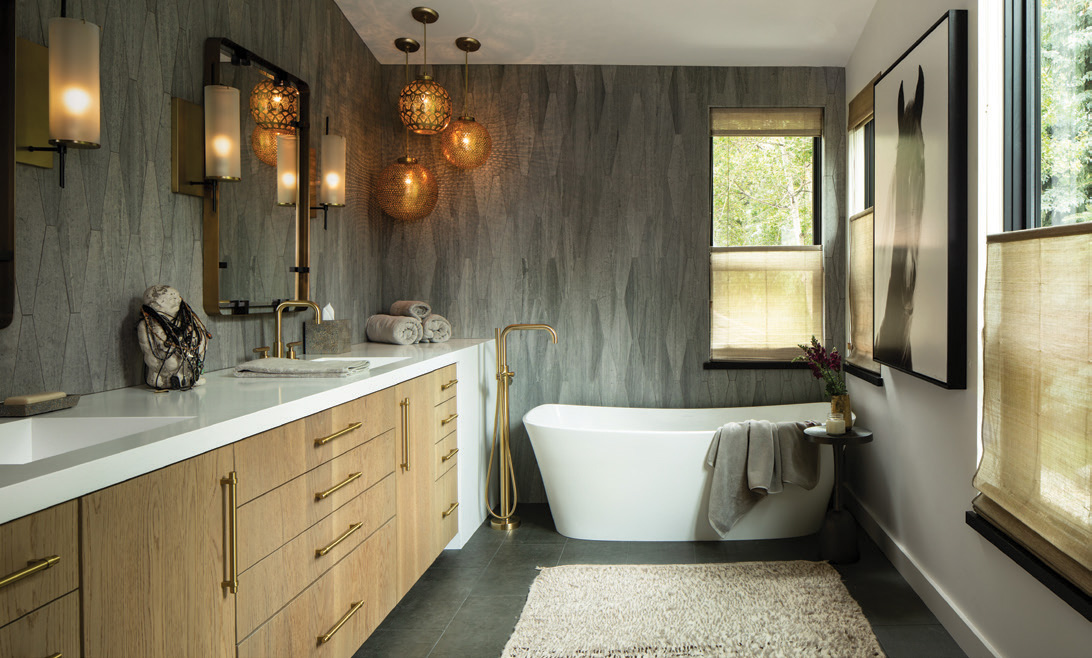
The designer used pendants she found on a trip to Morocco, hanging them off-center in the primary bathroom as an inviting focal point. The artwork, sourced from Altamira Fine Art, is by Kenneth Michael Peloke.
“When this residence was built, interior decorating was more aligned with log homes. The new design is more appropriate for the home’s architecture,” Dynia says. “While the refreshed interior design improved it, the shell and exterior architecture remain unchanged. It thrills me that someone is interested in the architecture again. It’s nice to see that this home has been cared for over the years and now gets a second life.”
Since this was the second Jackson Hole home Binger designed for the homeowner, the team was used to working together, and collaboration was seamless. “We looked at this home together before the purchase,” Binger says. “I knew that the homeowner was open to the process and would come with his own creative ideas. Color and texture invariably lead my design work. My trips to Morocco encouraged the direction of the interiors, which the homeowner embraced. Now, the home flows so well; there is not an inch of unused space.”
“Moroccan rugs, textiles, lights, and found artwork are stunning and bring in rich history,” says the homeowner. “The final hip vibe is very welcoming, and its sexy elements make you never want to leave other than to go catch an epic powder day at Teton Village.”
Dana W. Todd is a professional writer specializing in interior design, real estate, luxury homebuilding, landscape design, architecture, and fine art.
Combined with his personal photographic practice, Tuck Fauntleroy has developed a professional foundation as a photographer in the fields of architecture and interior design over the past 20 years. Published in recognized outlets such as The New York Times, The Washington Post, Dwell, Conde Nast Traveler, Newsweek, Powder Magazine, Ski, The Fly Fish Journal, Mountain Living, Range, and Town & Country, Fauntleroy’s successful commercial and interior work is committed to utilizing the aesthetics of the natural world.
No Comments