


30 Jan The Happiest New Year
Standing at my window on New Year’s Day — holding a steaming cup and watching the snow in the sliver of light cut by a streetlight across the way — I feel like I’m in one of those holiday coffee commercials. Christmas has come and gone and New Year’s Eve is also in the rearview, though only by a few hours.
There was a time when being up on January 1 at 5 a.m. would have been more about what had happened the previous night than about what was to happen on the day ahead. But today it’s all about the first day of fishing in 2025.
And this isn’t just any fishing trip. As of November 2024, for the first time in as long as anyone could remember (due to the government shutdown, the National Park Service never returned my query about just how long it has been, and I’m not even sure they know), Yellowstone National Park opened its boundaries to fishing between its customary road-closing dates from October to April, and this is my first chance to take advantage of it.

In winter, rainbow trout are stunning: Their colors often darken, and their cheeks take on a vibrant, rosy hue in preparation for spawning. | JAKOB BURLESON
That’s the reason I’m waiting in my driveway when Nate Stevane’s SUV headlights pierce the morning darkness. “Happy New Year!” he says, in a cheery, fishing-guide lilt that tells you he’s damn sure more used to seeing the sun come up than I am. After stowing my gear and rod in the back and kicking the snow off my boots, I’m greeted by another early riser, local guide Jarrett Voiles.
As so many winter outings in Montana are, the drive features some excitement of its own. With snow and ice coating the road from Gallatin Gateway to West Yellowstone, we see more than a few vehicles that have slid off the road on U.S. Highway 191. Nate unsuccessfully tries to pull one unlucky soul out of a snowbank that the driver has turned into a mud pit by spinning his tires. As the owner of outfitting company Trout on the Fly, and with decades of guiding experience in southwest Montana, Nate has driven this route more than most over the past 30 years. It goes without saying that I’m happy he’s behind the wheel.
By the time we reach West Yellowstone, the snow is coming down at a steady rate, adding to the 10 inches that already cover the ground. There’s only one truck in the pullout where we park. I take this as a good sign, since every time I’ve come to fish the Madison during the famous fall run, I’ve been elbow to elbow with folks hailing from as close as West Yellowstone and as far as Germany.
For those unfamiliar with the river’s draw at a time when summer tourists have gone and skiers have yet to arrive, when Montana’s weather turns from hot and dry to cool and wet, it acts as a natural signal for the large brown trout in area lakes to move into rivers to spawn.
In the case of the park’s Madison River, big fish, what some would call hogs, exit Hebgen Lake mid- to late-September, cross into Yellowstone, and spawn in November. Large rainbow trout follow the browns (as well as spawning whitefish), wintering in the park until they spawn during winter and early spring.
Before stowing my phone in an inside coat pocket, I check the weather app for an estimated outdoor temperature — 15 degrees — and though I’ve brought countless layers and two pairs of gloves, I’m forever grateful when Nate offers me a handful of nitrile gloves like you’d find at the doctor’s office. As someone who guides year-round, he swears by them as a way to keep your hands dry while maintaining the finger dexterity necessary for tying knots and handling fish. “Get them wet just like your hands when touching a trout to protect the slime layer on the fish’s skin,” he advises.
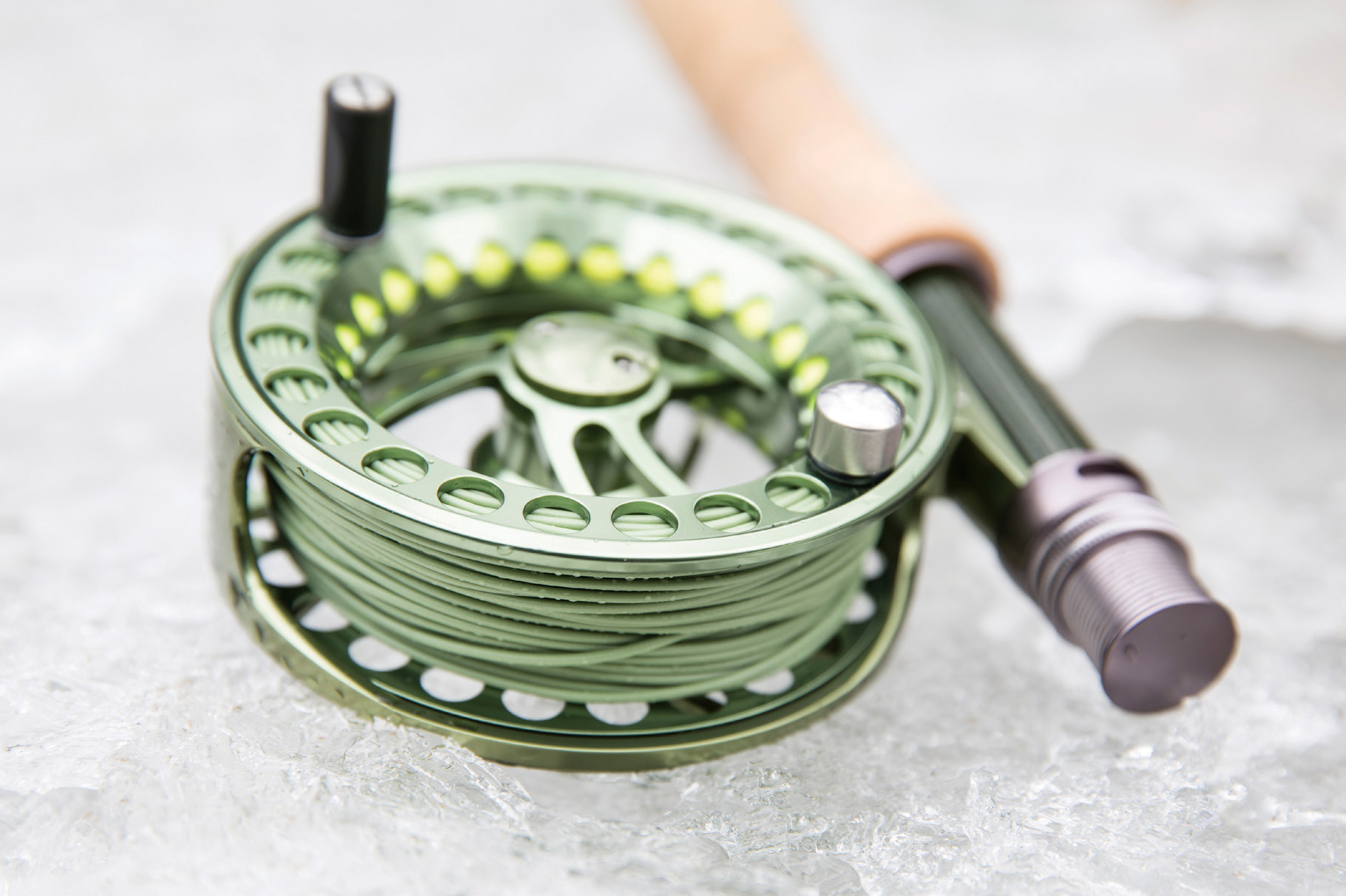
Hands and gear can get icy while fishing in subzero temperatures. Do your best to keep from submerging your reel in the water so it doesn’t ice up. On the flip side, when ice builds up on your rod’s guides, dipping them in the water is a safe way to clear them. Though it’s tempting to snap the ice off with your hands, doing so can break off the guides in the process. | ADOBE STOCK / JOHN RAFFAGHELLO II
Rods un-quivered and boots, waders, and layers on, we waddle toward the river. Post-holing through larger drifts and sliding like an otter down banks, I quickly warm despite the chilly temps. With the snow dampening any sound of the road, it takes mere seconds before we are in our own little winter wonderland.
I flash back to a winter spent as a volunteer for the Yellowstone Association and the many years I’ve enjoyed Nordic skiing in the park’s backcountry, miles from roads and infrastructure. Despite the nearly 5 million visitors that cross into park boundaries each year, it remains a place where you can experience silence and solitude if you know when and where to go.
As we sidle up to the river, I remember how I brought my fly rod with me to be snowed in at Old Faithful from early December to mid-March. Having been shut out from fishing the Firehole River the previous summer because the water was too warm to be safe for the trout, I had a vision of fishing the river during my stay, knowing that the thermal features would make it imminently fishable despite the snow and cold of a Wyoming winter. I didn’t know that fishing was closed during those months, and ended up leaving my rod in its case throughout my stay.
From that first winter, through nearly a decade spent living inside the park at Mammoth Hot Springs and just outside the entrance in Gardiner, I badgered countless rangers and even a few superintendents to let me fish during the winter — with zero luck. But today, all that would change.
Speaking of zero luck, that’s another thing I was hoping to change when it came to fishing the Madison during the fall run. The few times I had braved the crowds and did the “Barns Two Step” — fishing the famous Barns Hole with a crowd of anglers so that everyone casts, takes two steps upriver, then casts again — I’d had very little luck, only catching a few of the small, rare fish that hold all year in this part of the river. That pattern continued while fishing all the other well-known and packed spots, including the aforementioned Barns Hole #1 and Barns Hole #2, as well as Baker’s Hole, the Cable Car Run, and the Junction.
Hoping to rewrite history in a thankfully unnamed hole, I rig up and am ready to go when Nate points to the shallow, sandy bank in front of us. I think he’s telling me to wade in and take a shot, but he is in fact offering the opposite advice. “The fish are going to be close to the shore when the sun’s low in the sky,” he says. “As the sun gets higher and they feel pressure, they’ll retreat to deeper water, but for now, fish from the shore.”

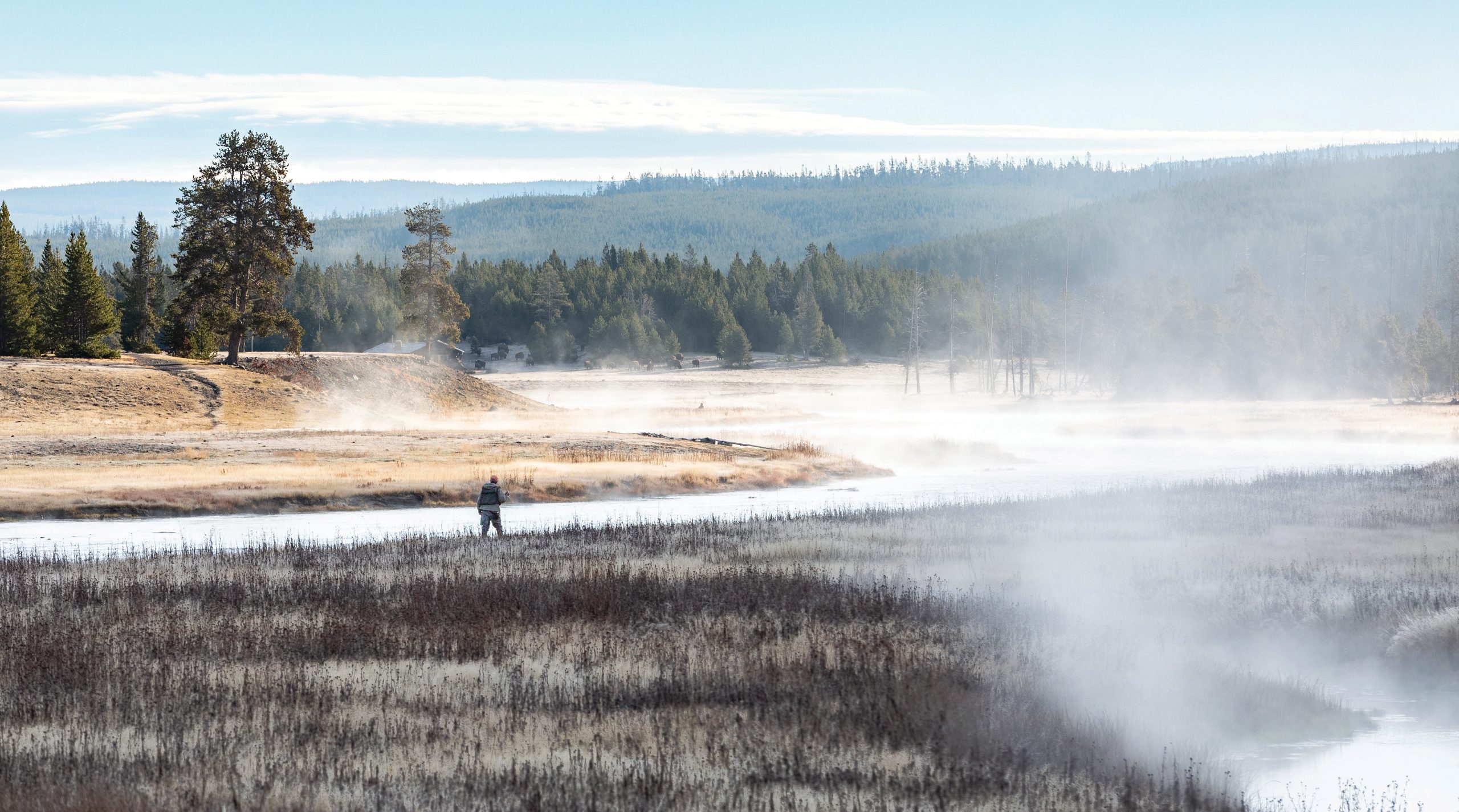
With water warmer than the chilly air, the steamy Madison River flows by snow-covered banks in Yellowstone. | ADOBE STOCK / JO
I start fishing a large reticulated streamer, the kind made famous by the fly shop a few miles away by Quake Lake that’s known for posting pictures of huge browns caught in the Madison. The river here is wide and shallow with pockets, or “deep depressions,” as Nate puts it, where the fish we are targeting hole up. In between are faster, choppier runs that gave the Madison its nickname, the “50-mile riffle,” but we’re foregoing fishing those areas this time of year.

In early fall, large brown trout move out of Hebgen and Quake lakes and into the Madison River. Many move upriver into Yellowstone National Park to spawn. The browns are followed by lake-dwelling rainbow trout (pictured), which spawn in the river during the winter and into the spring. | FISH EYE GUY
To show me what he’s talking about, Nate takes a few casts into the spot in front of me. Sure enough, he’s good on his word, landing a nice-sized rainbow in mere seconds. Though this is the first time we’ve fished together, I’ve known Nate through a couple of youth soccer seasons and have already sussed out that he’s just about the fishiest guy you’ll meet. Seeing him holding his first trout of 2025, I know my Spidey sense has proven dead-on.
Fishing a stretch above me, Jarrett breaks the seal on the calendar before long as well, landing one of the many 17- to 20-inch rainbows in the river this time of year. As Nate wanders away to check out a run downriver, I am determined to join the 2025 club. Extending my cast, I fling my streamer toward the far shore, figuring it will be at its deepest when it slices through the hole in the middle of the river. What I don’t know is that there is also a log down there and, in no time, I am monumentally tangled.
Instead of just cutting my line (and my losses), I try unsuccessfully to untangle the bird’s nest of my creation. Thinking it will help, I also take off my gloves. It does not. Soon, the wet line makes my hands unbearably cold and all I can do is stick them in my coat while I watch Nate and Jarrett land more fish upriver from me.
With my hands finally dry, I slip on a new pair of gloves and reach into my bag for the setup that Nate gave me earlier. On top, it has a small swivel ring that’s tied onto the tippet. Below that is a heavy nymph, and on the end sits a Shakey Beeley, a soft hackle fly. Rumor has it that its name comes from former Yellowstone seasonal employee Frank Beals, who would shake uncontrollably with excitement whenever he was about to go fishing.
Figuring the fly couldn’t tell if my shaking was from anticipation or hypothermia, I decided the name might be a good omen. Remembering to add a split shot above the swivel — what Nate calls the “shot knot” — so the flies drop down deep in the pool, I make my first cast. It doesn’t take long until I get my first hit — and miss. That’s followed by a second hit — and miss.
Like I said, Nate and I have never fished together before, but during multiple seasons of soccer practices, warm-ups, and halftimes, we’ve talked a lot about fishing. One day, I told him about missing a big fish on the Gallatin, and he mentioned that most of his clients get in the habit of setting the hook one direction — to the right or left — every time when they should be setting the hook in the direction of the current. Doing it that way means you are pulling the hook into the fish’s mouth, not out of it. In my haste, I did the opposite, hence the misses.
Deciding to let the hole rest, I crisscross the river until I find Nate and Jarrett hanging out by a long run. It’s shallow and rocky for a good 10 feet from where we stand, but in the middle of the river, it drops off into a murky darkness. Pointing his rod and nodding, Nate says, “That’s where they’re holding.”
They both look at me, and I nod in agreement. Laying out some line, I cast to the top of the pool and give my line a quick mend. As soon as the line straightens out, I feel the pull. This time, I set the hook in the right direction, and the line holds tight. The fish has plenty of fight in it, and after a few runs, I land it with the help of Nate and his big boat net.
Careful to wet my gloves, I kneel in the river and free a nice-sized rainbow from the fly. After a quick pic for the sake of posterity (and for my kids who will need proof that I caught something), the fish swims back to the hole seconds later. We continue to take turns swinging flies through the run, picking up fish on nearly every cast.
Once the hole is conquered, we hopscotch upriver, looking for the telltale drop-offs and dark water where fish should be holding. More often than not, each spot has a handful of fish staging for a run further upriver. Altogether, we land more than our share of rainbows, all pushing 20 inches — with a few crossing that barrier — as well as a few browns in the 12- to 16-inch range.
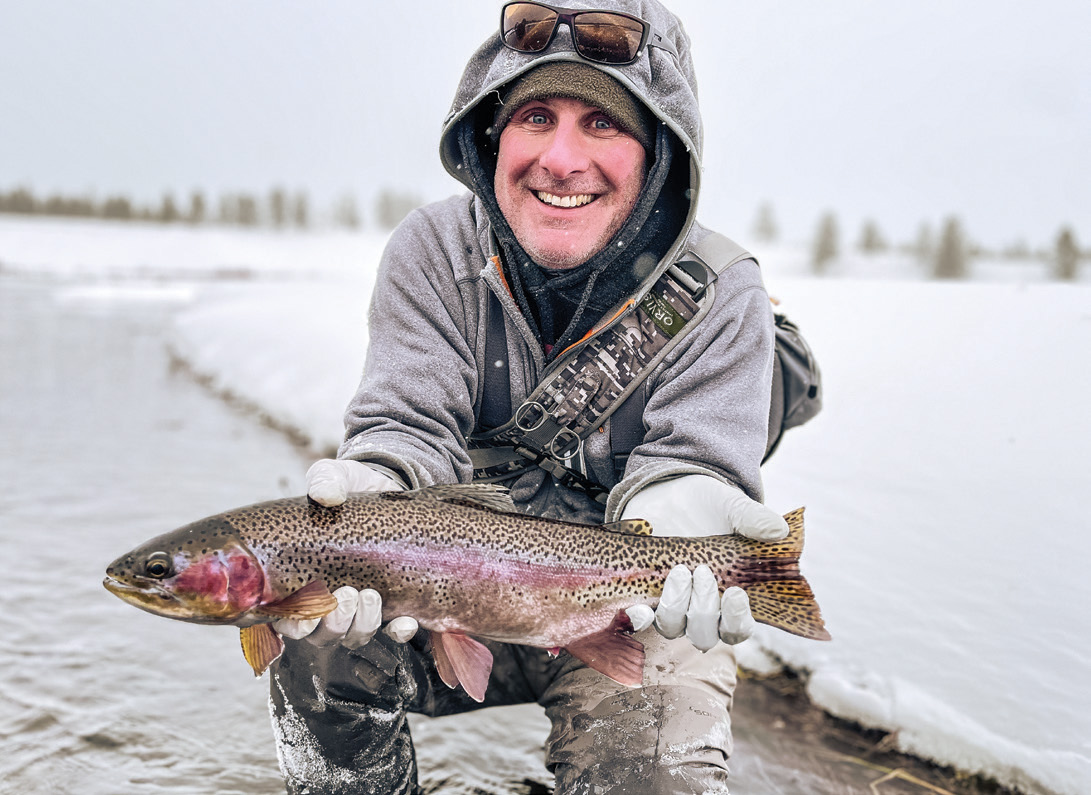
With a little help from his friends, the author finally found winter-fishing success on the Madison. | NATE STEVANE
Though the trophy brown remained elusive, I couldn’t have asked for a better way to start 2025. For someone who lived in Yellowstone for many years and continues to visit the park through all its seasons, it’s amazing to experience something that feels both new and timeless.
It’s even more amazing knowing we get to come back next year, provided Nate is up for driving.
An avid fly fisherman based in Bozeman, Montana, Stephen Camelio is a former editor for In Style magazine and has written for Fly Rod & Reel, The Drake, and Field & Stream, among others. He was a regular contributor to Yellowstone Quarterly, and he wrote the fishing chapter for the guidebook Yellowstone in a Day. Recently, Camelio wrote the fly-fishing feature film Mending the Line, which was the number-one film on Netflix the week it premiered.
No Comments