


30 Jan Parting Words
In the fall of 1991, I received a call from Robert Redford’s personal assistant: “Bob is extremely grateful for what you did for him yesterday and asked if he could return the favor,” she said.
Seriously? I thought. Robert Redford is granting me a favor?
Without hesitation, I suggested an interview.
I knew the reason for the call. The day before, I was at the epicenter of a fast-moving, behind-the-scenes caper that unfolded around Livingston, Montana, where the film A River Runs Through It was wrapping up. A National Enquirer photographer and reporter were arrested Saturday evening by local law enforcement.
The photographer had allegedly stolen a batch of photos I had taken while working as an extra on the film — specifically, those of Redford’s girlfriend at the time. The pressure of these two guys trying to dig up dirt on Redford caused him to lose his concentration on the details involved in finishing a $10-million film. He was stressed to the point that his people called in famed L.A. security specialist Gavin de Becker and his team to take control of the situation. Within 36 hours, the unscrupulous duo was arrested, and, with de Becker’s help, a deal was struck: I would not press charges if they agreed to leave town that evening.
Redford was relieved.
As co-publisher of the Livingston monthly tabloid The Montana Pioneer, I thought interviewing Redford would be the ultimate favor. When his assistant called back to confirm my request, she said, “Today’s the last day of filming; could you meet Bob on location along the Gallatin River in an hour?”
Redford met me at a turnoff along U.S. Highway 191 south of Bozeman. Pulling up alongside my Subaru in his mud-splattered Ford Bronco, he instantly sized me up as a lightweight journalist — which I was. Maybe that’s why he felt comfortable letting his guard down around me during the three hours we spent together.
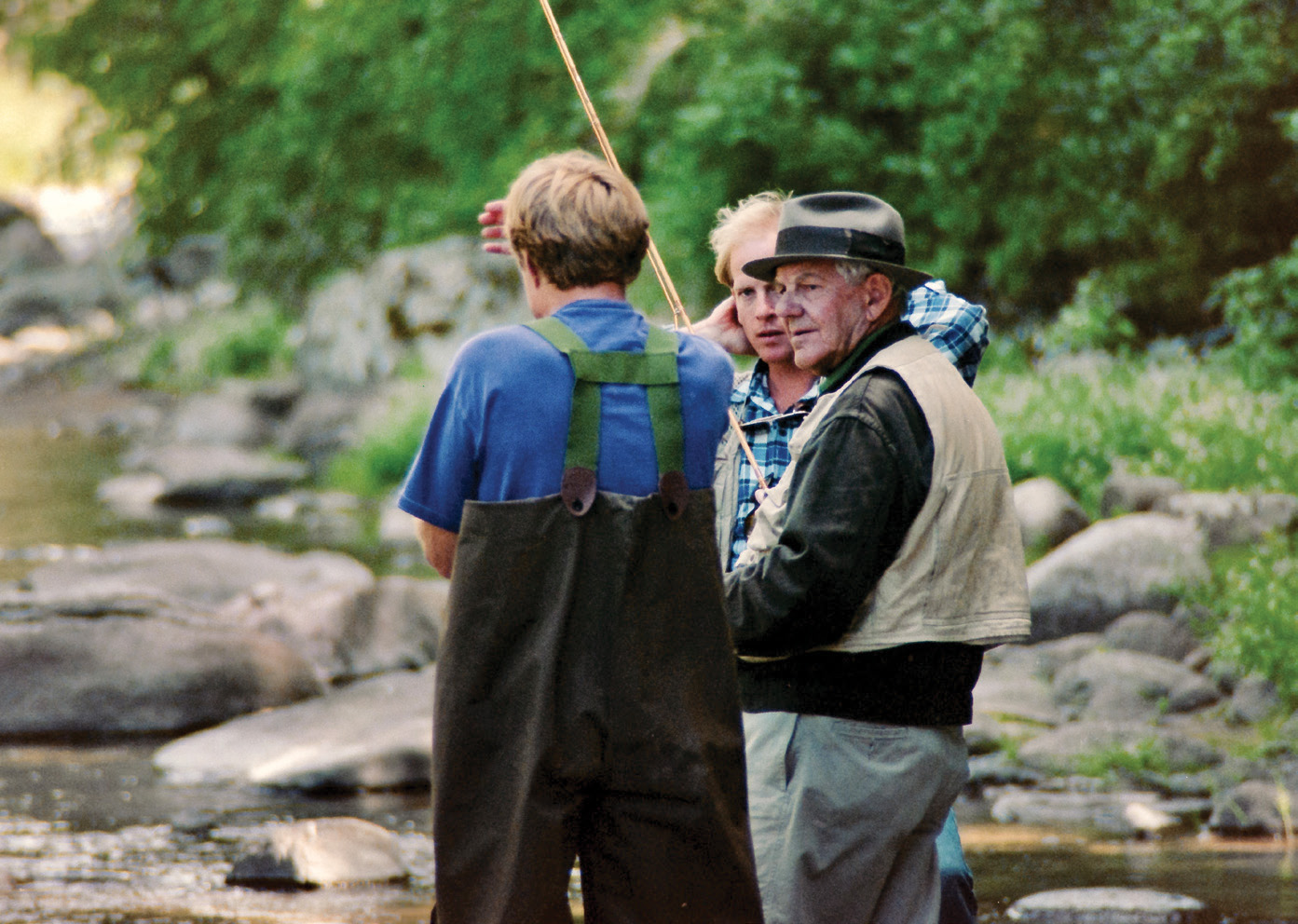
Redford shows actor Arnold Richardson, who plays old Norman, how to cast his line on the river to take advantage of the afternoon light.
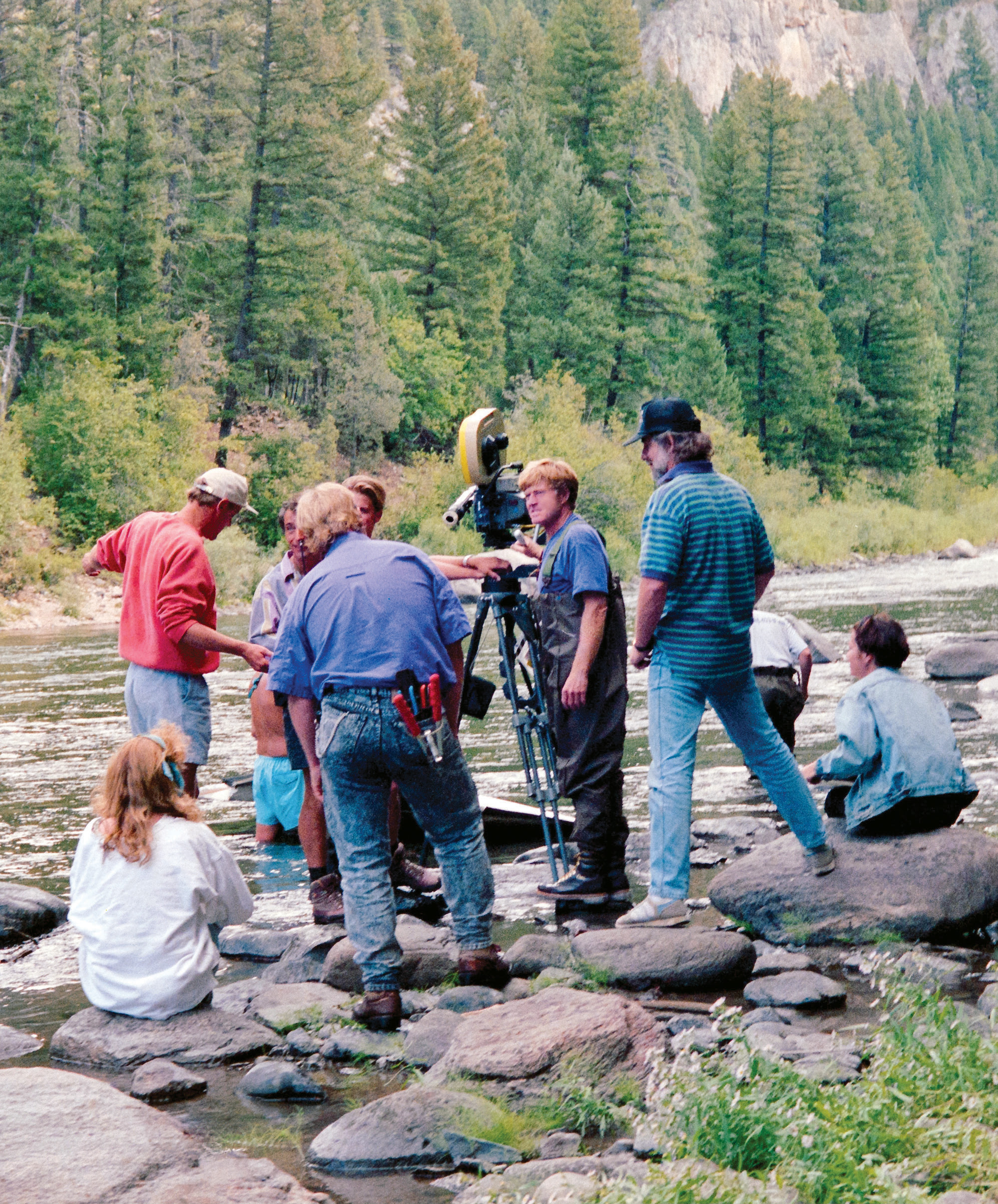
Sitting on a boulder along the river, I watched Redford direct Arnold Richardson, the actor portraying old Norman, casting his line on the river’s current. The scene would serve as the film’s opening and closing visual. In post-production, Redford would narrate a passage from Norman Maclean’s novella:
Eventually, all things merge into one, and a river runs through it. The river was cut by the world’s great flood and runs over rocks from the basement of time. On some of those rocks are timeless raindrops. Under the rocks are the words, and some of the words are theirs. I am haunted by waters.
Between takes, Redford spoke of his vision for the film, how he secured the screen rights from Maclean, and the pressures of directing the movie in three short months. During that time listening to and watching him interact with his crew, I had the perfect opportunity to assess the man behind the tousled blonde hair and blue eyes.
You’ll sometimes hear a regular Joe refer to a celebrity or prominent figure as someone they could have a beer with. Redford was that guy. Watching him direct the final scene of A River Runs Through It on that crisp Sunday afternoon on the Gallatin River was nothing short of sharing a drink.
As anyone in the fly-fishing industry will attest, the positive influence that the film had on the sport is incalculable. But more importantly in Redford’s mind, it brought to our collective awareness the ecological importance of Montana’s rivers, and rivers worldwide.
On September 16, 2025, Redford cast his line on the river of life’s current for the last time. The interview he gave 34 years ago to an obscure, small-town newspaper lives on in this publication as a testament to his legacy as an actor, film director, and outspoken environmentalist. What follows is that timeless interview, originally published in the October 1991 issue of The Montana Pioneer, reprinted here with permission.
Rest assured. Robert Redford at 55 still has the charisma, rugged good looks, and boyish innocence he possessed when he first came to prominence in the 1967 movie version of Barefoot in the Park, co-starring Jane Fonda. Granted, there’s more gray hair sprouting from the top of his cotton T-shirt these days, and it takes more discipline to keep his midriff taut, but the famous jutting jaw, blue eyes, and sandy-colored hair still identify him as American cinema’s reigning — perhaps more accurately “hanging in there” — golden boy. As Newsweek magazine pointed out a few years ago, “He’s still the most sought-after, dreamed-about, and speculated-upon screen idol of our time,” even if only to those old enough to remember him in Butch Cassidy and the Sundance Kid in 1969.
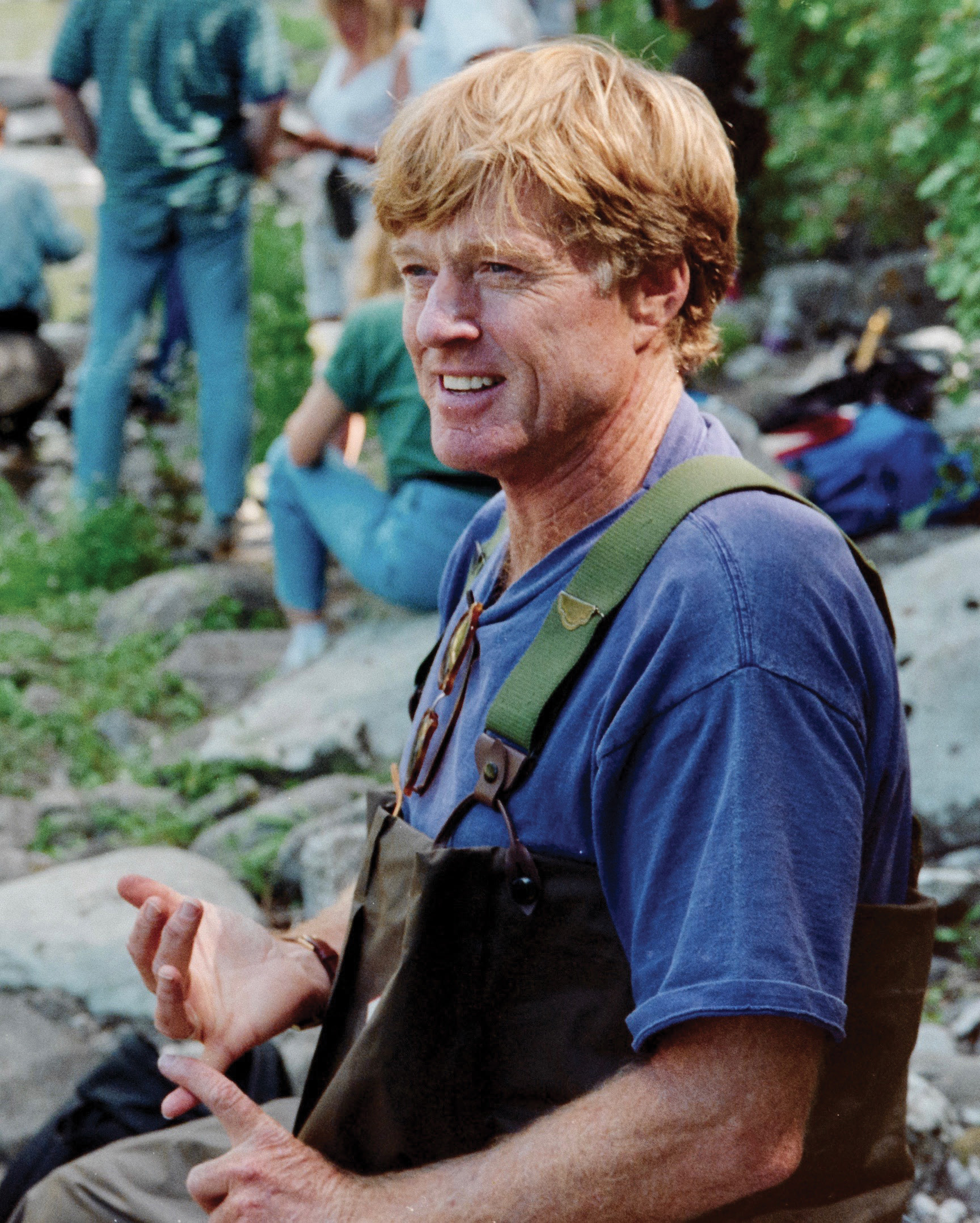
When asked how he rose above the fray each day to remain creative, Redford said it took commitment, concentration, and a passion for what he was doing.
An intensely private man, Redford prefers spending his leisure time — what little he allows himself — skiing the slopes of his 7,000-acre Sundance ski resort near Provo, Utah, or hiking in the Himalayas as he did in 1982. He’s a restless man who prefers reading a batch of movie scripts fireside at home to polishing the Hollywood tinsel. But more importantly, he’s a political and environmental activist.
In 1983, he created The Institute for Research Management, which sponsors conferences on a wide variety of environmental issues, such as the 1989 conference on global warming with the Soviet Academy of Sciences. He’s a long-standing board member of the Environmental Defense Fund and the Natural Resources Defense Council and has been the recent recipient of the prestigious United Nations Global 500 award and the Audubon Medal award.
In the seclusion of the wilderness, he finds solace and inspiration — even religion. “In nature is found the greatest, most profound spirituality,” he believes. So, it seems fitting to find Redford wrapping up the third film of his directorial career on a Sunday, surrounded by the forests and streams of the Northern Rocky Mountains. The final scene of A River Runs Through It was being filmed on the boulder-strewn Gallatin River, a day’s hike from the northwest corner of Yellowstone National Park. Nearly all the previous three months had been spent in sparsely populated Montana, fashioning a cinematic interpretation of the 104-page literary work of the same name by the late Missoula author Norman Maclean.
The story revolves around two brothers, Norman and Paul, and their “great-souled,” Presbyterian minister father, Reverend Maclean. Set in Missoula between 1910 and 1935, “It ties religion, family, and fishing together in an unusual and poetic fashion,” comments Redford, who said he was captivated by the book when he first read it in 1980. “It contains a deep understanding of the complexities of family life. And it’s completely about the West.”
I met Redford on a narrow bank of the Gallatin. An encroaching forest of cool pines, closely rooted to the slope of a steep bluff, came within 10 feet of the river, sheltering the location in privacy. A footpath through the trees led to the river’s edge.
The Gallatin mountains loomed in the background. Great swatches of cumulus clouds hung motionless overhead. And wading in the river was the character of old Norman, casting his fly line to the current of water before him, reflecting on the worth and course of his life. This scene, along with narration from Maclean’s book, would open and close the film.
Eleven years after reading the book given to him by Montana author Tom McGuane, Redford was finally weaving together into one poetic statement his version of cinematic beauty, environmental sensitivity, and America’s family heritage.
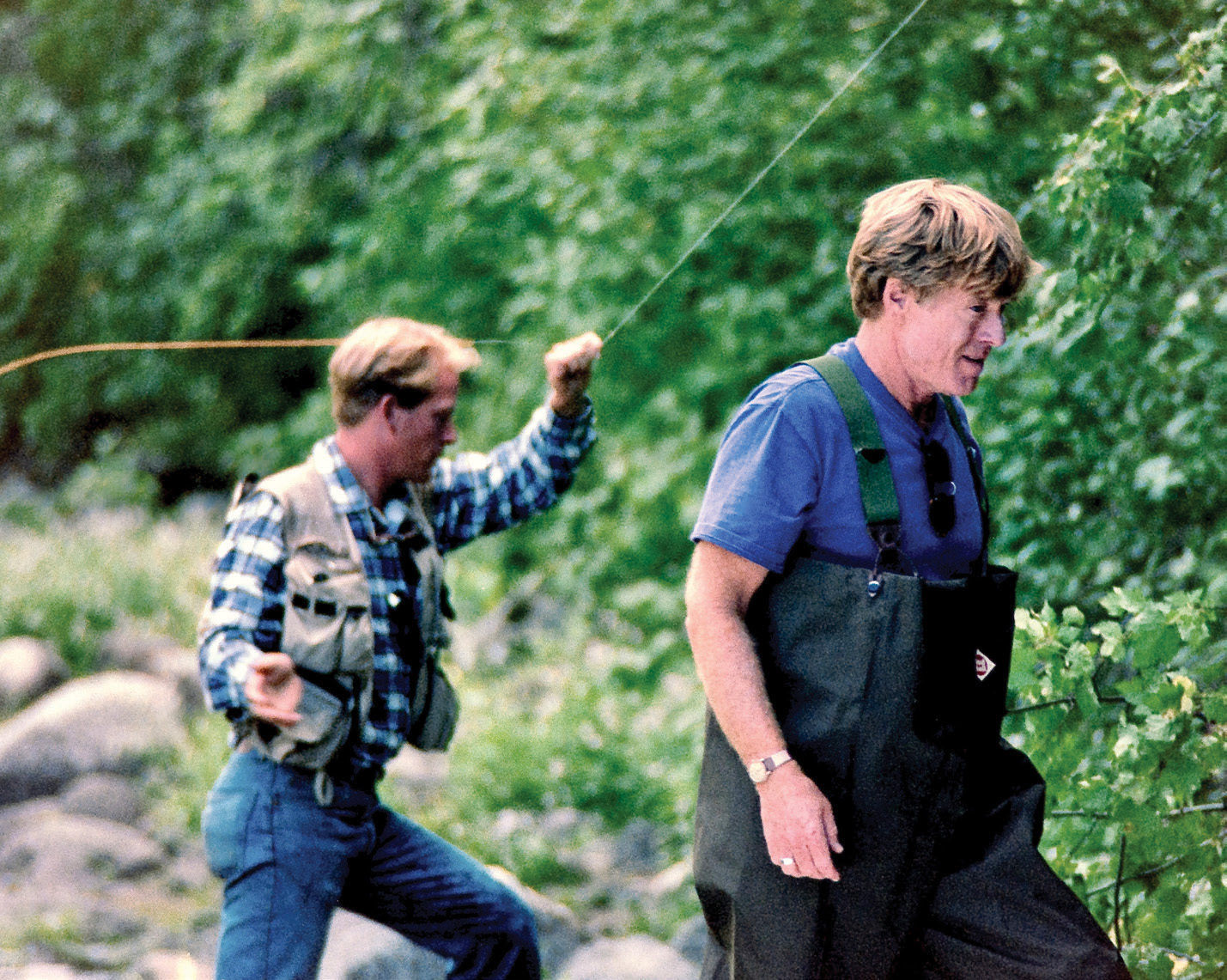
Casts along the forest’s edge often became tangled in the trees and bushes.
Redford was dressed in green, chest-high waders and a purple T-shirt, his nose smeared with sunblock. Earlier in the afternoon, he waded into the river — teeter-tottering his arms to maintain balance — searching for camera angles. At one point, while moving out into the river’s deeper currents, he stumbled into the water. Quickly recovering from the cold dunking — eyes lit up like a kid who just won a bet on a dare — he continued forging his way down river as if nothing had happened. The film crew scarcely reacted.
A gaffer commented: “Unless he’s in trouble, let him be; Bob (as he’s called on the set) is capable of taking care of himself.” Part of Redford’s personality is to flirt with danger; “Bob was just being Bob,” he added.
Between takes, he walked 30 yards or so along the rocky shoreline to a knee-high boulder, where he hunkered down to discuss his work, his convictions, and his battle for privacy.
Redford says this film is a piece about the soul, and hopes that audiences will be moved on that level. And what specifically does he hope to project to moviegoers? “Our history,” he says, “the history that speaks to our own real heritage, the fact that we are a country of immigrants who brought a way of life from other places and pulled together as a whole to create the American way of life.”
“Very little of our environment is identical to us as it was then. The effect which I’m trying for in this film is to look back in history by opening the scrapbook of a particular family living in a particular place and to let the audience come inside those pictures. That’s the whole concept of using Norman Maclean’s words as the guide.”
Has the Livingston-Bozeman area lived up to his expectations as the ideal location for this movie? “It’s been a wonderful location,” he says, eyes lighting up. “I’ve loved being here. The only other film I’ve loved as much was Jeremiah Johnson. It was shot on my own property in the mountains of Utah.” Sweeping his arm across the view of the Gallatin River and the mountains in the distance, he says, “I love this country. I’ve been very happy here. The people have been wonderful.”
In a career that began on Broadway in 1959, Redford has participated as an actor, producer, or director in more than 30 films, many of which are now considered classics. He sees himself as a working artist who would not be doing what he does if he didn’t enjoy it. But with all his personal and professional responsibilities, how does he rise above the fray to remain creative?
“Commitment…concentration…and passion for what I’m doing,” he says, pausing between each attribute. “I couldn’t do what I’m doing without these. It’s wonderful when people come up to me on the street and say hello and say nice things to me, but you must understand that it’s very distracting.”
Though intrusions of privacy come with the territory of being an international celebrity, the weekly tabloids, with their insatiable appetite for titillating news and gossip, are particularly offensive in their approach to getting stories and photos. In some cases, as in Redford’s, respect for privacy takes a backseat to their unorthodox tactics.
On one recent occasion, two men from the National Enquirer — one a reporter, the other a paparazzo photographer — arrived in Livingston during the final week of filming to scout out a juicy story on Redford. During their stay, several complaints were filed with the Park County Sheriff’s Department. Once they were found trespassing near Redford’s rented Alpine house. The next day, one allegedly stole photographs from a local freelance photographer in Livingston and misrepresented himself to gain possession of photographs from other people in town. Redford and members of his production crew were hounded for five days by the pair looking for something of a compromising nature on which to report.
One morning, as Redford walked to his car, the two men blitzed him with a close-up photo session. Normally mild-mannered, Redford was losing patience. When the photographer was caught with his camera butted up against the window of the small Airstream trailer he uses on the set for work and relaxation, the line had been crossed. Redford called in security expert Gavin de Becker from Los Angeles. Gavin and his staff arrived incognito at the Yellowstone Motor Inn in Livingston, the same motel out of which the Enquirer correspondents were working. Gavin’s mission was to get them off his client’s back; a $10-million movie was at risk.
Renowned for his cerebral approach to security matters, Gavin and his men, with the assistance of Livingston Undersheriff Roy Keto, two deputies, and Deputy Park County Attorney Tara Depuy, routed the duo out of town within 36 hours. The conniving photographer almost spent Labor Day weekend in the Park County jail. Charges against him were dropped after he agreed to return the photos found in the trunk of his rented car to their rightful owner and leave town.
When the Enquirer incident came up in conversation, Redford became noticeably distressed. As his eyes constricted, he plowed his fingers through his wind- tossed hair. “These people are despicable,” he says, riveting his attention on the events of the previous week. “They marred a perfectly wonderful stay in Montana. They’re only out to hurt me,” he says with an undertone of indignation.
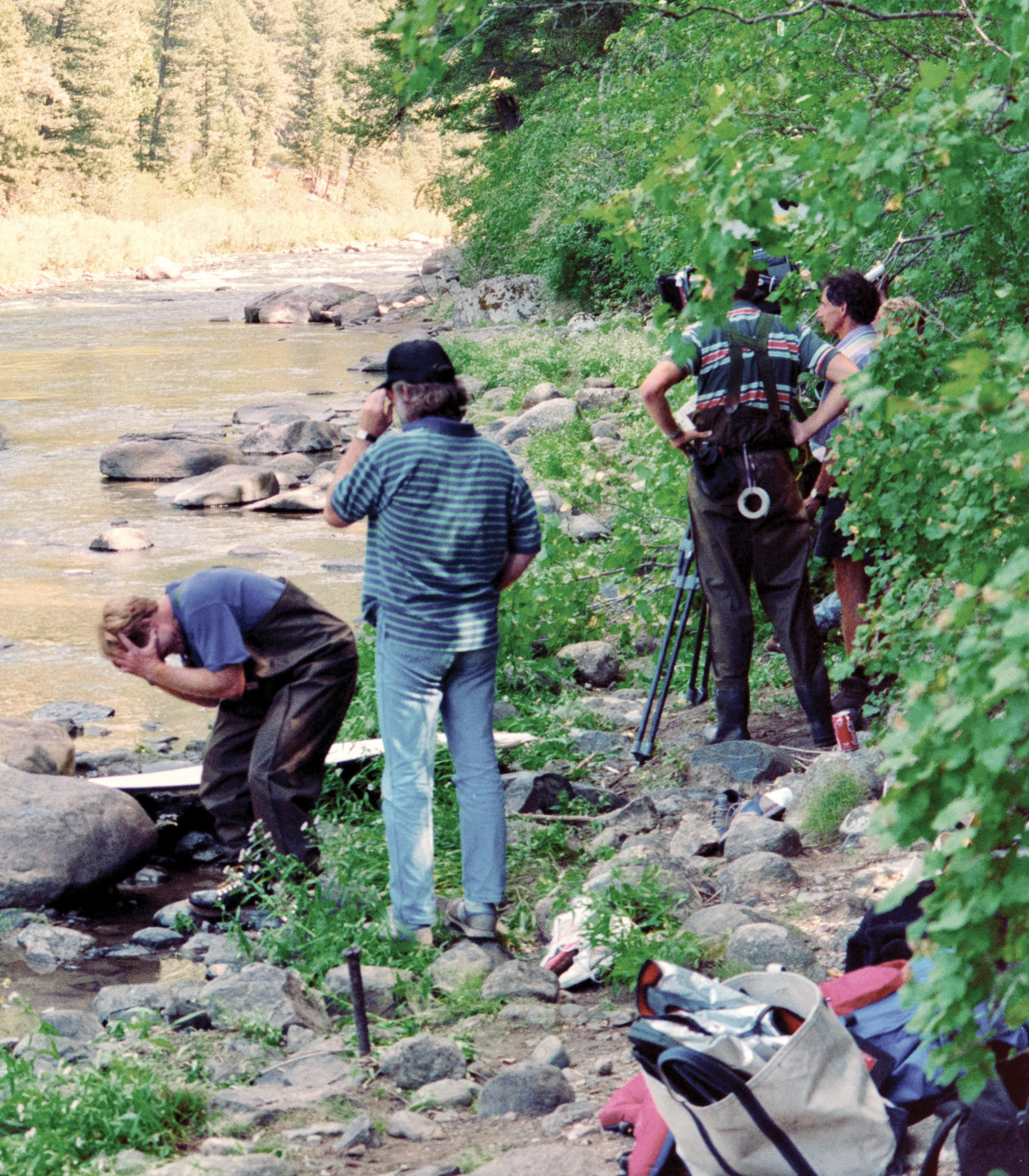
Redford expresses his relief on the final day of filming. He rarely felt constrained showing his emotions when around his dedicated crew.
Recomposing himself squarely on a nearby boulder, he becomes more introspective: “I’ve had some outrageous things happen to me during the last 15 years. There have been some serious threats to my family, and other incidents have been stupid and silly like this one. And it’s all just aggravation and harassment. When I’m producing and directing, it occupies all my time. I resent the attack on my senses; it’s like an attempted theft. These people will stop at nothing, they’ll do anything to get what they want. If it were possible to press charges all the way, I would have because that is what will stop them. They’re [the National Enquirer] a public company and they don’t like lawsuits — it’s bad for their stock. If you say you’re going to court or press charges, they’ll back off. But if you don’t, they’ll try anything, including intimidation.”
Propping his elbows on his knees and resting the weight of his head in the nest of his hunched shoulders, Redford’s blue eyes pale in thought. He gazes into the distance and says with a hint of defeat, “It’s an unfortunate situation having people coming in from the outside who have one thing in mind: to create something bad about you. It’s really malice aforethought. It’s a burden on me because you can get paranoid when you’re trying to concentrate on making a film — trying to hold everything together — and you don’t know what’s going on; people sneaking around the bushes.”
“You’re not doing anything wrong in your life — you just wonder why this is happening. Then you realize someone is trying to create something false about you. So, then you must fight just to keep from thinking about who might be behind the tree. Something like this spoils everything. You feel taken advantage of. You don’t want it to spoil the good feelings everyone had on the production, but it does.”
How far would Redford go to stop the tabloids from intruding on his privacy?
“They’ll stop at nothing, so it doesn’t bother me to stop at nothing.”
He does see the irony though, to say nothing of the humor, in the apprehension of the Enquirer photographer. “Here’s this guy sneaking around taking pictures of me and when he was brought in for questioning on a felony charge and his photo was being taken, he screams: ‘Don’t take my picture! I’ll get my lawyer!’” Redford chuckles, his eyes coming back to life.
The midday sun is lowering behind the mountains. Angular shafts of light penetrate through the trees; each beam suspending thousands of particles of earthen debris. A slight breeze flutters the nearby aspens. The pungent smell of moss and decomposing leaves permeates the crisp mountain air. This being Redford’s last day of filming, did he feel a burden slowly lifting?
“It’s been really hard for me,” he confesses while furrowing his brow. “I’ve worked 11 weeks every day without being off once. The days that I should have had off, I spent preparing for the next day’s shooting, going out and securing locations, and designing the shots for the whole week. I’m really tired.”
“This has been as tough a schedule as you can have for a film. I guarantee you, had the overall feelings not been good, the vibration, the harmony, the great community, the production crew, and this place not been what it is, we could never have made the film in the time we did. It was an inhuman schedule.”
All for the sake of art? “Yeah! But as Norman says, ‘…eternal salvation comes by grace and grace comes by art, and art does not come easy.’ And that is as good a statement about this experience as I can express.”
Responding to my observation that he appears to be a genuine, likable, down-to-earth guy, he says immediately and politely, “Thank you.”
Sitting silently on a wind-worn boulder, he then shifts his eyes to where I was sitting, waiting for the next question; then, without prompting, he breaks out into his famous Redford smile followed by laughter.
“A final comment?” I ask.
After a thoughtful pause he says, “I’ll let it lie.”
Thomas Burns has authored six chapbooks of poetry. His latest book, Breaking Through the Mist, In Search of the Meaning of Life, was published last year. He and his wife own and operate Howlers Inn and Wolf Sanctuary (howlersinn.com) outside Bozeman, Montana. Journaling, photography, and caring for wolves are his passions.
No Comments