


28 May Outside: Dark Matter
Montanans pride themselves on protecting natural wonders, but very few have considered protecting the dark. The dark, after all, scares us. Not the darkness of a room, perhaps, or even a house. But the dark street, the dark wood, and most certainly the dark that accompanies death, which seems one small step removed from the obscurity of sleep.
Despite this fear, two wondrous places in Montana are designated Dark Sky Sanctuaries by the International Dark Sky Association (IDSA): Medicine Rocks State Park near Ekalaka and Lost Trail National Wildlife Refuge near Marion. Such places are exceedingly rare. While the IDSA recognizes hundreds of Dark Sky Parks and Dark Sky Reserves around the world, they have so far documented just 39 sanctuaries, which are distinguished by their exceptional remoteness from artificial light in a world with 8.2 billion people.
If Medicine Rocks remains dark for another 59 years, when humans are projected to reach a statistical peak of 10.3 billion, then our grandchildren will have Sabre Moore to thank. Six years ago, Moore, who owns and operates the Carter County Museum in Ekalaka, began hauling a sky-quality meter to the 330-acre state park to measure light in the night sky. She followed the IDSA’s strict guidelines, taking measurements long after bedtime, only under a new moon, and never in consecutive seasons. It took her nearly three years to gather sufficient data to secure the designation.
“I think isolation gives you a healthy respect for independence and responsibility,” she says. “It forces you to reckon with yourself. Because you’re alone, it allows you to have those conversations with yourself, to love yourself, and to live with yourself.”
Since invitations to reckon with yourself don’t come along every day, my wife and I drove seven hours, from Helena to Medicine Rocks, last June with our 3-year-old son and 6-year-old daughter in the backseat. None of us were happy until we arrived and made camp, and then we were very happy — happy to make a temporary home in the middle of nowhere.
Long after sunset, we gathered around a dying fire and watched blue light linger above, held in the rims of sky long after it seemed possible for any color to remain. In the heavens, darkness spreads from the center. In our camp, the opposite was true. Orange coals illuminated the heart of a circle, and darkness was immediately complete around its margin. On earth, a reverse image of heaven.
As we visited, two pebbles of light suddenly rolled across the blackened surface of the campsite and stalled beneath the lip of our tent. A sudden and perplexing movement in the motionless dark. Curious, I flicked my headlamp on and saw a tiny body quivering in the flood of light. Quickly, I touched the lamp back out, and firelight once again gathered in the eyes of a mouse.
After s’mores and hot cocoa, the kids fell asleep in our arms. We sidled into the tent, slipped them into sleeping bags, and zipped them to their chins. Then, we stepped into the outer dark, which was falling everywhere, near and far. A path cut through the surrounding wood and led us east to Sunset Loop Trailhead, where the park’s roadless fringe begins.
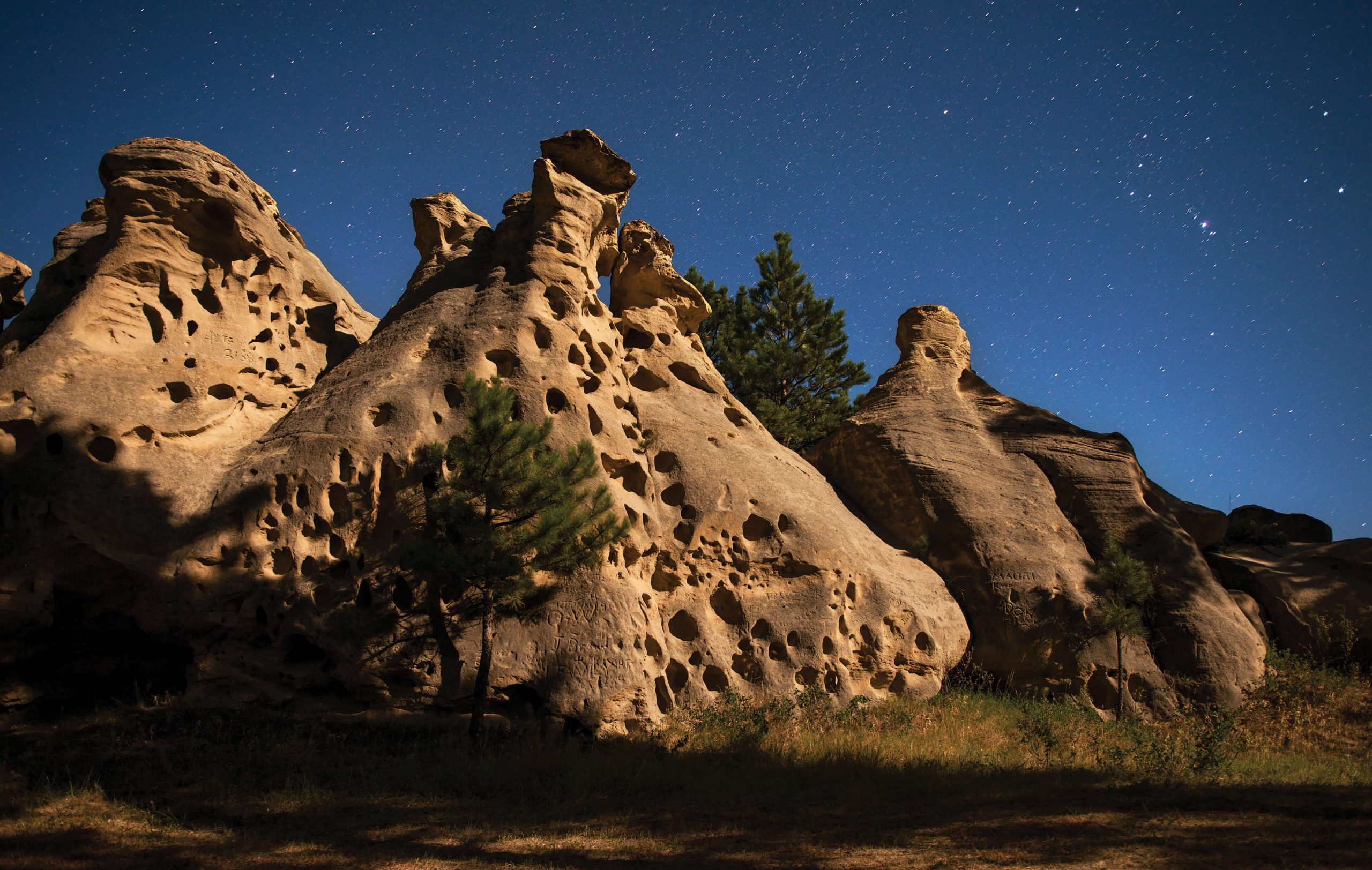
From that point, in the daytime, we could see swells of bluegrass, Junegrass, yucca, and prickly pear lapping at the shores of a sandstone archipelago, each island wind-whipped into astonishing shapes. Narrow tendons of rock stretched up into tiny mesas where plumes of ponderosa swayed. The walls of each figure, pocked with ovular hollows and grooved with deep shelves, slid down into labyrinthine channels of juniper and sagebrush: The prairie equivalent of tide pools.
At night, however, darkness made infinite detail invisible and left only the outlines of each earthstack evident against the horizon.
All was quiet as we lay down in the grassy center of the cul-de-sac. Because the State of Montana manages this place as a primitive park, its rock gardens are motorless and unlit. No RV generators. No latrine lampposts. All sounds were plant and animal, including the noise of our bodies moving through silence: lungs drawing air, feet crunching gravel.
One light source, though, remained behind in camp. A solar lantern on a picnic table threw light against ponderosa trunks and into their needled canopies. From 150 yards, this cool blue essence hovered within the dark copse like a biosphere on an inhospitable planet.
But this was a fragile illusion because the unseen world is teeming with life. More than two-thirds of animals are nocturnal, and insect activity is 30 percent higher at night. The non-human life we perceive in our waking hours, by chance, is a tiny sliver of the earth’s animate existence. By these facts, ignorance is the most basic tenet of human endeavor, a revelation that our consciousness quickly confirms when we allow ourselves to enter the dark. And this awareness of ignorance is not merely a sense of the unknown; it is a sense of not being able to know.
After leaving camp, I thought of Lucille and Ruth, the orphaned sisters in Marilynne Robinson’s Housekeeping, stranded on a far shore of Lake Pend Oreille as night fell around them. “The sky and the water were one luminous gray,” she writes. “The woods altogether black. The two arms of the land that enclosed the bay were like floes of darkness, pouring into the lake from mountains brimming darkness, but stopped and turned to stone in the brilliant ether.”
As this blackness takes hold, Lucille nervously fidgets and sings “Mockingbird” to dispel her fear, “never accepting that all [their] human boundaries were overrun.” Ruth, however, is strangely calm and lets “the darkness in the sky become coextensive with the darkness in [her] skull and bowels and bones.”
Lying on the grass in that terminal loop of road at Medicine Rocks, I tried to remain conscious of these options and follow Ruth’s example. I wanted the indifference between inner and outer dark to settle upon me, and this became easier as I looked around at what I could not see.
I could not see the grass growing beneath me or how I was encircled by it. I could not see the textures of trees or bushes or stones. My feet and hands, too, were dark, apparent only as moving parts of a larger darkness. The daytime singularity of things had gone. All was merged and ambiguous. Borders were no longer enforced. Until dawn, there would be no fix for my impulse to categorize things according to their differences.
What, then, could I see? The transition from earth to sky. Not light, exactly, but a lightness that started where stands of ponderosa and spires of sandstone stopped. The great grounds of earth were stewed thick. The atmosphere, though, was a broth, and surprising ingredients were floating therein.
Uncountable stars, and none of them gathered around or strewn across. Not one placed or set. The burnings of unnumbered celestial fires were visible but not measurable, frustrating my desire to compare near and far or here and there. They scrambled my ability to estimate when I might, if walking, be among distant things and touch them with my fingers. They defeated my sense of distance and thus my sense of time.
In this way, darkness decentered me. It frightened me. I shuddered and wanted to reach for the switch. I was frightened not only by what darkness concealed but also by what it revealed: not merely individual insignificance but the absence of individuality itself.
Still, I remained lying there after my wife returned to camp, and slowly, darkness became the primary force at work upon me. It became more noticeable than the earth beneath my spine. Eventually, gravity seemed even easier to take for granted than in the daylight. I wasn’t falling or flying but neither was I grounded. There was a sensation of my insides joining the outside. It’s strange to say, but I began to feel like I was no longer here or there. I was of.
“Why are things the way they are? Why are humans the way they are?” When we’re in the dark, Moore tells me, certain questions come naturally to mind. “You really learn to listen. You learn to see. At the end of the day, it’s just you and the universe.”
Now, looking back on that night at Medicine Rocks, I reckon that darkness is our way of referring to the ether that exists with equal regard or without regard for all things. It is the absence of positionality. It is everywhere all at once and, certainly, embowled within us. If we listen, then it never fails to convince us that, as Robinson writes, “Everything that falls upon the eye is apparition, a sheet dropped over the world’s true workings.” It never fails to persuade us that our manner of being, our essence, is perishable.
Looking back, I’m also persuaded to deepen my understanding of the word “sanctuary” as it applies to Medicine Rocks and other places recognized by IDSA. I realize it’s a mistake to think of protecting the dark in the same way we think of protecting wildlife. Whereas miraculous creatures have mortal limits and can be extinguished, the dark is boundless and can only be obscured.
Perhaps then, when we protect dark skies, we are actually providing a sanctuary for ourselves, a place of refuge from artificial illumination where we can enjoy the natural dark. A place for not seeing all that can be seen. A place consecrated by the limits of conservation.
Gabriel Furshong writes from Helena, Montana. His poetry collection, Surrounding the Country a Chasm, won the 2025 Slapering Hol Press Chapbook Prize. His writing has appeared in many journals and magazines across the country, and he reports on Montana politics for The Nation, High Country News, and Montana Quarterly; gabrielfurshong.com.
No Comments