


30 Jan History: Sinclair Lewis’ Yellowstone
It’s a bright summer day in the late 1910s. As Claire Boltwood drives up the steep hill from the north entrance of Yellowstone National Park to Mammoth Hot Springs, she has to pull over to cool the boiling radiator of her 70-horsepower Gomez-Deperdussin roadster. Her friend Milt Daggett catches up in his tiny bug of a car, a rut-jumping, dun-painted Teal. Milt grins as he gets out.
“The Teal is a grand car for mountains,” he says. “Aside from overheating, bum lights, thin upholstery, faulty ignition, tissue-paper brake bands, and this-here special aviation engine, specially built for a bumble-bee, it’s what the catalogues call a powerful brute!”
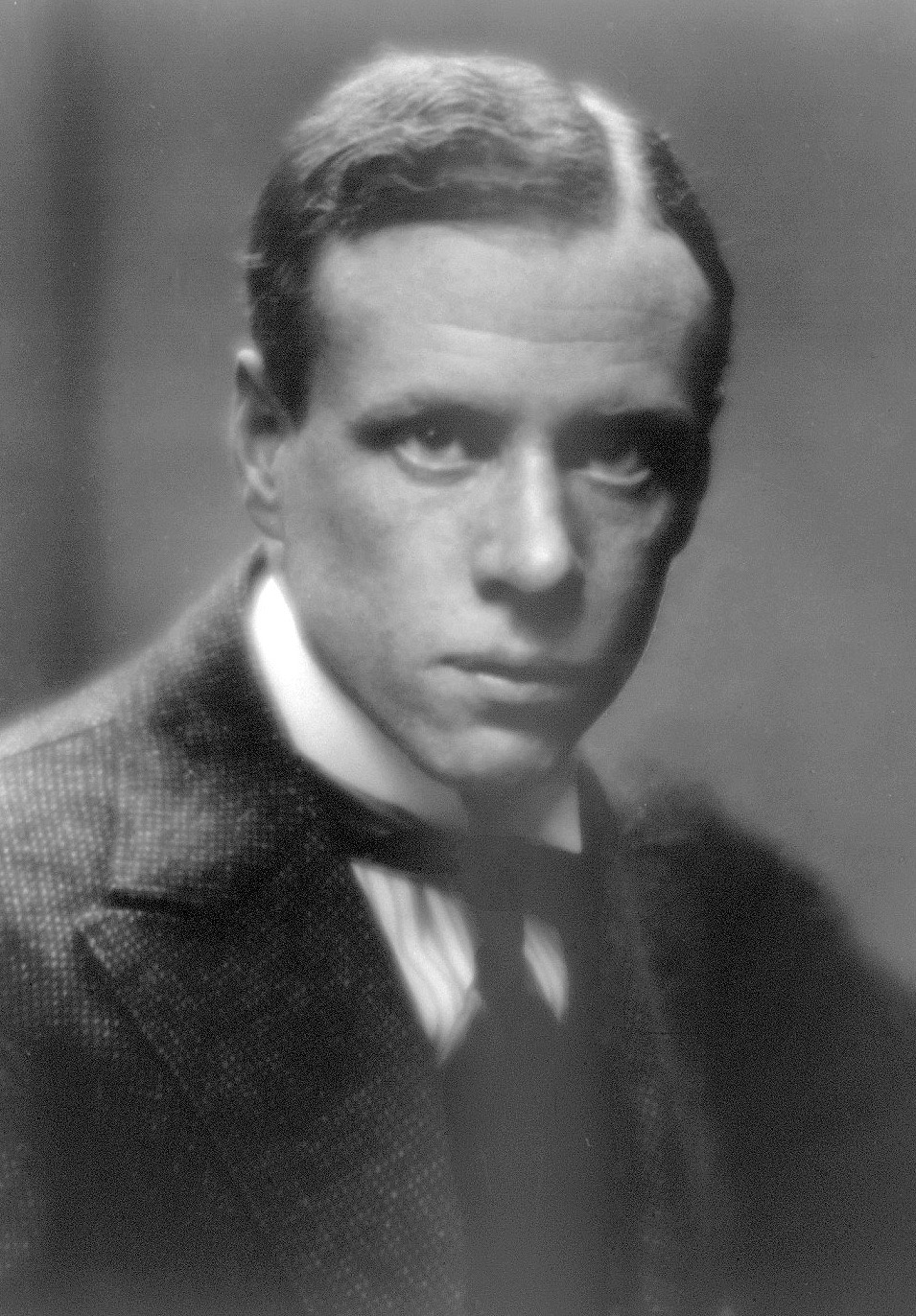
Sinclair Lewis, one of the earliest automobilists in Yellowstone, captured the park’s automobile-based class conflicts in his 1919 novel, Free Air. | ARNOLD GENTHE / LIBRARY OF CONGRESS
This is fiction: Claire, Milt, the Gomez-Dep, and the Teal all sprang from the imagination of novelist Sinclair Lewis. But Lewis himself had driven through Yellowstone in 1916. So he packed his 1919 novel, Free Air, with details of his vision of the park.
That vision is important for three reasons. First, Lewis was the first American to win the Nobel Prize for Literature — in other words, he was an important voice, whose opinions about rural places are worth exploring. Second, although Free Air is a lightweight, romcom-like novel, it features the same themes of class and conformity that marked Lewis’ masterpiece, Main Street, published the following year. Third, although the book takes its heroes through melodramatic scenes across the Northwest, its emotional heart is in Yellowstone. To Lewis, the park represented America.
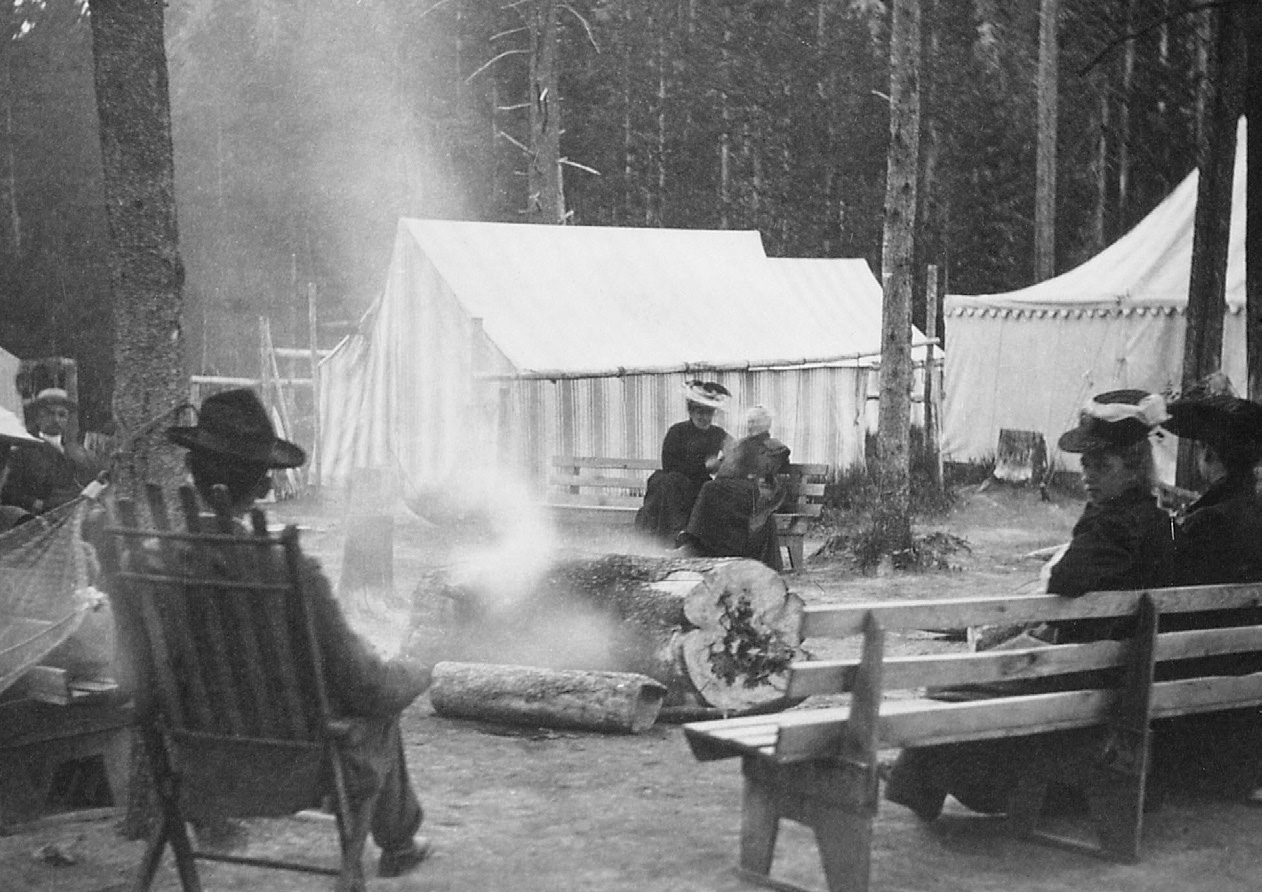
At permanent camps such as this one, shown in 1908, tourists slept in wood-floored canvas tents —
a decided step down from fancy hotels. But the camaraderie of gathering with strangers around a
campfire became part of the Yellowstone mystique that crossed class divides. | National Park Service
Dark, slender, 23-year-old Claire, seeking to escape a provincial, aristocratic life in New York, is vacationing with her widowed father by driving from Minneapolis to Seattle. On their first day, they stop at a garage to buy a new inner tube. (The title, Free Air, refers to a sign above the garage’s air hose.) The garage’s owner, 25-year-old Milt, is shy but smitten. Fed up with the stultifying Midwest, he decides, spur-of-the-moment, to shadow the Boltwoods on their journey.
Within an hour, Milt has pulled them out of a mudhole. And though Claire tries to shake him — his actions could be interpreted as stalker-ish even in the 1910s — she keeps encountering crises that he shows up just in time to help solve. Soon, they are separately touring Yellowstone, with the Boltwoods staying in fancy hotels and Milt in rustic glamping operations called “permanent camps.”
During Yellowstone’s first half century, most visitors arrived by train and took five-day packaged tours. They overnighted in luxury at places like the Old Faithful Inn and Lake Hotel, dressing up for dinners that included formal touches, such as finger bowls. Only the wealthy could afford the time and money to visit a national park.
Gaining in popularity during the 20th century, the permanent camps were more casual and relaxed. Lewis describes the one at Canyon as featuring a “big dining tent, [and a] city of individual bedroom tents, canvas-sided and wooden-floored, each with a tiny stove for the cold mornings of these high altitudes.” Informality bred camaraderie: After dinner, guests circled around a bonfire to sing songs together.
Lewis had fun with the contrasts. Refined Claire rages about lower-class tourists who “preferred freak museum pieces to plain beauty; who never admired a view unless it was labeled by a signpost and megaphoned by a guide as something they ought to admire — and tell the Folks Back Home about.”
Meanwhile, Milt is intimidated by Claire’s dining companion, “a man of thirty in riding-breeches, a stock, and a pointed nose, who bowed to her every time he spoke.” Milt imagines that their conversation must be incredibly sophisticated, perhaps even taking place in French.
But it turns out that the man is appalled that Claire drives her own car. “It must be dreadful for you to have to encounter so many common people along the road,” he says. He’s a snob, as well as an insufferable bore and a pretentious dandy. She later tells Milt that the man is a “creepy jack-ass, I don’t believe he’s ever been on a horse in his life!”
The next night, when Claire and her father dine with Milt at the permanent camp, she is amazed to overhear her waitress discussing the novels of a Spanish author named Vicente Ibanez. Milt explains that many of the camp’s employees are teachers and professors who have taken summer jobs. Compared to the class deference required of a fancy-hotel waiter, this version of Yellowstone is more fun.
Clarie is so delighted that she exclaims, “There is an America! I’m glad I’ve found it!”
Lewis makes these characters appealing by putting them in conflict with their class origins. For example, Claire starts using the word “limousinvalids” to refer to “smart people being conveyed in a bored way behind chauffeurs.” Meanwhile, Milt complains that the old-timers in his hometown say that “German was a good enough language for anybody, and that taxes for schools and sidewalks were, yes, something crazy.”
Lewis clearly based all this on his own experiences. Like Milt, he was a young man frustrated by Podunk life in his small Midwestern town. (Lewis himself escaped to Yale, where he mixed with the upper classes.) Like the Boltwoods, Lewis and his wife drove from Minnesota to Yellowstone on a road called the Red Trail, roughly the route of today’s Interstate 94. (Indeed, the Boltwoods spend their first night in the stand-in for Lewis’ own hometown of Sauk Centre, Gopher Prairie, a moniker the author reused in Main Street.) Like Claire, Lewis’ wife, Grace, was something of a spitfire. But like Milt, Lewis and Grace had traveled in a cheap, flimsy car — in their case, a Model T Ford.
The Lewises arrived in Yellowstone in 1916, the first full summer that cars were allowed past the entrance gate. This transition marked a profound change in the way tourists experienced the park: They were no longer cooped up with strangers in a stagecoach for a prescribed five-day tour. Instead, they could be themselves.
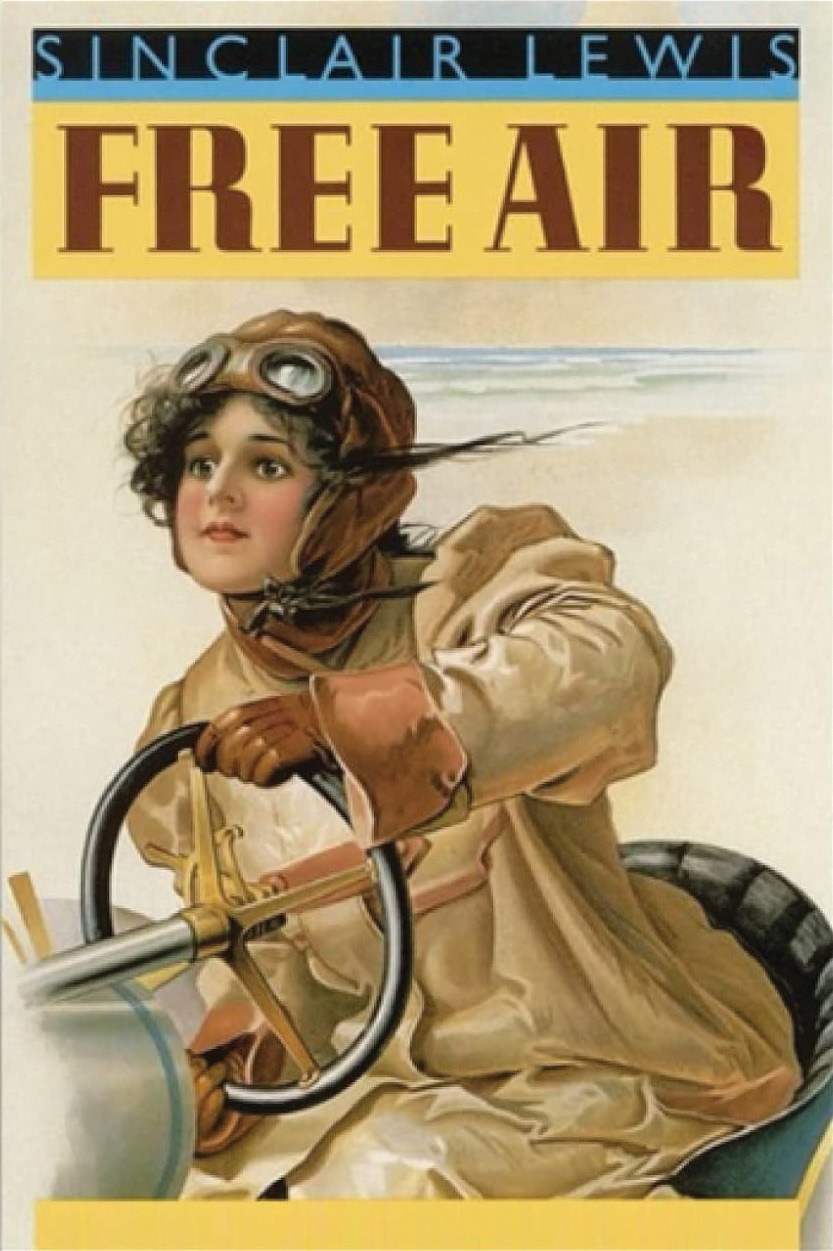
The cover of the 1993 Bison Books reissue of Free Air features artwork by G.F. Kaber that captures the adventurous, feminist spirit of early auto travel.
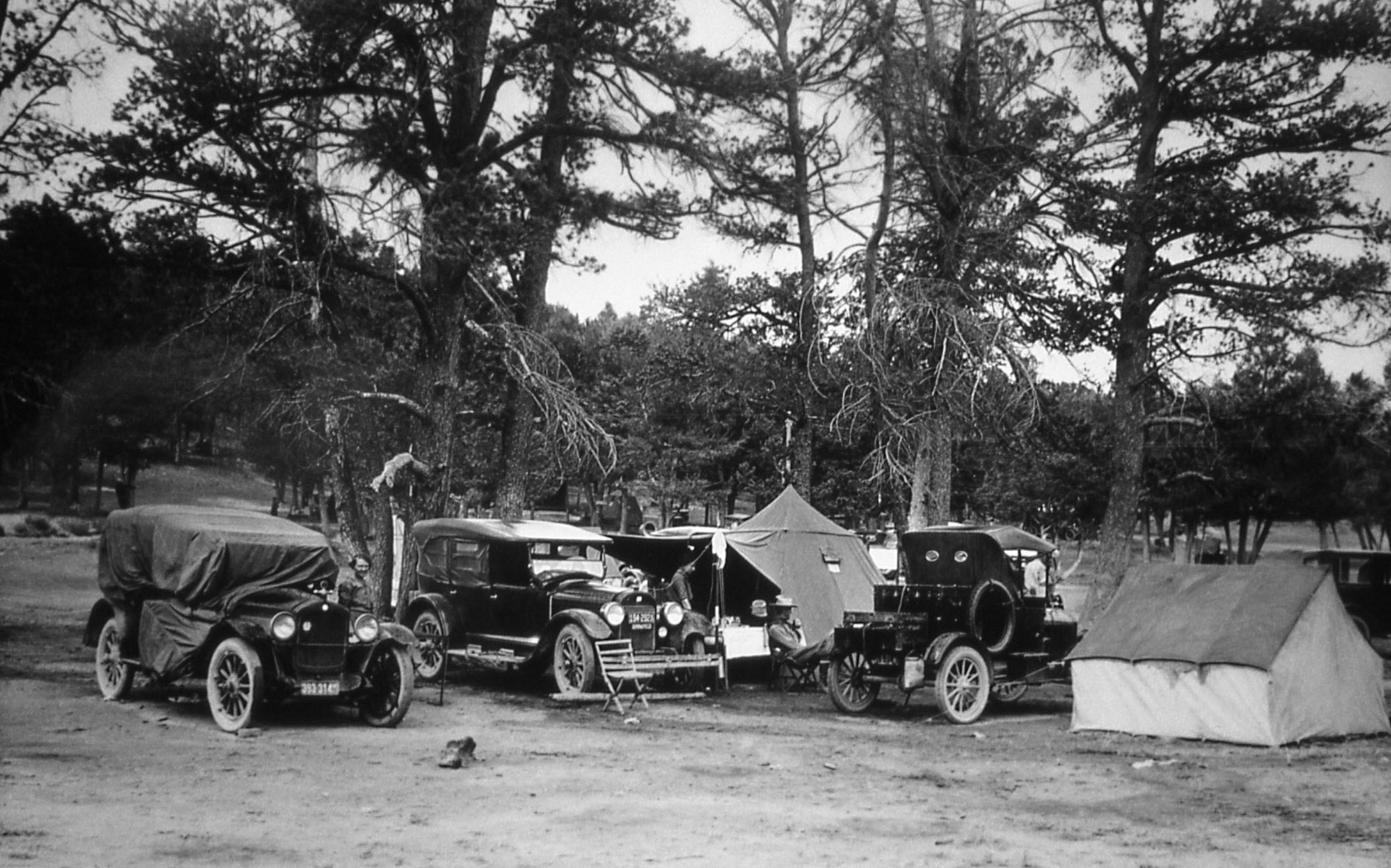
Furthermore, they could do it on the cheap. A car could take up to seven people, who would each have to buy their own tickets on a train. Cars could also take camping and cooking equipment to cut costs. Although Lewis had his fictional characters stay in the hotels and permanent camps because having more people around created more drama, he and Grace had been happy camping along the roadside and frying their own eggs.
One of the surprises of 1916 was how many Yellowstone visitors drove Fords. The Model T, likely to break down though easy to repair, had been intended for short jaunts around town. Cross-country travel, automakers believed, would be dominated by rich people in expensive roadsters. But Model T owners proved to be resourceful travelers, like Milt.
In other words, cars brought a middle-class revolution to Yellowstone. By 1925, automobilists comprised 70 percent of Yellowstone’s ever-growing visitation. The hoity-toity hotels found their rooms going empty, even when they dropped prices. Railroads, once the economic powerhouse behind the park, found themselves losing clout.
Lewis, who disliked money-grubbing materialism, clearly enjoyed this cultural turnaround. He had been an early adopter of the automobile because he saw its potential for class disruption. Then again, he liked to make fun of the smug, pompous, striving, and mediocre of every class. His award-winning satires of middle-class conformity and complacency show America’s vaunted small towns with a depressing bleakness — as if all people are too inherently flawed to ever construct a decent society.
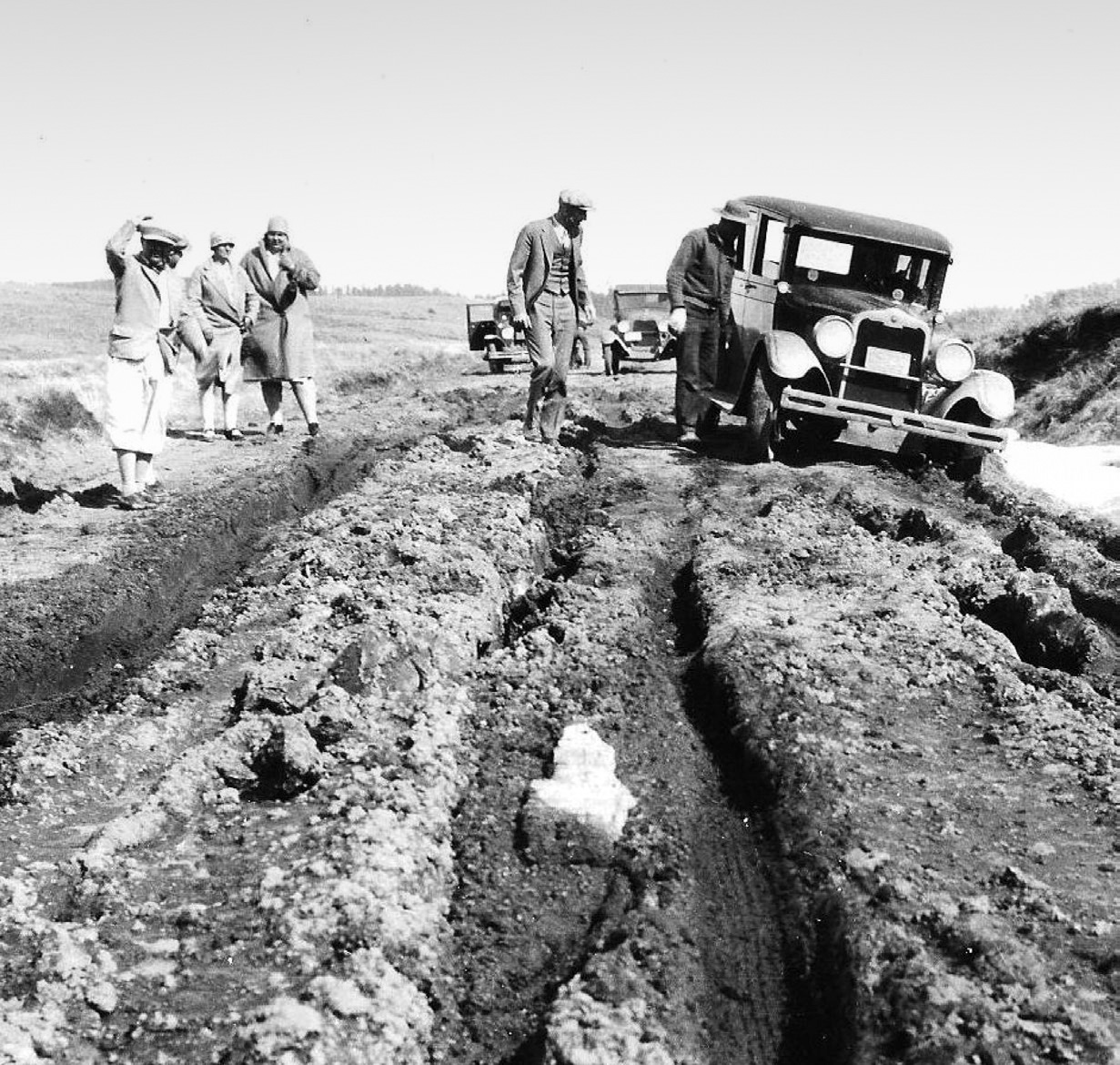
Reality could be far muddier than the advertisement depictions for early park travel, as demonstrated by this image — probably from the late 1920s — of autos struggling to negotiate rutted dirt roads in Yellowstone’s Lamar Valley. | National Park Service, Yellowstone National Park Library, Yellowstone National Park Photographs
By contrast, Free Air presents a vision of idealistic classlessness that Lewis’ later novels lack. As Claire and Milt find each other on the road, they find and contribute to a joyful society as well. Did the younger Lewis really believe in such hope, only later becoming disillusioned? Or was Free Air, which began as a serial in the Saturday Evening Post, an insincere attempt to write what he thought the market wanted? Only Lewis himself knew.
Lewis’ plot puts Claire and Milt through almost 2,000 miles’ worth of adventures, including escapades with a vicious bear, a faulty brake line, a gun-toting tramp, and Claire’s erstwhile boyfriend. The book’s third act is set in Seattle, as Claire and Milt try to figure out whether their love can overcome their differences.
But its emotional heart is in Yellowstone — that’s when “she fell to thinking that she preferred this American boy in this American scene to a nimble gentleman saluting the Alps in a dinky green hat with a little feather.” And it’s when, as she later says, she first knew that Milt would propose marriage.
Furthermore, as Lewis shows, Yellowstone is where the society around them best fits their ambitions to connect across class divides. When they climb the interminable steps down into the Grand Canyon of the Yellowstone and find themselves holding hands, it feels natural, not self-conscious. As they fall asleep in separate tents at an impromptu camp just north of the park, Claire is aware “of rustling sagebrush, of the rapids of the Yellowstone [River] beside her, of open sky and sweet air and a scorn for people in stuffy rooms, and comfortably ever conscious of Milt, ten feet away.”
When Claire and Milt can get out of the pretentious hotels and into the classlessness of automobile culture, they’re two people just like everyone else — which makes them truly special. Post-1915 Yellowstone made a similar journey, Lewis suggests, as automobiles transformed the park into a truly American destination.
This article is drawn from research for author John Clayton’s forthcoming book, The Auto-Biography of Yellowstone: How Cars Continually Transform America’s Natural Treasure.
John Clayton, a regular contributor to Big Sky Journal, is the author of several books, including Natural Rivals, The Cowboy Girl, and Wonderlandscape. He also writes the newsletter “Natural Stories;” johnclaytonbooks.com.
No Comments