


30 Jan Chasing the Montana Creek Rise
Undervaluing creeks seems a perennially popular ailment among fly fishers. Leave ’em to their losses, I say: All the more water and fish for me. Clearly, I don’t suffer from their dysfunction of insight.
My first fly-caught fish, a subcompact coastal cutthroat trout, happened on a creek when I was perhaps 12 years old, and that did it: I’ve been a creek lover all the decades since.
I was 17 when I caught my first Montana creek trout (probably a cutthroat, too, but of a whole other kind). He and the rest of the creek fish that followed over the two-week trip weren’t exactly big, but many seemed big — not the skinny 6- or 8-inchers of my home creeks scratching out meager meals but 10-, 12-, and up to 15-inchers grown stocky from ample feed. Those larger ones, they seemed like giants.

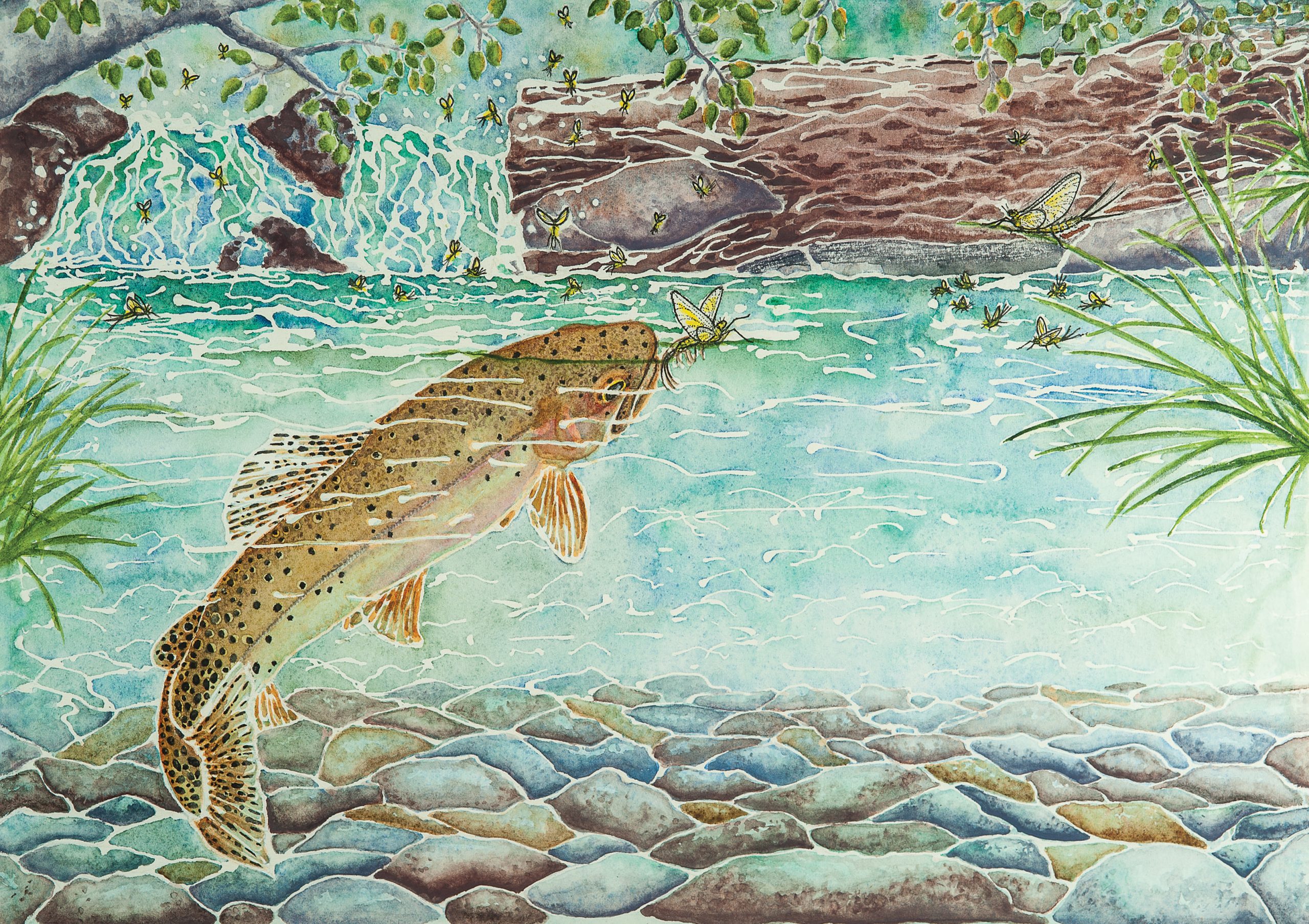
But trout size in creek fishing was, for me then, as it is now, a minor part of the attraction. What Montana creeks gave me, and give me still, is something nearly unknown on the western Washington creeks of my youth: The Rise. The Rise — trout taking floating insects down, in ways ranging from gentle sips to hearty grabs. The Rise — wherein, trout are “rising.”
On A creek’s slick or wrinkled surface, on that water pressing forever past, those insects may be floating high on invisible feet, floating only partway up through the surface, or floating on or in it in other ways. The constant is, all are afloat. And trout that take floating insects take them by some form of rising.
When The Rise happens on a creek half again as wide as your fly rod is long, it’s usually for the same reason it happens on Montana’s massive Clark Fork or Missouri: It’s because of a hatch. A hatch is a mass migration of a specific bug (not just any caddisfly, for example, but the American Grannom caddis), as underwater pupae or nymphs ascend to air, get their wings dry and working, and then fly off for romantic bliss.
A hatch on a creek could be Pale Morning Dun (PMD) mayflies popping out and standing on the water as they dry fresh wings, trout holding high in the flow, waving their stout yet streamlined bodies in the currents, plain where the light’s right to your astonished eye. Trout sway as though swimming in air, swinging up to kiss a winged mayfly, drifting down for a bit before another soft swing back up for another. Repeat, repeat. It’s such a heartbreakingly beautiful display that you hesitate to end it by hooking the fish. A few more mayflies go down under his industrious nose. Then, the draw of knowing that trout noses are doing the same thing up and down the creek is too much, and you send out your fly, matching size, shape, and color with the small PMDs (perhaps a size-16 Parachute Light Cahill). You send it sailing upstream of the riser. The fly drifts too far right, and almost as it passes him he comes up to a natural. You cast twice more, trying to catch the narrow lane of his feeding without spooking him with a rough presentation or by putting tippet or fly over his wary and watchful head. (There’s predator danger up there, so near the surface.) The fly drifts close. He noses it gently down…
Creek trout have gifted me with The Rise many times during mayfly hatches — in addition to PMDs, I’ve enjoyed Mahogany Duns and dinky bad-weather Blue-Winged Olives, among others.
And caddisflies, the pupae stroking vigorously to the surface with their long, strong hind legs, then (at least the sorts that aren’t quick to fly off) riding atop the smooth currents like floating moths.
And midges, mosquito-like, tinier than Blue Wings, often abundant, and always struggling in their squirming ascent to the surface and in their transition there.
Stoneflies? I’ve seen Yellow Sallys on creeks, but never enough of these bright little stones to particularly excite or focus the trout: just another item on the day’s buffet. But once, only once, there came the huge celebrated salmonfly that I’d always heard and read was a big-river bug. (Or was it the slightly smaller and eternally underrated Golden Stone? This happened so long ago…)
Stoneflies crawl up out of the water to hatch, so The Rise really doesn’t apply to their hatching. But the adults later scramble and flutter and fall back onto the water. The small trouts’ little mouths did their best to take in or disassemble the great fluttering stoneflies that landed on their creek, darting madly at each insect. I fished a fly enormous for creek trout (a Stimulator, perhaps?), yet a fly considerably smaller than the great big stones. It was hard to hook those trout on the big fly, so I landed only a few. No matter: The spectacle of it all was rich.
I’ve attended The Rise many times on creeks. Yet The Rise is perhaps less likely to occur on a creek than on a river. If I’m determined to find The Rise, I won’t go first to a creek I can cross in five wading steps; I’ll go to a river requiring cautious and determined wading — if it can be crossed on foot at all.
I do not, however, need hatches or The Rise they fuel to love fishing creeks.
I can love creeks for their intimacy.

Creek intimacy comes from three sources. First, creeks don’t get fished much, especially compared with rivers. They don’t get fished much, in part, because, again, a lot of anglers don’t consider them worth bothering to fish — too small, holding trout too small, too. But even if creeks were as popular as rivers, they would still stay uncrowded. Angler pressure is spread over more creek miles than river miles because it typically takes a lot of creeks to build a river. Consider: A trout river 80 miles long may be fed by 500, perhaps even 1,000, miles of creeks. (Though rough, these are real figures I came to by measuring the creek miles feeding a prominent Montana trout river I also measured on a detailed map.) Angler scarcity creates privacy; privacy invites intimacy.
Second, even if others are fishing your creek, the small water — its trees, bends, brush — will likely hide them from your sight, and the chuckling water will drown their speech. Again, privacy is achieved so that intimacy may follow.
Third, the closeness of it all: of water, forest, and fish. The narrowness of that sparkling flow bringing both its banks so near, banks of the thick, erect, furrowed trunks of larch — the creek sheltered under its outstretched bristled branches and the branches of lodgepole pine and such. All of it is the intimacy of close surroundings.
The hatches; the trout of perfect beauty, well-fed and wild; the closeness of everything, much of it scaled down from river size to an elegant miniature (and, of course, The Rise, when it comes), are why I, and a small (“select,” we like to think) group of other fly fishers, love our creeks. And Montana creeks are as easy to love as trout creeks can be.

Devoted seekers of trophy trout neither love nor bother with creeks because creeks, of course, are the least likely waters to serve their ambitions.
Yet creeks can hold big trout.
A fellow fly author once told me of a creek that ran through a ranch and held big trout: 20, 22, even 24 inches long. I know him; he’s to be believed. I have caught 20-inchers in creeks, and to me a 20-inch trout, no matter where it’s caught, is big. But big trout are rarely in my thoughts when I’m fishing a creek. The small- to modest-sized trout I catch there are too beautifully formed and artfully spotted to leave me wishing they were different in any way, including larger.
The true trout of Montana creeks — and lakes and rivers, too — used to be only the cutthroat, primarily the westslope, but also the Yellowstone cutthroat. (Though the trout-related bull trout and whitefish shared much of his water.) Back when state fish-and-game departments saw trout species as decorations of different colors you could use to dress up a stream, these agencies introduced to western waters east of the Rockies: the rainbow trout from the West Coast, the brook trout (which, like the bull, belongs to a class of trout’s close cousins called “char”) from the eastern United States, and the brown trout from Europe. I’ve fished Montana streams that were almost entirely populated by browns or brookies (not yet by rainbows, though I expect I will). This has been tough on the cutts. Their numbers are now way below historic levels in Montana and throughout the West.
But creeks remain a key cutthroat stronghold. One Montana mountain creek I’ve fished a lot, mostly racing through its bed of gold-tinged rocks that almost illuminate in sunlight through its crystalline water, is nearly all westslopes. Over dozens of visits, my wife, Carol, and I have knowingly landed but two or three brown trout compared with the hundreds of cutthroats we’ve caught there. Perhaps one out of a dozen fish is a small bull trout. (A Montana thing, according to my long creek-fishing experience: young bull trout, only 7 inches to a foot long, come from a creek. Everyone knows that, somehow, bulls are always big — 3, 5, 8 pounds, 10 — never have I caught baby bulls in Oregon, Washington, Colorado, Idaho, or British Columbia. Always a surprise. Always a curious delight.)

Gearing up for creeks is simple enough, even if you’re an idealist: a light floating line (4-weight or 3-weight does it), a shortish leader and tippet (I fish a 7.5-foot, 4X leader, 2 feet of 5X tippet), and an elegantly miniature reel mounted on your shortish (7- to 8-foot) supple rod (supple enough you feel it flex a little with just a few feet of line out the tip-guide).
Simpler yet: Just use what you have. If what you have is a 9-footer for a number-5 line, use that. It’ll work.
For the small mouths of smallish creek trout and their open-minded feeding, standard dry flies in smaller sizes, 14 and 16 mainly (though 12s and 10s are fine if the trout have a little heft), are perfectly reliable: Parachute Adams, Elk Hair Caddis, almost any dry fly.
Nymphs are not for creeks, most creek lovers would say. But often, I do fish them there, below a tiny strike indicator. The patterns, again, can be small standards: Copper John, Bead Head Pheasant Tail. If I’m going to hook a creek-large trout of 12 or 13 inches — or a stunning creek-giant 16-incher — it’ll likely be on a nymph.
This small selection of patterns will usually serve. But bring a solid range of imitative flies because these normally compliant trout can get snooty about what they’ll take — especially during a hatch.
Small water means mostly small trout, but there’s great beauty in both. And don’t forget the opportunity to intimately witness The Rise. Montana doesn’t hold the only fine trout creeks, but Montana creeks are as fine as any I’ve found. They’re abundant, most are little fished, and they’ve not seen nearly the last of me.
For more than three decades, Skip Morris has made his living by writing — 19 books to date — and speaking about fly fishing. His first book of essays is due out in early 2026. His wife, Carol Ann, provides illustrations, paintings, and photographs for his articles and books.
Carol Ann Morris is a fly-fishing photographer, speaker, and artist/illustrator whose work appears often in books, articles, and essays written by her husband, fly-fishing author Skip Morris. Seventy-five of her drawings will appear in Skip’s next book, an essay collection; etsy.com/shop/carolamorrisflyfish.
No Comments