



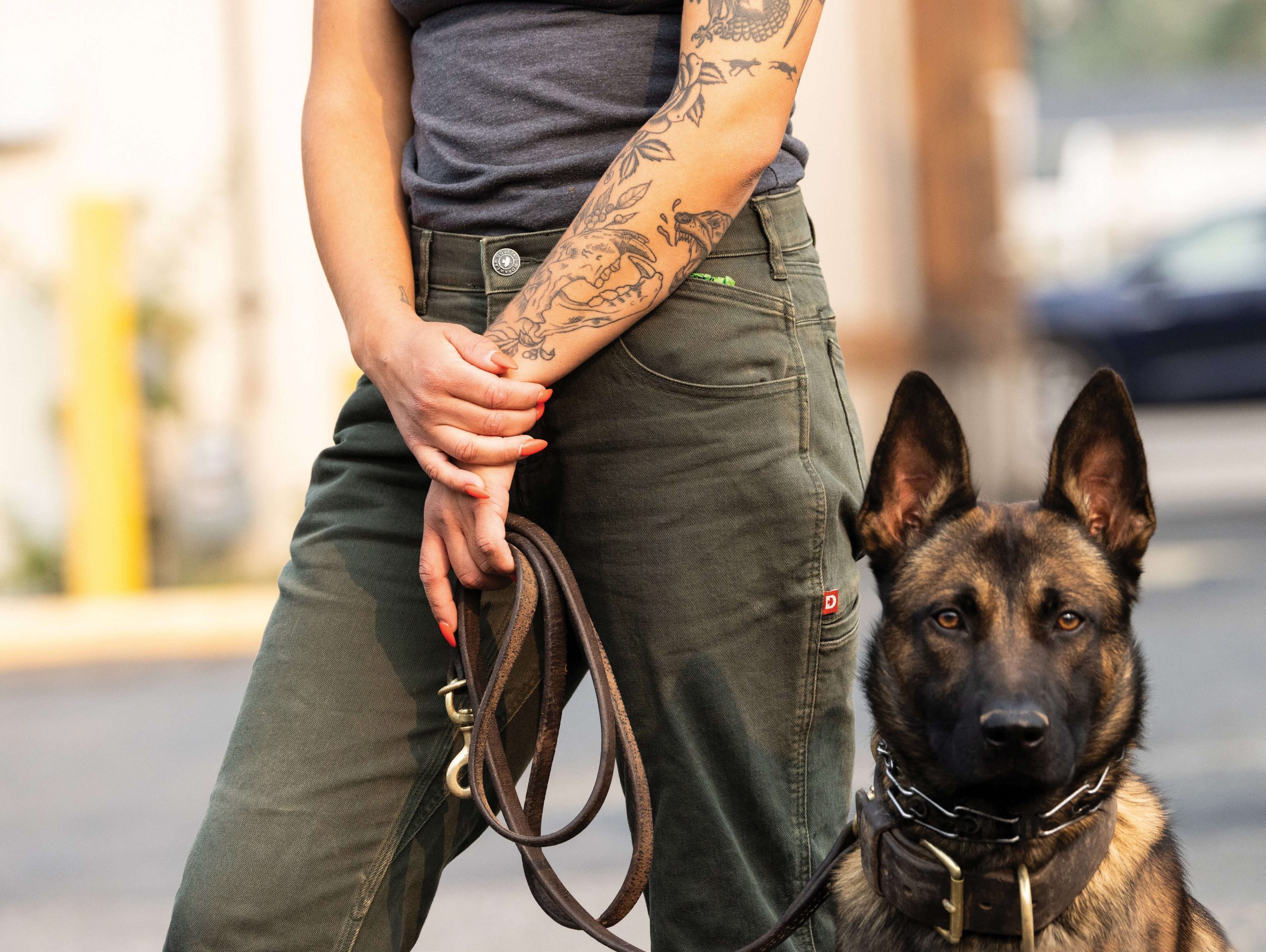
21 Nov Trust Your DOG
At 14 months old, Harpy makes her way over upended picnic tables, through tires, and across a wooden ladder suspended 8 feet in the air. Her blond jackrabbit legs slip out from underneath her, first one, then the other. She freezes long enough for the sun to shine through her oversized ears, still puppy pink. Kim Greene offers quiet, confident encouragement from the ground: “Keep moving, Harpy.” And she does. Harpy swings her hind leg up to the ladder’s rail and, when she has enough purchase, moves forward. When she gets to the end of the course, Greene says, “Sitz,” and Harpy balances her gangly, growing Belgian Malinois body in a seat atop the 2-inch top edge of a freestanding wall. “Good sitz,” Greene says.
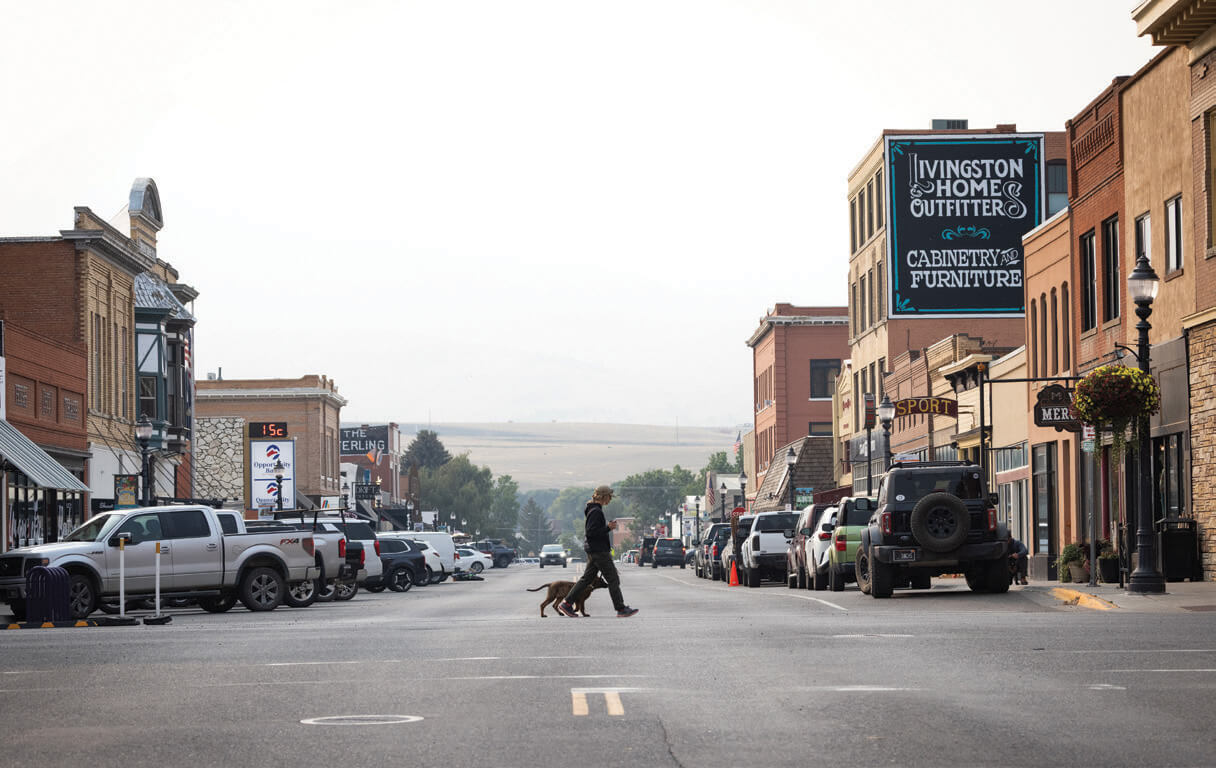
A Svalinn K9 handler and their dog cross the street in downtown Livingston. The handlers spend a significant amount of time working in public to socialize dogs and teach them problem-solving skills.
I want to imagine that it’s pride curving the dog’s black mouth into a grin. I’m grinning too. How could such a young dog focus so completely on this sprawling and wobbly obstacle course? Harpy’s eyes shine like wet agate, never moving from Greene’s face. That’s not pride, I realize. It’s desire. And drive. What’s next, she’s wondering. Give me some more.
Lucky for Harpy and the 45 other dogs in training at the Svalinn Ranch outside of Livingston, Montana, Greene is always ready for more. After 20 years, two continents, and 376 dogs that she and her team of handlers have raised, Greene, like Harpy, is laser-focused on what she describes as a passion project. Simply put, Svalinn dogs are bred and trained on-site to be both protection dogs and family companions capable of intensely deep connections. They are good citizens, incomparable sentries, fierce deterrents, and utter lovebugs. Though such a pairing seems unlikely, if not impossible, Greene has never been deterred by long odds.
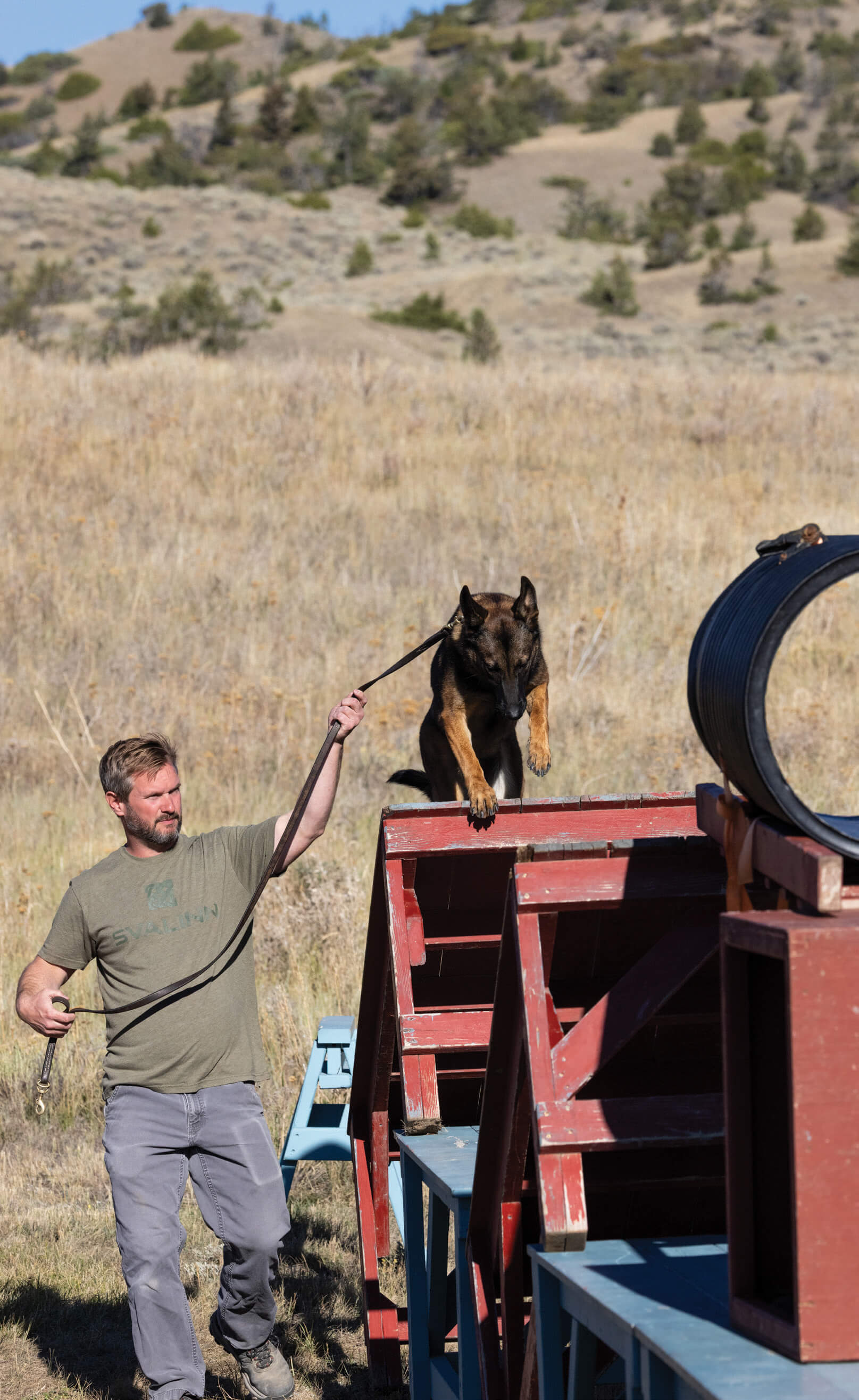
Svalinn K9 handler Brett Mullins leads Yeti, another 14-month-old from the monster litter, through the Phoenix obstacle course at the Svalinn Ranch, which is reinvented regularly, like the mythic animal, to keep the dogs on their toes.
Perhaps the Svalinn story begins at Princeton, where Greene entered into a master’s program in public policy and international relations on September 10, 2001. Or maybe it was two years later, when she worked as a wartime policy advisor in Afghan President Hamid Karzai’s office, learning firsthand about the importance of personal safety in a chaotic world. Two years after that, she and her then-husband launched a private security business in Nairobi, Kenya. What goes into realizing a 20-year dream — a 20-year tapestry of personal safety, public service, business acumen, and the power of the human-canine relationship — can hardly be pulled apart.
In Nairobi, Greene and her then-husband founded Ridgeback Limited in 2005, providing protection, advising, training, and intelligence gathering for private citizens, visiting diplomats, businesses, and humanitarian organizations at a time when robberies, carjackings, and home invasions were rampant in the region. When she learned she was pregnant with twins, Greene felt like a “sitting duck from a security standpoint.” She didn’t have a firearms background, and, regardless, gun licenses were nearly impossible to get for foreigners.
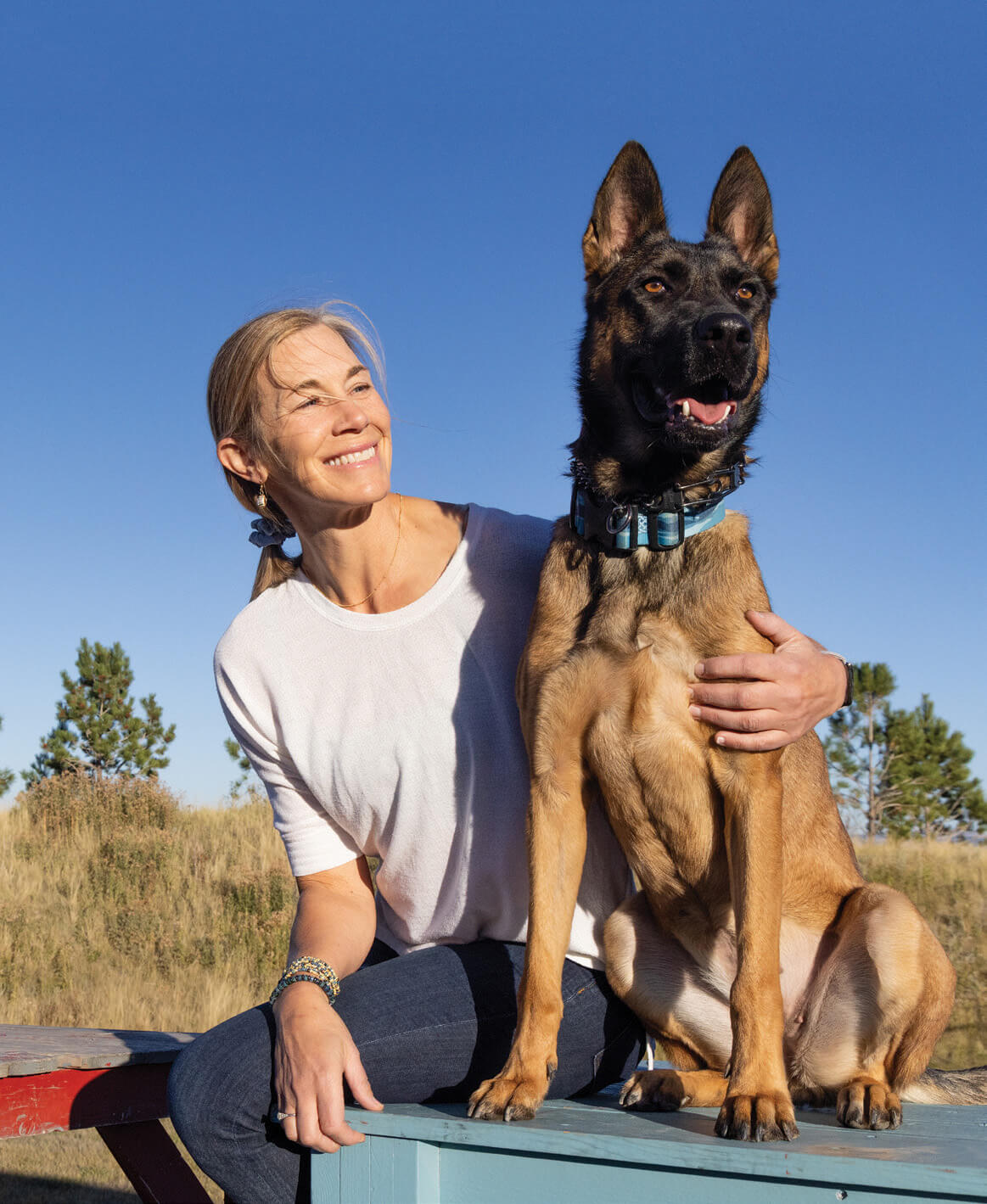
Svalinn founder and president Kim Greene poses with 2-year-old Nyiri on the ranch in Livingston.
“This is where dogs enter the story,” she says from the Svalinn Ranch, all these years later, the shine in her own eyes an instant giveaway to the life she’s made. Behind her, the Crazy Mountains rise to the east, and the land unfolds in every direction. Not a single bark pierces the quiet.
Enter Banshee and Briggs, two Dutch shepherds from a breeder in Canada. “They were very good protectors, and shitshows in many other ways,” Greene recalls, with a laugh, of their early days in Nairobi. But the dogs kept Greene and her family safe, and when they had an accidental litter of 12 puppies, Greene dove into her canine-training education with the intrepidity one gathers — after being in her company for just a few minutes — is second nature for her.
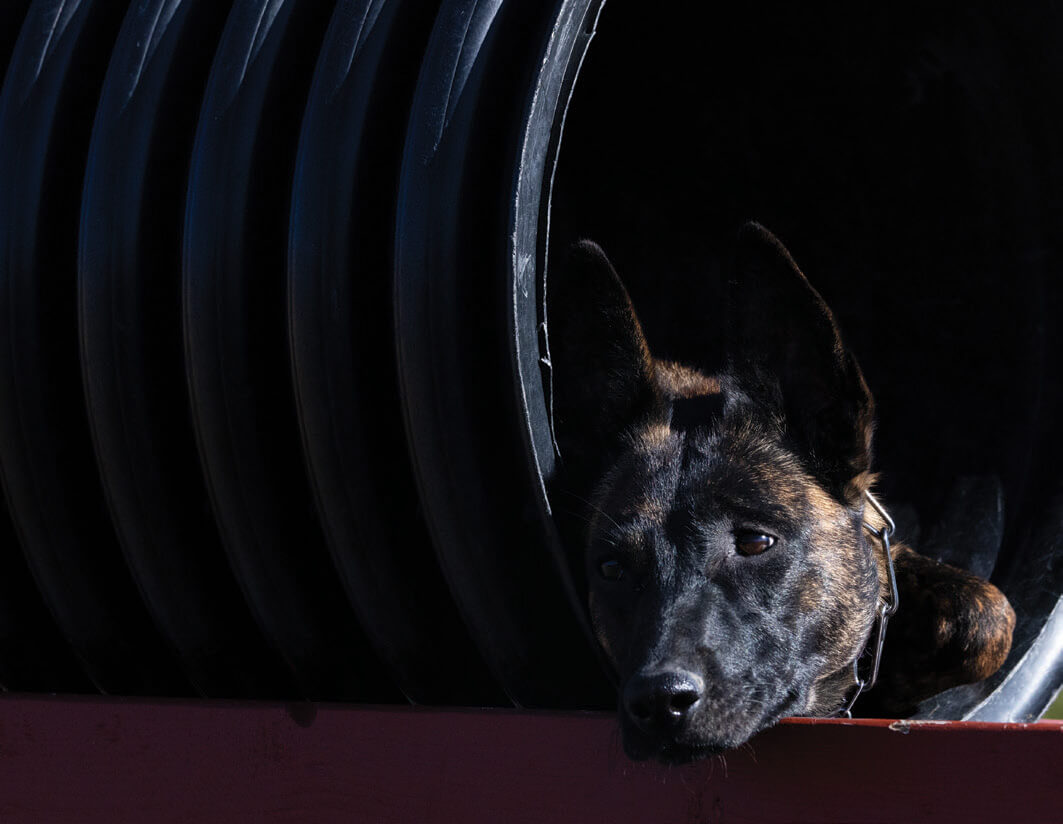
Rajah takes a quick break from her training work at the Phoenix obstacle course on the Svalinn Ranch.
“You don’t always get everything right out of the gate,” she admits. She wanted to find a way to do both things, to raise dogs with obedience and protection abilities that would make their owners a very hard target, and to raise those same dogs to be unconditionally loyal and loving.
So Greene kept learning, kept pushing. The dogs got better and better. Smarter. Stronger. Sweeter. She moved her family to the States when the twins were old enough to start school and, after a short stint in Jackson, Wyoming, landed in Livingston in 2016.
The end goal of the work she has committed her life to is connectivity — between dogs and their people. And while the $175,000 price tag for a 2- to 3-year-old Svalinn dog speaks to their rare abilities as discerning protectors through choice breeding and bespoke training, Greene isn’t reluctant to talk about the importance of what else her dogs can do.
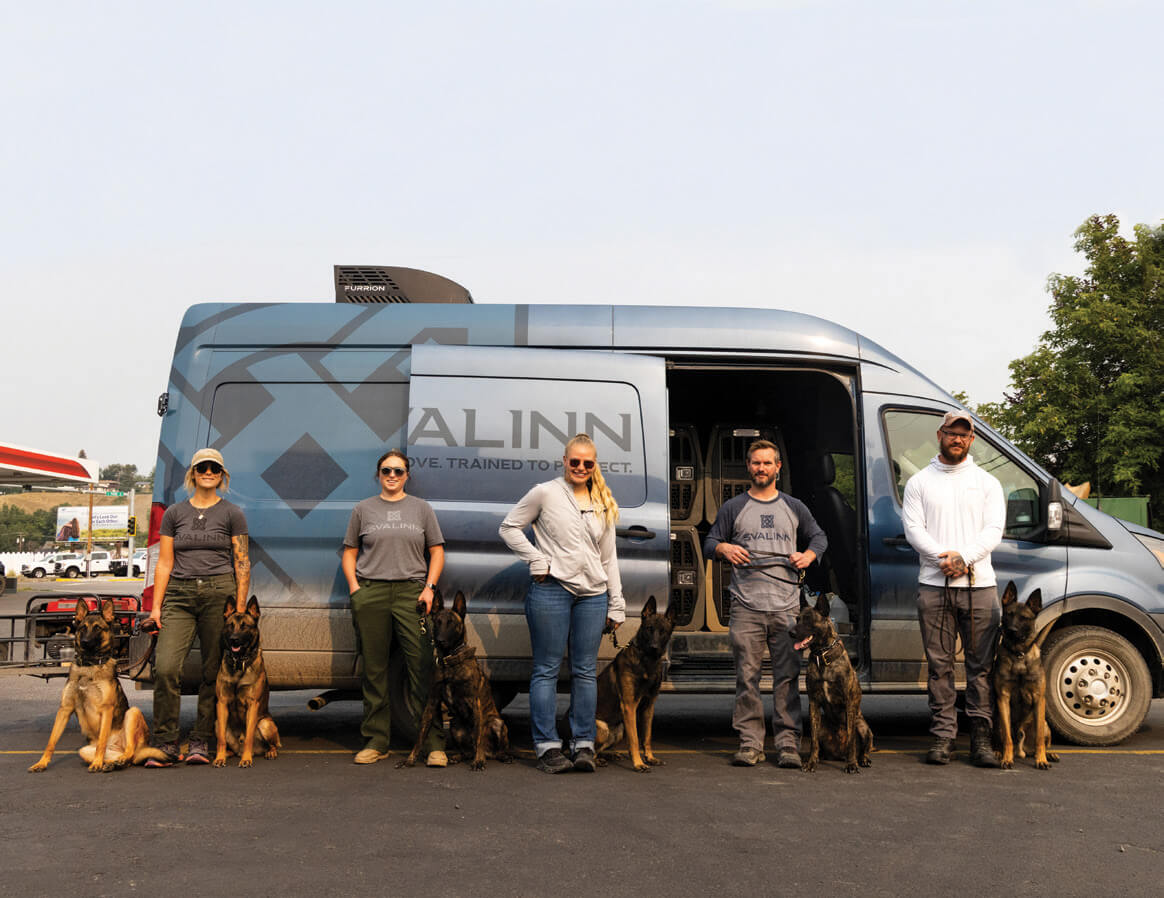
Shown on one of their regular town days in Bozeman, Montana, are (from left) Svalinn K9 handlers Julie West (with Siren and Kraken), Josie Gillespie (with Whistler), Courtney Huff (with Frank), Brett Mullins (with Fuego), and Matthew Wierman (with Griffin).
“It’s a partnership,” she says of the relationships she fosters between her dogs and the families she pairs them with. “People are looking for something greater than themselves,” she adds, describing the peace of mind and grounding that come part and parcel with owning a Svalinn dog. “When they have an intense and unconditional connection with a creature who has their back at every moment, people can show up as the best versions of themselves,” says Greene. Though it’s not written anywhere, that vision is at the center of everything that goes into every dog.
After her early experience with Dutch shepherds, Greene began to cross her dogs with German shepherds and Belgian Malinois. Though she does bring in the occasional hand-picked purebred to introduce new blood to her lines, within a generation the offspring are fabulous mutts, she says. Greene cherry-picks males and females for temperament, skill sets, and personality. All three breeds have unique qualities that make them eager to please, excellent thinkers, and caretakers. In females, who are the best predictors of personality in a pup, Greene looks for “sentries and mama bears,” while she seeks males that “can pack a little punch.”
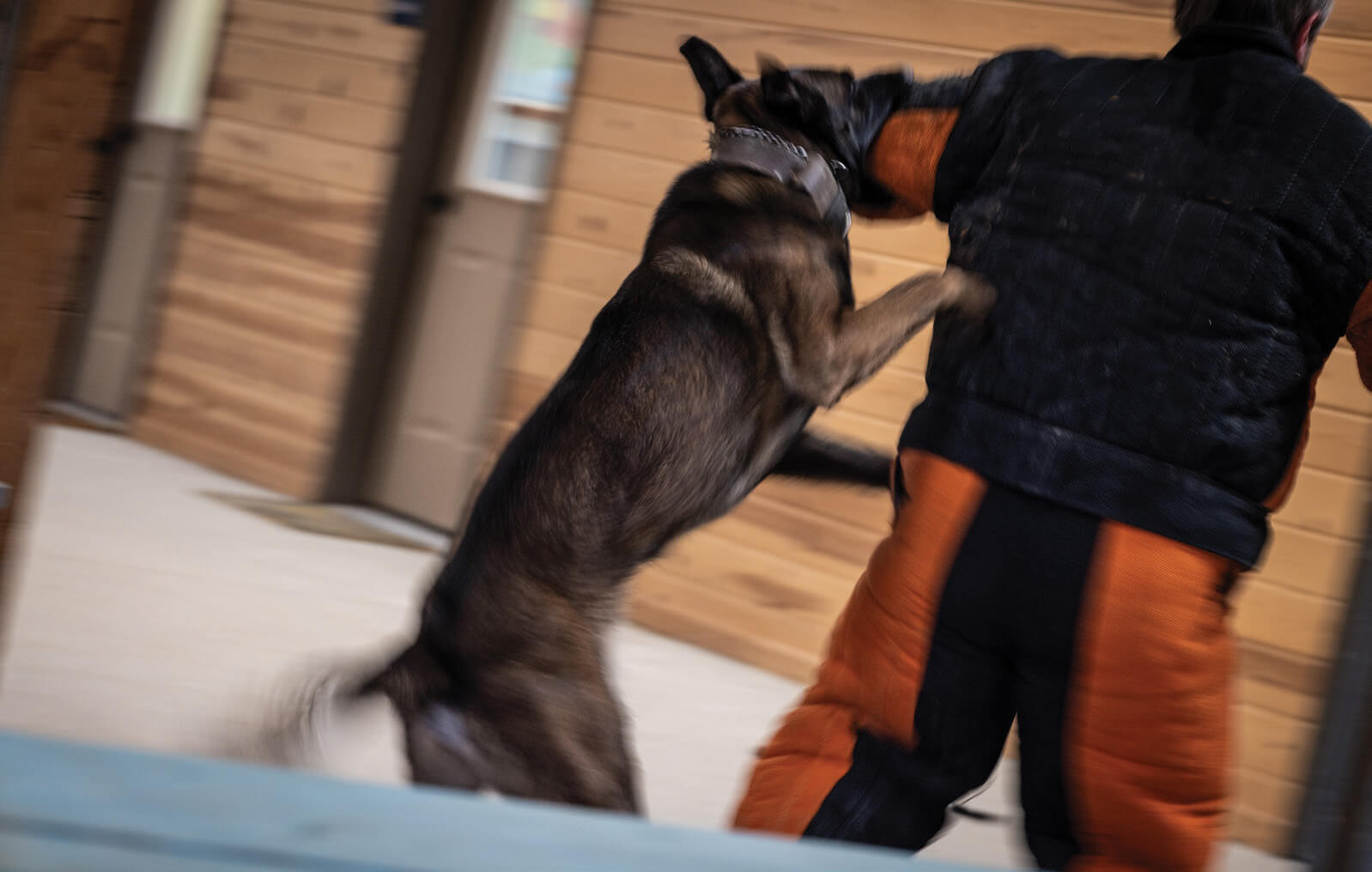
Dressed in the bite suit, Mullins does protection work with 14-month-old Frank.
One of the things that sets Svalinn apart is that they breed and train in-house; most protection dogs are bred by one outfit, sold as puppies or adolescents, and trained by another. Consequently, the amount of generational data Svalinn can collect on each dog throughout its development — data that can then be used to enhance both breeding and training — is unmatched in the industry. To make things even more challenging, Greene does not keep breeding stock. All the females that have a litter — rarely more than one, and never more than two — are in training to be placed with a family, usually by the time they are 2 years old. The breeding males, too, are either in training at the ranch or, occasionally, already placed with a family. Males take a little longer to train and tend to be placed in homes slightly later than females.
As for the training process, Greene uses words like “energy,” “essence,” “analog,” and “tactile.” Raising a Svalinn dog is an intuitive and hands-on project every day, and Greene explains how committed she is to letting nature lead the way. For starters, even though the dogs are raised in an indoor facility at the ranch, they live on natural earth, in a former riding arena known as “the pit,” where each dog has its own house and is staked close enough to its neighbors to touch noses. They eat a raw beef diet, including bones and fat.
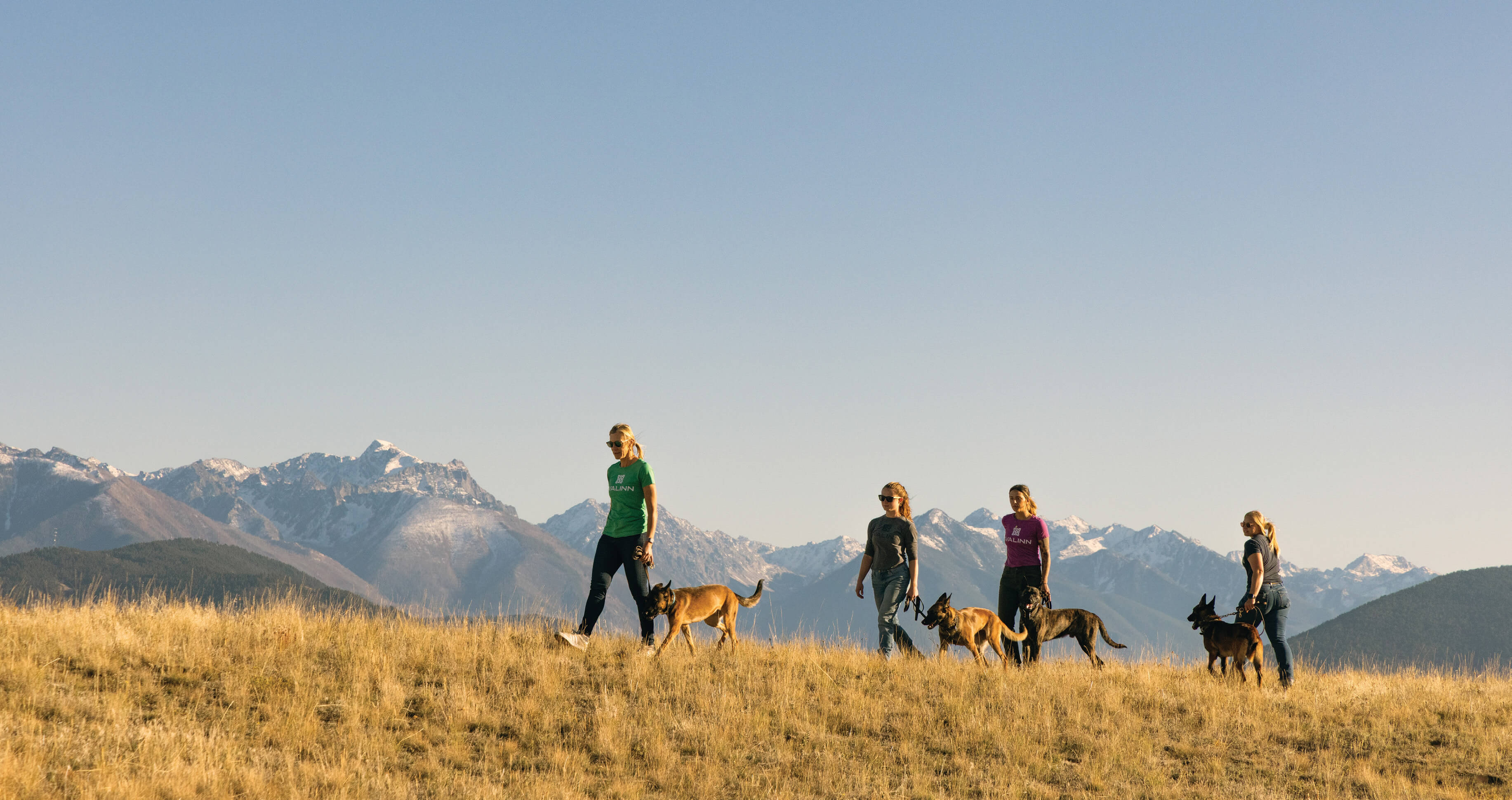
With the Absarokas as a dramatic backdrop, the Svalinn Ranch is a perfect place for a walk. Pictured here are Kim Greene (with Nyiri), Katerina Brumer (with Tink), Julia West (with Fuego), and Courtney Huff (with Yeti).
The breeding, too, is influenced by nature, where every female “has a say.” What that means practically is that females can sometimes reject the mate Greene has selected for them. “We always have to have a backup plan,” she says. Litters are raised in their own facility by the mothers, and human contact is limited to a small group of handlers over six weeks. “When it’s time, we all stand outside while the garage door is raised and we call those puppies to us,” says Greene. It’s what dogs have done for eons, she says of leaving their own kind to join people. “We’re just building on that innate bond between canines and humans,” she says.
The training happens both on-site — with equipment like the Phoenix, the ever-changing obstacle course that desensitizes the dogs, teaching them to be grounded in even the most unstable situations — and off the ranch, with handlers who manage four to six dogs in a “pod” for 30 days before rotating. In their pods, dogs are taken everywhere — into town, on the road, to homes, and even to schools — to be socialized and exposed to as much as possible and to practice problem-solving. The 11 Svalinn handlers get to know each dog in every scenario and can share with each other who did what well and who needs work where. Everything contributes to the human matches that are made for each dog as they are ready.
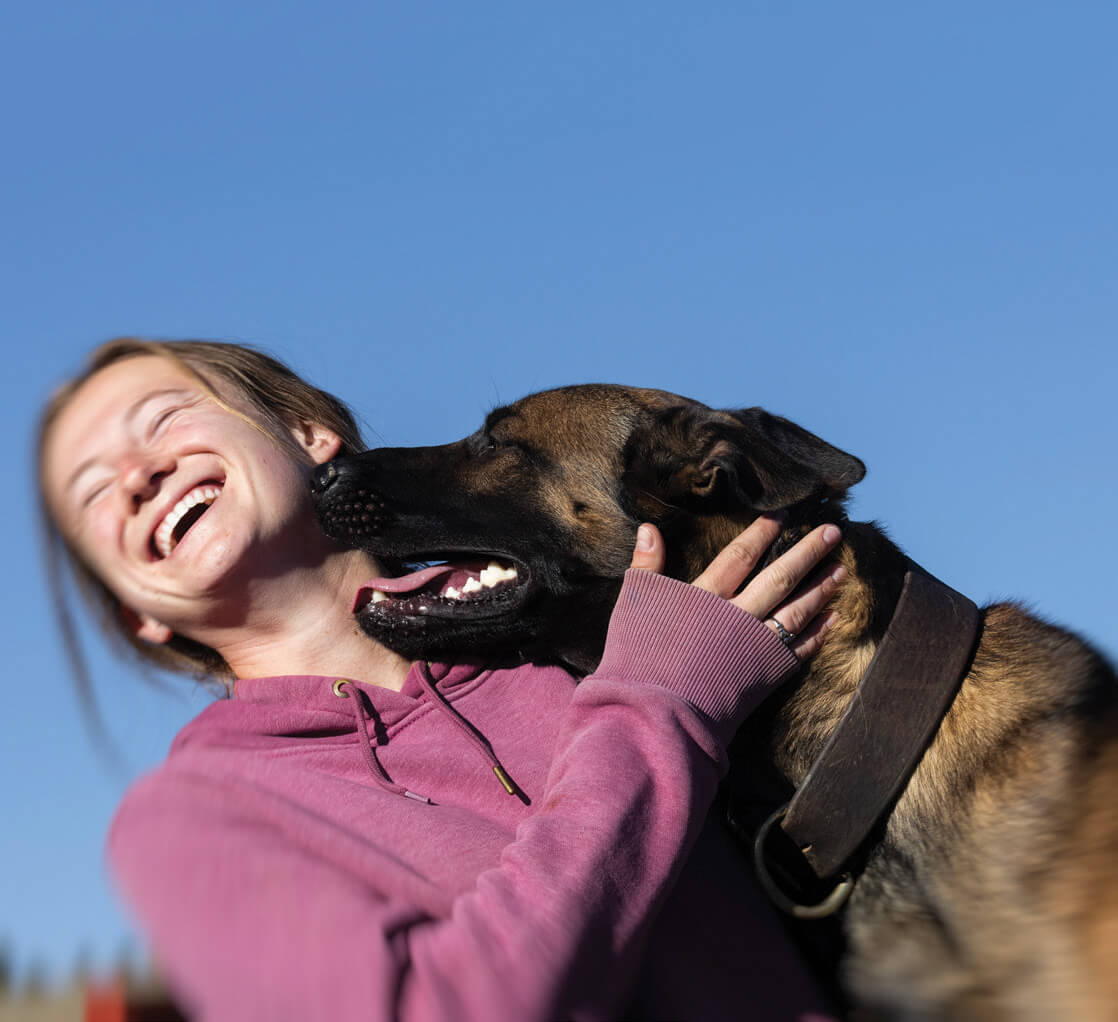
K9 handler Katerina Brumer enjoys a joyful moment with 14-month-old Frank, the same dog shown doing protection work. These two photos are testament to the dogs’ on and off switches.
Though it looks different day to day and hour to hour, the Svalinn training method is designed to develop the dogs’ on and off switches, Greene says. “We are building drive and layering in obedience.” It’s clear the plan is working when three of Greene’s longtime handlers — Josie, Cullen, and Julia — demonstrate protection work by two 4-month-old puppies that respond aggressively when Cullen appears noisily with decoys, hurling them toward the pups that are stationed next to their handlers and secured to a lead. The puppies — Brisket and Smoke, two of four in the “barbecue litter” — lunge for the decoys, establishing firm and complete grips with their mouths. Greene comments on their silent focus, calling them “quiet professionals.” Josie and Julia stay beside their charges the entire time, giving praise. Cullen pets them even as they have the decoys or his bite sleeve fully in their mouths, showing their remarkable ability to stay on task as protectors while maintaining an awareness of connection to their humans.
It’s obvious the dogs love what they are doing and are doing it phenomenally well. Greene points out that some dogs need more practice than others with protection work, while others need to focus more on their off switches.
Griffin, one of 10 in the 14-month-old “monster litter,” shows exceptional and natural ability as a protector, so it’s no surprise — when Josie deploys him against Cullen (in a full bite suit) — that he leaps at the command “Take,” latching onto Cullen’s arm and not releasing until Josie tells him, “Out.” Cullen doesn’t pet him immediately — Griffin is still perfecting his off button — but Josie gets him into a “sitz” on a bench, and he calms to her voice and touch in seconds.
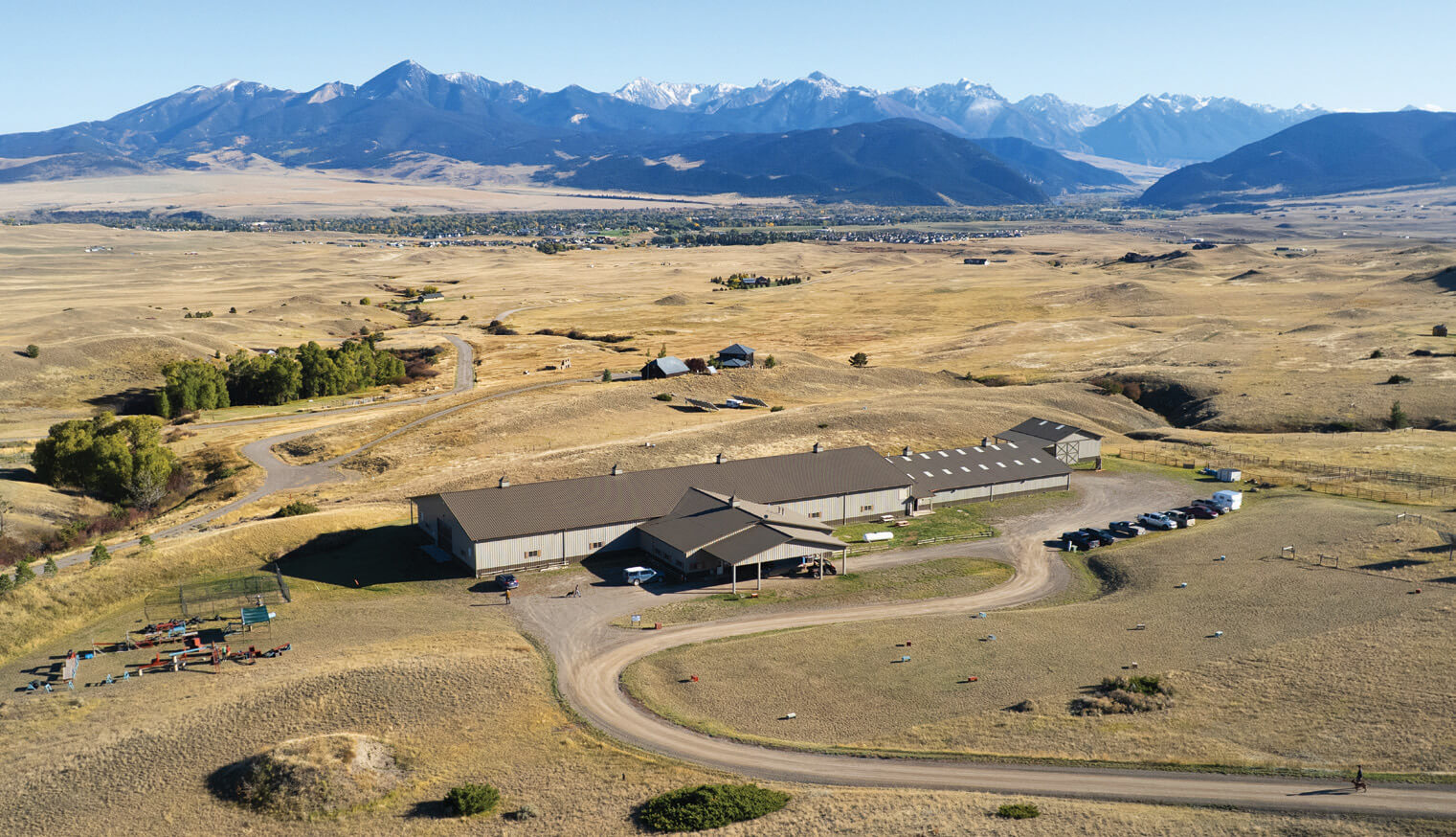
The Svalinn Ranch operates from what was once an equestrian facility, typically housing some 45 dogs in various stages of training and employing a staff of 13 people. | ANJA MOORE
“It’s not rocket science,” Greene says, noting the significant number of one-on-one hours that the Svalinn team invests into every animal. Rather, it’s an approach and methodology that has been developed and fine-tuned, based on Svalinn’s unique generational knowledge, over two decades.
I ask for stories of these incredible animals and Greene does not disappoint. She tells me about one of her dogs, homed in Maryland, that would not settle at an outdoor restaurant brunch with his family. The owner was thinking, Maybe he has to go to the bathroom. But he remembered Greene’s most common directive: “Trust your dog.” After a few minutes of watching his dog’s restlessness, the owner realized there was a ring of pickpockets working the crowd outside the restaurant. “These dogs sense malicious intent,” Greene says.
She tells another story of a woman in Seattle who was grabbed from behind on the street as she bent down to tie her shoe. The dog didn’t attack the person, who Greene suspects was “off, but not violent,” but rather just knocked them over to give the owner time and space to recover. “These dogs are that discerning,” she says.
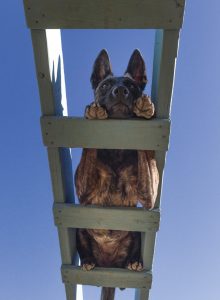
Rajah is a 2.5-year-old female, presenting as a Dutch shepherd. Here, she pauses for a moment on the Phoenix. Greene explains that they never use treats or toys as incentive for the dogs, but rather the dogs work exclusively for verbal praise. No doubt, Rajah’s handler was close by with an encouraging word.
As I take the winding road away from the Svalinn Ranch, the sun high and casting a honeyed glow on the sage-covered hills all around, a few of the dogs are still working their way through the Phoenix. I can see their tails wagging even at a distance.
Carter Walker is the author of several guidebooks, including two upcoming editions of Moon Montana & Wyoming (November 2025) and Moon Yellowstone to Glacier National Park Road Trip (May 2026). She spends a lot of time on the road between Montana’s Horseshoe Hills and the Yaak Valley.
Jeff Moore is a writer and photographer from Livingston, Montana. He shoots and writes about outdoor subjects across the West, and returns inside to shoot food and product photography, including expensive guitars, duck decoys, and top-notch steaks; jeffmooreimages.net.
No Comments