


09 Apr Renderings: Drawing a Full House
Just as the Gallatin Range will forever define the landscape in and around Bozeman, so, too, do the houses designed by Locati Architects that occupy sites throughout the Gallatin Valley. The stone, steel, timber, and glass that the firm regularly employs in their residences reflect the lasting, rugged Montana landscape while embodying an aesthetic that Locati is well-versed at creating.
Steve Locati, who joined the firm in 1991 after his brother Jerry established the practice in 1989, recognizes the collaborative nature of what he and his team of some 40 employees accomplish as architects. (Jerry’s role is now managing partner.)
“Our clients come from all over the country — and internationally — and every one of them is looking for their piece of the West,” Locati says. “So often, what we make comes back to the clients, their visions, their input. We hear what they say, and while their ideas may sometimes challenge our preconceived notions of the design, of what we envision, we use what they say as our creative fuel. We listen to our clients.”
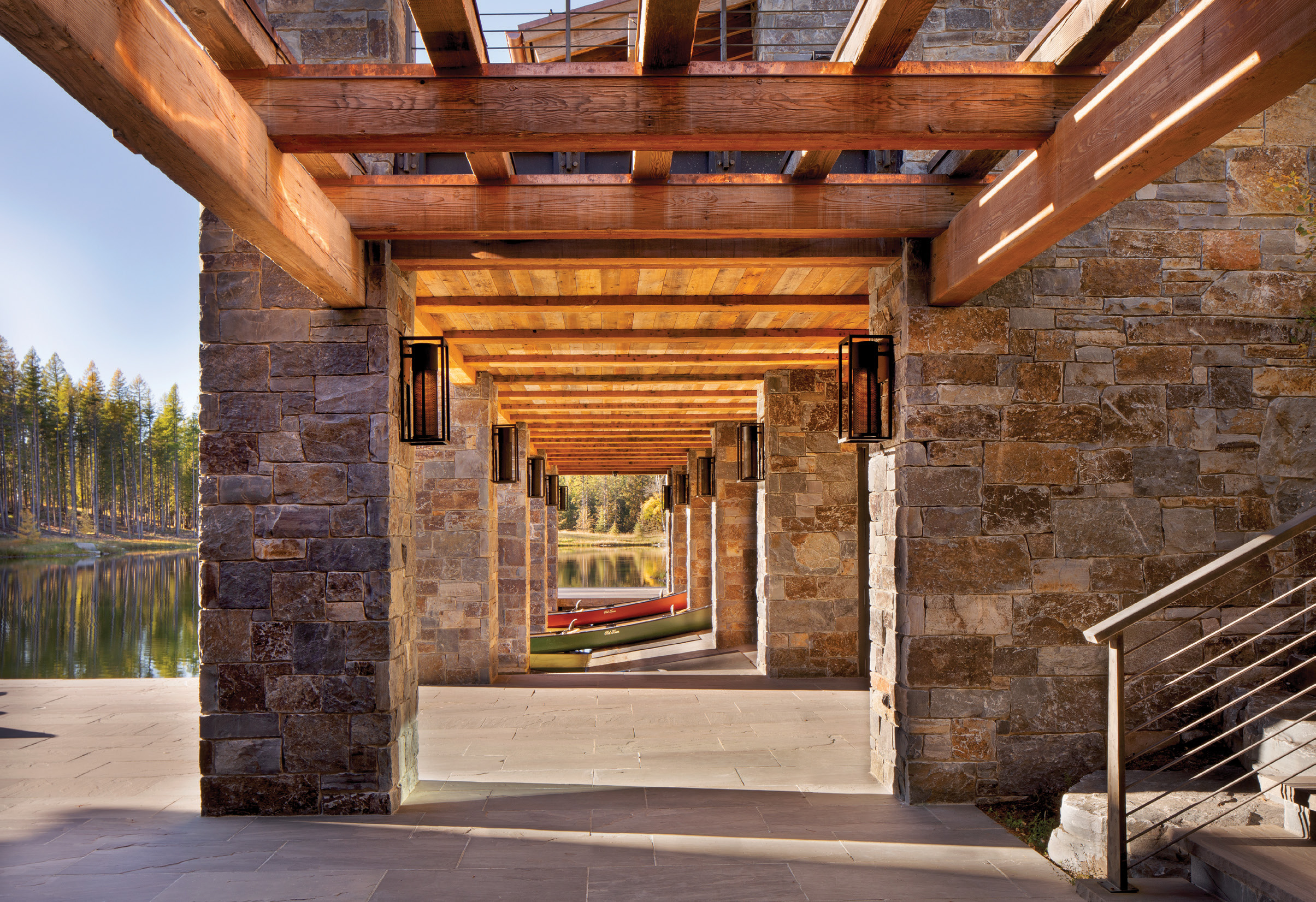
Part of a multigenerational family home in the midst of the Rocky Mountains, this boathouse is grounded in natural stone and reclaimed timber. The building was constructed by Bozeman-based SBC. | GIBEON PHOTOGRAPHY
Locati and his fellow architects, notably Greg Dennee — who has been with the company since his high school internship decades ago and is now one of the firm’s several partners — have witnessed a seismic shift in architectural styles. In some parts of the West, the prevailing motif for large-scale residences 20 years ago was for dwellings that resembled over-scaled log cabins. It was a look, and it could be a good one, with many such inspiring examples standing throughout locales like Bozeman, Big Sky’s members-only Yellowstone Club, and other exclusive residential enclaves.
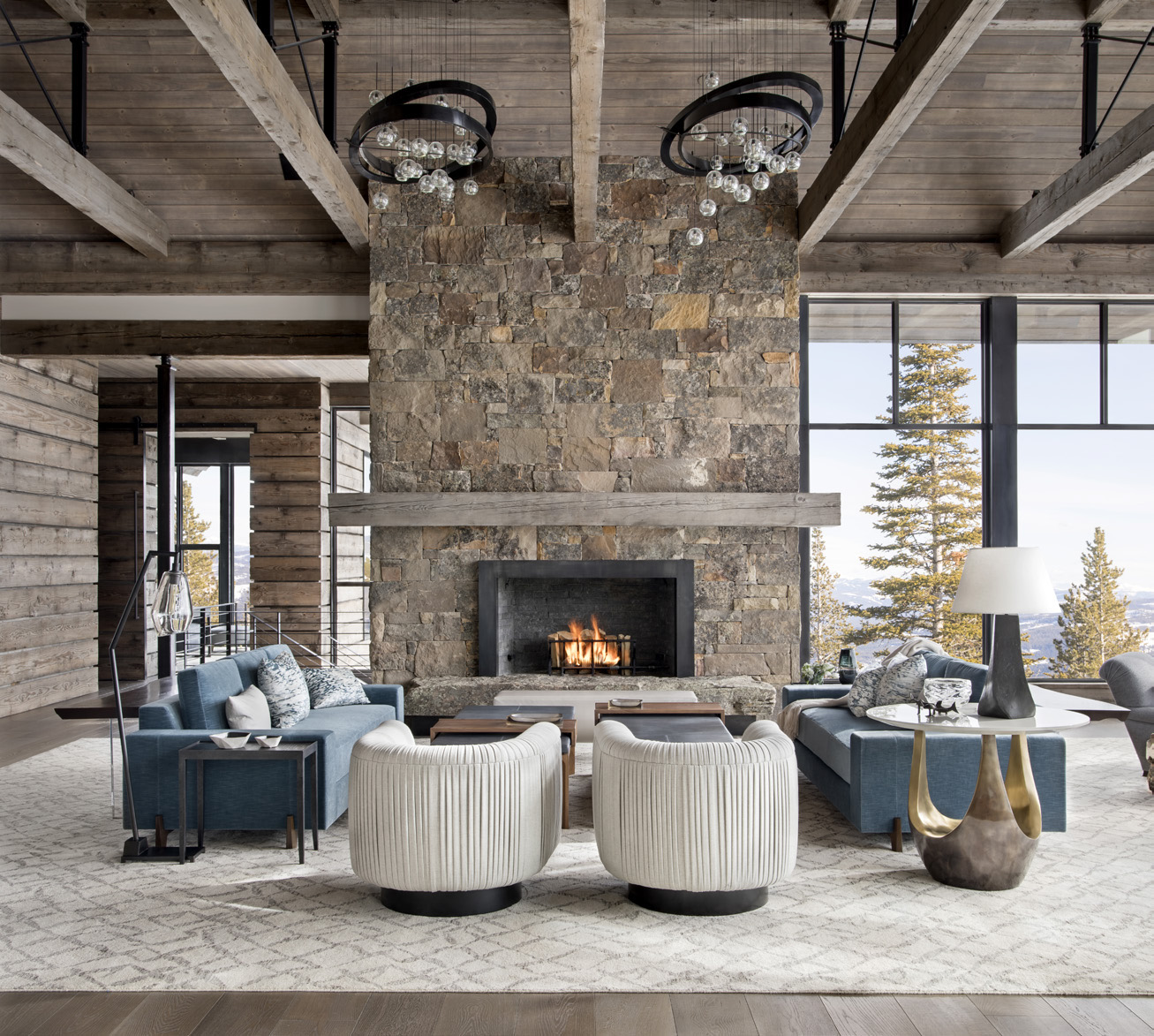
For the great room of a modern ski home, reclaimed timbers and planks are combined with steel elements, Montana moss rock, and bronze windows. The custom hanging lamps are by Debra Weninger. | GIBEON PHOTOGRAPHY
“When we started working at the Yellowstone Club,” says Locati, “the clientele there helped influence that change from traditional mountain architecture to something that might be called Mountain Modern.”
Of that stylistic shift, Dennee says, “We have always used timber, glass, steel, and stone, but the way the materials are used has simplified because the architecture has simplified. And that’s a refreshing change.”
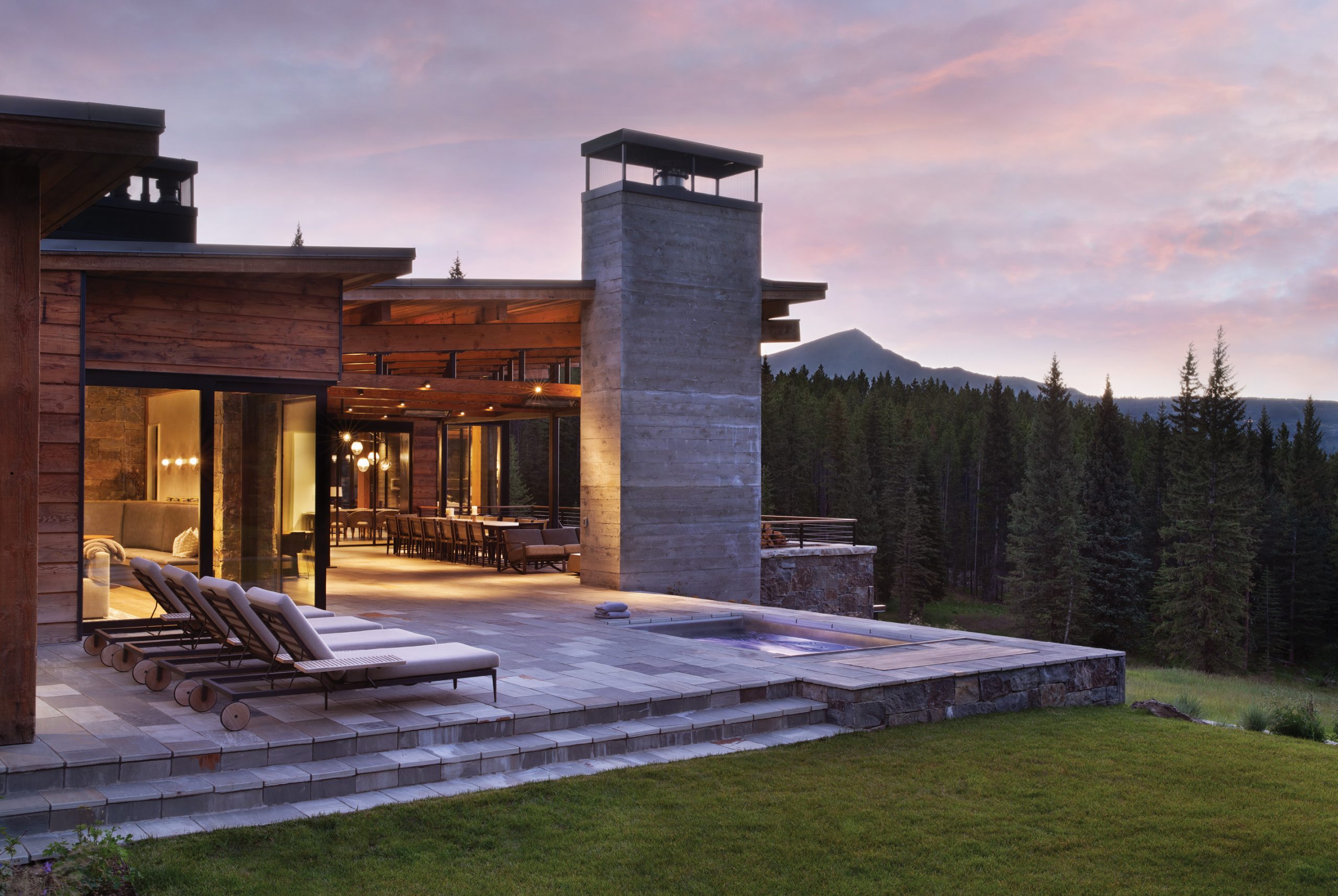
The expansive outdoor living area of this Montana home, referred to as the Travertine Ranch, is defined by a massive board-formed concrete fireplace that assumes a sculptural presence on the site. | GIBEON PHOTOGRAPHY
Locati concurs: “We’re not adding any unnecessary flare to a structure simply for visual interest. That can result in too much stimulation. There’s been an evolution even within the Mountain Modern style.”
Locati Architects’ portfolio of completed homes, a number that Locati and Dennee estimate at somewhere “past the thousand-mark,” reflects a surprising lack of redundancy considering the volume. The structures may share similar materials, and there is a characteristic “look” among them that reveals some hereditary aesthetic traits, but every home is unique — as it should be. A home in southwest Montana should differ from one in the northern reaches of the state. The firm’s homes throughout Big Sky Country — or those that it has designed in Texas, Nebraska, and even New York’s Long Island — reflect their locales.
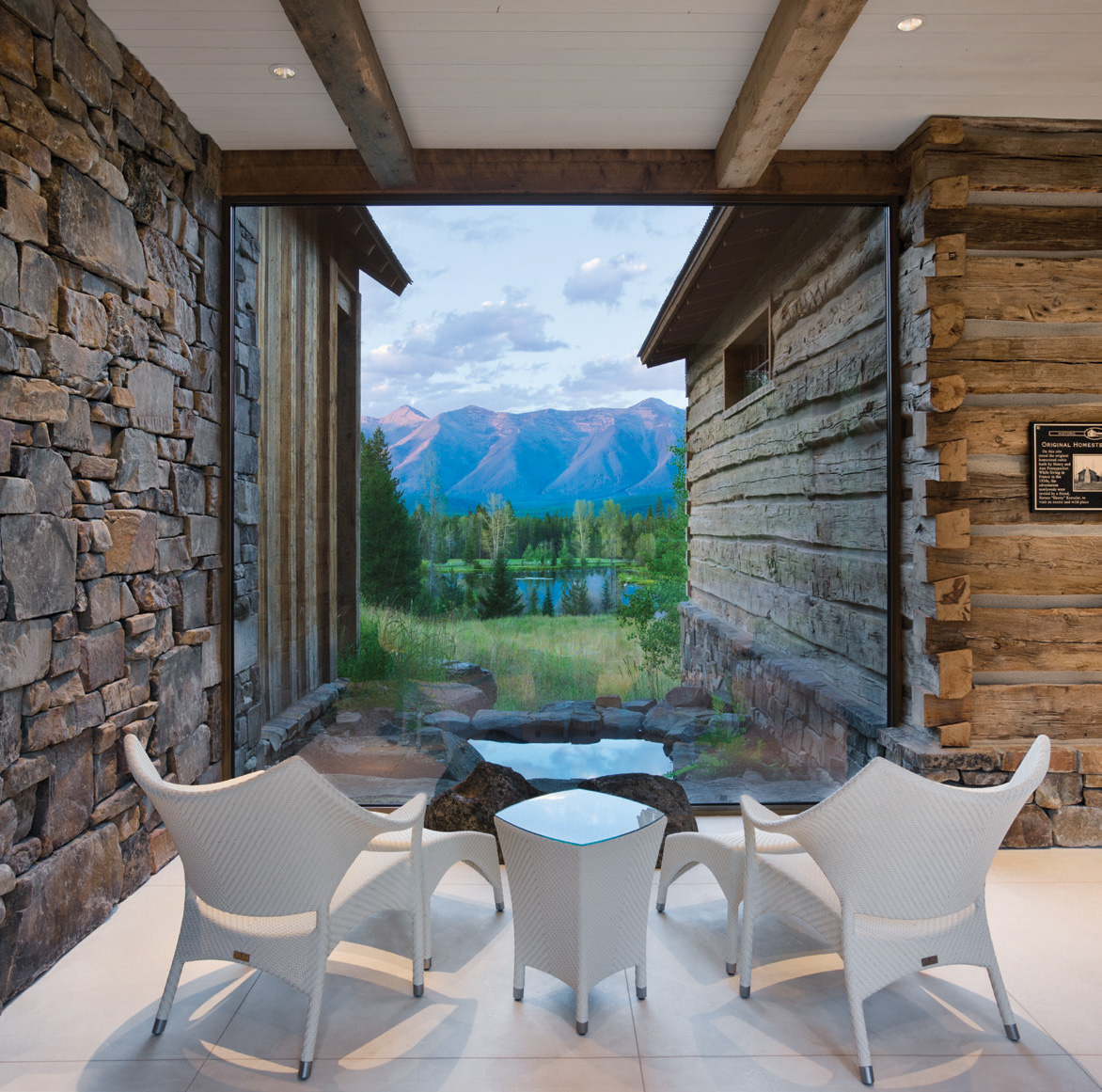
An old homesteader’s log cabin was given new life in a new home; the weathered, decades-old structure was restacked and repurposed as the guest wing. | ROGER WADE
“A cornerstone of our work is our materiality — the desire to use natural, durable materials — but also to use materials that relate to the place where the building is going to be,” Dennee says. “We’ll use stone native to that area; woods and timber, much of it reclaimed, that come from there. I think, too, that what separates our work from others is we get to know the family — the clients — from scratch, learning not only how they want to live in their new house, but also where. We get to know the property itself.”
Another defining feature of Locati houses, though, is the resulting structures’ aesthetic restraint. Many of the firm’s residences are sited to take in expansive views of mountains and valleys, ranchlands or forests, so the use of glass, coupled with the creation of outdoor rooms, is a chief component. But too many windows set amid a stone or wood façade can wind up negating the actual architecture. “The structure exists first, and the glass fills in the between,” says Dennee. “It’s less about the windows and more about creating transparency.”
The firm is versed at developing strong relationships with its clients to distinctly design for each individual, and this congenial approach extends to how the firm operates internally as a team and externally within its community. Many of the firm’s employees are graduates of Montana State University (MSU). Indeed, Locati Architects has maintained close ties with the neighboring university, noted for having one of the nation’s top-ranked architecture programs. The firm established an endowment that funds two scholarships there, while a good number of Locati employees, notably partner Laura Dornberger, serve as mentors for students.
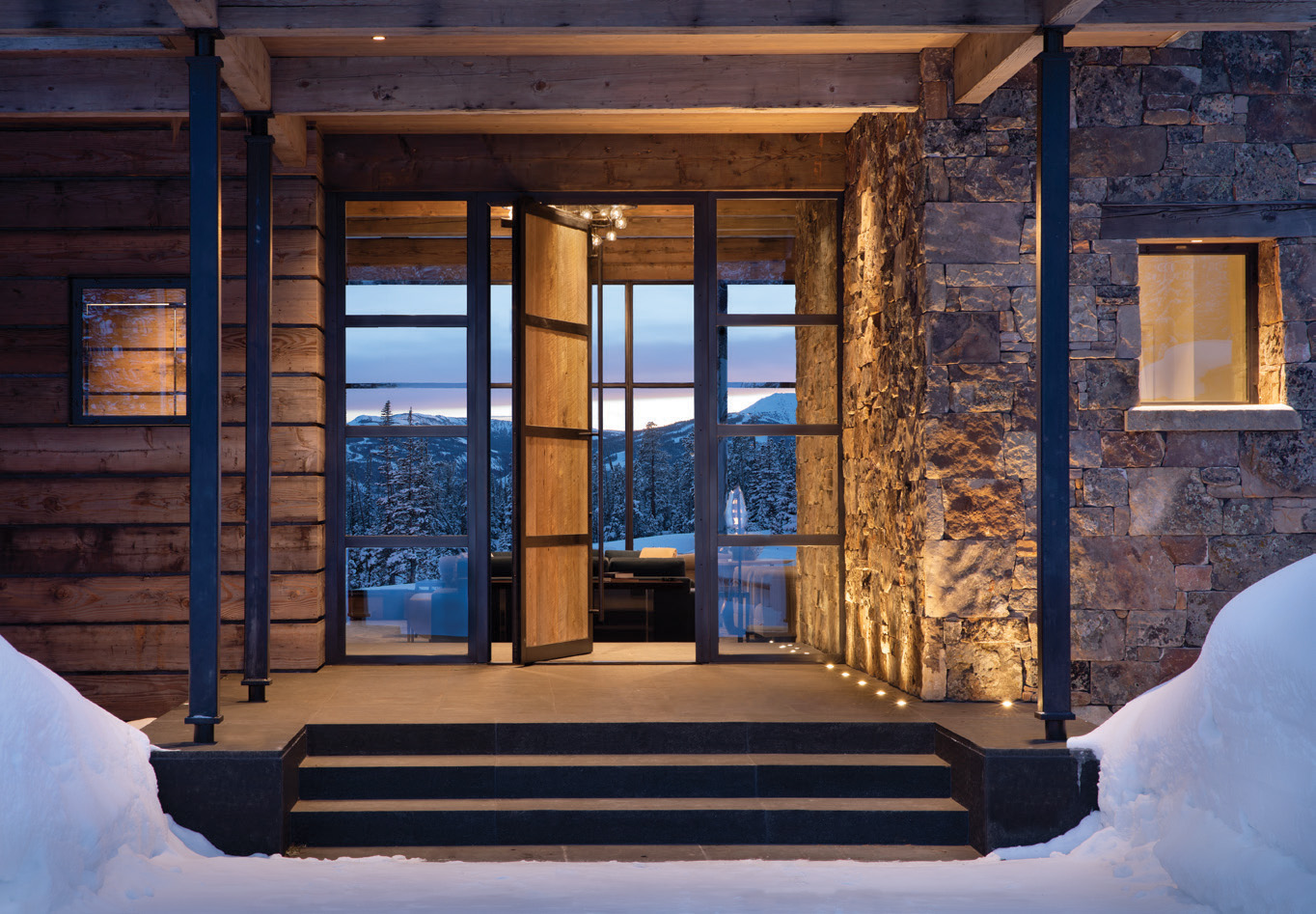
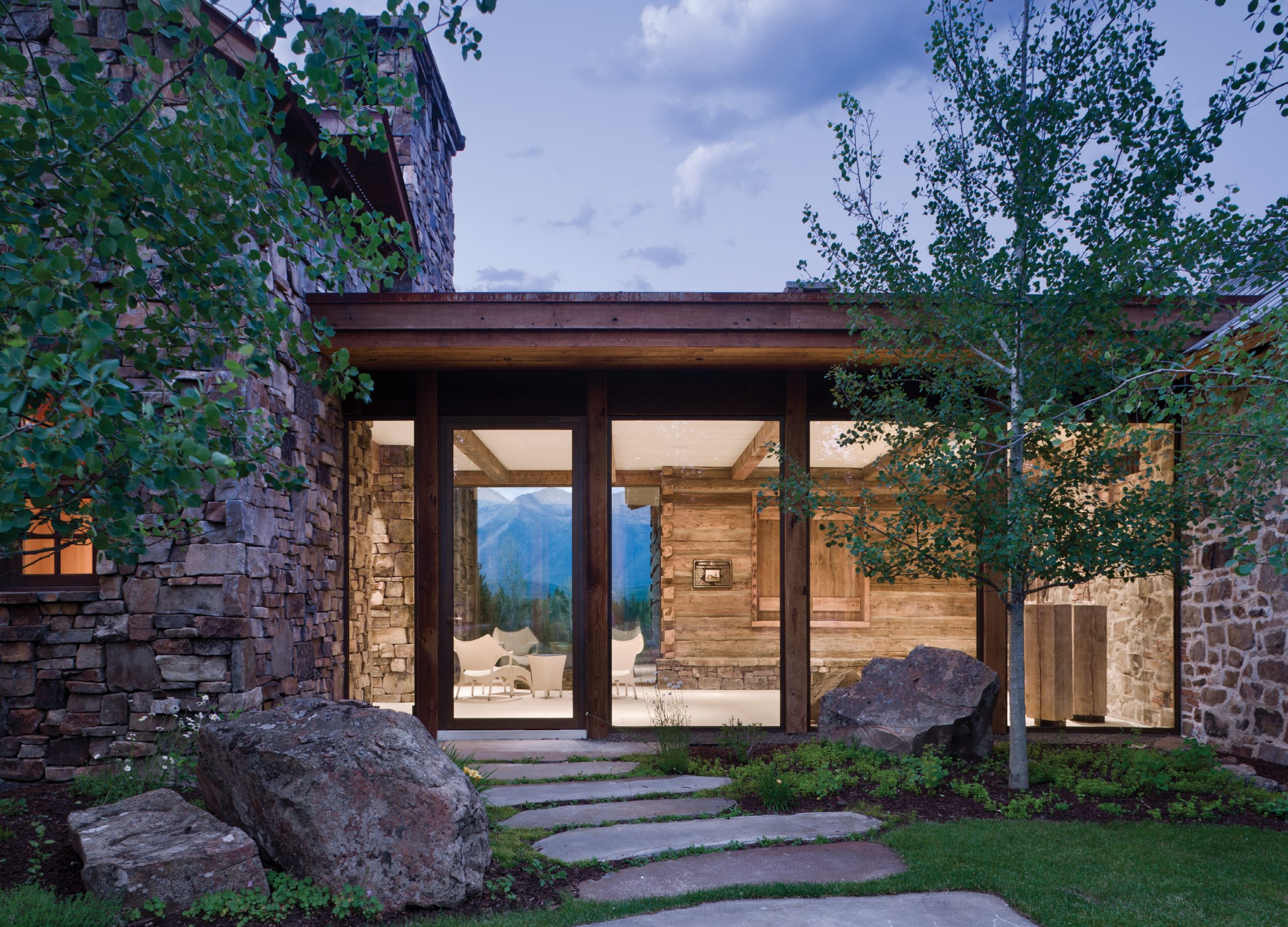
A bronze-framed glass door that pivots marks the entrance to a modern ski home. The outdoor surface is composed of a textured basalt, which extends seamlessly into the interior of the home. The lit stone wall also carries outside to inside, a design dynamic common to many residential works by Locati Architects. | GIBEON PHOTOGRAPHY
“Locati Architects mentors continuously with our open-door policy for high school and MSU students to shadow,” says Locati, who frequently meets with students considering a career in architecture.
“All of our lead designers and senior management come from very, very strong artistic backgrounds,” Locati adds, citing his still-active and talented 86-year-old artist mother as having had an immeasurable influence on him. “A very large number of our employees have been here 20 years and more, and that’s the result of our being able to recognize talent early on and nurture it. We definitely take a family approach to the way we treat our employees.”
He references not only Dennee’s first acquaintance with the firm as a high school student, but also the fact that Dennee’s family had commissioned the firm for their Bozeman home many years ago. “Sometimes the universe aligns and we get to design for people like his parents and then have Greg be part of us.”
Dennee recalls with fondness his teenage years at the firm. “I actually ran blueprints and other odd jobs to start and pay my way through college,” he says. “I found myself increasingly involved in drawings and renderings, actually, since everything was by hand at the time. That led to a more regular involvement directly in projects later in my college years.”
While the firm, of course, readily embraces the technology of our time, from AI to advanced architecture software systems, every project still begins the old-fashioned way: with pencil or pen and paper.
“A house originates with a sketch,” says Dennee. “After we’ve assessed the property, the views, the potential of the site, we begin drawing on paper. Something comes out in the drawing that wouldn’t by any other means.”
Although designing residences remains Locati Architects’ core practice, the firm does take on notable commercial projects — from private airplane hangars to boutique hotels and mixed-use in-town buildings. Not surprisingly, some of these projects are commissioned by homeowners eager to bolster the communities in which their (often second) homes are situated. “Most of our commercial work is done for clients who are also looking for something more elevated in design,” Dennee says.
For those who are not familiar with the scale of Bozeman’s Gallatin Valley, it’s reassuring to see the land vault unimpeded into seeming infinity, the mountain range scrolling distantly across the horizon. “Yes, Bozeman has grown,” says Locati. “But Bozeman continues to maintain and nurture its small-town feel.”
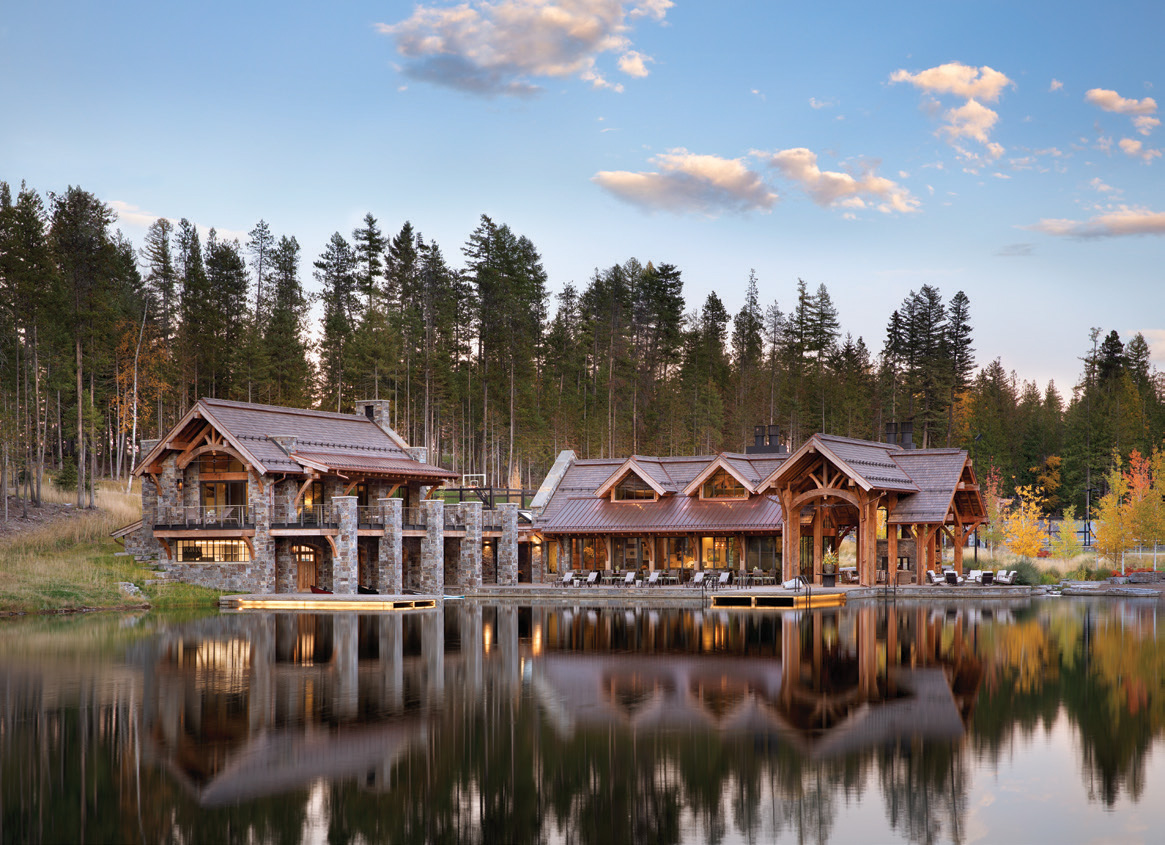
A boathouse assumes a strong profile on a manmade lake in the Rockies. The Locati team purposely kept the architecture restrained so as to allow the built entity to engage seamlessly with the surrounding landscape. The architects describe the finished structure as “designed to feel discovered rather than imposed on the natural site.” | GIBEON PHOTOGRAPHY
So, the news is good, in that homes thoughtfully designed by professionals like Locati Architects will continue to reflect an already beautiful part of the state and country.
Although writer David Masello lives and works in New York City, he longs always for his next trip to the great American West. He is executive editor of Milieu, as well as editor-in-chief of Art & Antiques magazine. In addition to his feature writings about art, culture, and architecture, he is a much-produced playwright, essayist, and poet. He is also the author of three books about art and architecture.
No Comments