


25 Sep History: A Horse of Mystery
Editor’s Note: This column is adapted from When Montana Outraced the East: The Reign of Western Thoroughbreds, 1886-1900 by Catharine Melin-Moser (University of Oklahoma Press, April 2025).
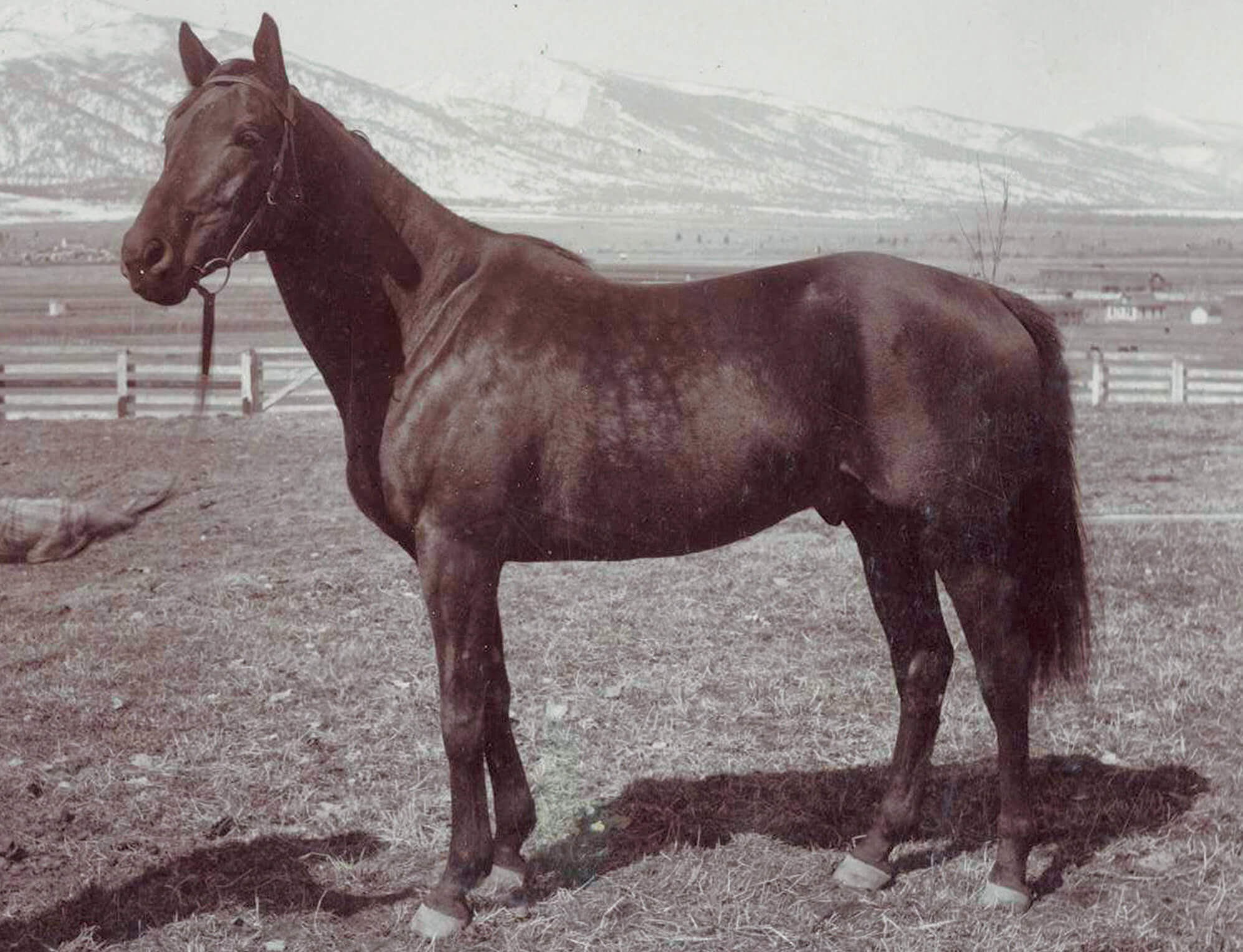
Nineteenth-century Montana folklore tells of a beautiful chestnut-colored Thoroughbred mare named Oriole. On April 10, 1894, the heavily pregnant mare traveled west by train. At a siding at Ogden, Utah, the locomotive paused expressly for her comfort. The steam engine idled while Oriole lay inside the stockcar and gave birth to a brown colt.
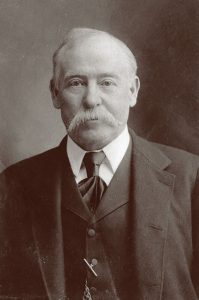
Unwavering in his belief that Montana could grow superior Thoroughbred horses, Marcus Daly audaciously stated: “When you read in the papers of a few years hence that the winner of the Futurity or the Realization were bred by Marcus Daly of Montana, do not be surprised, as the dry, bracing air and rich grasses of Montana are sure to give the youngsters plenty of lung power, with the constitution and conformation, backed by good breeding, to compete with the horses bred anywhere on the face of the globe.” | MARCUS DALY MANSION, HAMILTON, MONTANA
The tale was passed from one Montanan to the next. In the 20th century, an unidentified horse-racing historian dusted off the truth. It’s almost painful to have to deny the myth of Oriole delightfully steeped in American West romanticism, but there was no locomotive or pause or stockcar, and the place she foaled, well, that’s off by a hemisphere: It is England where Oriole foaled her colt, in the coziness of an Englishman’s estate, in April 1894. She and her colt soon sailed for New York, having been purchased by Marcus Daly, an American copper-mining magnate.
They rode in a stockcar to their new home, the Bitter Root Stock Farm near Hamilton, Montana. The colt was named Ogden, and as one observer said, “a good big little horse … compact, muscular, with good bone … good feet and legs, clean hocks.” Striking black points and a black mane and tail accentuated his brown coat perfectly.
Marcus Daly was so rich he could afford two divisions of his Riverside racing stable. He employed Johnny Campbell as trainer for the Thoroughbreds that raced under the Western division. In Anaconda on July 9, 1896, the Anaconda Driving Park was abuzz with smelter men and miners, gamblers, merchants, millionaires, colorfully dressed ladies, brothel keepers and their girls, cowboys, farmers, and politicians, all bumping up against one another in the grandstand, paddock, and betting shed.
Moments before the second horse race started, jockey Frank Duffy clutched a fistful of coarse black mane in one hand, reins in the other, and hung on. Ogden bolted into his powerful stride and won his race by a length.
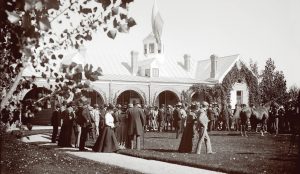
On September 28, 1899, the National Irrigation Congress toured Bitter Root Stock Farm. Members gathered in front of Tammany Castle, the luxurious stable in which Ogden was kept. The flag on the flagstaff displayed Daly’s racing colors, alternately silver, copper, and green. | B.C. BUFFUM PAPERS (4000055), BOX 4, ITEM 34, AMERICAN HERITAGE CENTER, UNIVERSITY OF WYOMING, LARAMIE
Meanwhile, trainer Matthew Byrnes was in New York where he was racing the Eastern division Thoroughbreds. The topflight two-year-olds he had selected for Eastern racing had flopped, and Daly was determined to win one of the most prestigious fixtures on the New York calendar, the Futurity, set for August 15. The winner’s purse of $43,940, roughly the equivalent of $1.6 million in today’s dollars, was the richest a two-year-old could win in America in 1896.
It was late July, and Daly and Byrnes scrambled to make a fresh draft by plucking Western division colts.
Johnny Campbell repeatedly urged Daly to pluck Ogden. Daly refused, as he had great confidence in Byrnes, who judged Ogden to be too immature for Eastern racing. Campbell, desperate, turned to Hugh Wilson, one of the few men who held sway with his boss. The trainer got straight to the point: “Try and persuade Mr. Daly to let me take Ogden East to run in the Futurity. I know this is a great colt, the best I ever saddled.”
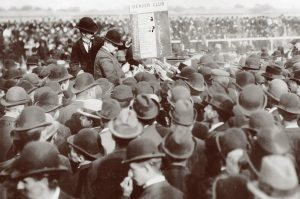
This betting frenzy took place prior to the 1894 Brooklyn Handicap at Gravesend Racetrack in Brooklyn, New York. Methods for betting at 19th-century racetracks were predominantly by auction pool or bookmaker. If choosing the auction pool, an auctioneer on his stand put up for auction every horse entered in the race. Bettors bid on the horse they liked. The highest bidder “won” the horse, and after every horse had been auctioned, the winning bids were placed into a winner-takes-all pool box. The bettor who purchased the winning horse won the pool, with the auctioneer retaining a percentage. At bookmaking stands, the bookmaker shouted the odds he offered. An assistant at his elbow recorded bets as fast as bets were made, and a second assistant accepted and counted the paper bills handed over. | KEENELAND LIBRARY
The next morning at the West Side Racing Association track in Butte, Campbell loaded Ogden with 125 pounds of tack and jockey and put him to the business of a seven-furlong workout. The colt needed only 48 seconds. Witnessing that, Wilson went looking for Daly. The boss gave in, and Campbell’s smile “could almost be heard,” Wilson said. Campbell told Wilson, “Have a bet on this colt when he starts in the big race. He will win as sure as he starts.”
Eastern turf writers covering the Futurity grumbled loudly when Ogden dropped into their laps virtually overnight with some kid jockey, Frank “Doc” Tuberville. Pre-race odds for the unknown Western horse were quoted as much as 150-1. On Futurity Day at Sheepshead Bay racetrack, the course was dry and fast under a bright-blue sky. Mingling with the crowd was the small coterie of Montana miners who had seen Ogden race in Montana. They were certain he’d win the six-furlong Futurity. As they entered the betting shed, they made a startling discovery: Ogden and stablemate Scottish Chieftain were coupled in the betting. They threw a fit. They wanted Ogden straight, no mixing him up with the other horse. Their protests, pointless, impelled each miner to state defiantly, “I’ll bet a hundred on Ogden,” when registering his bet.
By post time, 6-1 odds on the Ogden-Scottish Chieftain ticket were attributable to Scottish Chieftain’s popularity. The Futurity favorite, Ornament at 9-5, and seven more high-voltage two-year-olds stood ready at the post. The starter’s flag whirled. Ogden and Ornament sprang ahead of the field. Volumes of moist, sea-level oxygen poured into Ogden’s lungs, powering his gliding muscles, as he slipped slightly ahead of Ornament. Jockey Tod Sloan astride Ornament struck his whip and lifted his spur. The colt’s lightning-quick strides began to reel in Ogden. The crowd jumped and screamed for Ornament, and they readied for a dramatic duel until the unthinkable — Ornament bobbled mid-stride! They shrieked and wailed, and Sloan worked fast to regain control of his mount. Doc Tuberville, not wanting to risk anything to chance, touched his colt once with whip and spur. Ogden wheeled past the finish, crossing the wire more than a length ahead of Ornament. The perfect ride in the time of 1:10 was the fastest six furlongs in Sheepshead Bay history.
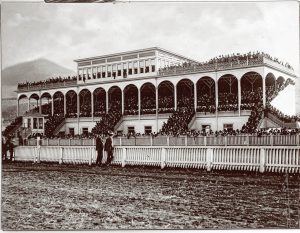
Pictured here is the grandstand at Anaconda Racetrack, circa 1920. Ogden debuted as a racehorse at Anaconda on June 30, 1896. Making four starts there, he won two and finished runner-up in two. | MONTANA STATE HISTORICAL SOCIETY, HELENA, MONTANA
Tuberville trotted Ogden back to the judges’ stand where he dismounted and handlers led Ogden away. Thousands in disbelief murmured, “Who is this Ogden? Who is this boy Tuberville?” Jubilant Montana miners struck up a “war dance” on the lawn, and a New York Times reporter on the scene began writing, “The wild Western fashion had taken possession of them. They threw their hats into the air, yelled at the top of their voices, and gave an exhibition of just how very excited men can become over such a thing as a horse race.” The miners kept rollicking, and the writer enthused, “The friends of Ogden danced and cheered and halloed [sic] and hurrahed as no similar coterie of men has ever before done at Sheepshead Bay.”
The New York Journal headline of the next morning exclaimed, “Ogden the Westerner, First. Futurity’s Great Prize Taken by a Horse of Mystery Ridden by a Boy of Mystery.” The Journal’s overnight sleuthing had demystified some of the mystery. “Ogden is just a plain-looking brown horse, coming out of that nowhere of the West, Montana. Tuberville is just a little earnest-faced, brown-eyed, thin-lipped, soft-voiced person, also from out of the nowhere. But he is a dare-devil horseman, and he has ridden the winner of the Futurity.” Newspapers on Ogden’s home turf told of celebrations throwing Montana towns into “the wildest time ever.”
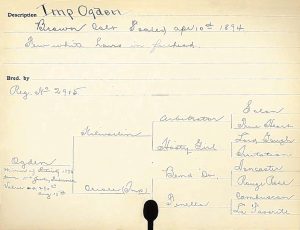
The lineage of every Thoroughbred at Bitter Root Stock Farm was recorded on a pedigree card. | ARCHIVES AND SPECIAL COLLECTIONS, MANSFIELD LIBRARY, UNIVERSITY OF MONTANA, MISSOULA
Ogden’s blistering Futurity performance inferred greatness, but disappointing losses would later outnumber memorable victories. He tallied 15 wins in 28 starts, with career earnings totaling $59,970. Greener pastures were in the stud. The last man to own Ogden, John E. Madden of Lexington, Kentucky, selectively bred the stallion to exquisite broodmares. A lengthy run on the American winning-sires list illustrates Ogden’s legacy as a sire: runner-up in 1908 and 1913, third in 1915 and 1916, and fourth in 1914.
Upon the death of his favorite Thoroughbreds, Madden buried them in a peaceful corner of his farm, Hamburg Place. When Ogden passed on New Year’s Eve of 1923, a new grave appeared in the shimmering bluegrass.
Catharine Melin-Moser’s articles about horse racing, Western history, and the outdoors appear in numerous journals and magazines. She writes from her home in the Judith Mountains of central Montana. Her book, When Montana Outraced the East: The Reign of Western Thoroughbreds, 1886-1900, was released in April 2025.
No Comments