



25 Sep From Beavers to Smart Collars
Like many of his grain-growing neighbors on northern Montana’s Hi-Line, Ryan Lankford has fully integrated computers and satellite connectivity into his farming operation. His John Deere tractors are guided by GPS waypoints, and his newest combine has forward-facing cameras that detect the amount of stubble entering the header to adjust the combine’s operation according to thatch density.
So it’s not a far reach for Lankford to think about applying the same digital technology to his 200-cow cattle operation.
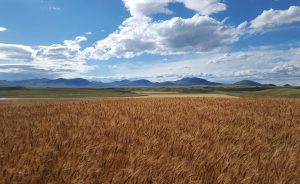
Montana Hi-Line rancher Ryan Lankford uses sophisticated GPS-directed mapping and navigation to guide his farming practices. This precision mapping allows him to match seeding rates and inputs to the soil type and precipitation patterns on his Chinook-area farm. | CLYDE JERRY LANKFORD
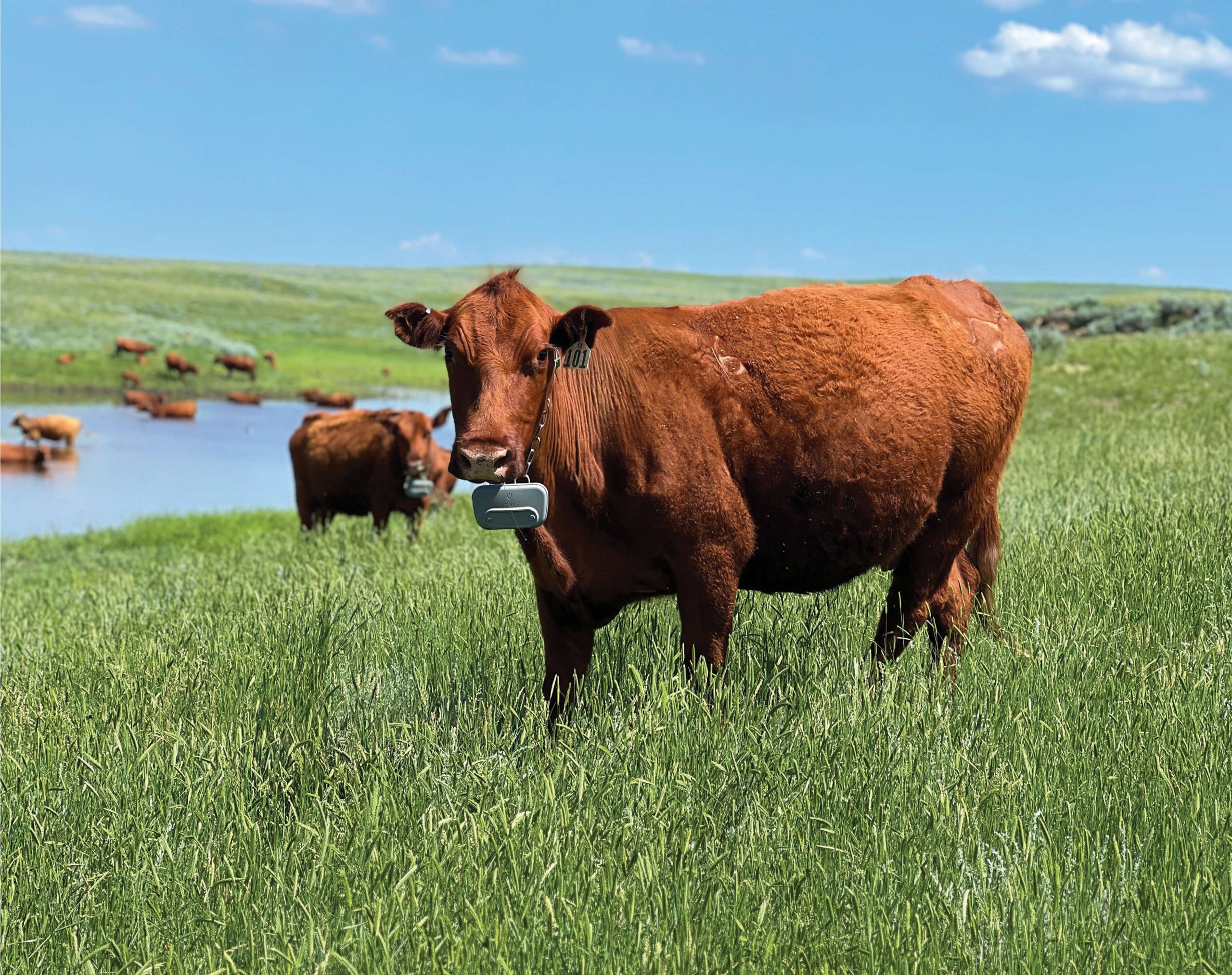
Earlier this year, Lankford snapped GPS-connected tags to the ears of his half-dozen bulls, both to get alerts when they jump the fence into his neighbor’s pasture and to test his belief that the technology can make him a smarter, more efficient, and more profitable rancher.
The eartags are a product of North Dakota-based 701x, whose wearable bovine devices keep tabs on the whereabouts of cows while also monitoring their reproductive cycles and overall health, much like a running watch tracks human biometrics.
“My initial interest in these GPS tags was as a labor saver,” says Lankford, whose operation is on the Fort Belknap Indian Community, where he’s an enrolled member of the Aaniiih Nation. “I wanted to know if they could make it easier for me to remotely monitor my cattle, because labor is so expensive.”
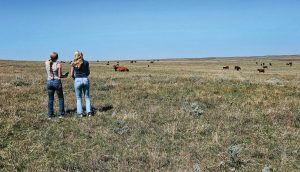
Lankford is starting to apply the GPS-enabled technology that he uses on his wheat farm to his 200-cow livestock operation. | CLYDE JERRY LANKFORD
However, because Lankford is involved in wider conversations about the role of farmers and ranchers in carbon capture, he thinks the 701x technology might also allow him to quantify the amount and type of forage that his cows eat. “There’s an emerging market for carbon, but so far it’s been the Wild West in terms of contracts and people trying to get market share because there’s been very little data or science to support market decisions,” he says. “Nobody can really answer key questions. How much carbon is going into grass? How much carbon is being captured in the cow? How much is going through the cow? How much remains on the range? But these [GPS-enabled] devices could generate location and performance data that start to answer those questions and create the traceability that the market demands.”
Beyond the carbon market, the eartags can inform a rancher’s grazing management plan based around seasonal grass growth, ensuring enough forage remains for wildlife.
CREATING WATER
About 40 miles north of Lankford, nearly within sight of the Saskatchewan border, Brian Fox and his cattle are benefiting from a decidedly low-tech — and cost-free — labor force: beavers. Fox was both surprised and a little dismayed when they showed up on his prairie ranch a few years ago. He was surprised because there hadn’t been a beaver in the stream in his or his elderly neighbors’ memory. Trapped out by fur harvesters over a century ago, beavers haven’t returned to many of the prairie tributaries that often bear their name. Trees are rare on this expanse of shortgrass prairie, and beaver activity has been limited to the Milk River, 30 miles south of Fox’s place.
Blaine County farmer Brian Fox is using a decidedly low-tech approach, mimicking beaver dams, to keep more water in his prairie streams. | BILL BUCKLEY
Fox was dismayed because the enterprising beavers had taken down a lone scraggly cottonwood that provided anemic shade for his cows and had served as a local landmark. The beaver bog drowned out cool-season grasses that his cows normally grazed. Beyond those practical considerations, seeing ducks dabbling and splashing in the prairie stream that the beavers dammed represented change and unpredictability to a ranching business built on tradition and predictability.
But a couple of years into the unexpected return of beavers to this stream, Fox sees manifold benefits, ranging from a higher water table in the streamside pasture to a wider diversity of native plants in the riparian habitat and more abundant water for cattle and wildlife.
The benefits are so noticeable that Fox, along with conservation partners Ducks Unlimited and Malta-based Ranchers Stewardship Alliance, is utilizing an equally low-tech approach to mimic the beavers’ hydrological services elsewhere on his ranch. Beaver-dam analogs, often called BDAs, consist of a lattice of wooden stakes and willow branches installed along the shallow banks of prairie streams to catch debris during runoff, slow and calm water flows, and promote stream sedimentation. (Turn to page 112 to learn about how Fox’s efforts are also aiding Montana’s sage grouse.)
“That’s one of about 75 BDAs on my place and, if they work, in a couple of years, you won’t be able to stand here,” says Fox, pointing to a tangle of woody brush in an inside bend of the prairie creek. The idea is that over time, the stream will widen and create boot-sucking bogs in an otherwise parched landscape.
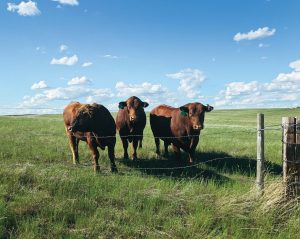
Lankford attaches GPS-connected ear tags to his bulls in order to keep track of their movements, as well as their breeding success. | CLYDE JERRY LANKFORD
Additional water provided by the BDAs and the natural beaver bogs, along with a new well that taps into the higher water table, allows Fox to run more cattle. The extra summer forage in the revived riparian plain adds valuable pounds to his calves. As a profit-minded rancher, it’s hard to ignore those upsides to a fairly low-tech improvement, says Fox.
Another benefit: BDAs cost virtually nothing. “The cost is just surveyors’ stakes and the time it takes somebody to cut willows downstream and then weave them around the stakes, plus getting [404 streamway] permits [from the U.S. Army Corps of Engineers],” says Ducks Unlimited biologist Adam McDaniel, who helped Fox identify BDA locations.
“When they work right, BDAs help creeks like this remember how to be a creek,” McDaniel says.
BDAs can also conjure the future in the same way that the fabricated baseball field in the movie Field of Dreams reconstituted the past. Both rely on the idea that “if you build it, they will come.” In the case of BDAs, “they” refers to real beavers. Years of observation have shown that beavers often find the water that has been slowed and spread by the artificial dams, and then amplify the human-made impoundments with their own stick-and-mud construction.
SHOCK COLLARS FOR COWS
To the south and east of both Fox and Lankford, Phillips County rancher Leo Barthelmess has adopted another variation on the “if you build it, they will come” construct. You might describe his application of technology as, “if you build it, they will stay.”
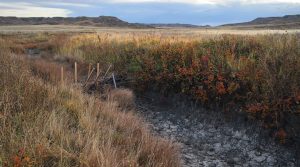
Called a beaver-dam analog, this dam made with willow limbs and wooden stakes will slow runoff and create small backwaters that retain moisture in prairie streams and eventually attract beavers. | BILL BUCKLEY
Barthelmess is one of a growing number of ranchers using battery-powered collars to keep his cows within designated perimeters while reporting their daily movements. The collars communicate wirelessly with a base station on a hill above his sprawling pastures; the base station then transmits information from the collars to a mobile app on Barthelmess’ cell phone.
Unlike Lankford’s eartags, which can only report location and biometric information, Barthelmess’ collars can actually jolt the cow with a mild electric shock, similar to the way a canine e-collar can vibrate, ping, or shock its wearer into corrective action.
The idea isn’t to unnecessarily torture his livestock, but rather to condition them to recognize virtual perimeters, allowing Barthelmess to remove miles of interior wire fencing that often restricts the movement of pronghorn antelope, mule deer, and other native wildlife.
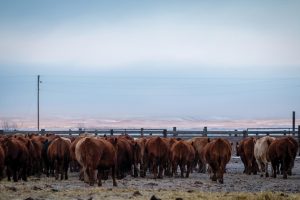
Phillips County rancher Leo Barthelmess hopes that by training his cows to move between pastures guided by electronic collars he can reduce internal fencing. | LAURA VERHAEGHE
“There’s a bit of a curve as [the cattle] learn where they can go and where they can’t, but in a surprisingly short period of time they’re trained to stay within a geofence defined by our cellular collars,” says Barthelmess, whose collars and cellular infrastructure were largely funded by grants from conservation organizations. “The result is that we have less fence on the landscape, there are less impediments for antelope and other wildlife to navigate, and we can more intensively graze cattle in smaller pastures, moving them more frequently to mimic bison grazing patterns.”
Barthelmess is quick to note that his high-tech collars, provided by a company called Vence, will never replace fences altogether. “We still require fencing,” he says. “When we’re training cows to use a new pasture, we still have to string an electric fence. That’s the way you train your cows to recognize and honor barriers. You have to show them one. They see it, and they get an audible cue. If they persist in pushing through the barrier, you discourage them with a shock. It only takes a day or two to train them, but you need that visual barrier to establish the virtual barrier.”
Barthelmess says battery life is a secondary issue. “We have to gather our cows two to three times a year just to change the batteries.”
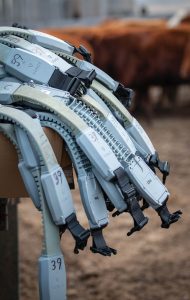
The electronic collars used by Barthelmess, made by a company called Vence, require periodic maintenance and battery charges. | LAURA VERHAEGHE
But Barthelmess is bullish on the technology: Maintaining the system enables him to be a better steward of native rangeland. “We divided two pastures into five as part of our rotational grazing plan,” he says. “With Vence, we can move cows more easily between pastures, intensively grazing one while giving the others more rest. Instead of spending a day gathering and moving cows and opening and shutting gates, we can do it from the house with a mobile app.”
Barthelmess says it will take several more years before he’s confident enough in the technology to remove his internal fences, including ratty woven-wire homesteaders’ fences that interfere with pronghorn migration across his ranch.
“I’m not just going to go pull interior fences that still serve a purpose,” he says. “If a [physical] fence is functional, it will stay awhile, but eventually it has to come down. I’m hoping virtual fencing will replace it, but you have to keep in mind that it’s almost as expensive to take down a fence as it is to build a fence.”
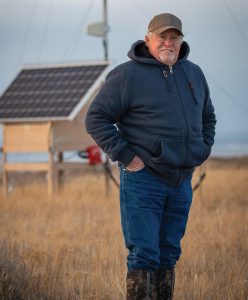
Barthelmess stands in front of a communications tower that connects his herd’s electronic collars to satellites in an area with limited cell service. | RANCHERS STEWARDSHIP ALLIANCE
And, at about $10,000 a linear mile to either build or fully remove a five-strand barbed-wire fence, it’s not a casual decision to either string or decommission them.
THE BOTTOM LINE
All three of these Hi-Liners’ experiences with adaptive technology, whether delivered through integrated circuits or beavers’ industry, share a hard-won reality: It has to work for agricultural producers, or it’s simply a distraction from the main business of making a living from some of Montana’s most unforgiving landscapes.
Employing satellite-age technology came surprisingly naturally to Barthelmess, the third generation of his family to ranch the sprawling spread between the Milk and Missouri rivers.
“These collars are never going to replace fences entirely,” says Barthelmess, former director of the Montana Stockgrowers Association and active member of the Ranchers Stewardship Alliance, which advocates for wildlife-friendly ranching practices. “You still need perimeter fences in order to be a good neighbor and keep your cows off the road. I love moving cattle, and I love managing grass. These collars are just another tool to keep me doing what I love.”
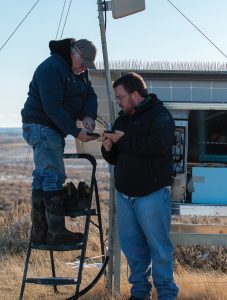
Barthelmess explains to neighboring Phillips County rancher Aaron DeVries the communications link between the tower that connects GPS-connected satellites to his cattle herd’s collars. | RANCHERS STEWARDSHIP ALLIANCE
But he notes that without grant support, they probably wouldn’t pencil out.
Ryan Lankford is only a few months into his investment in the 701x eartags, but he can already see a way to monetize them. “The tags have a feature that can detect when a bull mounts a cow,” he says. “Besides keeping track of them, that’s one reason I put them on my bulls. When you’re buying a bull that can cost anywhere from $4,000 to $9,000, a $75 investment doesn’t seem like that much, especially if it can help you find the duds.”
But Lankford has another, deeper reason for experimenting with the GPS eartags. “I’m a rancher, but I lack experience in ranching,” he says. “That’s because these things get handed down generationally, and my grandpa’s ranch went to another relative, so I’m having to learn a lot of this on my own. I figured the collars and the tags could help me learn the things that generations of ranchers learned by spending a lot of time with cows. I think these devices can help me learn in a couple of years at least a portion of what took my ancestors lifetimes to learn.”
Andrew McKean writes about hunting, conservation, and wildlife management from his home in Glasgow, Montana. The former editor-in-chief of Outdoor Life magazine and the current hunting editor, McKean is the author of How To Hunt Everything. He also contributes to a number of national publications.
No Comments