


21 Nov Artist of the West: Belonging, Yet Not Belonging
Lisa Simon, owner of Radius Gallery in Missoula, Montana, still remembers her earliest encounters with Stella Nall, whose Native name is Bisháakinnesh.
“She had such clarity of who she was and what kind of art she was creating,” Simon recalls. “Even though she is so humble, she had this confidence and vision that is really remarkable in someone so young.”
The two initially crossed paths when Nall, who is now 28, was an undergraduate at the University of Montana, only a handful of years ago. Though Nall had enjoyed making art all her life, some early experiences steered her away from pursuing it as a path. “I never really thought of it as something that would become a career,” she says. “I hadn’t met very many working artists and, growing up in Bozeman, there wasn’t any representation of Native artists.”
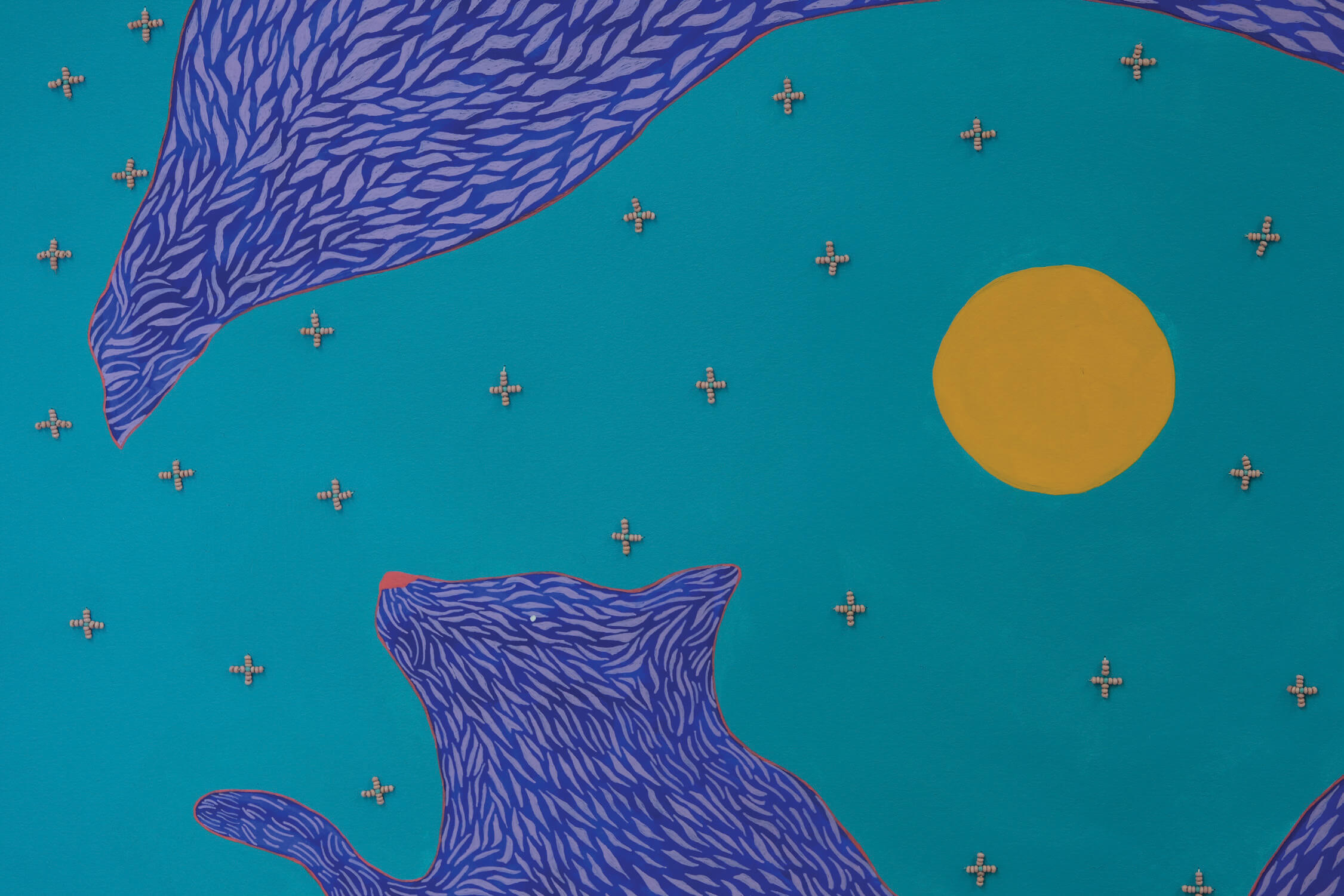
Old Man Coyote | ACRYLIC AND BEADWORK ON PAPER | 11 X 14 INCHES
When the art portfolio that she had carefully compiled throughout her senior year of high school failed its final review, she saw it as a clear sign: “I said, ‘I can never do art again.’ I thought it just wasn’t in the cards for me.”
So Nall, who is a first descendant of the Apsáalooke (Crow) tribe, decided to pursue a degree in psychology. But she couldn’t keep her creativity at bay for long. “I thought, Well, I’ll just take some art classes on the side for fun,” Nall remembers. “And then I kept taking more and more art classes, and I ended up getting a double degree.”
She credits the other students in the department and her professors for providing the necessary supportive environment to create work that she believed in. “During the last year of school, I met Jason Elliott Clark and Jim Bailey, who are both printmakers here in Missoula … and they were very encouraging,” she says. “Up until that point, I hadn’t really made work particularly about identity issues or serious things. But they created a space in which I felt understood and valued as a person, where I could make whatever I wanted.”
I Wish You Wish | ACRYLIC AND BEADWORK ON PAPER | 20 X 20 INCHES
One assignment, in particular, was a turning point for her: Each year, one of the university’s printmaking classes does a “steamroller printing project,” in which students carve large woodblock pieces and then a steamroller is used to create the prints.
“I made this piece, and it was the first time I had really talked about being a mixed-race person,” Nall admits. “I think it started me down the direction that I’m interested in now.” Despite growing up deeply rooted in Apsáalooke culture, the Crow tribe’s blood-quantum requirements, and the fact that Nall’s father is non-Native, mean she isn’t allowed to be an enrolled member of the tribe.
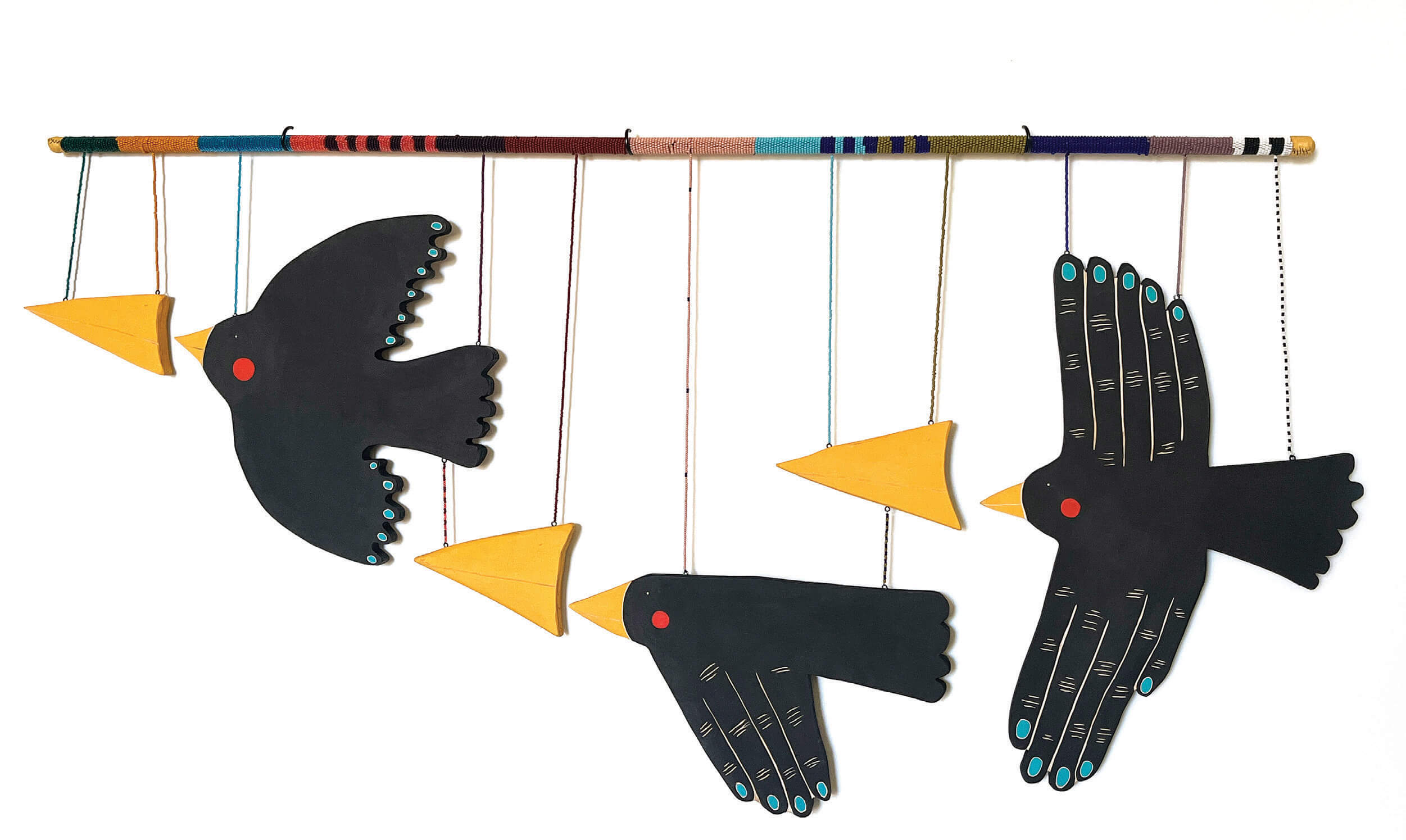
Flight | ACRYLIC, WOOD, AND GLASS SEED BEADS | 18.25 X 36 INCHES
It’s from this place of belonging yet not belonging that she created her steamroller print entitled First Descendent: Sterile Hybridity — a piece that has since been acquired by the Smithsonian’s National Museum of the American Indian in Washington D.C. Featuring a mule, a background of elk teeth, and a flock of black birds that have hands for wings, the large print incorporates symbolic motifs that have since appeared again and again in her work. “With these more political pieces, or ones about really specific cultural issues that people might not be familiar with, it’s important to me to have the symbolism broken down in a way that tells the story,” Nall explains. The mule is a sterile creature, incapable of continuing its bloodline. The flock is a nod to the word Apsáalooke itself, which means “children of the large-beaked birds.”
Some of the imagery is so deeply rooted that its origins are unclear. Nall tells a poignant anecdote about what may have been the first of the hand-winged birds: “In elementary school we were doing that Thanksgiving project where you trace your hand and make a little turkey. And my parents say that I came home with this drawing of a bird, but my hand had the fingernails drawn on it and it didn’t have the little pilgrim hat. And they said, ‘What’s that? That’s not a turkey.’ And I said, ‘Oh, I’m not really much of a pilgrim. I’m a Crow.’”
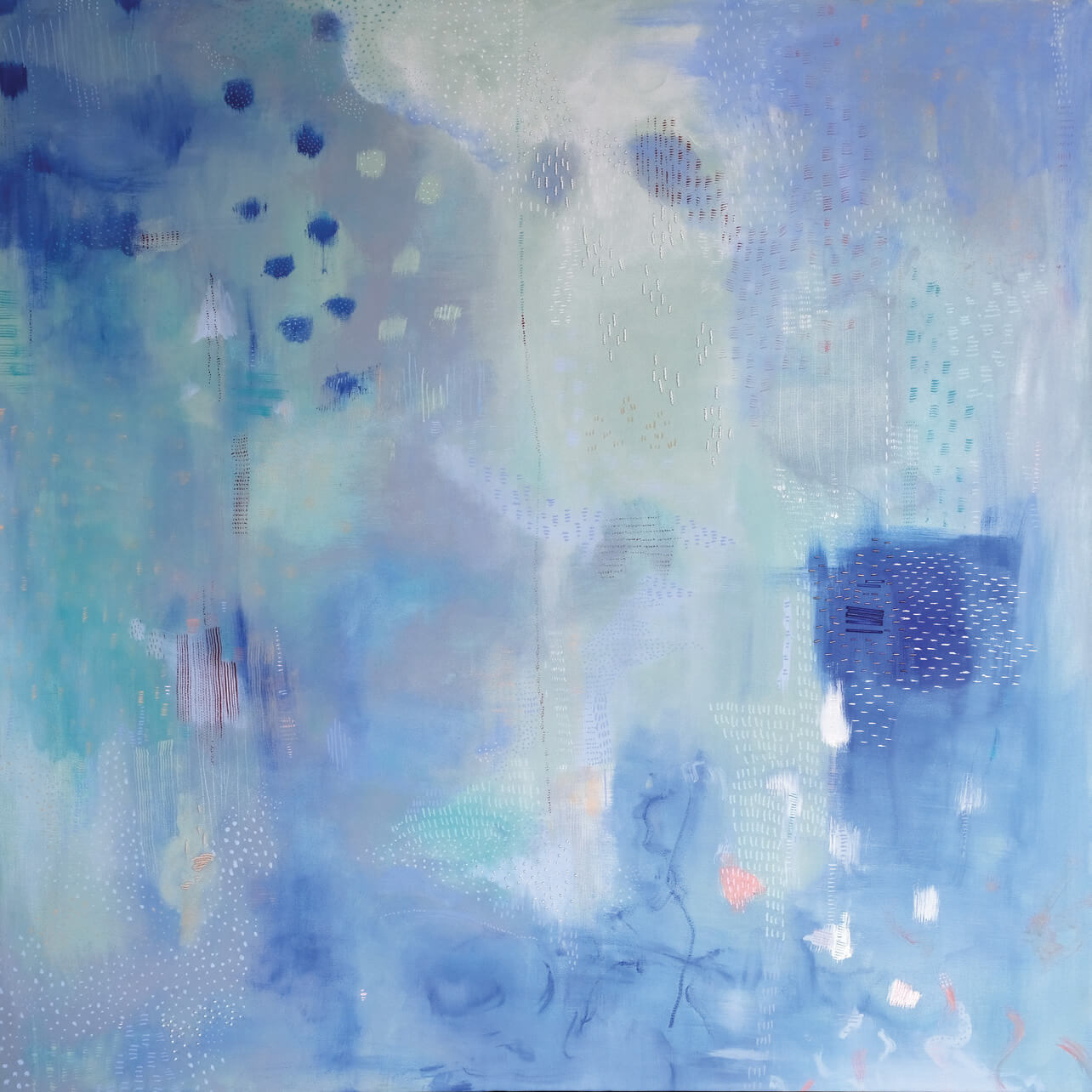
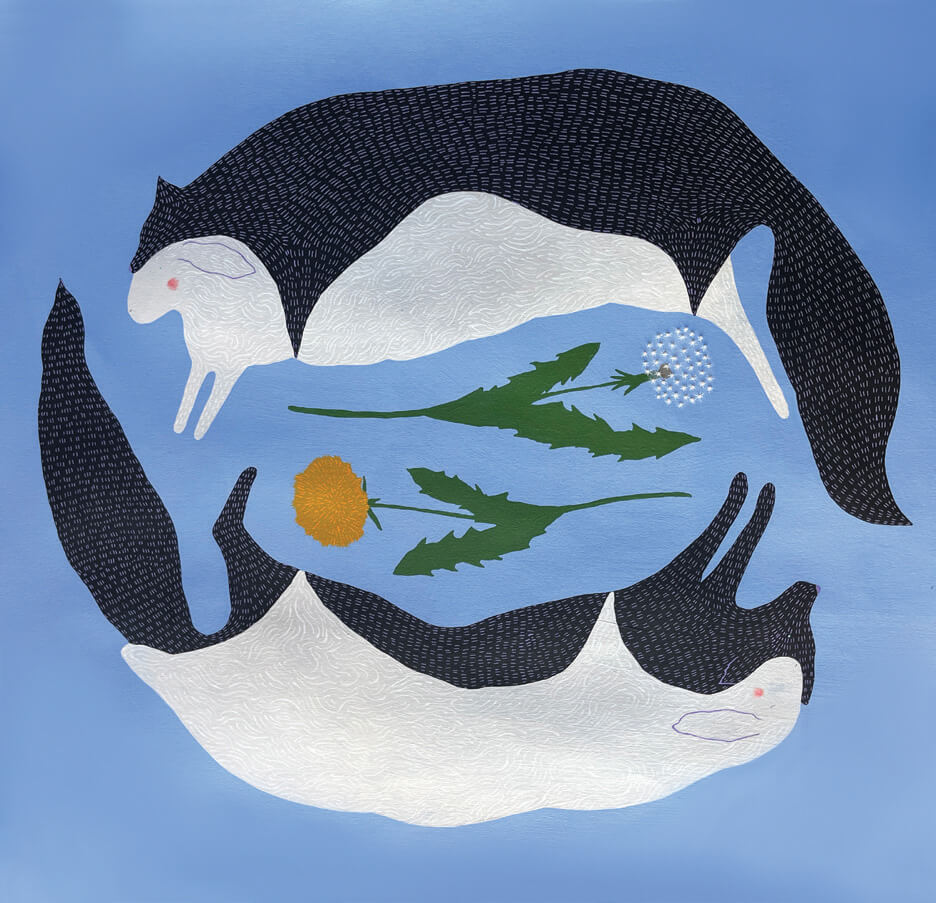
Iischilissúua / Rabbit Dance | SCREENPRINT | 20 X 20 INCHES
This questioning of convention remains pervasive in Nall’s work — but so does a deep sense of play. Because while these themes of politics and identity hold a central place in many of her pieces, much of Nall’s art is, at least at first glance, a bit more lighthearted, especially the work featuring animals.
“When I was a kid, I’d draw all sorts of stuff, but mostly animals because I’ve always loved a creature,” she says. “And in Crow culture, especially with dogs and horses, there’s a mindset of reciprocal respect with the world and the animals we share it with. I’ve always been raised to understand animals to be like people.” She pauses, then adds, “Yeah, they’re people. But more cute.”
And it’s true, some of Nall’s work is, admittedly, cute. Her creatures are endearing and enchanting. “People are drawn in by the curiosity of it, and then they’re all smiles,” says Simon. “That hook is so hard to do. And she seems to have a natural ability to create those hooks. It’s a super-sensitivity, and she got it.”
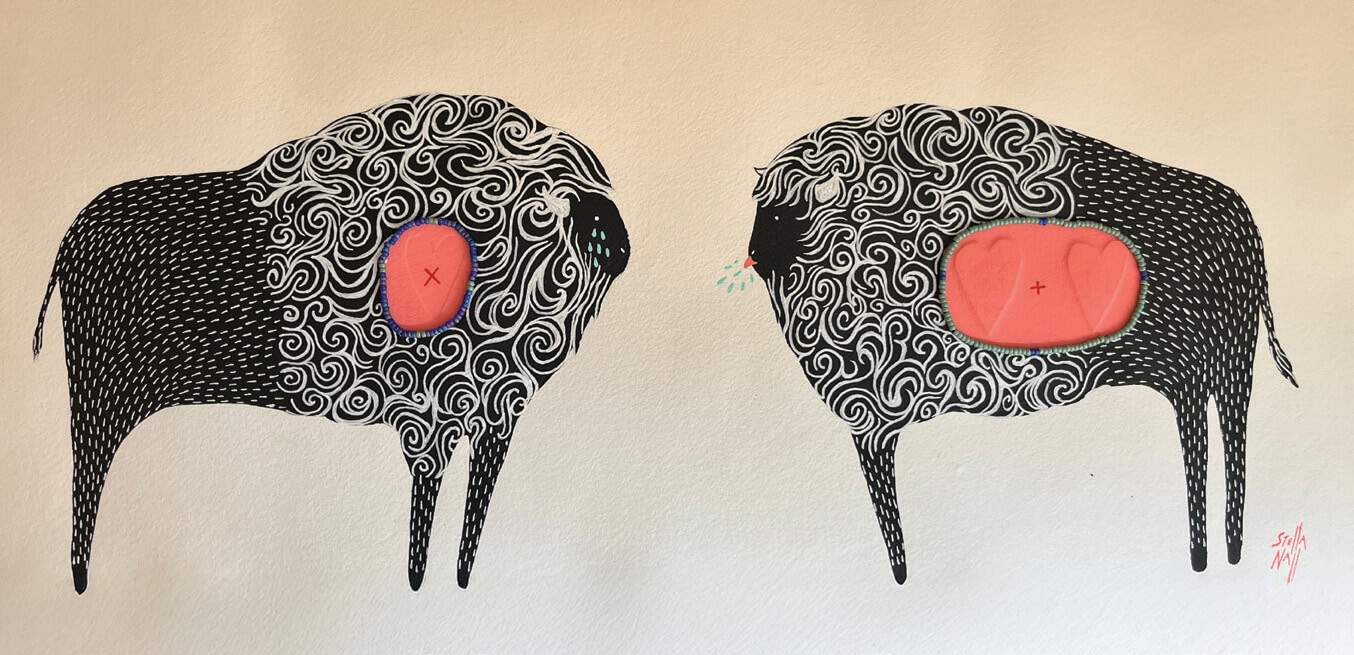
When I Gave You My Heart | ACRYLIC AND BEADWORK ON EMBOSSED PAPER | 8 X 17.5 INCHES
Nall acknowledges that sometimes it’s fun to create animal pieces for the sheer enjoyment of it, in part as a break from the weight of her heavier work. “I think of them as blank little animals, like, ‘This is a portrait of a deer named Susan,’ or, ‘That’s Howie, and he doesn’t have too much of a story aside from just being a friendly little guy.’” But often, her creatures are vignettes encapsulating universal human stories.
“Art is a good way to connect with people, and everything that it is to be human,” Nall says. “So I use it for storytelling — just fun stuff — or love and heartbreak and grief and joy.”
Connecting with people is one of Nall’s primary goals as an artist, and she’s found an avenue to do so on a large scale. “I first got into murals because I’ve always been really interested in public art, because I think art is really kind of an inaccessible thing in some ways for people,” she says. “If it’s in a fancy gallery or museum, maybe they wouldn’t feel comfortable engaging with it. Murals, to me, feel like a great way to have accessible art that’s free for everyone to just go out and see it.” Her huge work adorns public spaces throughout the western part of the state, from Missoula’s downtown bus station to Belgrade’s new public library to a rails-to-trails tunnel in Kalispell.
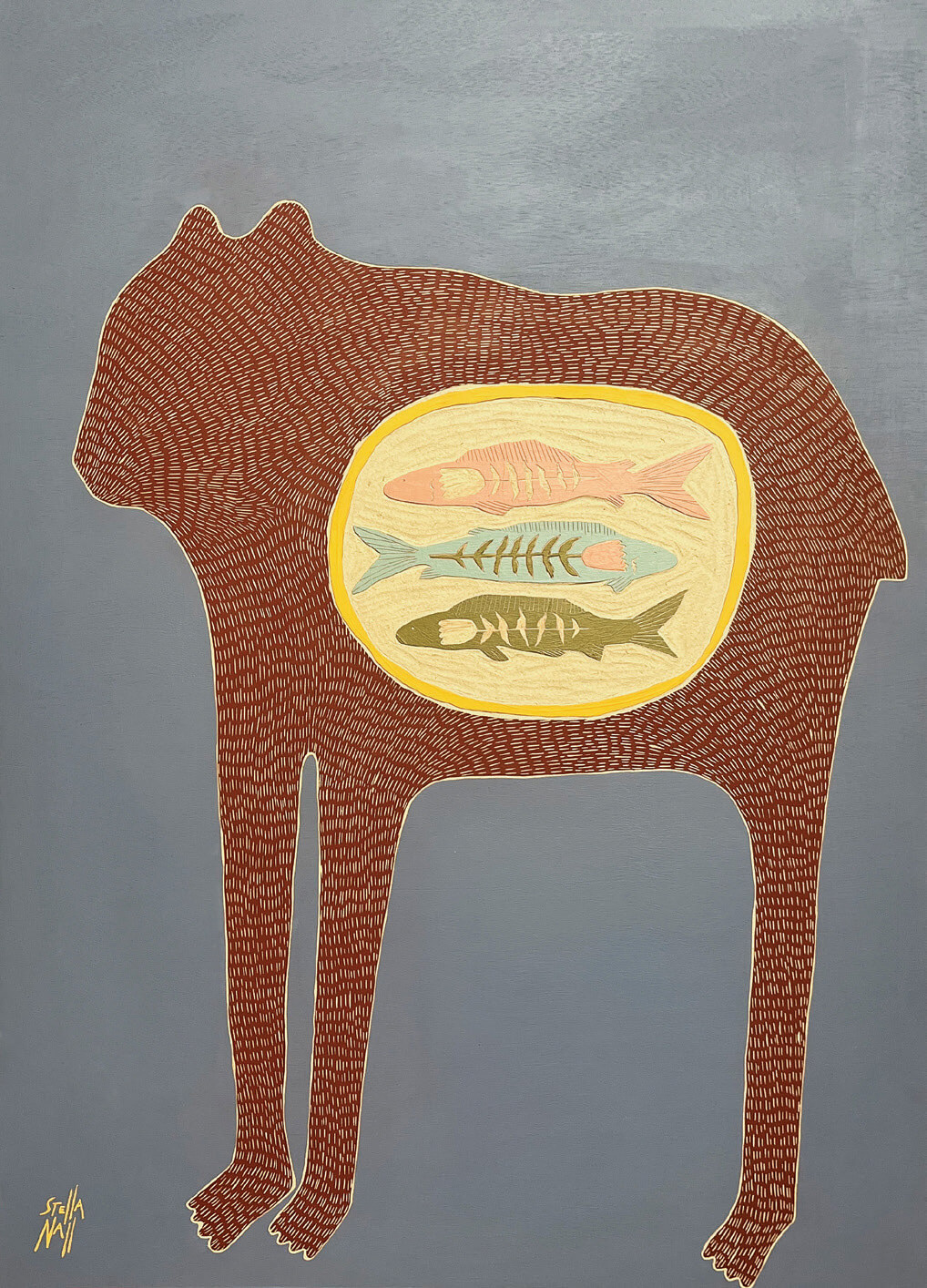
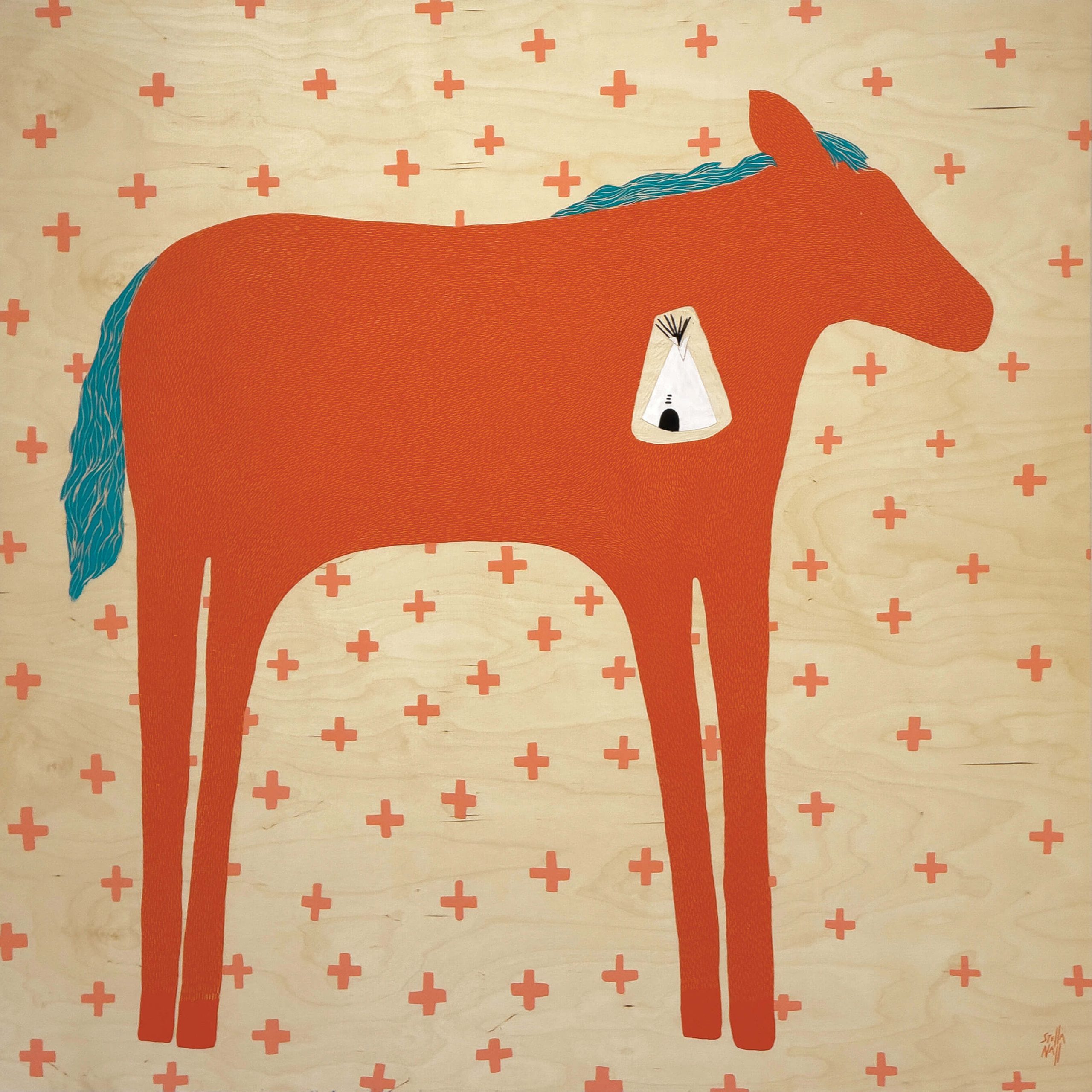
Óole (to be full/complete) | ACRYLIC ON WOODEN PANEL, WOOD CARVING | 32 X 22 INCHES
She uses her murals to quietly draw attention to the area’s original inhabitants, as well. “Usually they’ll be reflective of the place they’re being installed, and based on Montana wildlife.” She also references the region’s human history: A large mural in Bozeman features a creature with a belly full of berries that grow locally, accompanied by a few fish, and is titled Baáchuuaashe — the Apsáalooke placename for the Bozeman region — which means “berry river.”
No matter the scale or the medium, Nall’s distinctive voice pervades her body of work. Whether making prints, painting, working in clay, or adorning art books with the traditional beadwork she learned from her family, her vision and singularity of focus remain unwavering. “The confidence with which she moves from one medium to the next is unique,” says Simon. “She’s the youngest artist we’ve represented, and she’s working with a confidence that is beyond her years. She’s a unicorn, she really is.”
Melissa Mylchreest is a freelance writer and artist based in western Montana. When she’s not at her desk or in the studio, she can be found enjoying the state’s public lands and rivers with her two- and four-legged friends and family.
No Comments