


25 Sep Dining Out: Simple Wonder
This has never happened to me at a restaurant before. I’m seated at a picnic table. Before me, rows of vegetables and herbs unfurl themselves, pushing into the green foothills of the Gallatin Range. The light is golden and coming in slantwise between steel-gray storm clouds. Behind me, a creek tumbles over itself, making its own music. There is hickory smoke from the hand-built stove and the smell of meat on a fire. And right here at the table, Tia, who is our server for the night, points at the colorful Hippie Board she’s just set down and tells us what she harvested that day: “the grilled lettuce, the cucumbers, those shishito peppers, and the beans,” she says, delighted. “Oh, and all the herbs, that dill, and those beautiful little flowers. We love edible flowers here.”

These gentle Kunekune pigs — Larry, Curly, and Moe — are not only adorable inhabitants of Bodhi Farms, but they serve the important ecological functions of enhancing soil health, promoting biodiversity, and controlling invasive species.
I take a sip from the Mason jar she’s set before me — a spicy margarita with bitters made onsite from jalapeños grown within my sight range — and feel grateful for this cool night, for the friends around our table, and the way that even now, even here, we can still find a way to celebrate the simple wonder of things that grow and the beauty that can attend every encounter with the natural world.
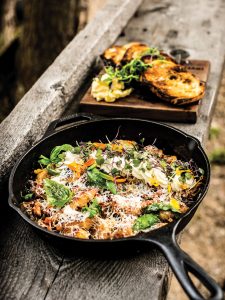
The Bodhi Farms bread-and-butter starter includes local sourdough with a rotating house butter made from farm ingredients. The Field Kitchen emphasizes wild game in dishes like this rabbit ragu, served in a cast-iron skillet.
The Field Kitchen Restaurant is the truest manifestation possible of a farm-to-table restaurant, and is a part of Bodhi Farms, a boutique eco-resort just south of Bozeman, Montana, along Cottonwood Creek. Founded, owned, and managed by Tanya and Rayner Smith — natives of Austin, Texas and longtime residents of Gallatin Valley — Bodhi Farms offers accommodations in nine Nordic tipis; spa and wellness amenities, including yoga taught by Tanya; a range of year-round outdoor activities and adventures; private and community events, including a kids’ summer camp that makes me want to raise my daughters all over again; an organic permaculture farm; and their unmatched wild-game farm-to-table restaurant.
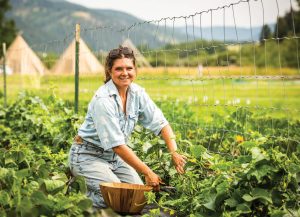
Farmer Addy oversees the self-governed organic farm, growing vegetables, annual and perennial herbs and flowers, trees, bushes, and shrubs. Here, she’s harvesting cucumbers.
When I ask, gobsmacked, how they do it all, Rayner doesn’t miss a beat. When you’re doing what you love, he says, “it doesn’t feel like work.” He describes how he and Tanya have always worked together, as “couplepreneurs,” and that this is the most fun they’ve ever had. They are gardeners and hunters, he says. They love to entertain and cook out. They believe in wellness practices, such as yoga. “This place is just a reflection of the things we get excited about,” Rayner says.
Everything Tia sets down on our table is easy to get excited about. Between the four of us, we order the aforementioned Hippie Board, with its array of fresh veggies and whipped tofu tahini; garden-fresh gazpacho; bison sliders with blue cheese and bacon-onion jam; beet salad with local goat cheese and steak; wood-roasted pheasant wreathed in flowers and herbs; garden pasta served in a giant cast-iron skillet; and the nightly special, a bavette steak with fingerling potatoes, Greek-style beans, and a chimichurri that could only come from a garden.
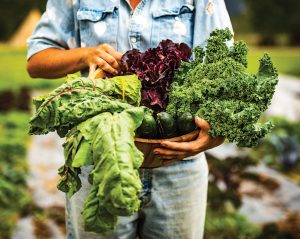
Addy holds a basket of freshly harvested red-leaf head lettuce, kale, Swiss chard, and cucumbers.
Chef Mark McMann briefly leaves his post at the outdoor kitchen to show me around the property. He points out the spotted Kunekune piglets and new trees that will someday become a walkable, edible forest. We walk past the chickens and, of course, the gardens. He starts each day by practicing gratitude, and lets me in on it as he extolls the Bodhi Farms’ staff by name — from the farm team to the hospitality, kitchen, and culinary crews — describing how it feels to work in such a place, with a hand-built outdoor kitchen surrounded by farmland, animals, and people he obviously adores. “Together, these elements create an environment where appreciation isn’t just practiced, it’s lived every day,” he says. I assure him we could taste it in his dishes.
What surprises me a little is when I ask McMann how he wants the dining experience at the Field Kitchen to differ from the other high-end restaurants where he’s been a chef, most recently The Montage in Big Sky. “I don’t want it to differ at all,” he says. “The goal is the same everywhere: Everyone deserves good food, good drinks, and good hospitality. It’s quite simple. No one leaves unhappy. No one leaves hungry.”

Chef Mark McMann works outside at the Field Kitchen’s wood-fired oven.
By the time the sun has set and we are standing around Bodhi’s nightly fire, where people can cook s’mores or warm themselves against the night chill as we are doing, it’s clear that McMann is batting a thousand when it comes to his goal.
There are challenges, of course, with cooking and serving outside, especially in Montana, but the Smiths and McMann don’t seem phased in the least. For starters, their nightly closing requires a stricter food security policy than most restaurants, as bears and other wildlife frequent the canyon. And the weather can wreak havoc without much warning. “We can’t control it,” McMann says, explaining that sometimes the front-of-house team has to move guests under cover in minutes due to rain or wind. Another challenge, Rayner adds, is that — because of the ground they have to cover between the gardens, outdoor kitchen, and indoor kitchen — staff members have to “love getting their steps in.” Still, no one is complaining. “Working outside all summer makes my NYC chef friends very jealous,” McMann admits.
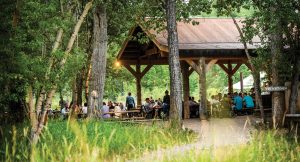
During the warmer months, meals are served creekside at the Field Kitchen, with twinkle lights and a bonfire offering charming ambiance.
When summer is over, and those warm October days we are so often spoiled by in the Gallatin Valley are gone, Bodhi Farms moves the Field Kitchen into a dining tipi and serves dinner on Thursdays, Fridays, and Saturdays through winter. It’s a totally different experience, Rayner says, but a more intimate one, and one that can feel more in sync with our circadian rhythm as humans. “It’s slower. The seatings are a lot smaller, and the chefs love it. They get to spend even more time with each plate,” he says. And it’s not hard to imagine this crew making the most of their extraordinary setting, still growing and utilizing herbs, microgreens, root vegetables, and wild game. “We keep a fire burning every meal of the year,” Rayner says. “Summer’s easy. Summer’s great,” he says. “It’s hard to mess that up.” But winter is cozy, he says.
For her part, Tanya is keen to focus on the guests’ experience of being at Bodhi Farms. “When you’re completely surrounded by nature,” she says, “your nervous system slows down before you even arrive at your experience,” whether that be dining, yoga, or one of the many activities offered to guests at the farm. “We have specifically designed the layout of the farm so our guests walk through the gardens to get to the dining table, walk along the creek to get their massage, and see an array of rare birds as they walk to the sauna,” she says.
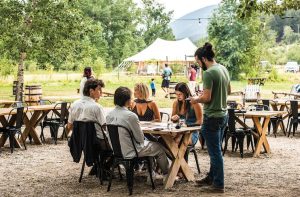
Seasonal meals are served year-round at Bodhi Farms, with the Field Kitchen setting up in a dining tipi after the weather necessitates a move indoors.
After we’ve had the last bite of carrot cake in big wooden Adirondack chairs by the fire, and the first stars of the night burn pinholes through the darkening sky, we wander back down the trail, listening to the creek, savoring the glow from the yellow cutleaf coneflowers that line its banks, and feel our hearts beat slow and full.
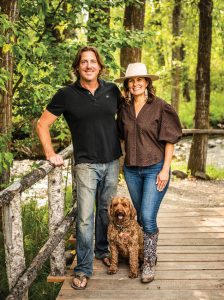
The founders, owners, and operators of Bodhi Farms, Rayner and Tanya Smith live on the property with two daughters and their dog, Bodhi, shown here.
Squash Croquettes
By Bodhi Farms’ Field Kitchen Restaurant
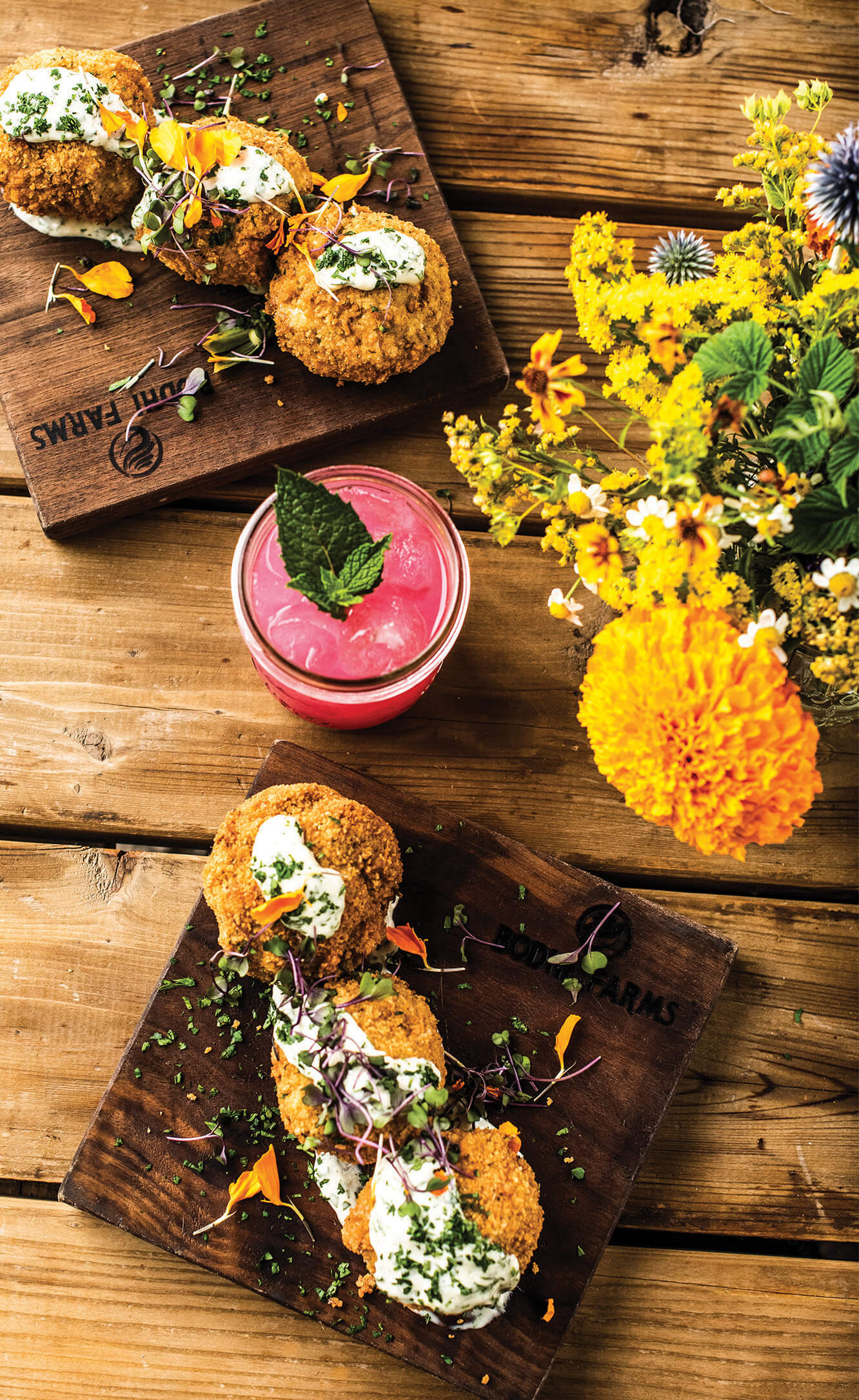
Squash croquettes fulfill all the comfort needs of fall — warm, savory, and a celebration of the season’s harvest.
Serves 3
2 cups butternut and/or
acorn squash
1 cup breadcrumbs
3 eggs
1 tablespoon garlic powder
1 tablespoon onion powder
1 tablespoon pumpkin-spice seasoning
Salt to taste
Pepper to taste
2 ounces chevre goat cheese
For coating: all-purpose flour, 5 eggs beaten, Italian breadcrumbs
For topping: Herb aioli (recipe below), microgreens, minced parsley
Preheat a fryer to 375°F and preheat an oven to 400°.
Cut raw squash in half and discard the seeds. Roast halves in the oven on a baking sheet until cooked, approximately 45 minutes.
Once cooked, allow to cool. Peel the skin off and place the flesh in a large bowl. Add breadcrumbs, eggs, garlic powder, onion powder, pumpkin-spice seasoning, salt, and pepper. Mix together with your hands.
Divide the goat cheese into three equal-sized balls and set aside.
Take the squash mixture and divide it into three portions. Wrap each portion around a goat-cheese ball, forming a baseball-sized ball with the goat cheese in the center. Place the formed balls on a sheet tray and set aside.
Next to the fryer, set up three bowls and add the flour to one, beaten eggs to another, and Italian breadcrumbs to the last.
With gloves on, designate a dry and wet hand. Take a squash ball and roll it in the flour with your dry hand, then move it to the egg mixture and coat it with your wet hand. Transfer to the breadcrumb bowl and coat with the dry hand. Once coated, transfer the ball to the fry basket and repeat with the remaining portions. Once all three balls are coated in the mixture, fry them until golden brown.
Apply a schmear of herb aioli to a small board and place the cooked croquettes on top. Add a small dollop of additional herb aioli, microgreens, and parsley to the top of each croquette, and serve.
Herb Aioli
Makes 1 quart
1 cup mayonnaise
1 small garlic clove, finely minced or grated
2 tablespoons fresh parsley, finely chopped
2 tablespoons fresh basil, finely chopped
1 teaspoon lemon juice (or more to taste)
Salt to taste
Black pepper to taste
In a small bowl, combine the mayonnaise, garlic, parsley, and basil. Stir in the lemon juice and season with salt and black pepper to taste. Blend thoroughly until smooth. Cover and refrigerate for at least 30 minutes to let the flavors develop.
Carter Walker is the author of several guidebooks, including two upcoming editions of Moon Montana & Wyoming (November 2025) and Moon Yellowstone to Glacier National Park Road Trip (May 2026). She spends a lot of time on the road between Montana’s Horseshoe Hills and the Yaak Valley.
Photographer Lynn Donaldson shoots regularly for National Geographic, National Geographic Traveler, Travel & Leisure, Sunset, and The New York Times. The founder and editor of the Montana food and travel blog The Last Best Plates, Donaldson lives outside of Livingston, Montana with her husband and three children.
No Comments